X Personally Terminates InfoFi Incentive Model, The Era of 'Mouth Farming' Comes to an End

Odaily星球日报Publicado a 2026-01-16Actualizado a 2026-01-16

Resumen

X, the platform formerly known as Twitter, has officially terminated the API access for InfoFi applications that reward users for posting, effectively ending the "post-to-earn" model. This decisive move, announced by X product lead Nikita Bier, targets what the company identifies as a primary source of AI-generated spam and low-quality replies flooding the platform. The policy shift immediately impacted several prominent InfoFi projects. Tokens like KAITO and COOKIE experienced significant double-digit price drops. Projects such as Cookie DAO's Snaps platform have ceased operations, while Kaito has shut down its Yaps incentive program and is pivoting to a new, more traditional creator marketing model called Kaito Studio. X's core objection was not to the content itself, but to the fundamental structure of external, unpermissioned incentives directly driving platform engagement. This model was seen as compromising content quality and, crucially, undermining X's sovereignty over its own content ecosystem and user experience. The platform emphasized that it does not need the revenue generated from these API fees. The event signals a major recalibration, forcing InfoFi projects to either retreat to a pure data/tooling role or completely reinvent their business models to align with platform policies. The era of easily farming rewards for social media posts ("嘴撸时代") is over, as content control is firmly reclaimed by the platform itself.

Original | Odaily Planet Daily (@OdailyChina)

Author | Ethan (@ethanzhang_web3)

Last night, a product update from X's official channels caused quite a stir within the InfoFi community.

At 22:39 on January 15th, platform X announced the revocation of API access permissions for InfoFi applications, immediately affecting multiple apps reliant on "posting incentives." As the API was cut off, some projects announced the suspension of related functions or adjustments to their business directions. InfoFi-related tokens saw significant declines, with multiple InfoFi-related tokens (KAITO, COOKIE) recording double-digit percentage drops in a short period. Community members offered a rather straightforward summary – "The era of 'mouth farming' is over."
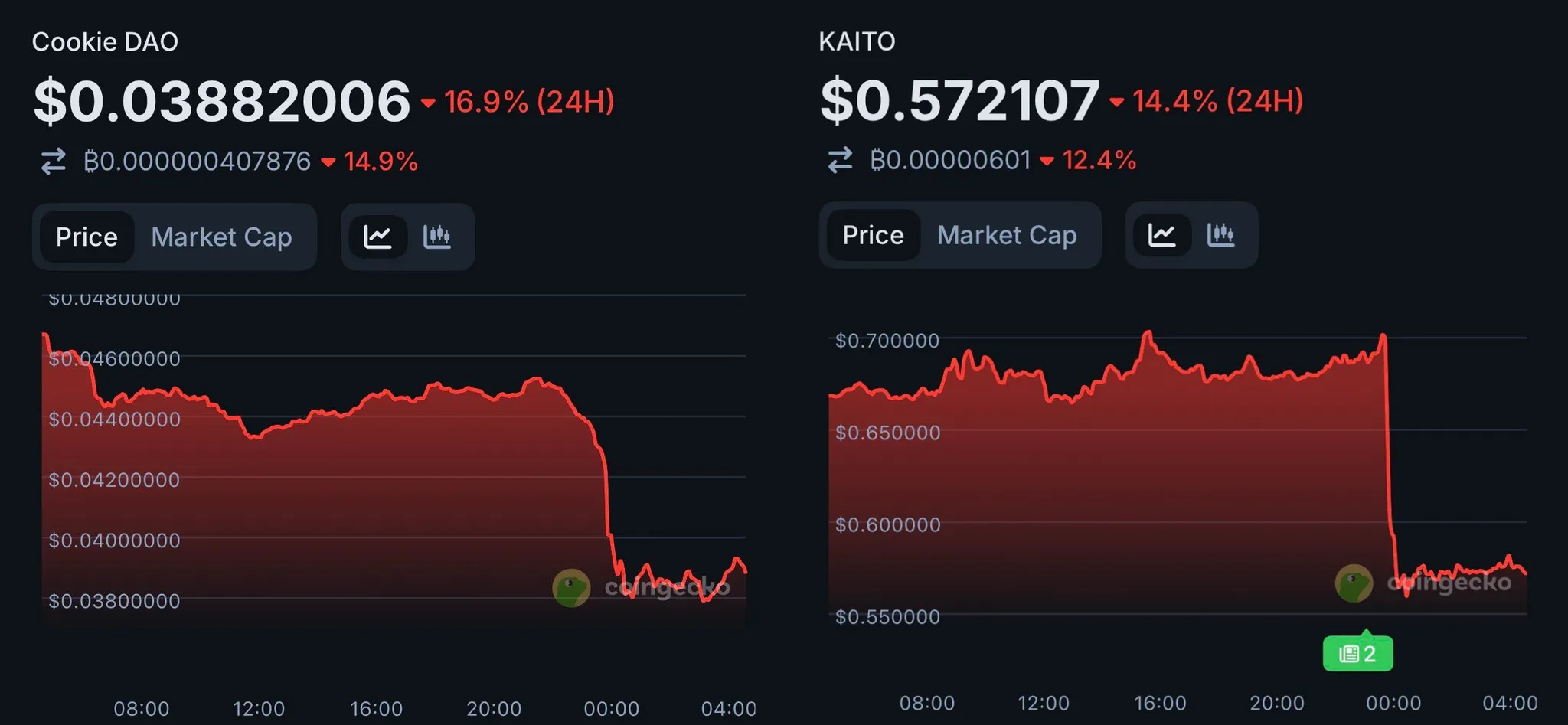
The strong reaction from InfoFi-related applications and tokens indicates that the impact of this change far exceeds a routine rule adjustment. It has altered the operational foundation of related applications and triggered a chain reaction in the market. This is not a minor tweak but a clear statement from X regarding a specific category of application models.

What Happened: X Formally Rejects the InfoFi Incentive Model

This time, X did not leave much room for explanation for InfoFi.

X's Product Lead, Nikita Bier, posted on the platform stating that X is revising its developer API policy and will no longer allow any applications that "reward users for posting on X" to continue accessing the API. In his statement, these applications were directly labeled as infofi and identified as a primary source of the recent AI spam content and reply pollution on the platform.
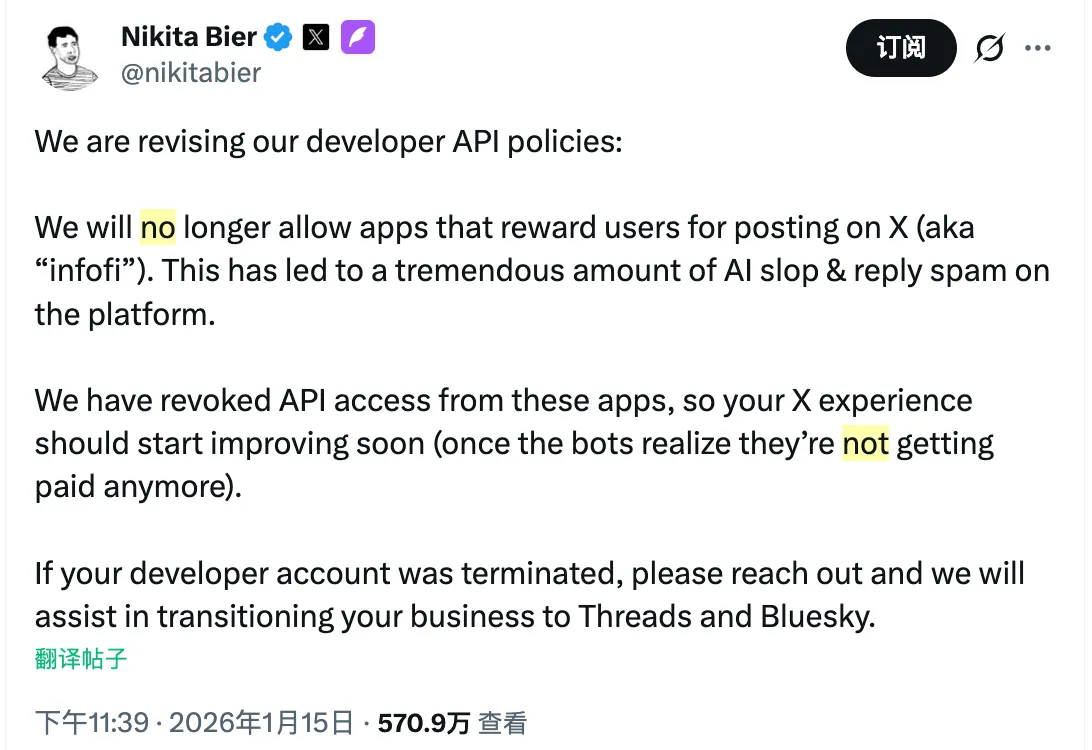
Unlike the "announce first, observe later" approach of previous platform governance, X's action this time was quite direct – API access permissions for related InfoFi applications have been revoked. The official reason given is also not complicated: external incentive mechanisms are driving a flood of task-oriented, templated content into the information feed, severely impacting the platform experience. X believes that once bots realize "there's no more money to be made from posting," the content environment will quickly self-correct.

It is worth noting that Nikita Bier specifically added a rather weighty statement: InfoFi applications had previously paid millions of dollars for API access, but X does not need this revenue.

This statement itself almost serves as a qualitative judgment on InfoFi's business model. Judging from the execution force and official wording, this adjustment is not targeting individual projects abusing the API but is rather a clear and unavoidable negative answer from X regarding the core InfoFi model of "external incentives directly intervening in platform content production."

The "aftermath solution" offered by X's official channels for teams whose developer accounts were terminated is equally telling: the platform will assist their business transition to Threads and Bluesky. In other words, X did not attempt to reform or absorb this incentive mechanism but clearly chose to remove it entirely from its own ecosystem.

What's Being Rejected is Not Content, But InfoFi's Incentive Path

If we only look at the official statement, this adjustment might seem like routine governance targeting AI spam content. But in the context of InfoFi, this reason is clearly insufficient to explain X's resolute stance.

The key issue might not be "whether the content has value," but rather who produces the content and why. The core logic of InfoFi is to directly drive users to perform actions like posting, replying, and interacting on the platform through external token or point incentives. While this model确实 boosts activity in the short term, it also rapidly alienates content production into "task execution." Posting is no longer about expressing opinions but a necessary step to claim rewards.

When the incentive itself is detached from the platform's governance system, the platform inevitably loses control over the motivation and quality of content. InfoFi applications don't care if a reply adds informational value; they only care if it meets the conditions for "settlement." For X, this means the information feed is being taken over by an external economic system.

From this perspective, AI spam is a consequence, not the cause. What truly crosses X's bottom line is the structural problem of "a third-party incentive layer being directly embedded into the platform's content distribution system." Once this model is tacitly approved, the platform's content order, recommendation logic, and even user relationships will gradually be influenced by the incentive designers.

This also explains why X, in this adjustment, left almost no room for InfoFi to reform. It implies that, in X's judgment, InfoFi is not an ecological participant that needs correction but rather a content production path that is no longer permitted to exist.

It is also why this API purge is an active reclamation of X's content sovereignty: when external incentives conflict with the platform experience, X chooses to cut off the former rather than cede control of the information feed.

From "Shutdown" to "Restructuring": The Collective Pivot of InfoFi Projects

X's API revocation did not remain at the policy level; it quickly triggered a chain reaction on the InfoFi project side.

According to Odaily Planet Daily's understanding, the first to provide a clear response was Cookie DAO. After communicating with the X team regarding the API and usage policy, the team announced the official shutdown of the Snaps platform and the termination of all ongoing creator incentive activities. Cookie stated bluntly in the announcement that this was a "difficult and sudden" decision, but the出发点 was not to abandon InfoFi but to ensure its data layer and core products remain compliant.
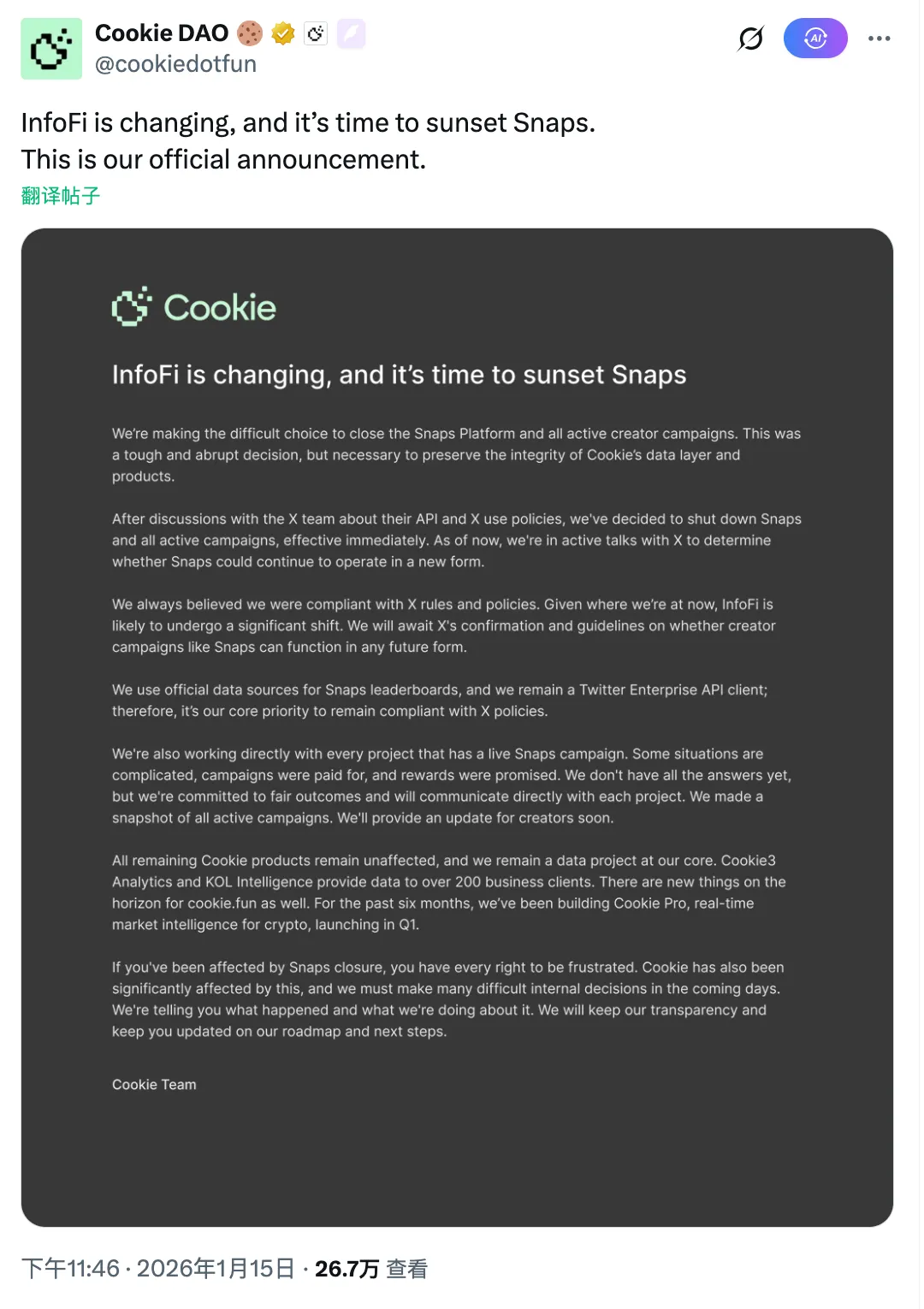
Judging from the wording, the shutdown of Snaps seems more like a passive choice to mitigate losses under the impact of the event. On one hand, Cookie emphasized that it always uses official data sources and remains an enterprise-level API client of X; on the other hand, the team also clearly stated that InfoFi is undergoing structural changes, and whether Snaps can exist in a "new form" still depends on further guidance from X. This wording itself reveals high uncertainty about the sustainability of the original incentive model.

In contrast, Kaito's adjustment appears more proactive. Kaito announced the cessation of Yaps and the incentive leaderboard, simultaneously launching a new Kaito Studio, explicitly bidding farewell to the "open, permissionless incentive distribution" path. According to the official statement, Kaito Studio will be closer to a traditional tiered marketing platform, where brands select creators for collaboration based on established criteria, covering platforms extending from X to YouTube, TikTok, and other social channels.
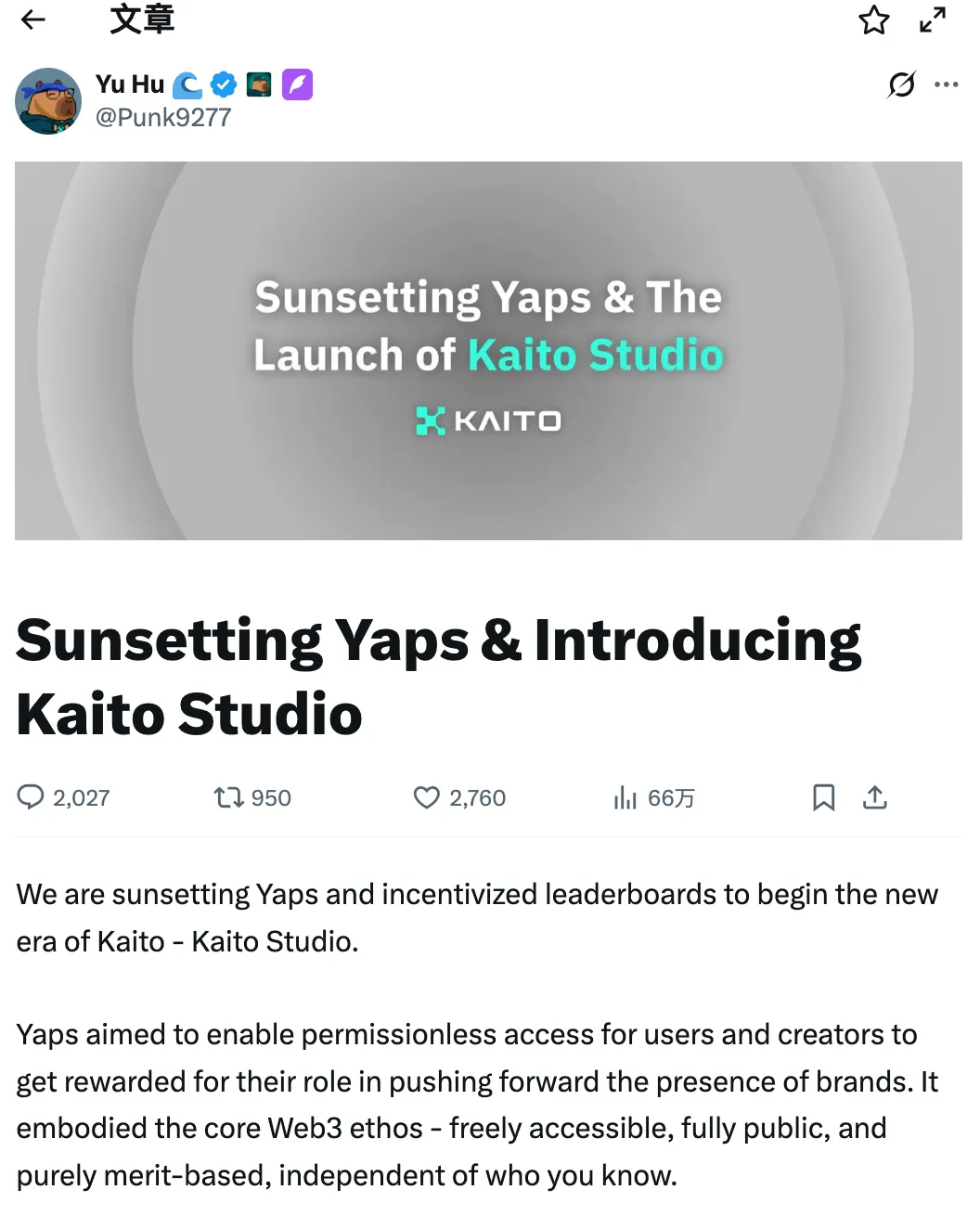
In explaining the reason for the pivot, Kaito did not avoid the problems of the InfoFi model itself. It pointed out that even after continuously raising thresholds and introducing screening mechanisms, low-quality content and刷量行为 (brushing/artificial inflation) were still hard to avoid; after communicating with X, the team also agreed that a "completely permissionless incentive distribution system" no longer meets the common needs of the platform, brands, and creators. Reading between the lines, it can be inferred that the end of Yaps is an active abandonment of the original InfoFi路线 (path).

But in any case, looking at both events together, a clear trend emerges: as the platform layer clearly tightens interface and incentive boundaries, InfoFi projects either choose to pause激进玩法 (aggressive playstyles) and return to data and tool attributes, or simply restructure their business logic, moving closer to models more akin to traditional marketing and content cooperation.

Currently, although token prices have fluctuated, a "collective collapse" of InfoFi projects has not yet occurred. What is certain is that the set of strategies reliant on platform APIs, driving posts and interactions directly through external incentives, can hardly continue to operate.

Conclusion: The Era of 'Mouth Farming' Ends, But InfoFi's Problems Remain

Judging from the reactions of the InfoFi projects, this change is not simply a "ban" or a "failure." Whether it's Cookie returning to its data layer positioning or Kaito pivoting to a Studio model closer to traditional marketing, it indicates that: InfoFi has not disappeared; it just can no longer exist in the form of "in-platform incentive arbitrage."

The so-called "end of the mouth farming era" does not mean the end of content being quantified or influence being priced, but rather the end of that open incentive path reliant on APIs, where the act of posting and replying itself was the settlement object. Against the backdrop of platforms reasserting sovereignty, the marginal space for this model is rapidly shrinking.

As for migrating to Threads or Bluesky, it seems more like a buffer solution than an answer itself. The real question is whether future InfoFi can find an irreplaceable value position without taking over the platform's content production rights.

X is just the first platform to explicitly press the button, but the signal it sends is clear enough: Content sovereignty is returning to the platforms.


Preguntas relacionadas

QWhat was the main announcement made by X that impacted the InfoFi community?

AX revoked API access for InfoFi applications that rewarded users for posting on the platform, effectively ending the 'post-to-earn' incentive model.

QWho is Nikita Bier and what role did they play in this update?

ANikita Bier is X's Product Lead who announced the revision of the developer API policy, stating that applications incentivizing users to post on X would no longer be allowed API access.

QWhat reason did X provide for revoking API access from InfoFi applications?

AX cited that these applications were a major source of AI-generated spam and low-quality content, which degraded the platform's user experience.

QHow did InfoFi-related tokens like KAITO and COOKIE react to the news?

AInfoFi-related tokens such as KAITO and COOKIE experienced significant price drops, with some falling by double digits shortly after the announcement.

QWhat alternative platforms did X suggest for affected InfoFi applications?

AX suggested that affected InfoFi applications transition their operations to Threads and Bluesky as alternative platforms.

Lecturas Relacionadas

What Happens to Ethereum Developer Tools After the Grants Run Out?

On February 27th, the Ethereum Foundation (EF) announced Project Odin, a structured sustainability support program designed for a select group of strategic, previously grant-funded teams. Unlike a standard grant, Odin offers a long-term advisory mechanism focused on helping these teams establish credible, sustainable paths within a two-year framework, thereby reducing long-term dependence on single funding sources. The program addresses a critical post-grant challenge: how essential public goods, especially major developer tools, can achieve financial sustainability beyond initial funding. While grants from EF and programs like Gitcoin or RetroPGF remain vital for startups and research, they often fall short for mature, widely-used infrastructure. Tools like compilers, languages, and network stacks are deeply embedded but struggle with monetization, trapped between being too foundational to lose and too public to generate natural revenue. Project Odin provides teams with a dedicated Strategic Advisor to guide them through a three-phase process: 1) analyzing current funding and realistic options, 2) validating potential paths with stakeholders, and 3) executing plans, which may include crafting support contracts, service agreements, or other recurring revenue models. The first pilot participant is Vyper, a critical smart contract language for the EVM, highlighting the need for sustainable models for core infrastructure. The initiative reframes the public goods conversation from "who should be funded" to "how do already-proven teams avoid perpetual funding crises?" It encourages ecosystem participants—protocols and projects that depend on these tools—to view sustainable support not just as charity, but as essential risk management for their own operational supply chains.

marsbitHace 18 min(s)

What Happens to Ethereum Developer Tools After the Grants Run Out?

marsbitHace 18 min(s)

MARA Reports Q1 Revenue Below Expectations, Net Loss of $1.3 Billion, Stock Plunges After Hours

Bitcoin mining firm MARA Holdings reported disappointing Q1 2024 results, causing its stock to erase all daily gains and fall 3.44% in after-hours trading. Revenue dropped 18% year-over-year to $174.6 million, missing Wall Street estimates of $192.7 million. The company posted a net loss of $1.3 billion, a significant increase from a $533.4 million loss a year ago, primarily driven by unrealized losses on its holdings of 38,689 Bitcoin, which depreciated in value during the quarter. MARA also sold over 15,100 BTC in late March to repurchase debt at a discount. The broader mining environment remains challenging due to a 35% decline in Bitcoin's price from its all-time high and a nearly 30% increase in mining difficulty over the past year. MARA's market cap ranking among U.S. miners has slipped to seventh. Critically, the company announced a strategic pivot away from Bitcoin mining expansion. It stated it has no plans to purchase new mining equipment and is fully transitioning toward AI data centers. Its strategy involves retrofitting existing mining sites for AI and high-performance computing (HPC) and leveraging its recent $1.5 billion acquisition of Long Ridge Energy & Power, a gas-fired power plant and data center. This infrastructure could eventually support 600 MW of AI compute capacity, allowing MARA to redeploy up to 90% of its non-custodial mining power for AI and IT workloads.

marsbitHace 18 min(s)

MARA Reports Q1 Revenue Below Expectations, Net Loss of $1.3 Billion, Stock Plunges After Hours

marsbitHace 18 min(s)

The AI Investment Landscape Is Being Reshaped: Beyond the 'Magnificent Seven', What Opportunities Lie in the Semiconductor Supply Chain?

AI Investment Map is Reshaping: Opportunities Beyond the 'Magnificent Seven' Since ChatGPT ignited the AI wave, investment initially focused on the "Magnificent Seven" tech giants dominating cloud infrastructure. However, the rise of DeepSeek and debates on AI capital expenditure effectiveness are shifting this dynamic. Investors now recognize opportunities deeper in the supply chain—the companies providing the essential "picks and shovels." Early concerns about an AI investment "arms race" and potential low returns were partly alleviated by strong Q1 earnings from cloud providers, validating robust compute demand. This has highlighted a more certain investment thesis: regardless of which AI applications ultimately win, massive capital expenditure will first fuel demand for semiconductors and related components. This "pick-and-shovel" logic has driven semiconductor ETFs to record highs. Key beneficiaries include: * **Memory Chipmakers (e.g., SK Hynix, Samsung, Micron)**: High Bandwidth Memory (HBM) is a critical bottleneck for AI training. * **Photonics Companies**: Crucial for high-speed data transfer within AI data centers. * **The Broader "AI-11" Semiconductor Ecosystem**: This encompasses foundries & lithography (TSMC, ASML), logic & custom chips (AMD, Broadcom, Intel, Marvell), and enterprise storage (SanDisk, Western Digital). Every dollar of AI infrastructure spending flows through this chain. While the "Magnificent Seven" remain dominant in market size, their earnings growth premium over the rest of the S&P 500 ("S&P 493") is narrowing. Market attention and marginal investment are shifting towards the expanding semiconductor supply chain. The investment narrative is evolving from "betting on the ultimate AI winner" to "investing in the certainty of the infrastructure build-out." Understanding this shift from the demand side to the supply side is key to identifying future AI investment opportunities.

marsbitHace 47 min(s)

The AI Investment Landscape Is Being Reshaped: Beyond the 'Magnificent Seven', What Opportunities Lie in the Semiconductor Supply Chain?

marsbitHace 47 min(s)

Trading

Spot
Futuros

Artículos destacados

Cómo comprar ERA

¡Bienvenido a HTX.com! Hemos hecho que comprar Caldera (ERA) sea simple y conveniente. Sigue nuestra guía paso a paso para iniciar tu viaje de criptos.Paso 1: crea tu cuenta HTXUtiliza tu correo electrónico o número de teléfono para registrarte y obtener una cuenta gratuita en HTX. Experimenta un proceso de registro sin complicaciones y desbloquea todas las funciones.Obtener mi cuentaPaso 2: ve a Comprar cripto y elige tu método de pagoTarjeta de crédito/débito: usa tu Visa o Mastercard para comprar Caldera (ERA) al instante.Saldo: utiliza fondos del saldo de tu cuenta HTX para tradear sin problemas.Terceros: hemos agregado métodos de pago populares como Google Pay y Apple Pay para mejorar la comodidad.P2P: tradear directamente con otros usuarios en HTX.Over-the-Counter (OTC): ofrecemos servicios personalizados y tipos de cambio competitivos para los traders.Paso 3: guarda tu Caldera (ERA)Después de comprar tu Caldera (ERA), guárdalo en tu cuenta HTX. Alternativamente, puedes enviarlo a otro lugar mediante transferencia blockchain o utilizarlo para tradear otras criptomonedas.Paso 4: tradear Caldera (ERA)Tradear fácilmente con Caldera (ERA) en HTX's mercado spot. Simplemente accede a tu cuenta, selecciona tu par de trading, ejecuta tus trades y monitorea en tiempo real. Ofrecemos una experiencia fácil de usar tanto para principiantes como para traders experimentados.

305 Vistas totalesPublicado en 2025.07.17Actualizado en 2025.07.17

Cómo comprar ERA

Discusiones

Bienvenido a la comunidad de HTX. Aquí puedes mantenerte informado sobre los últimos desarrollos de la plataforma y acceder a análisis profesionales del mercado. A continuación se presentan las opiniones de los usuarios sobre el precio de ERA (ERA).

活动图片