MARA Reports Q1 Revenue Below Expectations, Net Loss of $1.3 Billion, Stock Plunges After Hours

marsbitPublicado a 2026-05-12Actualizado a 2026-05-12

Resumen

Bitcoin mining firm MARA Holdings reported disappointing Q1 2024 results, causing its stock to erase all daily gains and fall 3.44% in after-hours trading. Revenue dropped 18% year-over-year to $174.6 million, missing Wall Street estimates of $192.7 million. The company posted a net loss of $1.3 billion, a significant increase from a $533.4 million loss a year ago, primarily driven by unrealized losses on its holdings of 38,689 Bitcoin, which depreciated in value during the quarter. MARA also sold over 15,100 BTC in late March to repurchase debt at a discount. The broader mining environment remains challenging due to a 35% decline in Bitcoin's price from its all-time high and a nearly 30% increase in mining difficulty over the past year. MARA's market cap ranking among U.S. miners has slipped to seventh. Critically, the company announced a strategic pivot away from Bitcoin mining expansion. It stated it has no plans to purchase new mining equipment and is fully transitioning toward AI data centers. Its strategy involves retrofitting existing mining sites for AI and high-performance computing (HPC) and leveraging its recent $1.5 billion acquisition of Long Ridge Energy & Power, a gas-fired power plant and data center. This infrastructure could eventually support 600 MW of AI compute capacity, allowing MARA to redeploy up to 90% of its non-custodial mining power for AI and IT workloads.

Author: Brayden Lindrea

Compiled by: Deep Tide TechFlow

Deep Tide TechFlow Summary: Bitcoin miner MARA Holdings has delivered a dismal Q1 report: revenue fell 18% year-on-year, net loss expanded from $530 million to $1.3 billion, and the stock erased all its intraday gains after hours. The bulk of the loss stemmed from unrealized losses on its BTC holdings. More notably, MARA has clearly stated it will no longer purchase new mining rigs, pivoting entirely to AI data centers—its ranking as the largest miner by market capitalization has already slipped to seventh place.

MARA Holdings' stock fell 3.44% after hours on Monday, closing at $12.93, completely wiping out its 3.48% gain from the day. The reason is simple: its Q1 earnings report missed expectations across the board.

Revenue and Profit Both Miss

According to the report filed by MARA, revenue for the quarter ended March 31 was $174.6 million, down 18% year-on-year, falling short of Wall Street's expectation of $192.7 million.

Net loss was $1.3 billion, compared to a loss of $533.4 million in the same period last year, expanding by nearly 1.5 times. Loss per share was $3.31, also significantly exceeding analysts' forecast of $2.20.
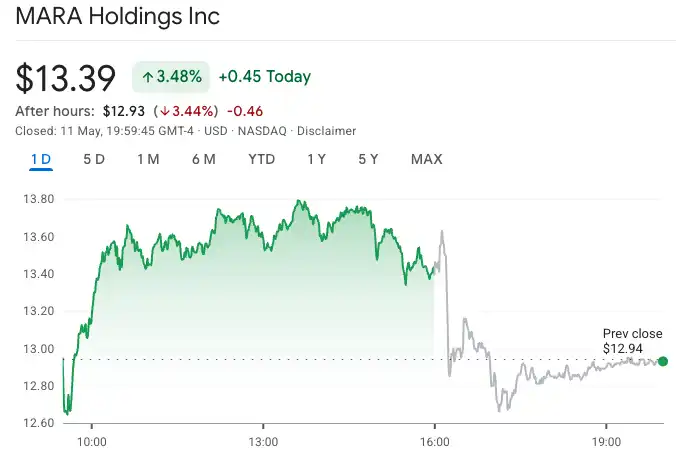
Caption: MARA's after-hours stock price movement, source: Google Finance

Where Did the $1.3 Billion Loss Come From?

The main reason for the loss was the unrealized losses on MARA's holdings of 38,689 bitcoins. Bitcoin price fell 23% in Q1, directly dragging down the book value.

MARA sold over 15,100 bitcoins in the final week of March, worth approximately $1.1 billion, to repurchase its debt at a discount.

Mining Environment Continues to Deteriorate

MARA's predicament is not an isolated case. The entire U.S. Bitcoin mining sector is sliding from profit to loss.

Two core pressures: Bitcoin is down over 35% from its all-time high of $126,080, significantly reducing miner revenue per block; simultaneously, mining difficulty has increased by nearly 30% over the past year, pushing hashing costs consistently higher.

MARA's industry standing is also declining. By market cap, it has fallen from being the largest Bitcoin miner to seventh place, as competitors move faster in their AI pivots.

Full Pivot to AI Data Centers

MARA says Bitcoin mining remains the "operational foundation" of the company, but its actions are already clear.

The company's AI strategy has two main thrusts: first, collaborating with Starwood Capital to convert existing mining sites into AI and High-Performance Computing (HPC) data centers; second, acquiring Long Ridge Energy & Power for $1.5 billion in late April, a natural gas power plant with an associated data center.

MARA's statement is:

"Our strategy is to colocate new infrastructure with our existing Bitcoin mining sites. The flexibility this creates is that we can generate revenue through mining today while preserving the option to divert power to AI and other critical IT loads."

The Long Ridge acquisition ultimately supports 600 MW of AI compute power, and approximately 90% of MARA's non-custodial mining capacity could be redeployed for AI and IT computing.

A one-sentence summary of its transformation resolve: The company explicitly stated it has no plans to purchase new mining rigs in the future.


Preguntas relacionadas

QWhy did MARA Holdings' stock price drop after-hours despite a gain during the day?

AThe stock dropped because the company released its Q1 earnings report, which showed both revenue and profits missing analyst expectations. Revenue fell 18% year-over-year, and the net loss expanded to $1.3 billion, causing investors to sell.

QWhat was the primary cause of MARA's significant $1.3 billion net loss in Q1?

AThe primary cause of the $1.3 billion net loss was the unrealized loss on the company's holding of 38,689 Bitcoins, as the price of Bitcoin fell by 23% during the quarter.

QWhat strategic shift did MARA announce regarding its mining operations?

AMARA announced a strategic shift away from purchasing new mining machines and towards fully transitioning into AI data centers. The company plans to repurpose its existing mining infrastructure for AI and High-Performance Computing (HPC) workloads.

QWhat actions did MARA take regarding its Bitcoin holdings in March, and why?

AIn the final week of March, MARA sold over 15,100 Bitcoins, valued at approximately $1.1 billion, in order to repurchase its debt at a discount.

QHow has the competitive landscape changed for MARA within the U.S. Bitcoin mining sector?

AMARA's position has weakened. By market capitalization, it has fallen from being the largest Bitcoin miner to the seventh largest. The company noted that competitors are moving faster in their transitions to AI-related businesses.

Lecturas Relacionadas

Currency & Stock Barometer | Strategy Sells MSTR Stocks for $2.007 Billion; BitMine Increases ETH Holdings by 32,447 Last Week, Asset Scale Reaches $14.9 Billion (August 25)

**Crypto & Stock Market Snapshot: Strategy Sells MSTR Stock for $2.007B; BitMine Adds 32,447 ETH (Aug 25)** Following a bullish crypto market triggered by positive US regulatory signals and political commentary, major crypto-related stocks saw significant rebounds. Data reveals a 1,431.6% weekly increase in net Bitcoin purchases by public companies (excluding miners), reaching $81.48M. Two key developments stood out: **Strategy** sold over 18.2 million shares of MSTR, raising $2.007 billion in cash, though its Bitcoin holdings of 840,447 BTC returned to a profit of ~$2.53B. Concurrently, **BitMine**, an Ethereum-focused firm, added 32,447 ETH last week, bringing its total holdings to ~5.847 million ETH (4.8% of supply) and its total assets under management to ~$14.9B. Chairman Tom Lee expressed strong confidence in Ethereum's future as a leading platform for tokenization and AI. Other notable updates include: **Solmate Infrastructure** increasing its SOL holdings; **AIxCrypto Holdings** planning an exit from crypto assets to pivot to robot leasing; and **Eightco Holdings** maintaining a large WLD treasury while repurchasing shares. Meanwhile, in traditional markets, hedge funds recorded their largest weekly net selling of US stocks since April 2025, particularly in tech and industrial sectors, amid a cooling AI investment narrative and concerns over market concentration risks reminiscent of the dot-com bubble.

marsbitHace 16 min(s)

Currency & Stock Barometer | Strategy Sells MSTR Stocks for $2.007 Billion; BitMine Increases ETH Holdings by 32,447 Last Week, Asset Scale Reaches $14.9 Billion (August 25)

marsbitHace 16 min(s)

Goldman Sachs Bullish on Crypto Brokerage Trading Platforms: Can Prediction Markets Fuel a New Cycle?

Goldman Sachs remains cautiously optimistic about the prospects for crypto and brokerage platforms, forecasting potential for a new cycle driven by structural growth in traditional brokerage and prediction markets, rather than a broad crypto trading recovery alone. While retail stock trading cooled seasonally in July and August, Goldman notes that absolute volumes remain high, and adjusted for account growth, per-account activity is still below the 2021 peak, suggesting room for further expansion. Seasonal recovery and record equity issuance are expected to boost traditional brokerage commissions and trading volumes starting in September. Prediction markets show significant potential for autumn growth, with trading volume up approximately 1160% annually since 2024. Driven by sports, crypto, and political contracts, this segment could see a more pronounced rebound as major US sports seasons resume and election activity increases. The crypto market presents a more cautious picture. Trading volume has declined for about 10 months, exceeding historical median downturns. Although total market cap recently rose ~21%, a sustained price level is needed to drive a meaningful recovery in trading activity. Regulatory progress continues through agency actions, but comprehensive legislation is still seen as key for large-scale institutional adoption. To navigate the crypto trading slump, platforms are diversifying revenues and controlling costs. Goldman's top picks are FIGR (leveraging HELOC growth), HOOD (driven by account growth and business diversification including prediction markets), and IBKR (benefiting from global expansion). COIN is viewed as a play on direct crypto market recovery, given its exposure but also its growing subscription and service revenues. The report's thesis hinges on validating an autumn trading rebound and the sustainability of new revenue streams like prediction markets, rather than assuming a crypto bull market has already resumed.

marsbitHace 21 min(s)

Goldman Sachs Bullish on Crypto Brokerage Trading Platforms: Can Prediction Markets Fuel a New Cycle?

marsbitHace 21 min(s)

Trading

Spot
活动图片