WLFI shows strength amid broader market sell-off: But is it a trap?

ambcryptoPublicado a 2026-03-23Actualizado a 2026-03-23

Resumen

The crypto market, including Bitcoin, faced a sharp sell-off following comments from former U.S. President Donald Trump, with BTC dropping below $68k. Despite the downturn, World Liberty Financial (WLFI) showed relative strength, gaining 2% while Bitcoin fell over 3%. However, the longer-term trend for WLFI remains bearish. A key support zone of $0.095-$0.10 was breached, and it is now acting as resistance. Volume indicators like OBV, A/D, and CMF suggest continued selling pressure and capital outflows. Although a short-term bounce above $0.10 is possible if Bitcoin recovers, WLFI’s bearish structure persists. A break above $0.107 is needed to turn the trend bullish. Traders are advised to maintain a cautious or bearish bias.

The crypto markets were deeply affected by U.S. President Donald Trump’s comments over the weekend. On Saturday, the 21st of March, Bitcoin [BTC] plunged below the $68k level after spending nearly two weeks above it.

As a result, the altcoin market also faced losses. Select altcoins showed notable relative strength against the market, and World Liberty Financial [WLFI] was one of them. In the past 24 hours, it has gained 2% in value while BTC dropped by 3.22%.

Is it time to buy WLFI?
Source: WLFI/USDT on TradingView

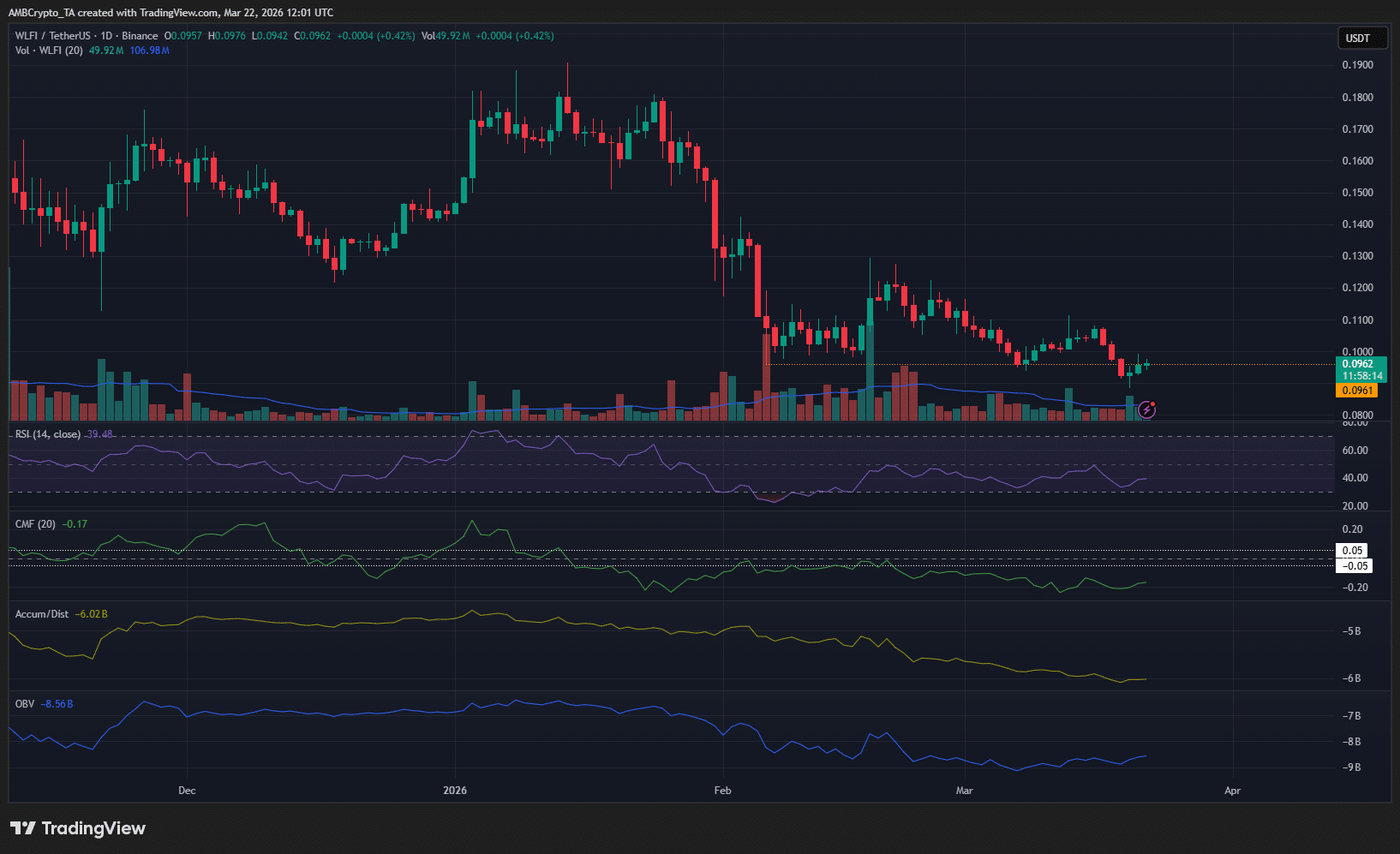
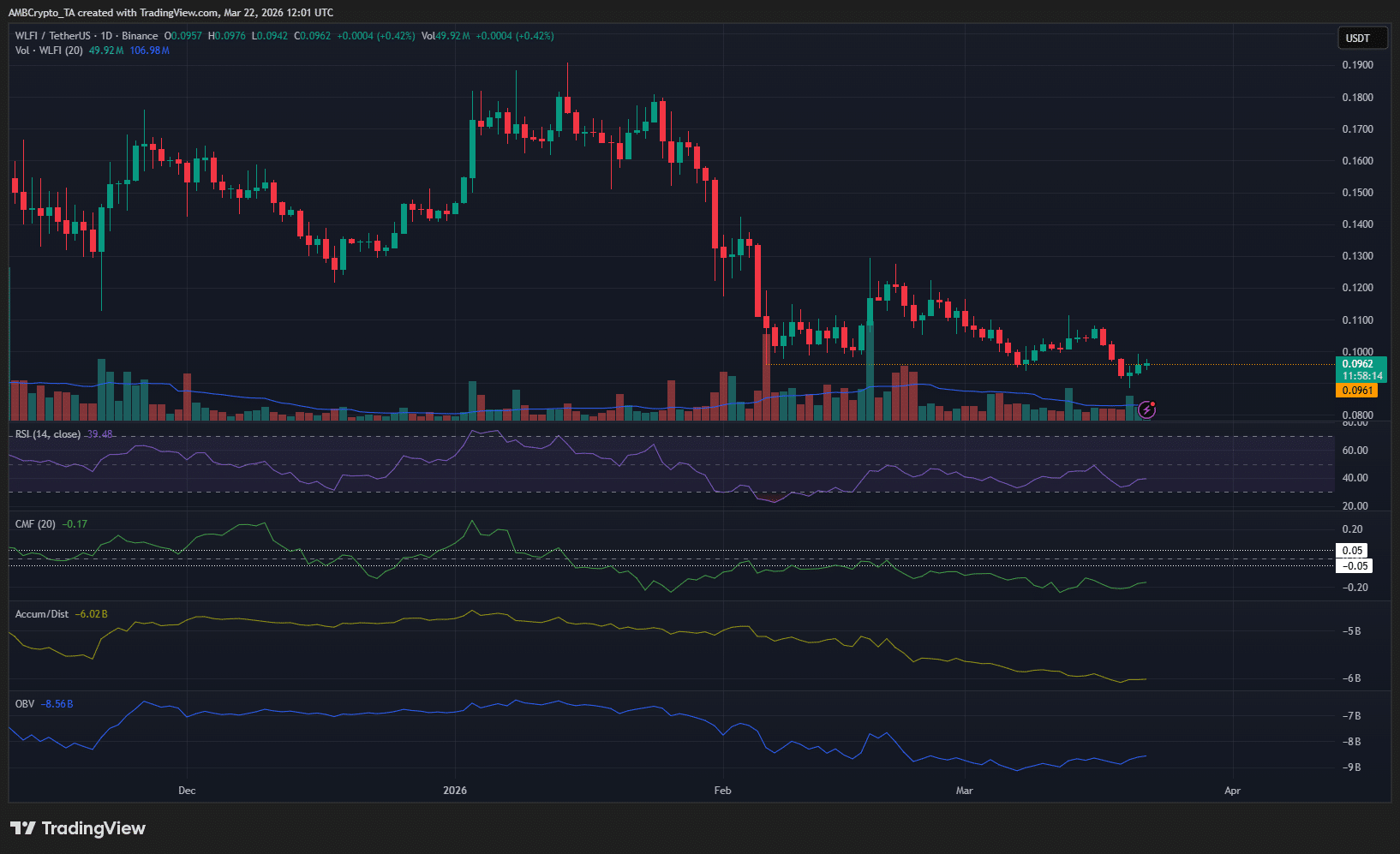
Maybe day traders can look into it, but not for long-term investors. The price action on the 1-day chart was severely bearish despite the past three days’ gains. The $0.095-$0.10 support, which WLFI has traded above since February, was breached on Thursday, the 19th of March.

At the time of writing, this supply zone was being retested as resistance. Like WLFI’s price action, the volume indicators were unanimously bearish. The OBV and the A/D maintained their downtrend to show that selling pressure remained prevalent.

The CMF was below -0.05 to suggest capital outflows were dominant. The demand was fleeting and simply not enough to reverse the downtrend in play.

What can WLFI traders expect next week?
Source: WLFI/USDT on TradingView

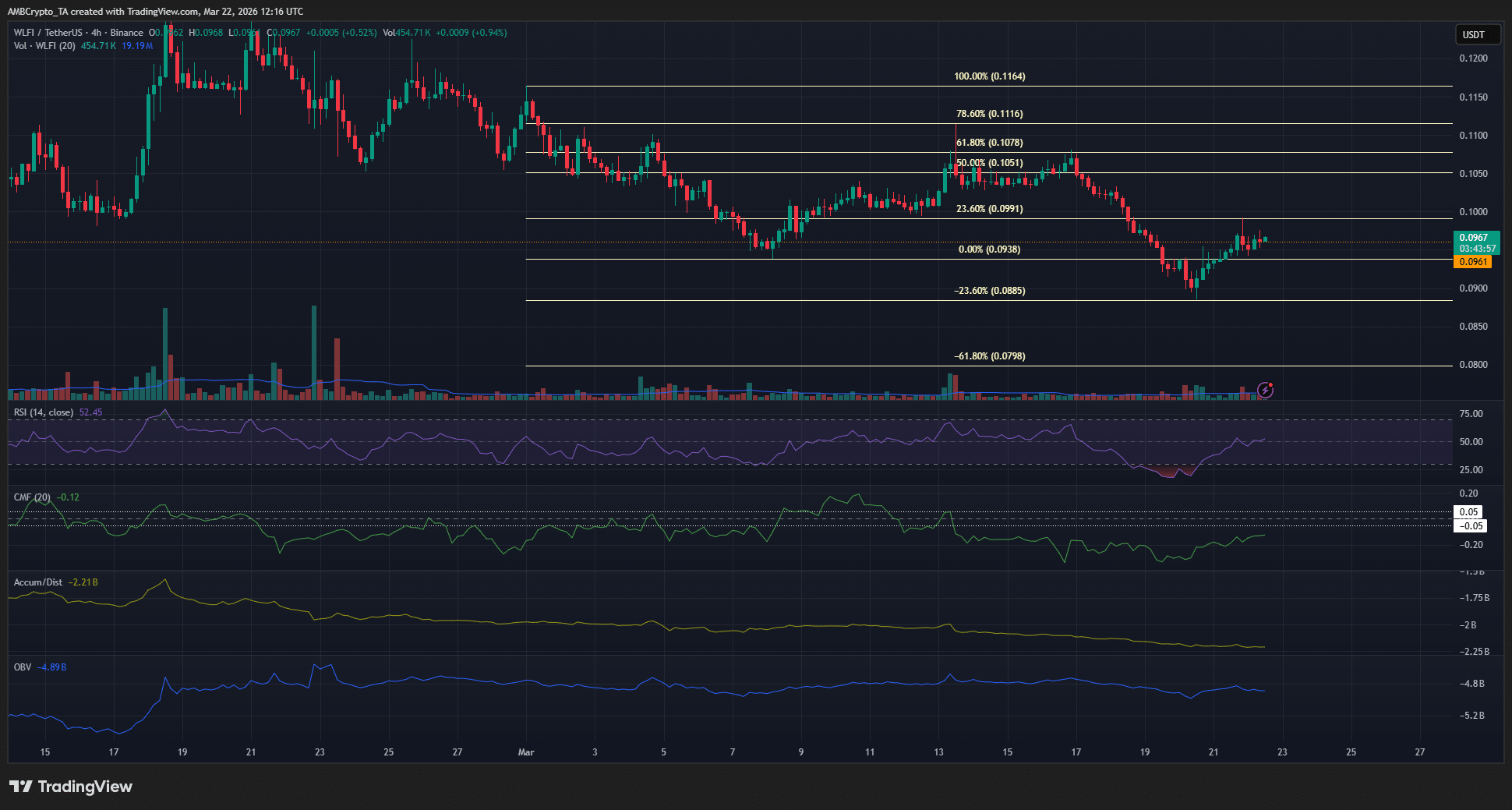
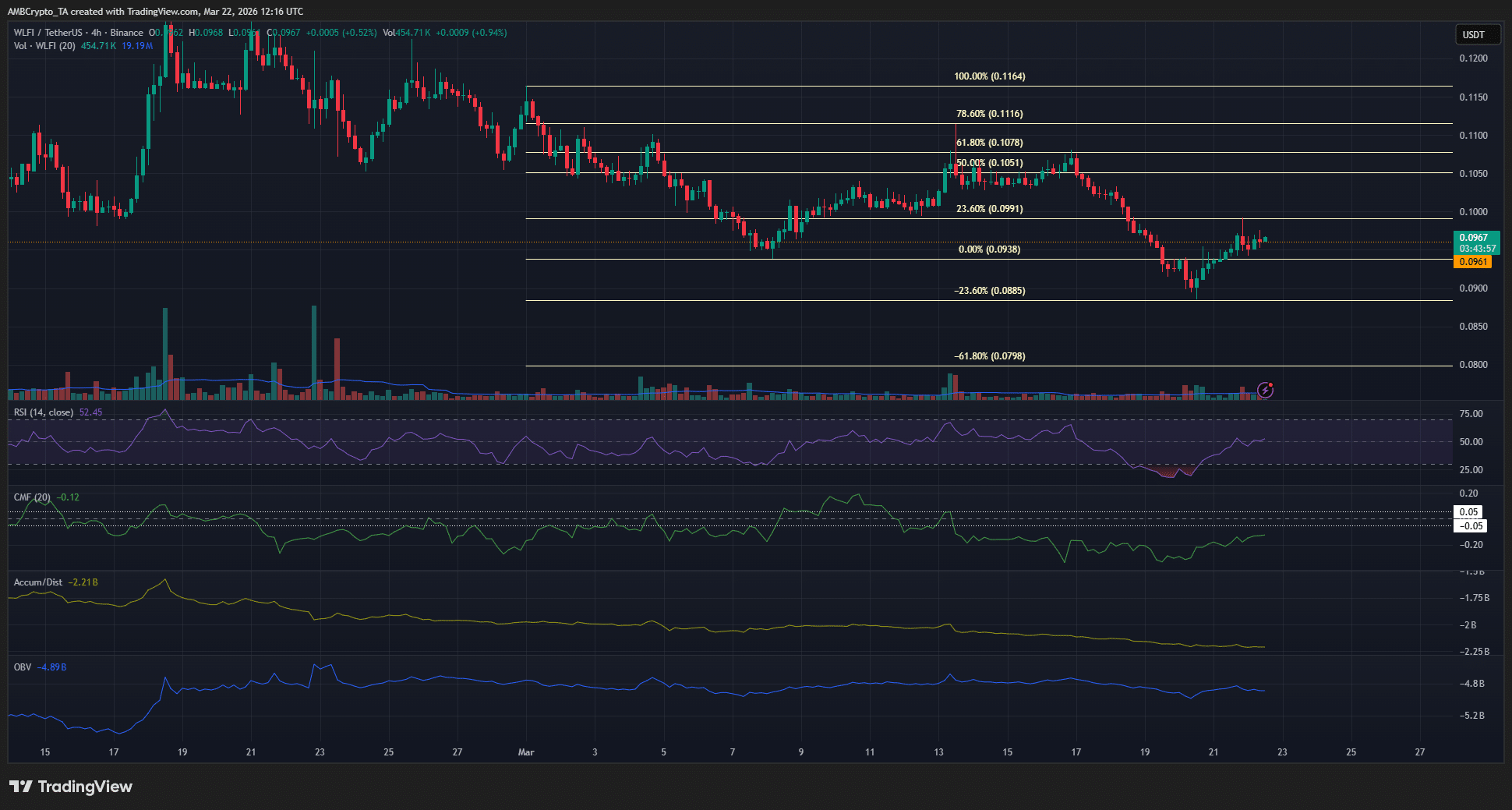
The World Liberty Financial token reached the 23.6% extension level at $0.0885 on Friday, the 20th of March. The RSI on the H4 chart recovered to neutral 50 and is poised to fall lower alongside the price.

The importance of the $0.095-$0.10 supply zone has already been highlighted. Traders can be prepared for a rejection from this area and a bearish continuation.

Bitcoin was trading at a key support and could see a price bounce back above $70k. This can give altcoins some short-term strength and can spur WLFI to climb above $0.10.

Traders should remember the bearish swing structure of the altcoin. A break of $0.107 is needed to flip the H4 structure bullishly. Until then, traders and investors can maintain a bearish bias.


Final Summary

  • World Liberty Financial token saw some short-term gains, but the longer-term trend was bearish.
  • The $0.095-$0.10 is a key supply zone, and $0.107 needs to be breached to flip the price structure bullishly.


Preguntas relacionadas

QWhat was the main reason for the crypto market downturn mentioned in the article?

AThe crypto markets were deeply affected by U.S. President Donald Trump's comments over the weekend.

QHow did WLFI perform compared to Bitcoin in the past 24 hours?

AWLFI gained 2% in value while Bitcoin dropped by 3.22% in the past 24 hours.

QWhat key support level was breached by WLFI on March 19th?

AThe $0.095-$0.10 support level, which WLFI had traded above since February, was breached on March 19th.

QWhat price level needs to be broken for WLFI's H4 structure to flip bullish?

AA break of $0.107 is needed to flip the H4 structure bullishly.

QWhat do the volume indicators (OBV, A/D, CMF) suggest about WLFI's market pressure?

AThe OBV and A/D maintained their downtrend showing selling pressure remained prevalent, and the CMF was below -0.05 suggesting capital outflows were dominant.

Lecturas Relacionadas

The Value Distribution of Stablecoins

**Summary: The Value Distribution of Stablecoins** The article argues that stablecoins are evolving from mere trading tools into broader channels for dollar access. It divides the stablecoin ecosystem into four layers to analyze how value is distributed: 1. **Issuance Layer:** Mints stablecoins, holds reserve assets, and captures the spread between reserve yield and user costs (e.g., Tether, Circle). This layer currently earns the largest profit margin. 2. **Infrastructure Layer:** Connects stablecoins to the traditional financial system, handling fiat on/off-ramps, banking integration, compliance (KYC/AML), and asset management (e.g., Bridge, BVNK). This is the "unglamorous" but critical work, building the essential bridges between crypto and real-world finance. 3. **Acquiring/Distribution Layer:** Integrates stablecoins into merchant systems, manages payment flows, and provides enterprise financial software (e.g., Stripe, Coinbase). They act as the access point for businesses. 4. **Application Layer:** The end-users and businesses that ultimately use stablecoins for payments, settlements, or as a store of value. They benefit from convenience but have little pricing power. The core thesis is that while the issuance layer currently dominates profits, the often-overlooked **infrastructure layer holds significant long-term potential**. The real challenge and barrier to mass adoption is not the on-chain transfer of stablecoins (which is simple), but the complex "last mile" integration into existing business workflows, banking systems, and regulatory frameworks across different countries. Companies in this layer are currently in a "land grab" phase, investing heavily to build networks, secure bank partnerships, and establish compliance pathways. While their position is currently pressured by the profitable issuers above and distribution platforms below, the article suggests that if stablecoins become a default financial rail for businesses, the infrastructure providers who have done the hard work of integration will ultimately gain strong pricing power and become entrenched, essential players.

marsbitHace 6 hora(s)

The Value Distribution of Stablecoins

marsbitHace 6 hora(s)

The Value Distribution of Stablecoins

The Value Distribution of Stablecoins The article argues that stablecoins are evolving from a mere trading tool into a broad "dollar channel." It analyzes the industry's value chain through four layers: 1. **Issuance Layer (e.g., Tether, Circle):** The top layer that mints stablecoins, holds reserve assets, and captures the thickest interest rate spread. 2. **Infrastructure Layer (e.g., Bridge, BVNK):** Connects stablecoins to the traditional financial system, handling critical but complex "dirty work" like fiat on/off-ramps, banking integration, compliance (KYC/AML), and cross-border settlement. 3. **Acquiring/Distribution Layer (e.g., Stripe, Coinbase):** Embeds stablecoins into merchant systems, manages payment flows, and integrates with enterprise software. 4. **Application Layer:** End-users and businesses that ultimately use stablecoins for payments, settlement, or storing value. The author posits that while the issuance layer currently captures the most profit, the most overlooked and potentially critical layer is infrastructure. The core challenge for stablecoin adoption isn't the on-chain transfer (which is simple), but bridging the gap between blockchain and the real-world financial system. This involves solving practical problems for businesses: fiat conversion, reconciliation, tax handling, and user onboarding. Infrastructure companies are currently in a difficult "land-grab" phase—building networks, securing banking relationships, and achieving compliance country-by-country. They face pressure from both the profitable issuance layer above and distribution platforms below. However, the author suggests this layer is building a crucial moat. Once stablecoins become a default business rail, the infrastructure players who have done the hard work of integration may gain significant, durable value and pricing power.

链捕手Hace 6 hora(s)

The Value Distribution of Stablecoins

链捕手Hace 6 hora(s)

Trading

Spot
Futuros

Artículos destacados

Cómo comprar WLFI

¡Bienvenido a HTX.com! Hemos hecho que comprar Official World Liberty Financial (WLFI) sea simple y conveniente. Sigue nuestra guía paso a paso para iniciar tu viaje de criptos.Paso 1: crea tu cuenta HTXUtiliza tu correo electrónico o número de teléfono para registrarte y obtener una cuenta gratuita en HTX. Experimenta un proceso de registro sin complicaciones y desbloquea todas las funciones.Obtener mi cuentaPaso 2: ve a Comprar cripto y elige tu método de pagoTarjeta de crédito/débito: usa tu Visa o Mastercard para comprar Official World Liberty Financial (WLFI) al instante.Saldo: utiliza fondos del saldo de tu cuenta HTX para tradear sin problemas.Terceros: hemos agregado métodos de pago populares como Google Pay y Apple Pay para mejorar la comodidad.P2P: tradear directamente con otros usuarios en HTX.Over-the-Counter (OTC): ofrecemos servicios personalizados y tipos de cambio competitivos para los traders.Paso 3: guarda tu Official World Liberty Financial (WLFI)Después de comprar tu Official World Liberty Financial (WLFI), guárdalo en tu cuenta HTX. Alternativamente, puedes enviarlo a otro lugar mediante transferencia blockchain o utilizarlo para tradear otras criptomonedas.Paso 4: tradear Official World Liberty Financial (WLFI)Tradear fácilmente con Official World Liberty Financial (WLFI) en HTX's mercado spot. Simplemente accede a tu cuenta, selecciona tu par de trading, ejecuta tus trades y monitorea en tiempo real. Ofrecemos una experiencia fácil de usar tanto para principiantes como para traders experimentados.

577 Vistas totalesPublicado en 2025.09.01Actualizado en 2026.06.02

Cómo comprar WLFI

Discusiones

Bienvenido a la comunidad de HTX. Aquí puedes mantenerte informado sobre los últimos desarrollos de la plataforma y acceder a análisis profesionales del mercado. A continuación se presentan las opiniones de los usuarios sobre el precio de WLFI (WLFI).

活动图片