Author: Gu Yu, ChainCatcher
On July 8, 2026, Seb Audet, the CEO of the DeFi portfolio tracker Zapper, posted a brief yet somber announcement on X: after nearly seven years of operation, Zapper will be completely shut down on August 3. All functions, including the official website zapper.xyz, the mobile application, and API services, will be formally discontinued. This marks the end for the project which once boasted 2 million monthly active users and handled transaction volumes exceeding $13 billion.
Audet wrote in the announcement: "We evaluated multiple different options and did our best to advance some of them, but ultimately realized that an orderly shutdown is the best choice." He expressed his gratitude to all users, investors, advisors, employees, and community members, candidly stating that Zapper's mission was to make DeFi more accessible. Although they could not fulfill this mission in the way initially envisioned, he believes the team indeed helped a considerable number of people make the on-chain economy significantly easier to use.
Unlike the vast majority of projects that shut down, Zapper was once a product frequently used by many DeFi users, enjoying high market adoption and user stickiness. Its curtain call is more lamentable than those projects that relied on narratives from start to finish but had few users.
"This is truly the collective memory of the earliest generation of DeFi airdrop farmers. Back when exploring DeFi, many people opened Zapper daily to check assets, LPs, and yields. However, the project missed its prime opportunity and, with a touch of arrogance, headed towards decline," said the well-known KOL Fengmi on X.
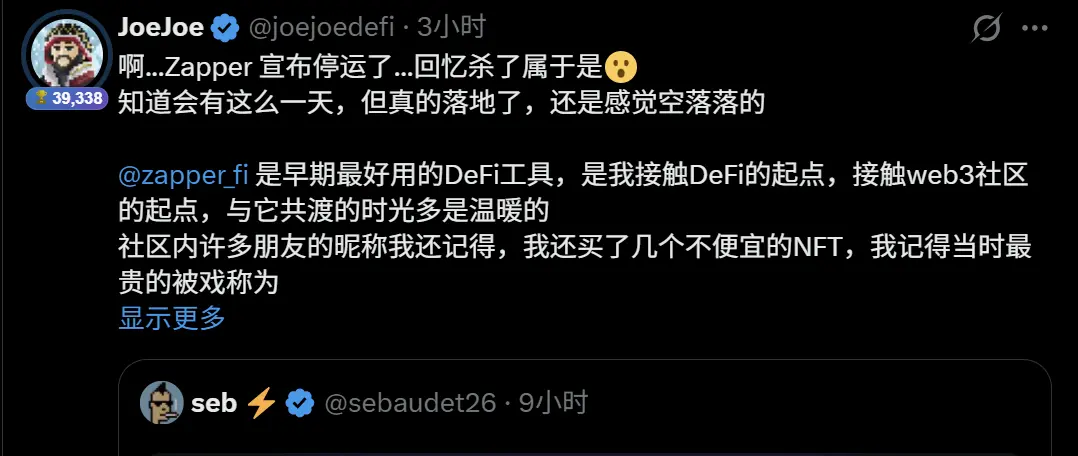
Comments filled with nostalgia, such as "Memory lane," "Sad," "The best product," and "Used it daily," are repeatedly seen in the post's comment section.
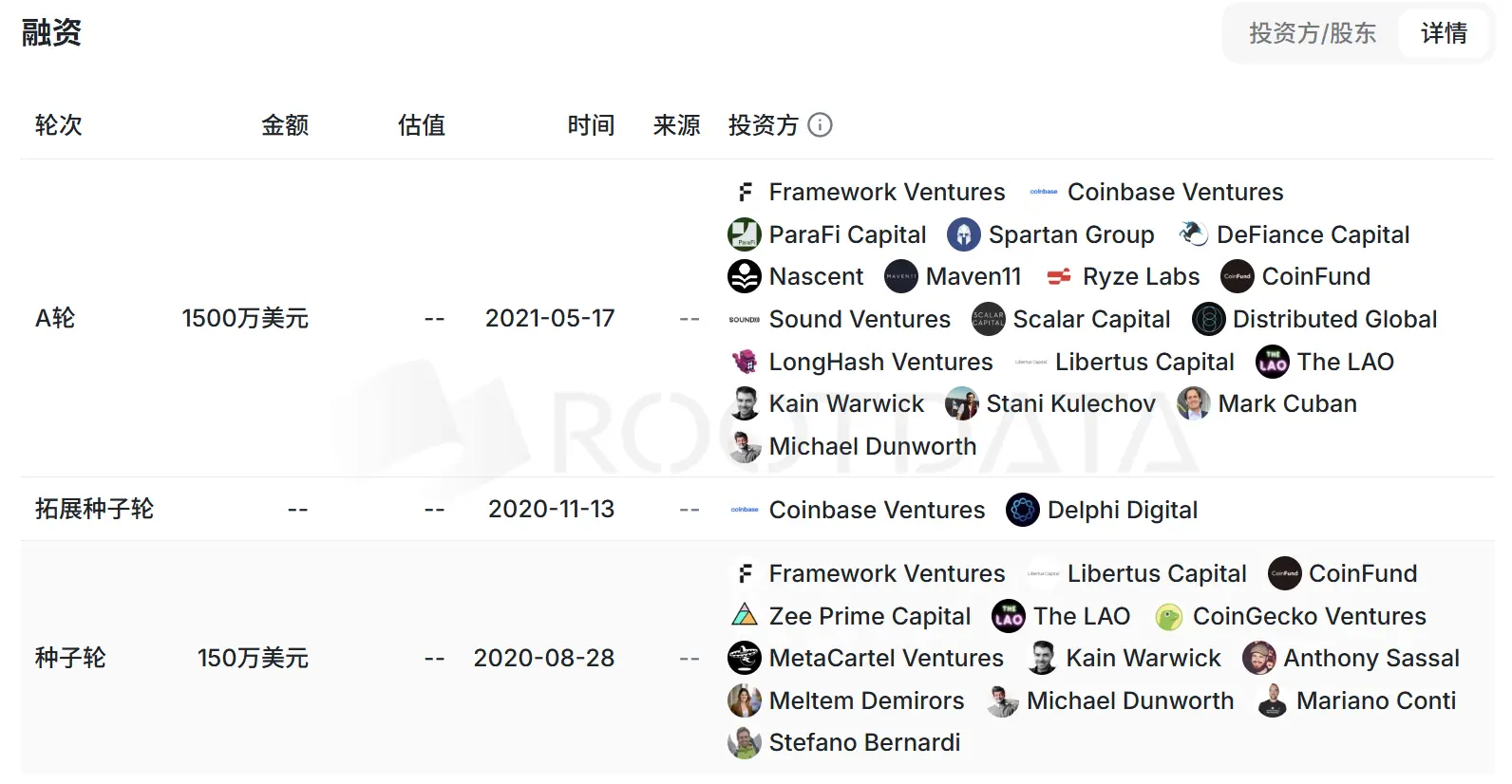
Zapper's story began in 2019. That year, the project won Kyber's DeFi hackathon and subsequently completed a $1.5 million seed round in early 2020, with investors including Framework Ventures, MetaCartel Ventures, and ParaFi Capital. What truly brought Zapper into the mainstream spotlight was its $15 million Series A funding round in May 2021, led by Framework Ventures, with participation from renowned investor Mark Cuban and Ashton Kutcher's Sound Ventures, among others.
Zapper was formed by the merger of two products: DeFi Snap and DeFi Zap. Its core function was portfolio tracking—after connecting their wallets, users could monitor their assets in the DeFi space in real-time.
At that time, various Layer1 and Layer2 solutions were flourishing. Users often needed to participate in DeFi protocols or purchase NFTs or tokens across different public chains, leading to highly fragmented asset distribution. Therefore, asset aggregators represented by Zapper, Debank, and Zerion quickly attracted a large number of users.
As Zapper continuously integrated with major public chains and DeFi protocols, it gradually expanded to include features such as asset exchange trading, NFT queries, and cross-chain asset bridging. The platform covered over 450 DeFi protocols, more than 7,000 tokens, across 14 networks. Its most distinctive "Zap" function allowed users to complete complex multi-step DeFi operations with a single transaction, including yield farming, liquidity provision, and cross-protocol strategies.
In fact, Zapper was likely the pioneer of the now-popular point systems based on on-chain interaction behaviors. In September 2021, Zapper launched a point system based on behaviors like check-ins, cross-chain transactions, and trades. Different point levels could be exchanged for corresponding NFTs, with over 100,000 addresses participating in interactions and minting NFTs. Its airdrop expectations also sparked significant user interest in trading.
According to Opensea, the cumulative trading volume of this NFT series exceeded 1200 ETH, equivalent to approximately $5 million at the time based on ETH prices. However, as the narratives of DeFi and NFTs weakened thereafter, Zapper did not launch related activities again. Currently, the price of this NFT series has completely plummeted to zero.
The ceiling for a pure dashboard product is limited. Zapper subsequently attempted a series of pivots.
In October 2023, Zapper launched the on-chain social application Chainchat. Users needed to purchase "shares" of corresponding channels to join group chats. Leaving a channel required selling all shares, and channel members shared transaction fees according to their shareholding ratios.
Later, Zapper launched V2, repositioning the product as a Web3 exploration tool, expanding its scope from DeFi to NFTs, DAOs, portfolios, and other on-chain accounts.
In June 2024, Zapper announced the launch of the Zapper Protocol with the vision of "enabling Onchain Literacy" and planned to launch the ZAP token in the fourth quarter. The protocol was designed as an open protocol aimed at incentivizing the parsing and contextualization of on-chain information—converting complex on-chain transactions into human-readable outputs. The ZAP token would serve as a reward for curators contributing data parsing, and application developers could also access Zapper's API services by paying ZAP.
However, this ambitious plan ultimately failed to materialize. The ZAP token was never officially issued, and the Zapper Protocol was shelved as the market turned bearish. All these attempts ultimately failed to reverse the project's fate.
Zapper's seven-year journey, to some extent, mirrors the trajectory of the DeFi industry from its nascent stage to explosive growth, and then to rational contraction.
During the bull market from 2019 to 2021, substantial capital flowed into the DeFi sector, giving rise to numerous tool and aggregation projects. A lenient financing environment allowed many projects to expand rapidly without pursuing profitability—Zapper's consecutive seed and Series A funding rounds in 2020 and 2021 are typical representatives of this period.
The reason Zapper's shutdown is lamentable is that it was not an obscure failed project. At its peak, with 2 million monthly active users and transaction processing exceeding $13 billion, it represented a considerable scale by any standard. However, there remains a difficult-to-cross chasm between traffic and sustainable commercial revenue.
Zapper's previous revenue model primarily relied on small fees charged from DEX aggregated transactions. However, in the fiercely competitive aggregator space, fee margins were continuously compressed. Meanwhile, maintaining data indexing and real-time updates covering multiple chains and hundreds of protocols required continuous investment in engineering resources and infrastructure costs. When the logic of "traffic first, monetization later" could not materialize during the prolonged market contraction, shutdown became an unavoidable choice.
Zapper ultimately fell into the chasm between traffic and revenue. Its shutdown does not disprove the value of DeFi entry points but rather indicates that pure tool products struggle to survive independently without strong transaction-based monetization channels. The next Zapper might not appear, but the industry still needs a better "entry point."