GPT-6 is Coming, OpenAI Completely Abandons the 4T Old Foundation

marsbitPublicado a 2026-07-09Actualizado a 2026-07-09

Resumen

OpenAI is accelerating its roadmap, with GPT-6 rumored for imminent release and the complete abandonment of the older ~4 trillion parameter "Spud" base model. Meanwhile, the GPT-5.6 series has been officially greenlit by regulators and will launch publicly on Thursday, July 9th. This release features three specialized models: GPT-5.6 Sol (a high-performance flagship for complex coding, science, and security), GPT-5.6 Terra (a cost-effective generalist), and GPT-5.6 Luna (a high-speed, low-cost option for agents). Early testers praise Sol's relentless, "never-give-up" problem-solving approach, comparing its tenacity to a "Rottweiler" versus competitor Anthropic's Fable 5, described as a more insightful but sometimes haughty "wise owl." While some testers still favor Fable for certain creative or architectural tasks, GPT-5.6 Sol is highlighted for its dependable execution, strong sub-agent coordination, and significant improvements in coding efficiency, leading to a proposed optimal workflow: using Fable for brainstorming, Sol for execution, and Fable again for documentation.

OpenAI urgently moves up the schedule for GPT-6, completely abandoning the 4T old foundation? Moreover, GPT-5.6 is officially lifted from restrictions and will be launched this Thursday! The three models Sol, Terra, and Luna are fully open, covering coding, scientific research, and daily tasks. Early testers have already raved about the Sol model, praising it for "never giving up." Now, all developers are gearing up.

Just now, a piece of news instantly spread across the industry.

The release date for GPT-6 has been significantly brought forward, with the earliest official launch expected within this month!

If the leaks are true, it means the GPT-5.x series will conclude with GPT-5.6, becoming the final chapter.
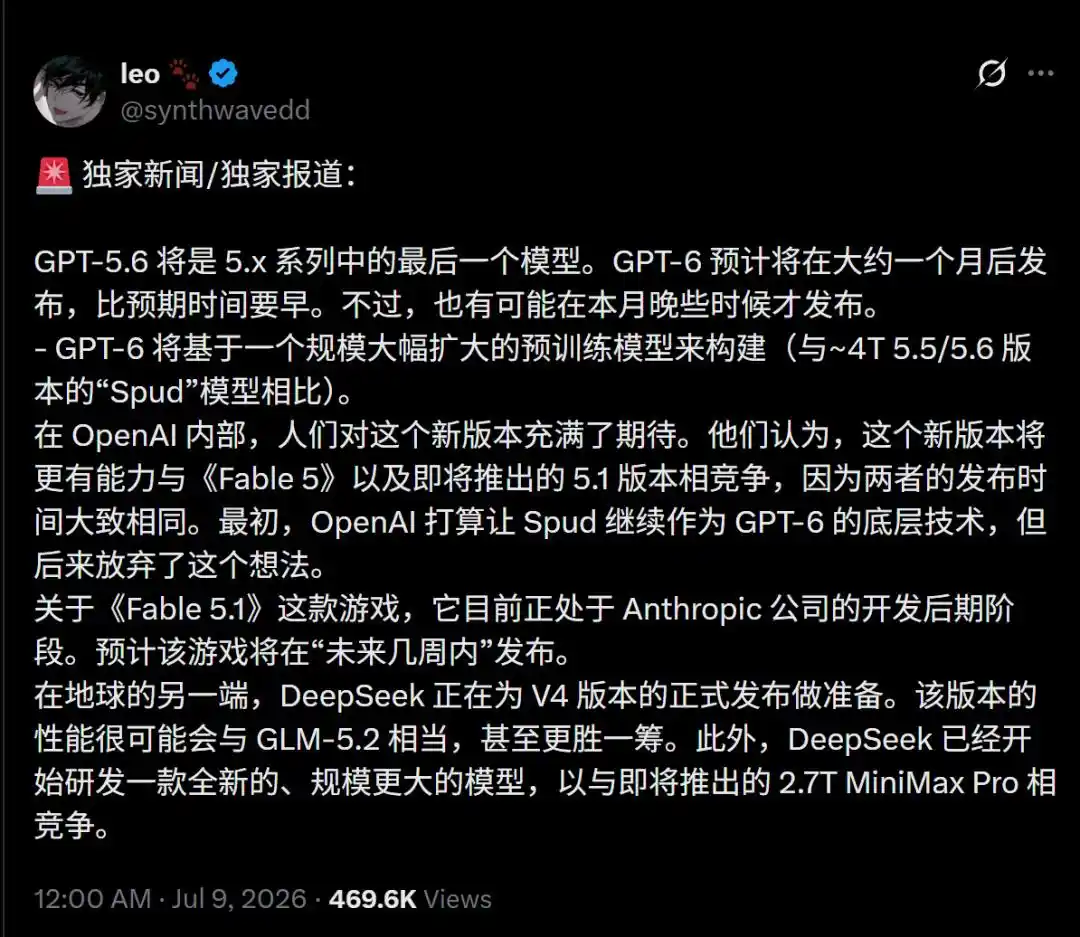
It is reported that this time, OpenAI has made a highly audacious decision—completely abandoning the previous 'Spud' foundation with approximately 4 trillion parameters, and instead betting on a new, larger-scale pre-training foundation.

Clearly, OpenAI's intention is direct: to use this new foundation to directly compete with Anthropic's upcoming Fable 5.1, which is set to be released in a few weeks.

And just yesterday afternoon, good news arrived: GPT-5.6 is fully unrestricted! See you this Thursday!

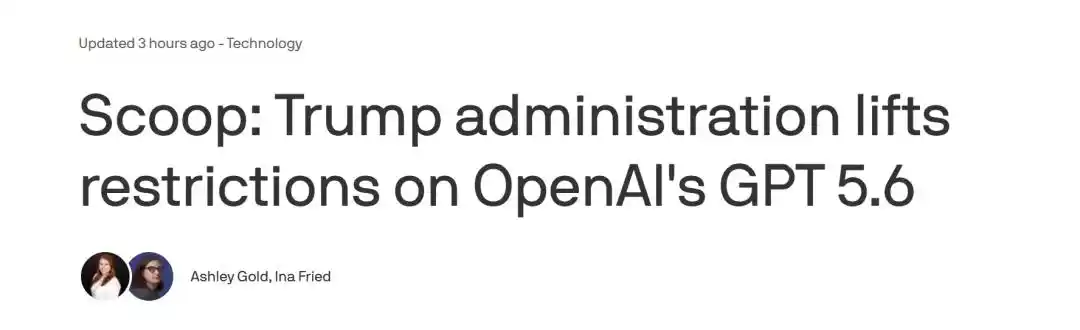
Yesterday at noon, Axios exclusively broke the scoop: the official restrictions on OpenAI's GPT-5.6 access have been formally lifted.
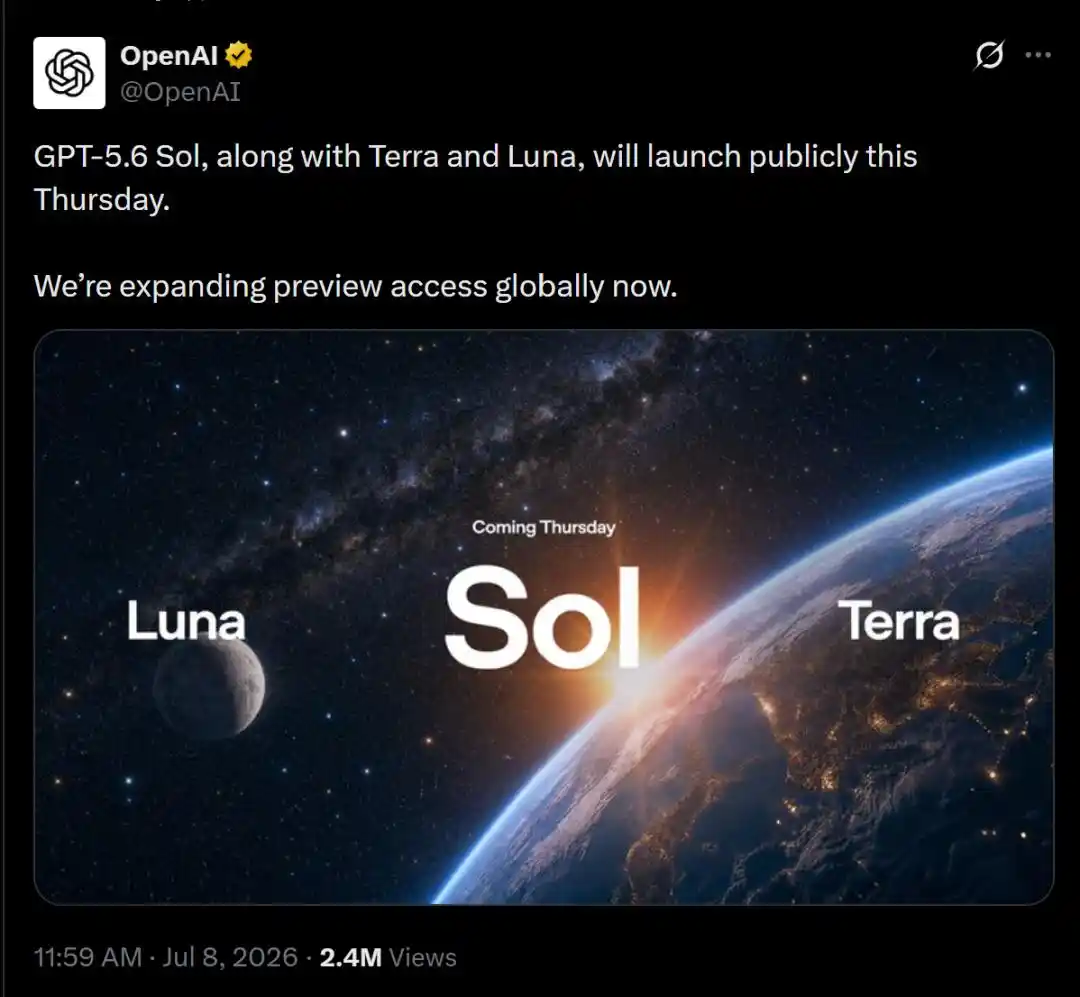
Immediately after, OpenAI officially announced on X: the flagship model GPT-5.6 Sol, along with Terra and Luna, will be officially released to global users this Thursday (July 9)!
The highly anticipated "trump card" model, having struggled through a month of "limited preview for government and enterprise," has finally been freed.

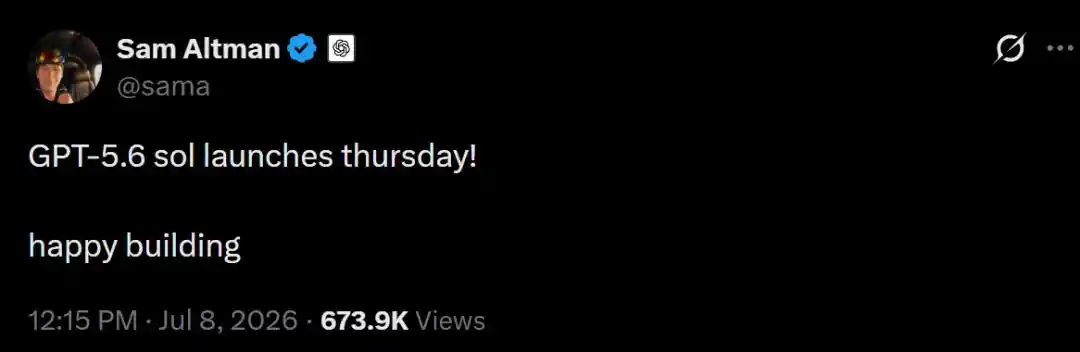
Sam Altman addressed developers: Happy Building!
Coercion, Negotiation, and a Midnight Unlock

On June 26, OpenAI quietly began a preview of GPT-5.6, limited to a select few.

This was because the "AI Standards and Innovation Center" under the U.S. Department of Commerce directly stationed itself at OpenAI, even forcibly detaining OpenAI's technical experts for "security review."

According to the latest AI executive order, the release of frontier models must undergo real-time case-by-case negotiation.

Now, why has the government suddenly relented?

Industry insiders reveal that OpenAI's experts underwent countless real attack pressure tests and vulnerability fixes in Washington, ultimately successfully proving: GPT-5.6 is OpenAI's most robust security system to date.

In today's announcement, OpenAI particularly emphasized with implied meaning: "We cooperate with the government, but short-term restrictions pave the way for broader availability. We absolutely do not want government pre-access to become the norm; technology must not be monopolized."

Now, the shoe has dropped, and the government has given the green light. The long-awaited global developer community's anticipation has instantly skyrocketed.

"Three Arrows Released": How Powerful Are Sol, Terra, and Luna?

This trio of new models has clearly defined roles.

GPT-5.6 Sol: The Ultimate Flagship

Sol focuses on frontier capabilities, specializing in complex coding, cutting-edge science, and cybersecurity tasks.

Its biggest feature is extreme reasoning.

Some say the capability leap of GPT-5.6 is comparable to the jump from GPT-4 to o1.
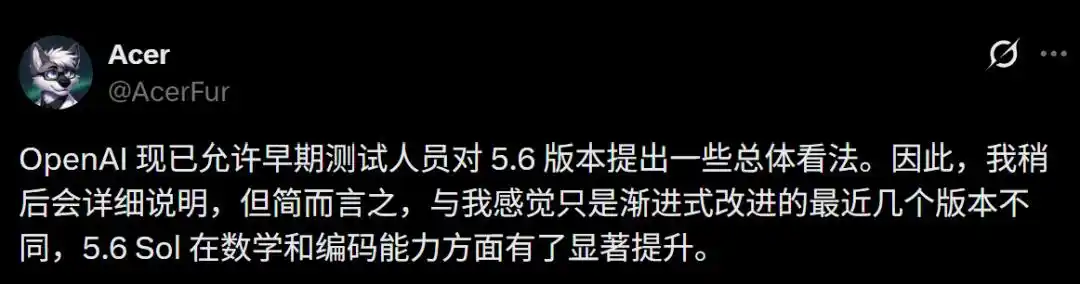
Early tester Max Weinbach excitedly commented: "The most terrifying thing about this model is that it never gives up! If you throw it into extreme reasoning mode, it obsessively perseveres and won't stop until the problem is completely solved."
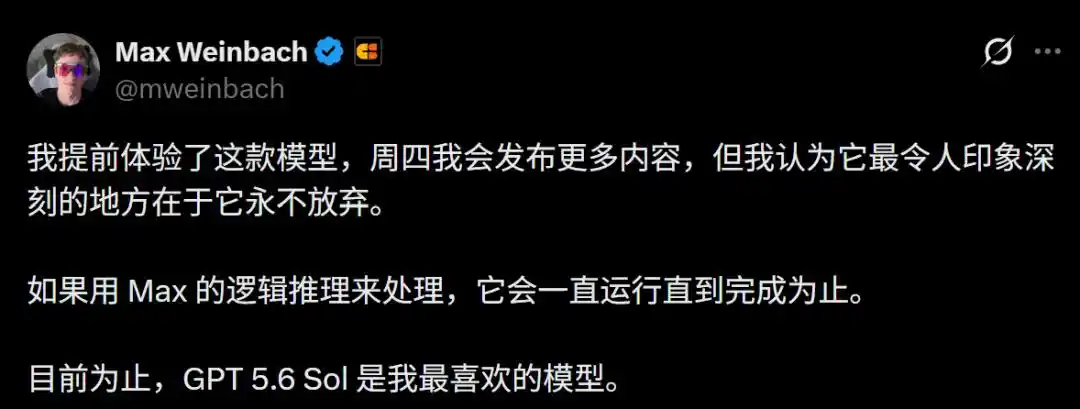
Others say GPT-5.6 is extremely tenacious, able to run for an entire day even without the /goal command.
GPT-5.6 Terra: King of Cost-Effectiveness, The Terminator of 5.5

Performance approaches the previous super flagship GPT-5.5, but the cost is directly halved!

This is a workhorse tool tailored for high-frequency daily workloads. Its arrival means GPT-5.5 is out.

GPT-5.6 Luna: Fast as Lightning, Dirt Cheap

Luna focuses on extreme speed and ultra-low cost, the top choice for frequently called agents.

Even more exaggerated is the seamless integration into the hardware ecosystem. It is reported that GPT-5.6 Sol will directly land on the Cerebras inference platform, achieving a breathtaking inference speed of 750 tokens per second!

In high-intensity scenarios like coding, biopharmaceutical R&D, and network attack/defense, this experience is simply mind-blowing.
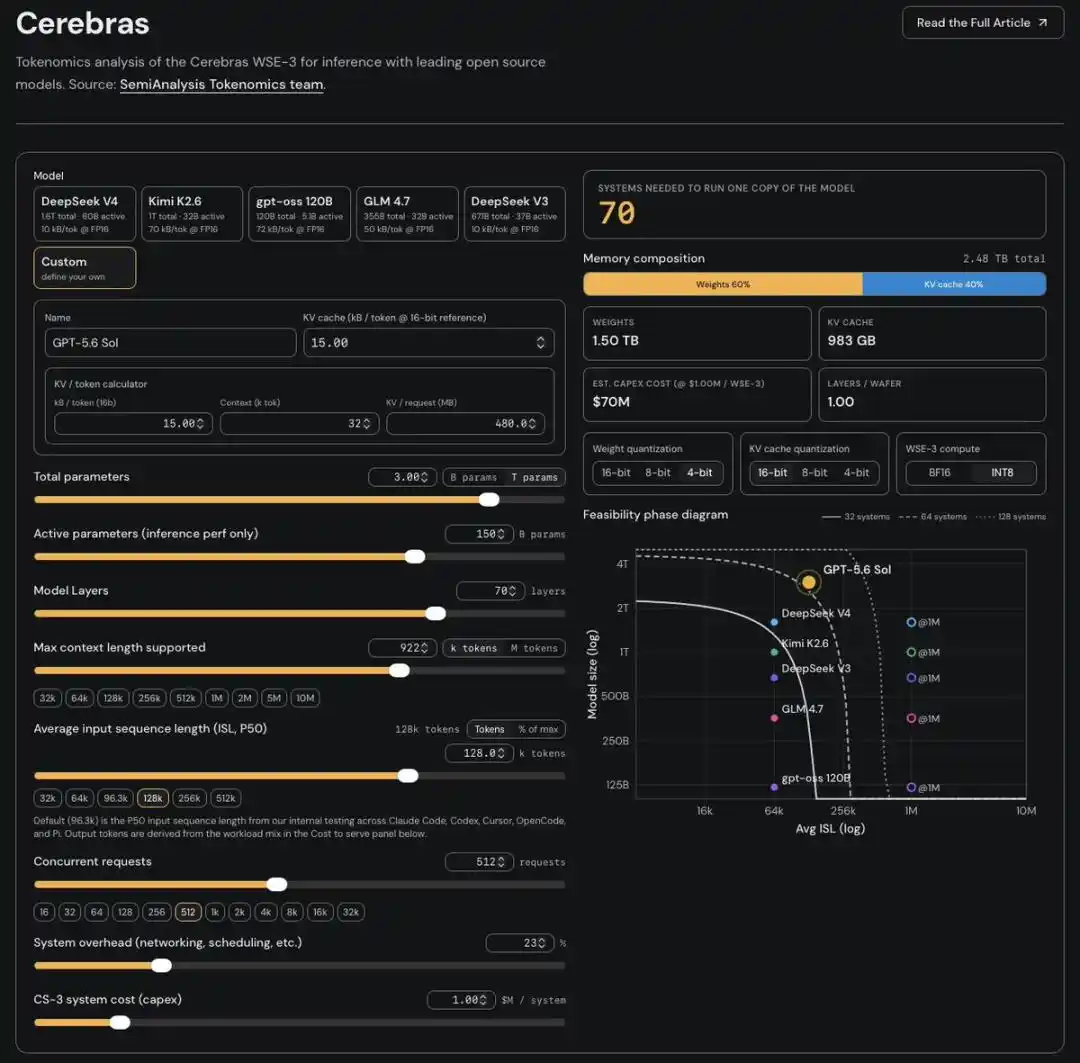
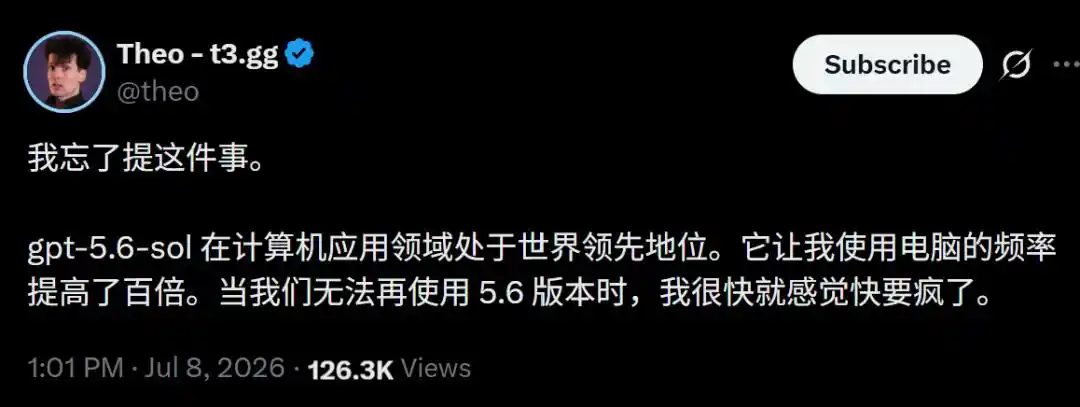
No wonder a developer who tested it early exclaimed: "I felt like I was going crazy when I couldn't use the 5.6 version."

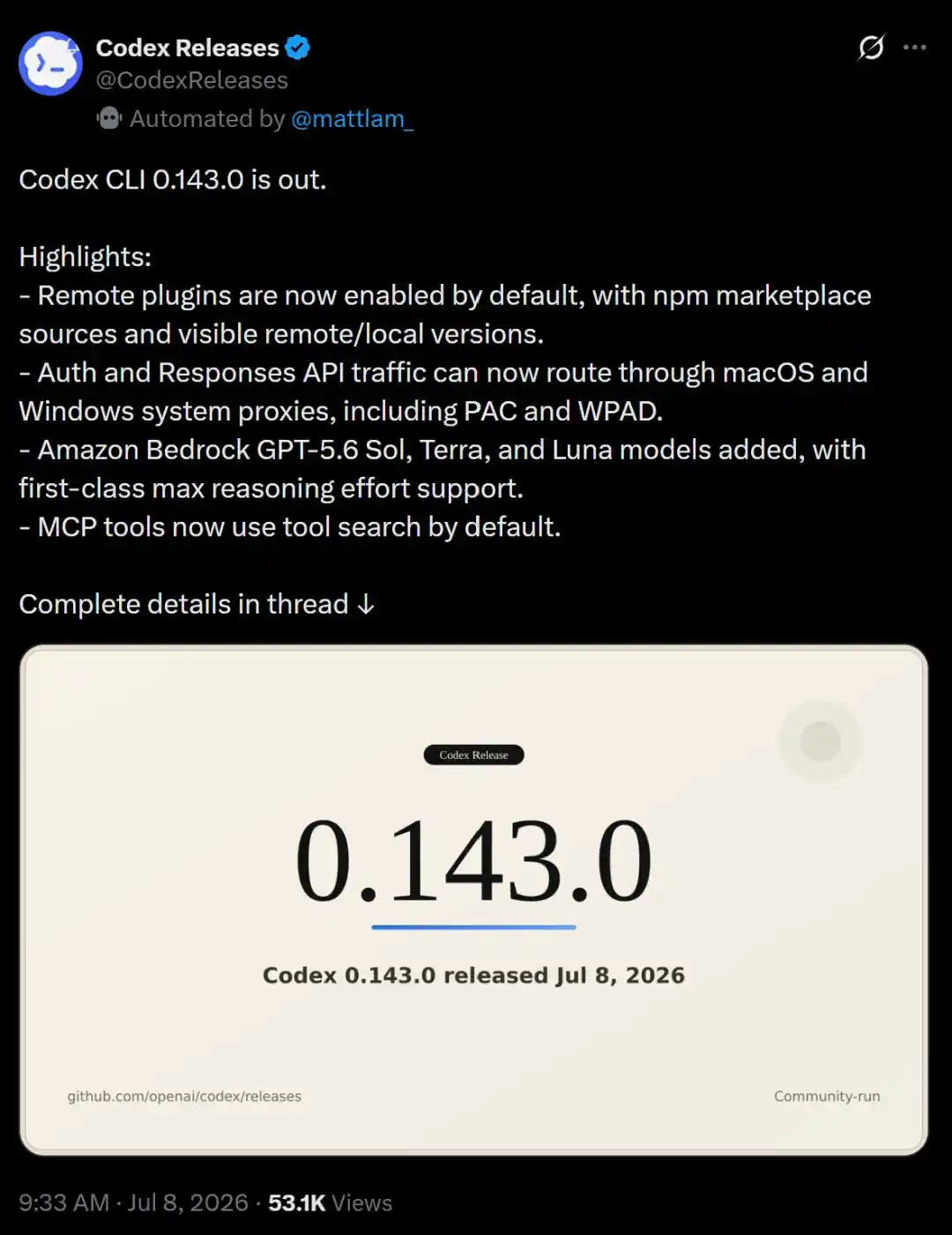
Just today, the update log for Codex CLI version 0.143.0 was also leaked: the Amazon Bedrock platform has quietly added the GPT-5.6 trio and provides support for Max inference intensity.

Judging from the configuration, these models are likely specifically prepared for the Max tier.
The First Wave of Hands-On Experts Have Spoken

Now, users on X who got early hands-on access have started giving their reviews.

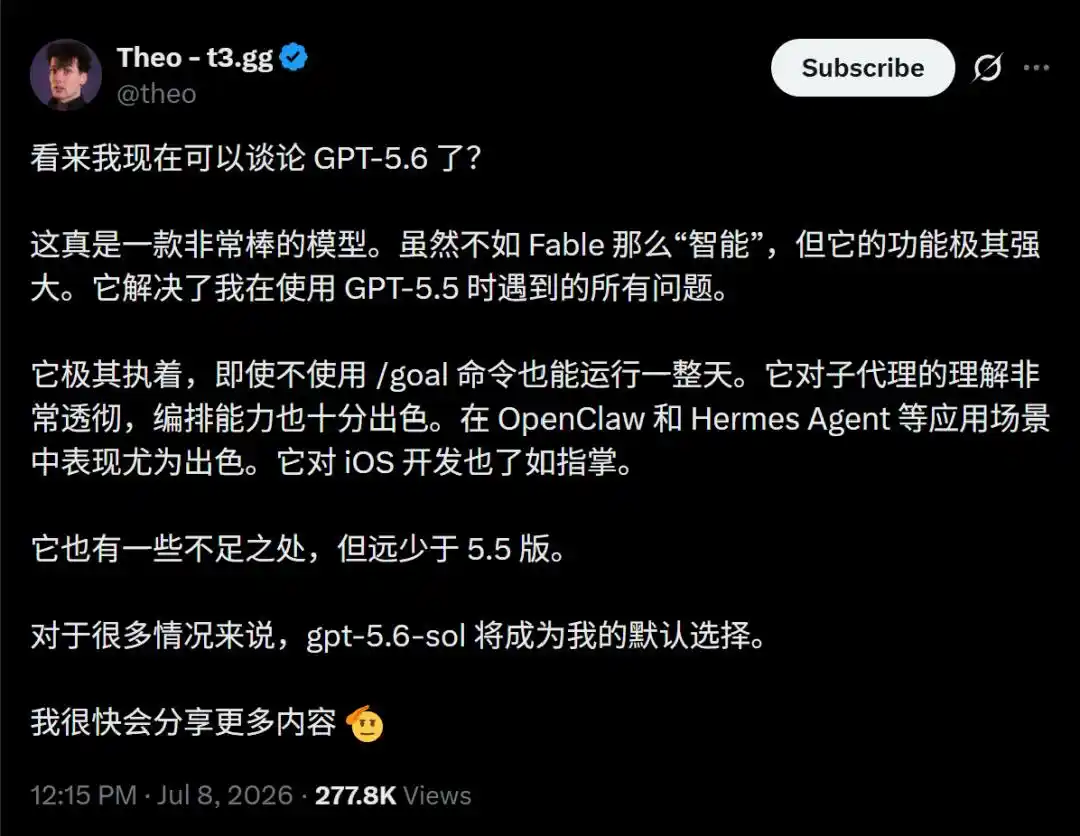
Well-known developer Theo posted several tweets on X, directly praising it to the skies.

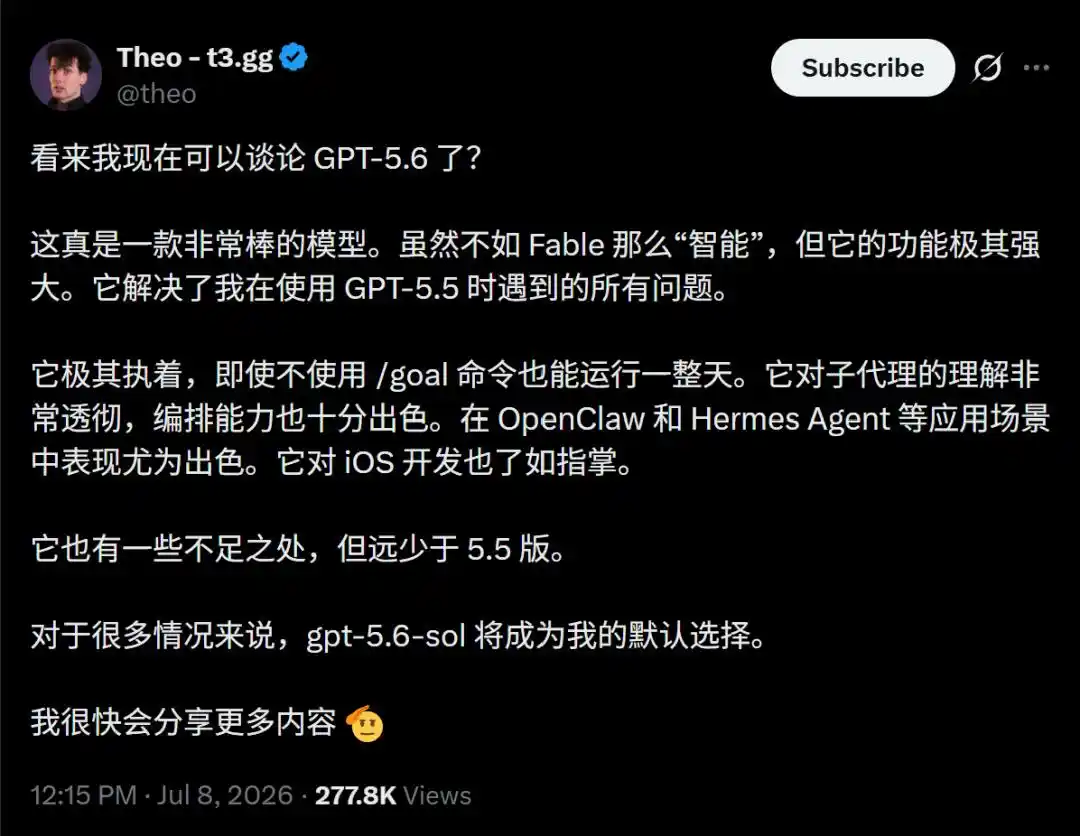
GPT-5.6 solves all the pain points I encountered when using 5.5. It is extremely tenacious; even without giving it a /goal instruction, it can run by itself for an entire day! Its understanding and orchestration of sub-agents is magical. It increased my computer usage frequency a hundredfold. When the beta ended and I could no longer use 5.6, I felt like I was going crazy!
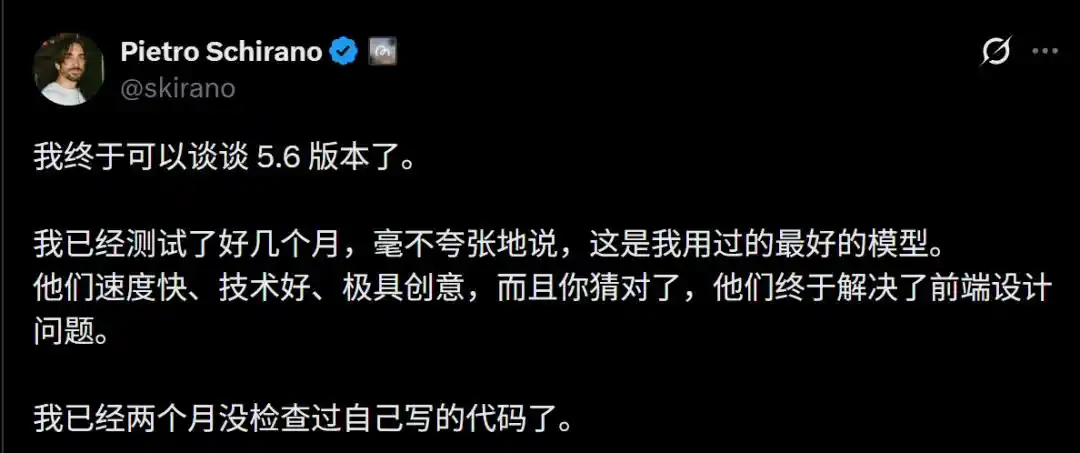
Magicpathai CEO Pietro Schirano also gave positive feedback.

Without exaggeration, this is the best model I've ever used. It's fast, highly creative, and they finally fixed the frontend design issues! I haven't checked my own code for a full two months!
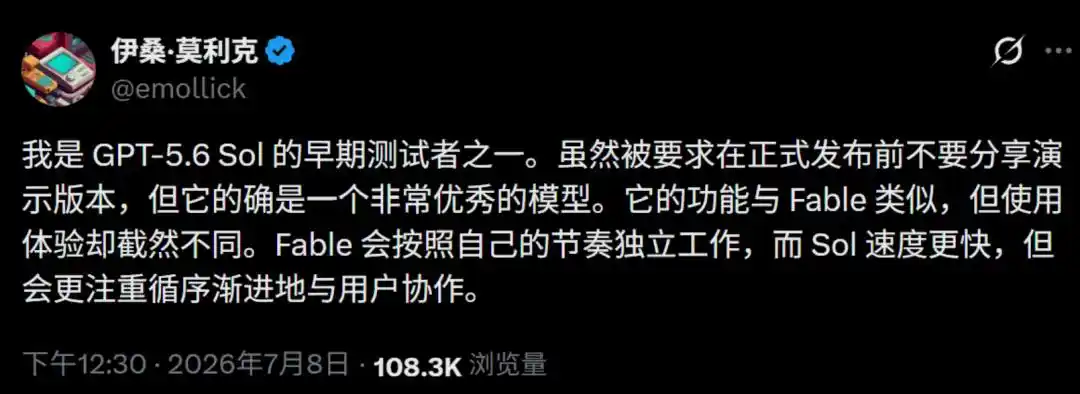
Wharton professor Ethan Mollick, on the other hand, compared Sol to Fable.

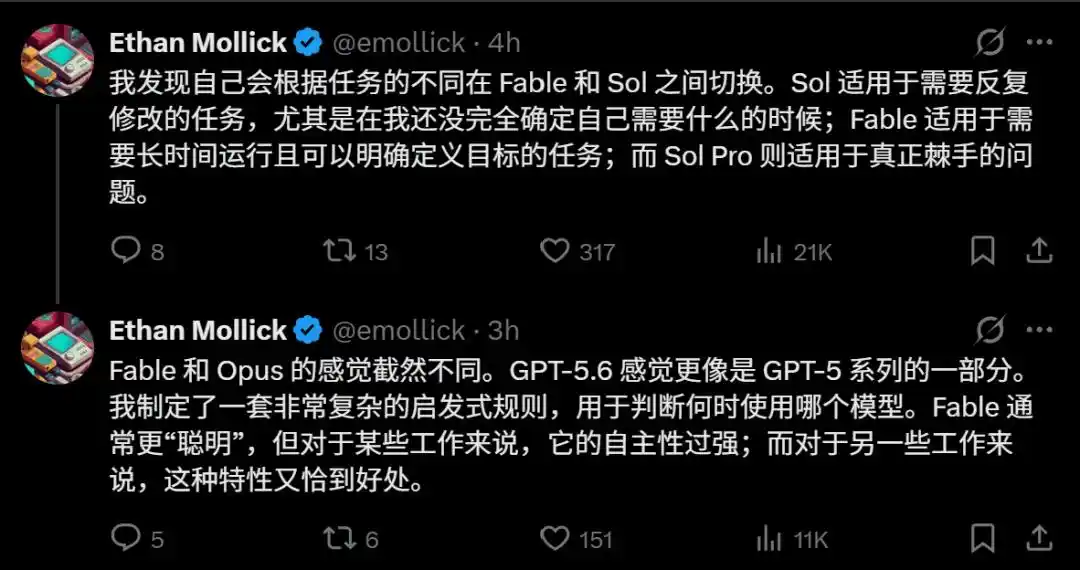
Sol's capabilities are similar to Fable's, but the experience is completely different. Fable likes to run off and complete tasks independently at its own pace; Sol is extremely fast and prefers high-frequency interaction, step-by-step with you. When I'm not clear about what I want, I'll use Sol for back-and-forth brainstorming; when I can clearly define the task, I'll use Fable for the long run. If I encounter a hellishly difficult problem, I'll go for Sol Pro.
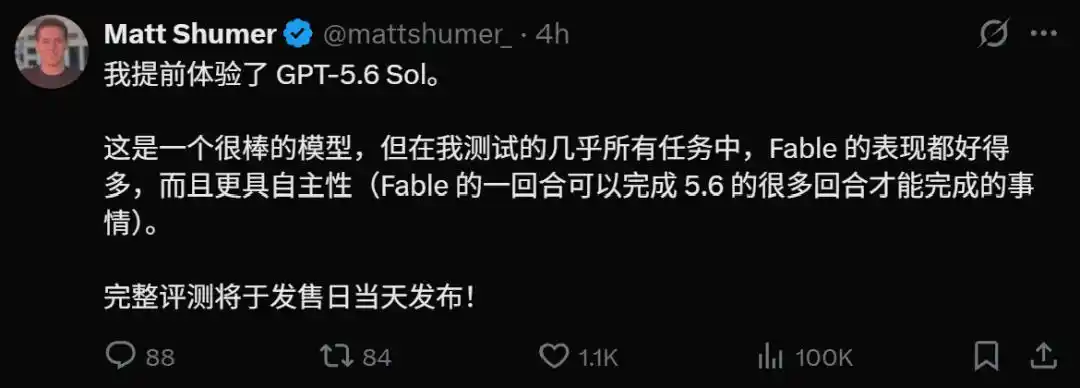
However, AI entrepreneur Matt Shumer voiced some dissent, stating bluntly:

Sol is a great model, but in the vast majority of tasks I tested, Fable is still better and more agentic.
LMArena Boss's Definitive Verdict: Wise Owl vs. Vicious Rottweiler

As a heavyweight player, LMArena head Peter Gostev also released the most in-depth and hardcore comparison currently available online.

He gave a highly visual metaphor: Fable 5 is like a "wise owl," while GPT-5.6-Sol is a "Rottweiler"—it will clamp down on the throat of the problem and won't let go until it's completely solved!
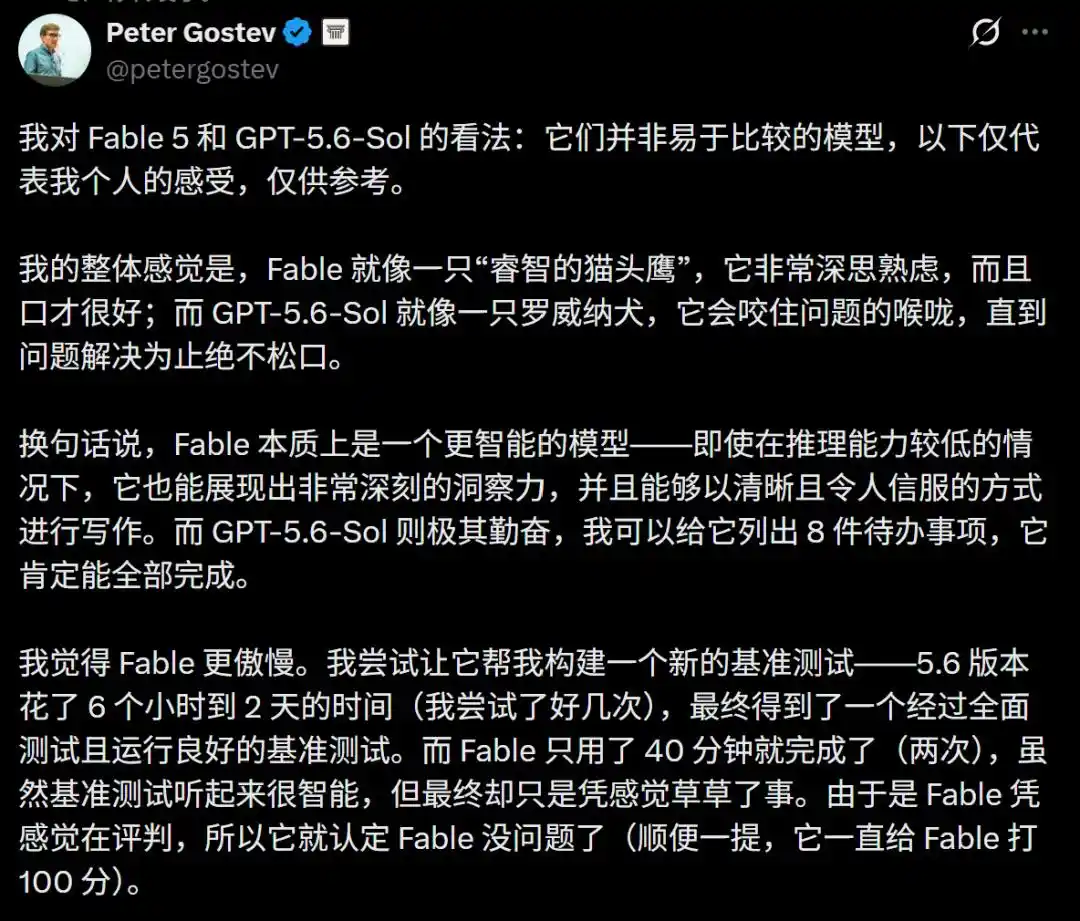
In Gostev's view, the underlying logic and user experience of the two are in stark conflict.

First, Fable 5 appears more arrogant.

Fable is essentially smarter and has deeper insight. But when building a new benchmark test, Fable shows its "arrogance"—it finishes in 40 minutes, sounding intelligent but just going through the motions based on feeling, even giving itself a perfect 100 score.

In contrast, GPT-5.6-Sol is incredibly diligent, spending a full two days obsessively grinding out a perfectly tested and well-functioning benchmark.

Comparatively, GPT-5.6-Sol is a work machine, offering a sense of security.

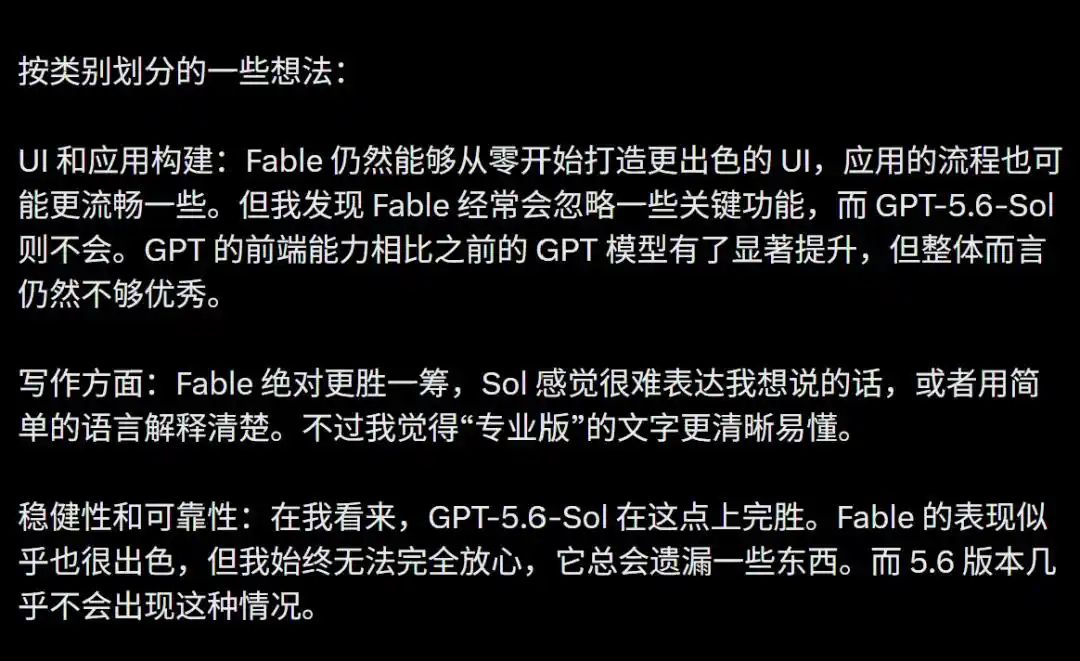
Although Fable still dominates in building UI from scratch and text writing, it always misses key functionalities.

GPT-5.6-Sol brings unparalleled security—throw it 8 to-do items, and it will complete them all without fail, never missing a thing. Combined with the powerful /goal command, Sol can run continuously at high frequency for days and nights.

Additionally, Sol has achieved a qualitative leap in following existing code patterns, video editing (seamlessly handling 1-hour footage), managing sub-agent communication, deep research, and token efficiency.
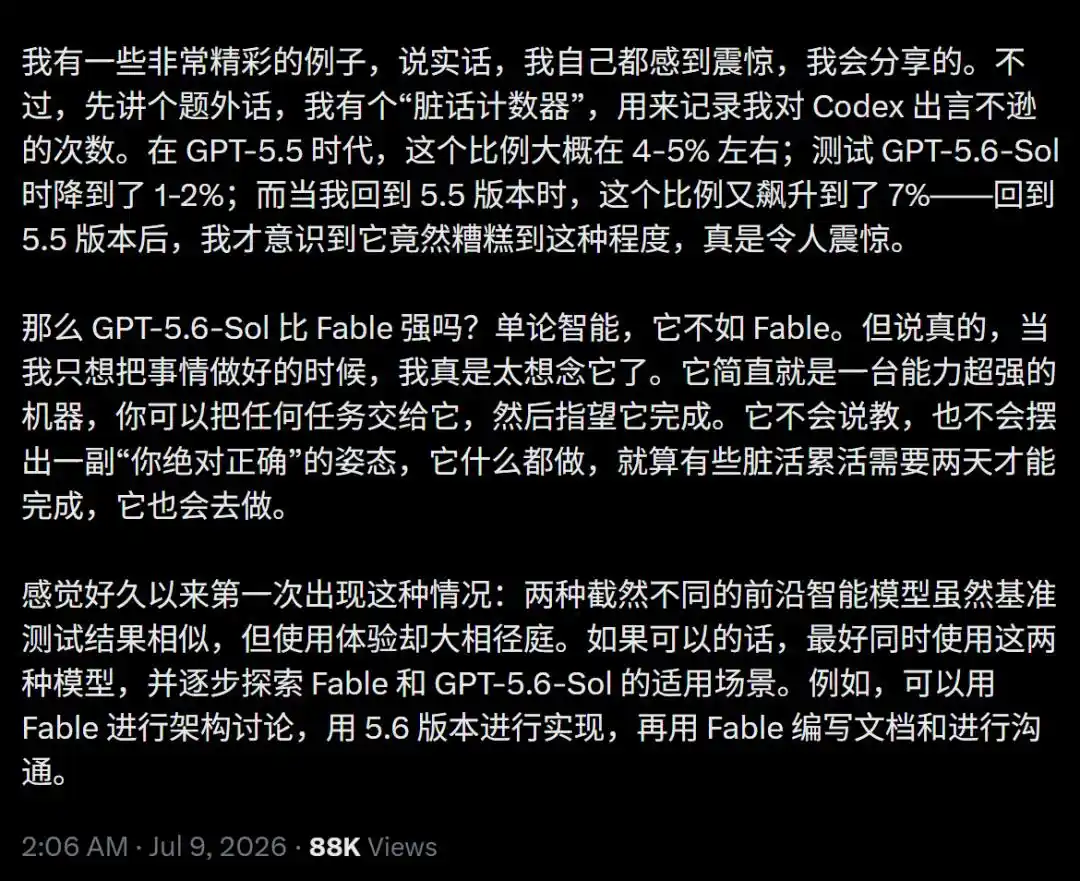
Gostev even shared an incredibly real "swear word counter": in the GPT-5.5 era, his frequency of cursing at the AI while coding was 4-5%; after using 5.6-Sol, it plummeted to 1-2%; and once he switched back to 5.5, the frustration index instantly shot up to 7%!

In short, purely in terms of intelligence, Sol is indeed not as good as Fable. But it's a tireless super work machine that won't lecture you.

Thus, Gostev presents the strongest workflow solution for current large models:

Use Fable for architecture discussions and brainstorming → throw it to GPT-5.6-Sol to obsessively write code and execute dirty work → finally use Fable to write documentation and external communications.
Tomorrow, the GPT-5.6 trio of models will officially launch.

This time, it's up to global developers to get hands-on and give their scores.

References:

https://x.com/ai_for_success/status/2074700209339367617

https://x.com/OpenAI/status/2074704958419792299?s=20

This article is from the WeChat public account "新智元" (New AI Era), author: ASI启示录, editor: Aeneas

Criptos en tendencia

Preguntas relacionadas

QAccording to the article, what major change is OpenAI making with GPT-6, and why?

AOpenAI is reportedly ditching the old 'Spud' pre-training base, which had about 4T parameters, for a new, much larger one. The intent is to directly compete with Anthropic's upcoming Fable 5.1 model.

QWhat are the names and primary focuses of the three GPT-5.6 models announced for release?

AThe three models are: GPT-5.6 Sol (flagship for complex coding, frontier science, cybersecurity), GPT-5.6 Terra (cost-effective 'daily workhorse'), and GPT-5.6 Luna (focused on speed and low cost for high-frequency agent tasks).

QHow did one early tester, Max Weinbach, describe the standout characteristic of the GPT-5.6 Sol model?

AMax Weinbach described GPT-5.6 Sol as 'never gives up,' stating that in its extreme reasoning mode, it would 'insanely' stick with a problem until it was completely solved.

QAccording to the article, what was a key reason given for the official 'green light' and lifting of restrictions on GPT-5.6?

AOpenAI's experts successfully passed numerous real attack pressure tests and vulnerability fixes in Washington, proving that GPT-5.6 is OpenAI's most robust safety system to date.

QWhat workflow did LMArena's Peter Gostev suggest for combining the strengths of Fable 5 and GPT-5.6-Sol?

APeter Gostev suggested: use Fable 5 for architectural discussion and brainstorming, hand tasks off to GPT-5.6-Sol to grind through code and execute the 'dirty work,' and finally use Fable 5 for writing documentation and external communication.

Lecturas Relacionadas

Glassnode: Cryptocurrency Market Entering Late-Stage Consolidation Phase

Bitcoin has now been trading below the realized price and short-term holder cost basis for nearly five months, indicating a prolonged period of undervaluation. The market exhibits late-stage accumulation characteristics. Long-term holders (LTHs) are the primary source of sell-side pressure, with their realized losses reaching a daily peak of $280 million, the highest since December 2022, and accounting for 43% of total on-chain realized losses. A sustained decline in this LTH selling is a crucial prerequisite for a meaningful reversal. Spot ETF flows, while moderating from June peaks, remain in a state of monthly net outflows. Daily trading volumes have collapsed roughly 80% from the October 2025 highs, reflecting weak institutional demand and lack of confidence. Derivatives markets show a cautious tilt towards bullishness, with the put/call ratio hitting a 2026 low and funding rates neutral. However, the options volatility skew remains in "put premium," indicating persistent demand for downside protection, even as the absolute cost of that protection has declined. The spot price currently trades approximately 6% below the $66,000 max pain level. In summary, key conditions for a market bottom are in place, including sustained undervaluation and significant LTH capitulation. However, definitive signals for a transition to a bull market—namely, a sustained drop in LTH realized losses, stabilization of ETF fund flows, and price reclaiming key on-chain cost bases—are not yet confirmed. The market is in the late stages of basing, awaiting these catalysts for a sustained recovery.

marsbitHace 1 hora(s)

Glassnode: Cryptocurrency Market Entering Late-Stage Consolidation Phase

marsbitHace 1 hora(s)

Trading

Spot

Artículos destacados

Qué es ₿O₿

Bitcoin Bob ($₿o₿): Pionero en DeFi Centrado en Bitcoin a Través de la Innovación Híbrida de Capa 2 En una era donde la economía digital está evolucionando rápidamente, Bitcoin Bob ($₿o₿) surge como un proyecto revolucionario que busca mejorar la utilidad de Bitcoin en el sector de las finanzas descentralizadas (DeFi). Lanzado oficialmente en mayo de 2024, Bitcoin Bob, también conocido como Build on Bitcoin (BOB), representa una solución híbrida de blockchain de Capa 2 que combina la reconocida seguridad e inmutabilidad de Bitcoin con la programabilidad de Ethereum. Esta iniciativa busca llenar un vacío crucial en el ecosistema de Bitcoin al facilitar la integración de contratos inteligentes y aplicaciones descentralizadas, manteniendo al mismo tiempo los principios fundamentales de confianza y seguridad inherentes a Bitcoin. Con un respaldo significativo de destacados capitalistas de riesgo, Bitcoin Bob está posicionado para redefinir el papel de Bitcoin en el paisaje DeFi, convirtiéndolo en una piedra angular de las operaciones financieras descentralizadas a nivel global. ¿Qué es Bitcoin Bob, $₿o₿? En su esencia, Bitcoin Bob es una solución de blockchain híbrida diseñada para mejorar la funcionalidad de Bitcoin. El objetivo principal del proyecto es habilitar las finanzas descentralizadas en Bitcoin, facilitando transacciones rápidas y sin problemas mientras se asegura altos niveles de seguridad. Bitcoin Bob emplea tecnología avanzada, específicamente una arquitectura híbrida de capa 2 que combina los atributos de seguridad de Bitcoin con la programabilidad y flexibilidad de la Máquina Virtual de Ethereum (EVM). Este enfoque pragmático permite que el proyecto opere de manera efectiva sin comprometer los valores fundamentales de Bitcoin, convirtiéndolo en un paso monumental para cerrar la brecha entre los tenedores tradicionales de Bitcoin y el emergente ecosistema DeFi. Una de las características destacadas de Bitcoin Bob es su papel en proporcionar un entorno minimizado en confianza a través de mecanismos innovadores, como los rollups optimistas que inicialmente dependen de Ethereum, y que eventualmente transicionan a una integración completa con Bitcoin. Este sistema híbrido está diseñado para asegurar que la vasta liquidez presente en Bitcoin no solo se preserve, sino que también se utilice de manera efectiva en varios protocolos DeFi. ¿Quién es el Creador de Bitcoin Bob, $₿o₿? La fuerza creativa detrás de Bitcoin Bob es el cofundador y CEO Alexei Zamyatin, quien aporta una gran experiencia y conocimiento de su extensa trayectoria en el espacio de las criptomonedas. Zamyatin tiene un doctorado en Ciencias de la Computación y ha estado involucrado activamente en el desarrollo de Bitcoin desde 2015. Su profundo entendimiento de los ecosistemas de Bitcoin y Ethereum juega un papel crucial en la formación de la visión y los fundamentos tecnológicos de Bitcoin Bob. Junto a Zamyatin está el cofundador Dominik Harz, quien se desempeña como Director de Tecnología (CTO). Juntos, el dúo ha cultivado un equipo de individuos talentosos con una pasión compartida por empujar los límites de la tecnología blockchain, asegurando el estatus innovador de Bitcoin Bob en el mercado. ¿Quiénes son los Inversores de Bitcoin Bob, $₿o₿? Bitcoin Bob ha logrado obtener apoyo de una variedad de inversores prominentes y firmas de capital de riesgo que reconocen su potencial para transformar el paisaje de Bitcoin. En marzo de 2024, el proyecto completó una robusta ronda de financiamiento inicial de $10 millones, liderada por Castle Island Ventures, con la notable participación de firmas como Coinbase Ventures y Bankless Ventures. Poco después, en julio de 2024, Bitcoin Bob aseguró un adicional de $1.6 millones en financiamiento estratégico. Esta ronda fue co-liderada por Ledger Ventures y contó con ángeles de varias firmas prominentes como BlackRock, Aave y Curve. El fuerte respaldo financiero refleja un reconocimiento en toda la industria del enfoque innovador de Bitcoin Bob para desbloquear el potencial de Bitcoin en el espacio DeFi. Este financiamiento es crucial no solo para el desarrollo continuo del proyecto, sino también para establecer un incubador que fomente aplicaciones descentralizadas (dApps) nativas de Bitcoin, dirigidas específicamente a satisfacer las necesidades de una base de usuarios en crecimiento. ¿Cómo Funciona Bitcoin Bob, $₿o₿? La mecánica operativa de Bitcoin Bob se basa en su arquitectura de rollup híbrido, que está diseñada para combinar los beneficios de la seguridad de Bitcoin con la versatilidad de la EVM de Ethereum. El proyecto emplea un modelo de seguridad por fases que describe su interacción con usuarios y desarrolladores de la siguiente manera: Fase 1 – La fase inicial opera como un rollup optimista en Ethereum, donde las transacciones se procesan con una expectativa prometedora de validez, allanando el camino para futuros desarrollos en Bitcoin. Fase 2 – A medida que el proyecto transiciona, integrará la finalización de Bitcoin a través de Staking de Bitcoin, aprovechando la Red Babylon para mejorar la seguridad. Este mecanismo requiere que los validadores bloqueen Bitcoin, verificando así las transacciones de BOB, lo que no solo mejora la seguridad, sino que también crea perspectivas de rendimiento para los participantes. Fase 3 – La visión a futuro para Bitcoin Bob es integrarse completamente con Bitcoin, utilizando tecnologías innovadoras como BitVM y pruebas de conocimiento cero para facilitar la computación fuera de la cadena mientras se mantiene la integridad de seguridad de Bitcoin. Innovaciones clave como BitVM2, un protocolo de puente minimizado en confianza co-autorado por Zamyatin, son críticas para la funcionalidad del proyecto, permitiendo depósitos y retiros de Bitcoin sin necesidad de una extensa dependencia de la red. Esto permite que el ecosistema se conecte de manera eficiente con Ethereum y otras cadenas compatibles, creando un modelo de interacción fluido y efectivo para usuarios y desarrolladores. Cronología de Bitcoin Bob, $₿o₿ Entender la evolución de Bitcoin Bob implica rastrear sus hitos importantes: 2019: Alexei Zamyatin y Dominik Harz establecen una firma de investigación enfocada en soluciones blockchain, sentando las bases para futuros proyectos. Marzo 2024: Bitcoin Bob recauda exitosamente $10 millones en una ronda de financiamiento inicial, marcando su entrada en el competitivo paisaje de blockchain. 1 de mayo de 2024: Ocurre el lanzamiento oficial de la mainnet, mostrando las capacidades del proyecto con una adopción significativa de usuarios y valor total bloqueado (TVL). Julio 2024: El proyecto atrae un adicional de $1.6 millones en financiamiento estratégico para establecer su incubadora, destinada a fomentar innovaciones impulsadas por Bitcoin. Octubre 2024: Bitcoin Bob publica un “Documento de Visión”, detallando su diseño de capa 2 híbrida y estrategias a futuro. 2025: Se espera el lanzamiento de las características de la Fase 2, enfocándose en la finalización de Bitcoin y puentes BitVM destinados a mejorar la funcionalidad general. Conclusión: Redefiniendo el Papel de Bitcoin en las Finanzas Descentralizadas Bitcoin Bob ($₿o₿) no es solo otro proyecto de blockchain; representa un cambio de paradigma en la forma en que Bitcoin puede interactuar con aplicaciones financieras más amplias. Al combinar meticulosamente la seguridad de Bitcoin con la flexibilidad de Ethereum, Bitcoin Bob busca remodelar el paisaje DeFi, cerrando la brecha entre la moneda digital y las aplicaciones descentralizadas. Con un robusto marco tecnológico, un liderazgo fuerte y financiamiento estratégico, Bitcoin Bob está bien posicionado para establecerse como un jugador fundamental en el ecosistema de criptomonedas, desbloqueando nuevas dimensiones de liquidez y utilidad para Bitcoin. A medida que el proyecto continúa evolucionando y expandiéndose, promete inaugurar una nueva era de innovación, demostrando que el potencial de Bitcoin se extiende mucho más allá de ser un mero almacén de valor, sino más bien como una piedra angular del futuro paisaje financiero. A medida que el proyecto avanza a través de sus fases anticipadas, todas las miradas estarán puestas en Bitcoin Bob, particularmente en lo que respecta a su compromiso de incorporar principios descentralizados y asegurar que los usuarios puedan disfrutar de todos los beneficios de DeFi anclados en Bitcoin.

41 Vistas totalesPublicado en 2025.06.30Actualizado en 2025.06.30

Qué es ₿O₿

Cómo comprar O

¡Bienvenido a HTX.com! Hemos hecho que comprar O1 exchange (O) sea simple y conveniente. Sigue nuestra guía paso a paso para iniciar tu viaje de criptos.Paso 1: crea tu cuenta HTXUtiliza tu correo electrónico o número de teléfono para registrarte y obtener una cuenta gratuita en HTX. Experimenta un proceso de registro sin complicaciones y desbloquea todas las funciones.Obtener mi cuentaPaso 2: ve a Comprar cripto y elige tu método de pagoTarjeta de crédito/débito: usa tu Visa o Mastercard para comprar O1 exchange (O) al instante.Saldo: utiliza fondos del saldo de tu cuenta HTX para tradear sin problemas.Terceros: hemos agregado métodos de pago populares como Google Pay y Apple Pay para mejorar la comodidad.P2P: tradear directamente con otros usuarios en HTX.Over-the-Counter (OTC): ofrecemos servicios personalizados y tipos de cambio competitivos para los traders.Paso 3: guarda tu O1 exchange (O)Después de comprar tu O1 exchange (O), guárdalo en tu cuenta HTX. Alternativamente, puedes enviarlo a otro lugar mediante transferencia blockchain o utilizarlo para tradear otras criptomonedas.Paso 4: tradear O1 exchange (O)Tradear fácilmente con O1 exchange (O) en HTX's mercado spot. Simplemente accede a tu cuenta, selecciona tu par de trading, ejecuta tus trades y monitorea en tiempo real. Ofrecemos una experiencia fácil de usar tanto para principiantes como para traders experimentados.

81 Vistas totalesPublicado en 2026.06.19Actualizado en 2026.06.29

Cómo comprar O

Discusiones

Bienvenido a la comunidad de HTX. Aquí puedes mantenerte informado sobre los últimos desarrollos de la plataforma y acceder a análisis profesionales del mercado. A continuación se presentan las opiniones de los usuarios sobre el precio de O (O).

活动图片