Willy Woo says Bitcoin OGs will buy Satoshi's stash if a quantum hack occurs

cointelegraphPublicado a 2025-12-14Actualizado a 2025-12-14

Resumen

A debate emerged on social media regarding the potential scenario of a quantum computer hacking and dumping Satoshi Nakamoto’s 1 million BTC. YouTuber Josh Otten suggested this could crash Bitcoin's price to $3, but long-term holder Willy Woo countered that many original Bitcoin investors (OGs) would buy such a flash crash, ensuring the network's survival. Woo noted that around 4 million BTC in older "pay-to-public-key" (P2PK) addresses, including Satoshi's, are vulnerable because they expose public keys onchain, which a powerful quantum computer could use to derive private keys. Newer wallet types are more secure as they don’t reveal public keys. While some fear quantum computing could destroy crypto, experts like Blockstream’s Adam Back believe the threat is decades away, allowing time to adopt quantum-resistant cryptography. Analyst James Check added that the bigger risk is to Bitcoin’s market price, as the community is unlikely to preemptively freeze Satoshi’s coins before a quantum attack.

A debate broke out on social media on Saturday about the potential effects of a quantum computer hacking Satoshi Nakamoto’s Bitcoin (BTC) stash and then dumping those coins onto the market.

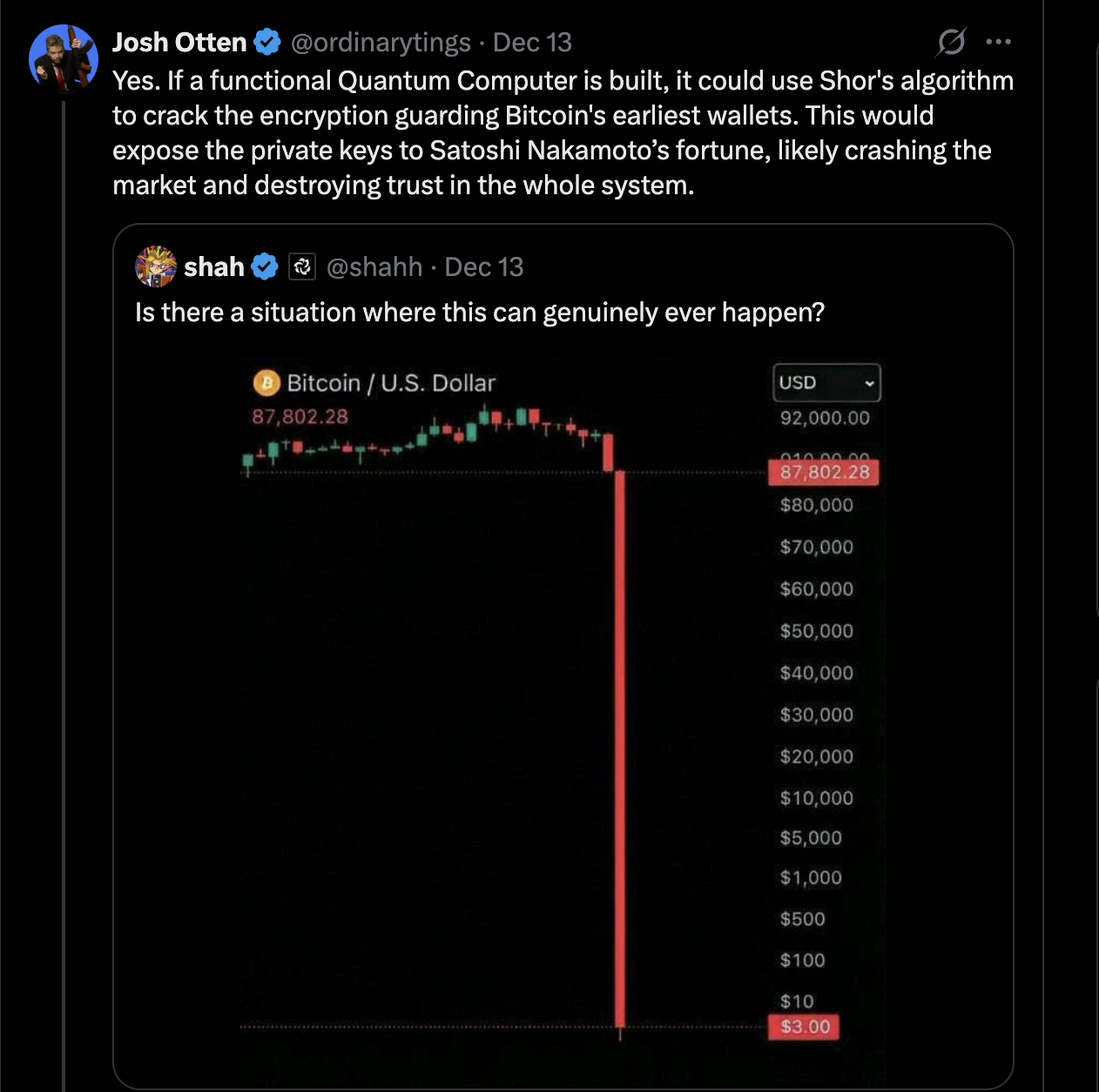
The debate began when YouTuber Josh Otten shared a price chart of BTC crashing to $3.00 and said that this could happen if a sufficiently powerful quantum computer emerges and steals pseudonymous Bitcoin creator Satoshi Nakamoto’s 1 million BTC and sells them.

“Many OGs would buy the flash crash. The Bitcoin network would survive; most coins are not immediately vulnerable,” long-term Bitcoin holder Willy Woo said.
Source: Josh Otten

However, there are about 4 million BTC held in pay-to-public-key (P2PK) addresses, including Satoshi’s coins, which show the full public key onchain when coins are spent, making them vulnerable to quantum attacks, Woo added.

Exposing a Bitcoin wallet’s full public key onchain exposes these wallets to quantum attacks in the future because a sufficiently powerful quantum computer could theoretically derive the private key from the public key in the future

Newer types of BTC wallet addresses are not as vulnerable to quantum attacks because they do not expose the full public keys onchain, and if the public key is not known, then a quantum computer cannot generate the paired private key from that data.
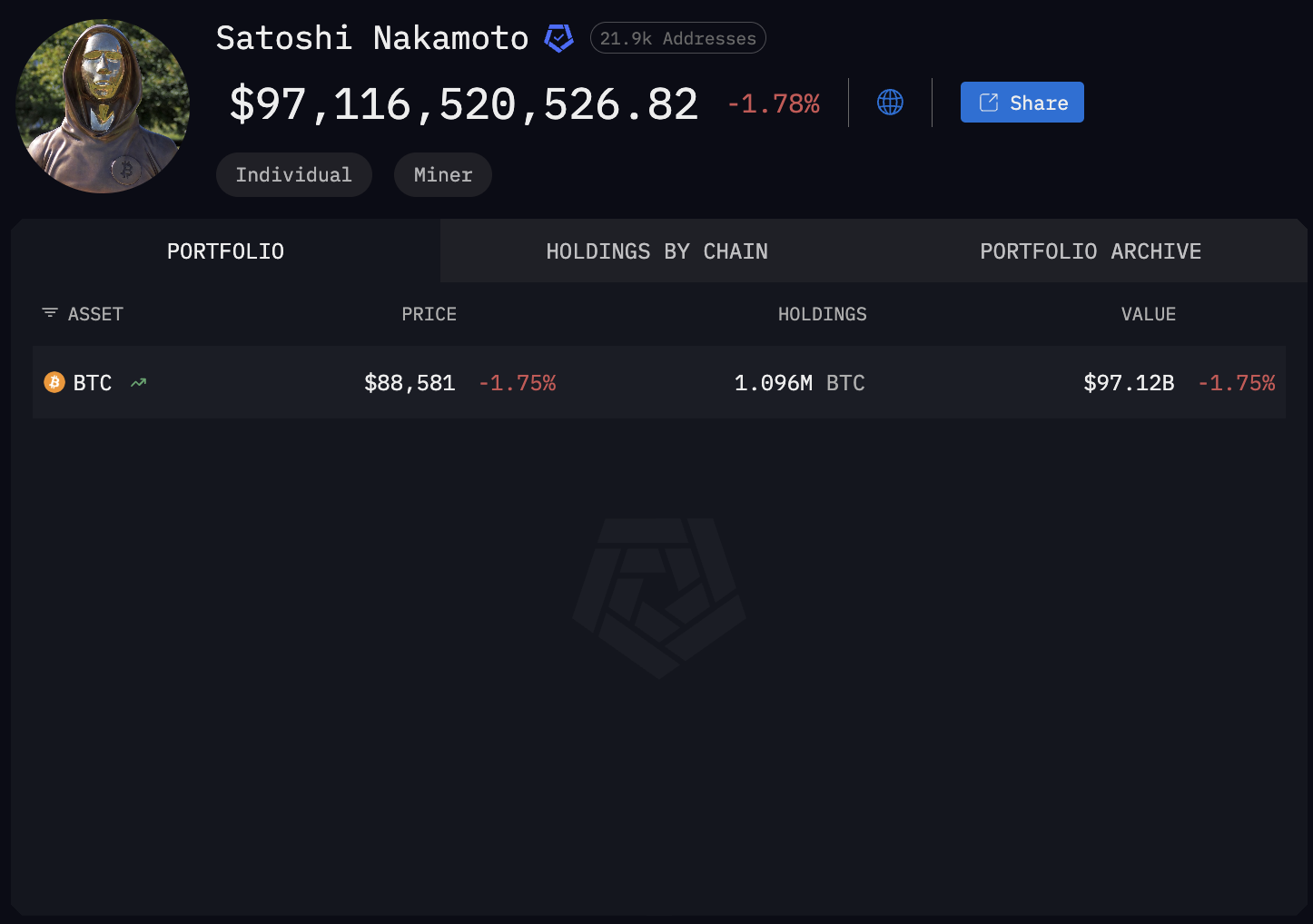
Satoshi Nakamoto’s Bitcoin holdings. Source: Arkham Intelligence

The Bitcoin and crypto communities continue to debate the potential effects of quantum computing on Bitcoin and the encryption technology that underpins cryptocurrencies, with some arguing that quantum computing will be the death of the industry.

Related: VanEck boss questions Bitcoin’s privacy, encryption against quantum tech

Bitcoin OG Adam Back says the threat of quantum computers is decades away

Adam Back, an early Bitcoin holder, cypherpunk and co-founder of Bitcoin technology company Blockstream, said that BTC will not face a quantum threat in the next 20-40 years.

Back argued that there is plenty of time to adopt post-quantum cryptography standards, which already exist, before a quantum computer powerful enough to crack modern encryption and cybersecurity standards is built.

Market analyst James Check said that quantum computing does not threaten Bitcoin’s technology because users will migrate to quantum-resistant addresses by the time a viable quantum computer emerges.

The quantum threat poses more of a threat to Bitcoin’s market price because there is “no chance” that the Bitcoin community will agree to freeze Satoshi’s coins before a quantum computer hacks his wallets and puts the coins back into circulation, Check said.

Magazine: Quantum attacking Bitcoin would be a waste of time: Kevin O’Leary

Criptos en tendencia

Lecturas Relacionadas

In Jinjiang, Fujian, a Storage Super Unicorn Lies Quiet

In Fujian's Jinjiang, a city known for sportswear, lies a quiet semiconductor giant: Fujian Jinhua Integrated Circuit Co. (JHICC). Once a promising domestic DRAM manufacturer alongside Yangtze Memory and ChangXin Memory Technologies (CXMT), its journey was derailed in 2018 when the U.S. placed it on an Entity List and filed criminal charges for alleged trade secret theft. This halted production for years. A turning point came in February 2024 when a U.S. federal court found JHICC not guilty. However, it had lost crucial time. While CXMT soared to become a top-valued A-share company in 2024, JHICC, with an estimated valuation of 80 billion RMB, was just restarting. Its current output is primarily customized DDR4 chips, not the advanced DDR5/HBM demanded for AI, but it still benefits from the broader memory chip upcycle. JHICC's story is tied to Chen Zhengkun, a veteran engineer who left Micron to lead the venture. Founded in 2016 with state-backed funding, JHICC partnered with Taiwan's UMC to develop DRAM technology. Rapid progress was cut short by the U.S. actions, which Micron initiated, partly due to its heavy reliance on the Chinese market. Post-sanctions, Chen's team worked to rebuild the production line with reduced reliance on U.S. technology. According to its records, JHICC achieved small-scale production and revenue growth under immense pressure. It now focuses on the stable "niche" DRAM market (e.g., TVs, routers) with a monthly capacity of ~40,000 wafers, aiming for 60,000 by 2026. It holds over 1,000 patents but remains on the Entity List. For Jinjiang, investing in JHICC was a bold industrial leap. The local government provided unwavering financial and logistical support during the crisis, helping the company survive. JHICC has become the anchor for a growing local semiconductor cluster. Though its scale lags behind domestic peers, JHICC's persistence symbolizes a hard-won foothold in a global market long dominated by Samsung, SK Hynix, and Micron. Having missed one boom, it seeks a place in the new AI-driven memory supercycle.

marsbitHace 48 min(s)

In Jinjiang, Fujian, a Storage Super Unicorn Lies Quiet

marsbitHace 48 min(s)

Trading

Spot

Artículos destacados

Cómo comprar WOO

¡Bienvenido a HTX.com! Hemos hecho que comprar WOO (WOO) sea simple y conveniente. Sigue nuestra guía paso a paso para iniciar tu viaje de criptos.Paso 1: crea tu cuenta HTXUtiliza tu correo electrónico o número de teléfono para registrarte y obtener una cuenta gratuita en HTX. Experimenta un proceso de registro sin complicaciones y desbloquea todas las funciones.Obtener mi cuentaPaso 2: ve a Comprar cripto y elige tu método de pagoTarjeta de crédito/débito: usa tu Visa o Mastercard para comprar WOO (WOO) al instante.Saldo: utiliza fondos del saldo de tu cuenta HTX para tradear sin problemas.Terceros: hemos agregado métodos de pago populares como Google Pay y Apple Pay para mejorar la comodidad.P2P: tradear directamente con otros usuarios en HTX.Over-the-Counter (OTC): ofrecemos servicios personalizados y tipos de cambio competitivos para los traders.Paso 3: guarda tu WOO (WOO)Después de comprar tu WOO (WOO), guárdalo en tu cuenta HTX. Alternativamente, puedes enviarlo a otro lugar mediante transferencia blockchain o utilizarlo para tradear otras criptomonedas.Paso 4: tradear WOO (WOO)Tradear fácilmente con WOO (WOO) en HTX's mercado spot. Simplemente accede a tu cuenta, selecciona tu par de trading, ejecuta tus trades y monitorea en tiempo real. Ofrecemos una experiencia fácil de usar tanto para principiantes como para traders experimentados.

102 Vistas totalesPublicado en 2024.12.12Actualizado en 2026.06.02

Cómo comprar WOO

Discusiones

Bienvenido a la comunidad de HTX. Aquí puedes mantenerte informado sobre los últimos desarrollos de la plataforma y acceder a análisis profesionales del mercado. A continuación se presentan las opiniones de los usuarios sobre el precio de WOO (WOO).

活动图片













