Why Truly Mature Traders Are Starting to Monitor Bitcoin Volatility

marsbitPublicado a 2026-03-20Actualizado a 2026-03-20

Resumen

The article explains why sophisticated traders are increasingly focusing on Bitcoin volatility rather than just price direction. It argues that while price indicates where the market is, volatility reveals the density of risk and the path ahead. Many traders lose not because they misjudge direction, but because they misjudge volatility—entering or exiting at inopportune times due to unexpected swings. The text distinguishes between historical volatility (past price movements), implied volatility (market expectations derived from options pricing), and volatility indices like BVIX, EVIX, and Cboe’s BITVX, which make future volatility expectations visible and tradable. These instruments signal a maturation in crypto markets, shifting from purely trading price to also trading risk, uncertainty, and market expectations. A key insight is that low volatility does not mean low risk; it often masks growing fragility, as complacency leads to increased leverage and crowded strategies. When volatility is compressed, the risk of a sudden, extreme move (a "fat tail" event) rises. Conversely, high implied volatility may indicate overpriced fear, creating opportunities to sell volatility for seasoned traders. The article concludes that understanding volatility is essential for advanced trading—it helps with risk management, identifies mispriced expectations, and reveals market sentiment before price moves. As crypto develops better volatility infrastructure, traders who monitor indicators...

Author: Michel Athayde

Many traders have experienced the same kind of frustration: they correctly predicted the direction, but still ended up not making money.

You predicted Bitcoin would rise, and it did, but you chased the breakout and were quickly stopped out by a sharp pullback. You predicted the market reversal was coming, and it did, but before the big move truly unleashed, those whipsawing minor fluctuations had already exhausted your position, patience, and stop-loss space. Superficially, you lost to the rhythm; on a deeper level, you lost to a misjudgment of volatility.

This is precisely why many people, having long focused only on price, still struggle with trading. Price answers "where is the market now," while volatility answers "how restless might the market be next." The former describes the outcome, the latter describes the path; the former tells you the direction, the latter tells you the density of risk.

Therefore, truly mature market participants are no longer just looking at whether BTC will rise or fall, but at how the market is pricing "future volatility."

This is particularly noteworthy recently. More and more platforms and institutions are turning "crypto volatility" from a professional variable隐含 in options into more explicit indices and trading objects. Gate has already listed BVIX and EVIX perpetual contracts, and BitMart has also listed the corresponding BVIXUSDT and EVIXUSDT; meanwhile, Cboe announced in March 2026 the launch of BITVX based on IBIT options. According to its announcement, this index uses a VIX-like methodology to measure Bitcoin's 30-day forward-looking volatility.

This indicates that the crypto market is moving from "only trading price" to "simultaneously trading price, expectations, and risk."

What exactly is volatility?

To explain it in as straightforward a sentence as possible, volatility is the measure of the magnitude of price changes. It doesn't answer the direction, only "how much will it move."

This means that even if a market does not show obvious gains or losses, as long as the intraday and interday swings are large enough, volatility can be high. Conversely, even if a market is rising, as long as the process is smooth enough, volatility may not necessarily be high.

To understand Bitcoin volatility, it is most important to distinguish three levels.

The first level is historical volatility. It is calculated based on past price data, measuring how much BTC has actually fluctuated over a certain period. It's like a rearview mirror, telling you how bumpy the market has been in the past, but it cannot directly represent the future. Historical volatility is suitable for review, horizontal comparison, and risk control baselines, but not for direct prediction of the future.

The second level is implied volatility. It is not directly calculated from past prices, but is derived from option prices, reflecting the market's expectation of future volatility. Mainstream definitions generally emphasize that implied volatility reflects the market's expectation of the magnitude of future fluctuations, not the realized volatility itself. In other words, options are expensive not only because the market is bullish or bearish, but also because the market is putting a price on future uncertainty.

The third level is the volatility index. You can think of it as compressing the market's expectation of volatility over a future period into a more intuitive, observable, and comparable number. In traditional finance, the VIX is the most typical representative. Now, Bitcoin is also acquiring a similar "fear thermometer." Cboe's description of BITVX is that it is based on IBIT options, using its VIX methodology, to measure Bitcoin's 30-day forward-looking volatility.

From this perspective, the truly important thing about indicators like BVIX and EVIX is not whether the name is new, but that they have turned a core variable that originally only existed in complex derivative pricing into something more traders can directly understand and observe.

Why does price not moving not mean risk is low?

Many people are accustomed to interpreting "sideways movement" as "safe" and "low volatility" as "nothing's happening." But in the real market, the opposite is often true.

Calm prices only indicate that volatility has not been released for the time being; it does not mean that the risk has disappeared, nor does it mean the system is more stable. Often, long-suppressed low volatility is accompanied by a rise in something more hidden: fragility.

Because once the market gets used to calm, participant behavior changes accordingly. Leverage will slowly increase, stop-losses will gradually loosen, risk budgets will become more aggressive, and strategies like selling volatility, earning premium, and collecting time value will become increasingly crowded. On the surface, volatility disappears; but more accurately, risk is squeezed into a position that is harder to see.

This is also why the truly dangerous moments are often not when violent fluctuations are already happening, but when volatility has been compressed for a long time and everyone starts to believe that "nothing should go wrong."

Once an unexpected shock occurs at this time, the market faces not ordinary volatility, but the sudden realization of tail risk. Originally seemingly linear price changes can quickly turn into non-linear stampedes, chain liquidations, and liquidity evaporation. What many people earn during low volatility periods is just some small, very stable "calm returns"; but a fat tail extreme event is enough to swallow these returns principal and interest included.

So, low volatility does not naturally equal low risk. Often, it just transfers risk from "visible volatility" to "invisible fragility."

This is also why volatility is worth studying separately. It not only tells you whether the market has been moving a lot lately, but also reminds you: is the market's pricing of future uncertainty beginning to deviate from this surface calm?

For traders, there is a very important sentence here: When volatility is extremely compressed, do not take on extremely asymmetric risks for small profits. What you see in front of you may just be quiet; but what is accumulating deep in the market may be a violent release that has not yet been realized.

Why does volatility often reflect sentiment earlier than price?

Price is explicit; volatility is often leading.

A period where the chart may seem unchanged, the candlesticks even look boring, but as long as the market starts paying a higher premium for future uncertainty, volatility will move first. That is, the行情 hasn't truly developed yet, but capital is already paying for "the big move that might happen."

This is where volatility is more valuable than price. Price reflects the result of already concluded transactions, while volatility is closer to the提前 pricing of collective market psychology. It reflects not simply the bullish or bearish direction, but the degree of divergence, the density of anxiety, the intensity of expectations.

The reverse is also true. A decline in volatility does not automatically equal bullishness, nor does it automatically equal bearishness. A more common implication is that the market's divergence over the future path is narrowing, or short-term risks are considered less urgent. But another situation is equally important:持续 compression of volatility is sometimes not the disappearance of risk, but risk that has not yet materialized. Truly experienced traders will not just ask "will it rise," but will first ask: next, will volatility expand or continue to contract?

This is the core认知 of the entire article: Volatility is not an accessory to price, but the price of market expectations itself.

From BVIX, EVIX to BITVX: Volatility is becoming new infrastructure for the crypto market

If we broaden the perspective a bit, what products like BVIX, EVIX, and BITVX truly illustrate is not that another platform has listed two new products, but a clearer industry trend: the crypto market is gradually补全 the infrastructure layer of "volatility pricing."

Gate's announcement shows that BVIX and EVIX perpetual contracts were listed on January 28, 2026, supporting 1 to 50x leverage; BitMart also issued an announcement listing BVIXUSDT and EVIXUSDT perpetual contracts on the same day. Cboe announced in March 2026 that it plans to launch BITVX on March 23, introducing its VIX-style volatility methodology to the Bitcoin market.
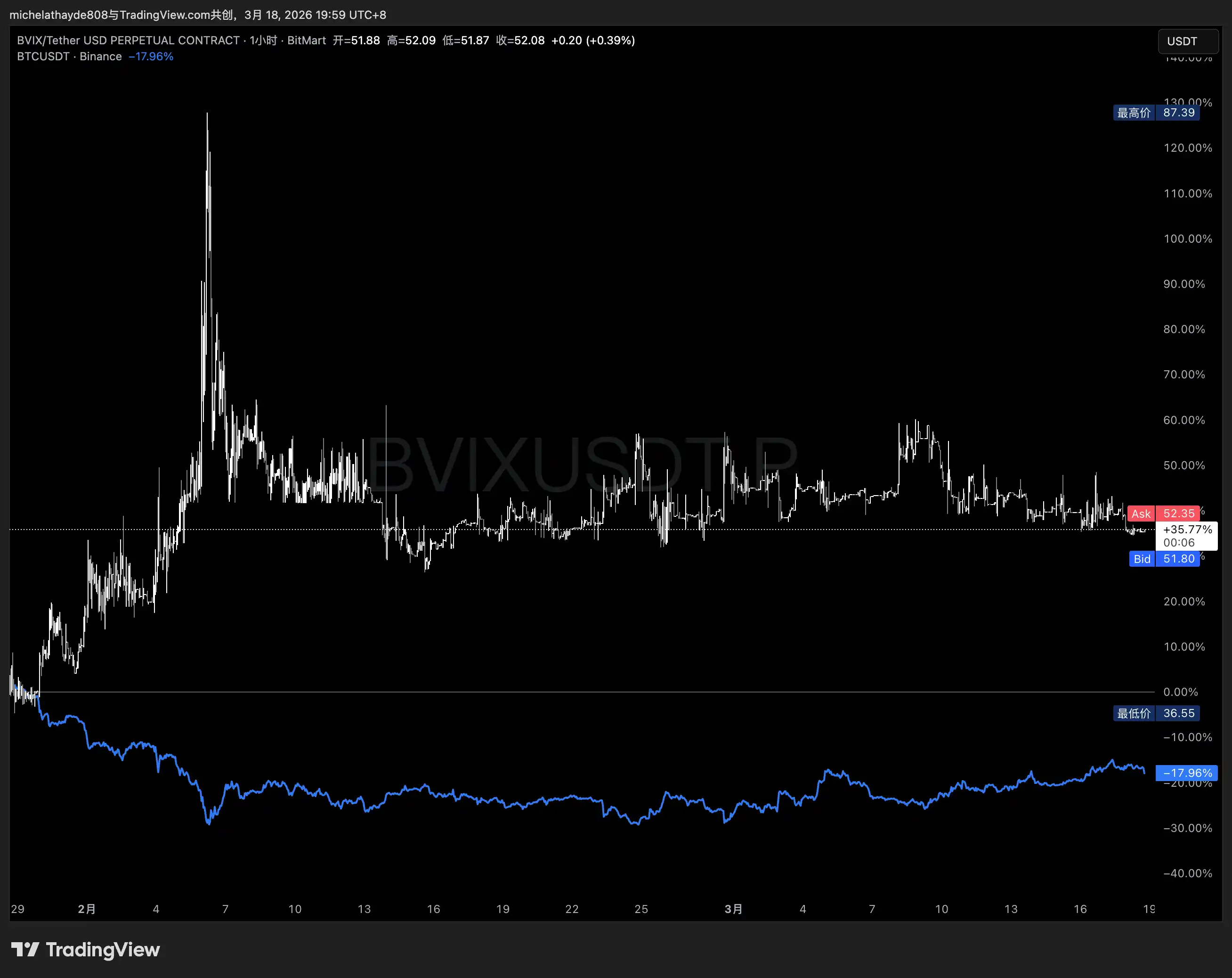
Figure: BVIX vs. BTC trend, gray-white candlesticks are BVIX, blue line is BTC

Looking at these events together, the meaning is clear: The expression of volatility around crypto assets is gradually changing from scattered, professional information hidden in the option surface to a more standardized, explicit index system.

The more mature a market is, the less it will only trade direction. It will also trade risk, trade divergence, trade the uncertainty of future paths. Whoever can more accurately understand what risk the market is actually putting a price on is closer to the true core of this market.

Therefore, the most noteworthy aspect of products like BVIX and EVIX is not whether they are new hot topics, but that they represent a change in the crypto market structure: this market is beginning to more seriously quote prices for "future uncertainty."

How to use volatility in实战?

Many people's first reaction when mentioning volatility is risk control. Actually, this is only half right. Volatility can certainly help you defend, but more importantly, it can also help you understand when the market is selling panic at a high price and when it is selling calm at a low price.

1. Defensive perspective: Don't chase in when sentiment is most expensive

When the price has just broken out, market sentiment quickly ignites, and BVIX or EVIX surges simultaneously, many people will instinctively feel "this is the real breakout." But from a volatility perspective, this often means the market is paying a high premium for future uncertainty.

This is not necessarily a time when you cannot go long, but you need to understand: what you are buying may not only be the direction, but also an already expensive emotional price.

When volatility is high, the margin for error in chasing rallies and selling dips usually decreases significantly. You might be right on direction, but because you entered at the point where sentiment was most euphoric and expectations were most expensive, you still end up not getting ideal returns. Being right on direction does not equal a correct trade; often, what eats away profits is not being wrong on direction, but buying too expensively.

2. Risk identification perspective: Surface calm does not necessarily mean真正的安全

Another more hidden and dangerous scenario is when prices narrow, the market is dull, and many people start to think "there's no risk now." But if you observe that the volatility structure begins to move abnormally, or the market's pricing for future events quietly rises, it indicates that the calm may only be a surface phenomenon.

The most important thing to do at this stage is not to immediately bet on a direction, but to first acknowledge one thing: the market内部 may be accumulating fragility that you cannot see with the naked eye.

For high-leverage traders, this stage is particularly dangerous. Because what truly destroys accounts is often not the big volatility you can see, but the fact that you increased your risk exposure when things "looked fine."

3. Offensive perspective: When panic is being sold at a high price, selling volatility may be more attractive

The真正 interesting thing about volatility is that it can not only signal danger but also provide offensive windows at the strategy level.

When BVIX, EVIX soar, or more broadly, when implied volatility is significantly higher than historical realized volatility, it indicates that the market is paying a very high premium for future uncertainty. For directional traders, this is often one of the most uncomfortable zones because what you are buying is not just the direction, but expensive panic itself.

But for more mature traders, this may instead imply another type of opportunity: selling overestimated volatility.

In the traditional derivatives framework, this type of thinking is typically manifested as selling high implied volatility options, collecting higher premiums, or executing systematic rolling short option strategies to earn sentiment premiums and time decay. Its core logic is not "I must be bearish," but "I think the market's pricing of future volatility is too high."

Of course, this is not a direction suitable for novices to imitate rashly. Selling volatility is essentially a business of making small money while carrying large risks, most afraid of tail events suddenly landing. It has very high requirements for margin management, position constraints, liquidity judgment, and tail hedging. Precisely for this reason, the真正 important thing is not to have everyone become a seller, but to understand a higher-dimensional trading logic: when others are trading direction, mature traders may be trading "whether expectations are overestimated."

4. Relative value perspective: Observing the volatility difference between BTC and ETH

In addition to looking at single volatility levels, the volatility difference between BTC and ETH is also worth observing.

If EVIX remains significantly higher than BVIX, it usually means the market believes ETH faces higher uncertainty, or is willing to pay a higher risk premium for ETH's future path. This does not necessarily give a simple bullish or bearish conclusion directly, but it can help you understand which asset capital is betting risk on, and also assist in judging whether the market currently prefers core hedging or high-elasticity speculation.

Often, the truly valuable information is not in one absolute number, but in the relative changes between different assets and different time periods. The volatility spread is, to some extent, the temperature difference of risk appetite.

The real upgrade is not knowing how to predict rise/fall, but knowing how to read "expectations"

Many traders, upon growing to a certain stage, slowly discover a fact: the hardest thing about the market is never guessing a single rise or fall, but understanding what the market is pricing.

Sometimes, the market prices direction; sometimes, the market prices liquidity; but at many critical moments, what the market is truly trading expensively is uncertainty itself.

This is also why volatility should not be understood as an accessory indicator to price. It is not a footnote next to the行情, nor is it an advanced term only option players need to care about. It is itself a kind of price, a price for future paths, risk distribution, and expectation divergence.

Price reflects the present; volatility prices the future.

And what is most expensive about the future is often not the trend itself, but people's fear of the unknown, or their mistaken belief in calm.

When more and more traders start paying attention to volatility indicators like BVIX, EVIX, and BITVX, what they are truly concerned about is no longer just whether Bitcoin will rise or fall, but:

Could this market be more violent than imagined?

Is this expectation already priced too high, or too low?

Am I trading direction, or overestimated emotion itself?

The crypto market is moving from "only trading price" to "trading expectations, trading risk, trading volatility." Whoever accepts this earlier will have a better chance of breaking free from the trading method of simply guessing direction and entering the next stage of truly understanding market structure.


Preguntas relacionadas

QWhat is the core reason why mature traders are paying attention to Bitcoin volatility?

AMature traders focus on Bitcoin volatility because it provides insight into the market's pricing of future uncertainty and risk density, rather than just the direction of price movement. It helps them understand the path and potential turbulence of the market, not just the destination.

QWhat are the three key layers of understanding Bitcoin volatility mentioned in the article?

AThe three layers are: 1) Historical Volatility, which measures past price movements; 2) Implied Volatility, which is derived from option prices and reflects the market's expectation of future volatility; and 3) Volatility Indices (like BVIX, EVIX, BITVX), which compress these expectations into a single, observable number.

QWhy can a period of low price volatility (calm market) actually be dangerous?

AA calm market with low volatility can be dangerous because it often masks rising fragility. It leads to increased leverage, relaxed stop-losses, and crowded 'sell volatility' strategies. This creates a situation where a single unexpected shock can trigger a non-linear cascade of liquidations and a rapid evaporation of liquidity, wiping out gains made during the calm period.

QHow can volatility be used from an offensive trading perspective?

AFrom an offensive perspective, when volatility indices like BVIX or EVIX are high, it indicates the market is paying a high premium for uncertainty (panic). This can present an opportunity for sophisticated traders to 'sell volatility' by writing options to collect the inflated premium, betting that the actual future volatility will be lower than what is currently priced in.

QWhat major shift does the emergence of products like BVIX, EVIX, and BITVX signal for the crypto market?

AThe emergence of these volatility indices signals that the crypto market is maturing beyond just 'trading price.' It is building the infrastructure to 'trade expectation, trade risk, and trade volatility' itself. The market is beginning to more formally and transparently price future uncertainty, moving towards the sophistication seen in traditional finance.

Lecturas Relacionadas

Trading

Spot
Futuros

Artículos destacados

Qué es BITCOIN

Entendiendo HarryPotterObamaSonic10Inu (ERC-20) y Su Posición en el Espacio Cripto En los últimos años, el mercado de criptomonedas ha sido testigo de un aumento en la popularidad de las monedas meme, capturando el interés no solo de los comerciantes, sino también de aquellos que buscan compromiso comunitario y valor de entretenimiento. Entre estos tokens únicos se encuentra HarryPotterObamaSonic10Inu (ERC-20), un proyecto intrigante que mezcla referencias culturales en el tejido de las criptomonedas. Este artículo profundiza en los aspectos clave de HarryPotterObamaSonic10Inu, explorando sus mecanismos, ethos impulsado por la comunidad y su relación con el paisaje cripto más amplio. ¿Qué es HarryPotterObamaSonic10Inu (ERC-20)? Como su nombre sugiere, HarryPotterObamaSonic10Inu es una moneda meme construida sobre la blockchain de Ethereum, clasificada bajo el estándar ERC-20. A diferencia de las criptomonedas tradicionales que pueden enfatizar la utilidad práctica o el potencial de inversión, este token prospera en el valor de entretenimiento y la fuerza de su comunidad. El proyecto tiene como objetivo fomentar un entorno donde los usuarios comprometidos puedan reunirse, compartir ideas y participar en actividades inspiradas por diversos fenómenos culturales. Una característica notable de HarryPotterObamaSonic10Inu es su cero impuestos en las transacciones. Este atractivo elemento tiene como objetivo incentivar el comercio y la participación comunitaria, sin cargos adicionales que puedan disuadir a los comerciantes de pequeña escala. El suministro total de la moneda está establecido en mil millones de tokens, una cifra que marca su intención de mantener una circulación sustancial dentro de la comunidad. Creador de HarryPotterObamaSonic10Inu (ERC-20) Los orígenes de HarryPotterObamaSonic10Inu están algo envueltos en misterio; los detalles sobre el creador siguen siendo desconocidos. El desarrollo de este token carece de un equipo identificable o de un plan explícito, lo cual no es inusual dentro del sector de monedas meme. En cambio, el proyecto ha surgido de manera orgánica, con su progreso muy dependiente del entusiasmo y la participación de su comunidad. Inversores de HarryPotterObamaSonic10Inu (ERC-20) En cuanto a inversiones externas y respaldo, HarryPotterObamaSonic10Inu también sigue siendo ambiguo. El token no lista ninguna fundación de inversión conocida o apoyo organizacional significativo. En cambio, la savia del proyecto es su comunidad de base, que informa su crecimiento y sostenibilidad a través de la acción colectiva y el compromiso en el espacio cripto. ¿Cómo Funciona HarryPotterObamaSonic10Inu (ERC-20)? Como una moneda meme, HarryPotterObamaSonic10Inu opera principalmente fuera de los marcos tradicionales que a menudo rigen el valor de los activos. Hay varios aspectos distintivos que definen cómo funciona el proyecto: Transacciones Sin Impuestos: Sin tarifas impositivas en las transacciones, los usuarios pueden comprar y vender el token libremente sin preocuparse por costos ocultos. Compromiso Comunitario: El proyecto prospera en la interacción comunitaria, aprovechando plataformas de redes sociales para crear entusiasmo y facilitar la participación. Las discusiones, el intercambio de contenido y el compromiso son elementos cruciales que ayudan a expandir su alcance y fomentar la lealtad entre los seguidores. Sin Utilidad Práctica: Cabe señalar que HarryPotterObamaSonic10Inu no ofrece utilidad concreta dentro del ecosistema financiero. Más bien, se clasifica como un token principalmente para actividades de entretenimiento y comunitarias. Referencia Cultural: El token incorpora astutamente elementos de la cultura popular para atraer interés, conectando con entusiastas de los memes y seguidores de las criptomonedas por igual. HarryPotterObamaSonic10Inu ejemplifica cómo las monedas meme operan de manera diferente a los proyectos de criptomonedas más tradicionales, ingresando al mercado como construcciones sociales innovadoras en lugar de activos utilitarios. Cronología de HarryPotterObamaSonic10Inu (ERC-20) La historia de HarryPotterObamaSonic10Inu está marcada por varios hitos notables: Creación: El token surgió de un meme viral, capturando la imaginación de muchos entusiastas de las criptomonedas. Las fechas específicas de creación no están disponibles, subrayando su ascenso orgánico. Listado en Exchanges: HarryPotterObamaSonic10Inu ha llegado a varios exchanges, permitiendo un acceso y comercio más fácil por parte de la comunidad. Iniciativas de Compromiso Comunitario: Actividades continuas destinadas a mejorar la interacción comunitaria, incluyendo concursos, campañas en redes sociales y generación de contenido por parte de fanáticos y defensores. Planes de Expansión Futuros: La hoja de ruta del proyecto incluye el lanzamiento de una colección de NFT, mercancía y un sitio de comercio electrónico relacionado con sus temas culturales, involucrando aún más a la comunidad e intentando añadir más dimensiones a su ecosistema. Puntos Clave Sobre HarryPotterObamaSonic10Inu (ERC-20) Naturaleza Impulsada por la Comunidad: El proyecto prioriza la participación colectiva y la creatividad, asegurando que la involucración de los usuarios esté a la vanguardia de su desarrollo. Clasificación como Moneda Meme: Representa la epítome de las criptomonedas basadas en el entretenimiento, diferenciándose de los vehículos de inversión tradicionales. Sin Afiliación Directa con Bitcoin: A pesar de la similitud en el nombre del ticker, HarryPotterObamaSonic10Inu es distinto y no tiene relación con Bitcoin u otras criptomonedas establecidas. Enfoque en la Colaboración: HarryPotterObamaSonic10Inu está diseñado para crear un espacio para la colaboración y el intercambio de historias entre sus poseedores, proporcionando una vía para la creatividad y el vínculo comunitario. Perspectivas Futuras: La ambición de expandirse más allá de su premisa inicial hacia NFTs y mercancías describe un camino para que el proyecto potencialmente ingrese a avenidas más tradicionales dentro de la cultura digital. A medida que las monedas meme continúan capturando la imaginación de la comunidad de criptomonedas, HarryPotterObamaSonic10Inu (ERC-20) se destaca debido a sus lazos culturales y su enfoque centrado en la comunidad. Si bien puede no encajar en el molde típico de un token impulsado por la utilidad, su esencia radica en la alegría y la camaradería fomentadas entre sus seguidores, destacando la naturaleza en evolución de las criptomonedas en una era cada vez más digital. A medida que el proyecto continúa desarrollándose, será importante observar cómo las dinámicas comunitarias influyen en su trayectoria en el cambiante paisaje de la tecnología blockchain.

1.3k Vistas totalesPublicado en 2024.04.01Actualizado en 2024.12.03

Qué es BITCOIN

Cómo comprar BTC

¡Bienvenido a HTX.com! Hemos hecho que comprar Bitcoin (BTC) sea simple y conveniente. Sigue nuestra guía paso a paso para iniciar tu viaje de criptos.Paso 1: crea tu cuenta HTXUtiliza tu correo electrónico o número de teléfono para registrarte y obtener una cuenta gratuita en HTX. Experimenta un proceso de registro sin complicaciones y desbloquea todas las funciones.Obtener mi cuentaPaso 2: ve a Comprar cripto y elige tu método de pagoTarjeta de crédito/débito: usa tu Visa o Mastercard para comprar Bitcoin (BTC) al instante.Saldo: utiliza fondos del saldo de tu cuenta HTX para tradear sin problemas.Terceros: hemos agregado métodos de pago populares como Google Pay y Apple Pay para mejorar la comodidad.P2P: tradear directamente con otros usuarios en HTX.Over-the-Counter (OTC): ofrecemos servicios personalizados y tipos de cambio competitivos para los traders.Paso 3: guarda tu Bitcoin (BTC)Después de comprar tu Bitcoin (BTC), guárdalo en tu cuenta HTX. Alternativamente, puedes enviarlo a otro lugar mediante transferencia blockchain o utilizarlo para tradear otras criptomonedas.Paso 4: tradear Bitcoin (BTC)Tradear fácilmente con Bitcoin (BTC) en HTX's mercado spot. Simplemente accede a tu cuenta, selecciona tu par de trading, ejecuta tus trades y monitorea en tiempo real. Ofrecemos una experiencia fácil de usar tanto para principiantes como para traders experimentados.

4.7k Vistas totalesPublicado en 2024.12.12Actualizado en 2025.03.21

Cómo comprar BTC

Qué es $BITCOIN

ORO DIGITAL ($BITCOIN): Un Análisis Integral Introducción al ORO DIGITAL ($BITCOIN) ORO DIGITAL ($BITCOIN) es un proyecto basado en blockchain que opera en la red Solana, cuyo objetivo es combinar las características de los metales preciosos tradicionales con la innovación de las tecnologías descentralizadas. Aunque comparte un nombre con Bitcoin, a menudo referido como “oro digital” debido a su percepción como un refugio de valor, ORO DIGITAL es un token separado diseñado para crear un ecosistema único dentro del paisaje Web3. Su meta es posicionarse como un activo digital alternativo viable, aunque los detalles sobre sus aplicaciones y funcionalidades aún están en desarrollo. ¿Qué es ORO DIGITAL ($BITCOIN)? ORO DIGITAL ($BITCOIN) es un token de criptomoneda diseñado explícitamente para su uso en la blockchain de Solana. A diferencia de Bitcoin, que proporciona un papel de almacenamiento de valor ampliamente reconocido, este token parece centrarse en aplicaciones y características más amplias. Aspectos notables incluyen: Infraestructura Blockchain: El token está construido sobre la blockchain de Solana, conocida por su capacidad para manejar transacciones de alta velocidad y bajo costo. Dinámicas de Suministro: ORO DIGITAL tiene un suministro máximo limitado a 100 cuatrillones de tokens (100P $BITCOIN), aunque los detalles sobre su suministro circulante no se han divulgado actualmente. Utilidad: Si bien las funcionalidades precisas no están delineadas explícitamente, hay indicios de que el token podría ser utilizado para diversas aplicaciones, potencialmente involucrando aplicaciones descentralizadas (dApps) o estrategias de tokenización de activos. ¿Quién es el Creador de ORO DIGITAL ($BITCOIN)? En la actualidad, la identidad de los creadores y el equipo de desarrollo detrás de ORO DIGITAL ($BITCOIN) sigue siendo desconocida. Esta situación es típica entre muchos proyectos innovadores dentro del espacio blockchain, particularmente aquellos alineados con las finanzas descentralizadas y fenómenos de monedas meme. Si bien tal anonimato puede fomentar una cultura impulsada por la comunidad, intensifica las preocupaciones sobre la gobernanza y la responsabilidad. ¿Quiénes son los Inversores de ORO DIGITAL ($BITCOIN)? La información disponible indica que ORO DIGITAL ($BITCOIN) no tiene patrocinadores institucionales conocidos ni inversiones destacadas de capital de riesgo. El proyecto parece operar en un modelo de peer-to-peer centrado en el apoyo y la adopción de la comunidad en lugar de rutas de financiamiento tradicionales. Su actividad y liquidez se sitúan principalmente en intercambios descentralizados (DEX), como PumpSwap, en lugar de plataformas de trading centralizadas establecidas, lo que resalta aún más su enfoque de base. Cómo Funciona ORO DIGITAL ($BITCOIN) Los mecanismos operativos de ORO DIGITAL ($BITCOIN) pueden elaborarse en función de su diseño blockchain y atributos de red: Mecanismo de Consenso: Al aprovechar el único proof-of-history (PoH) de Solana combinado con un modelo de proof-of-stake (PoS), el proyecto asegura una validación de transacciones eficiente que contribuye al alto rendimiento de la red. Tokenómica: Si bien los mecanismos deflacionarios específicos no se han detallado extensamente, el vasto suministro máximo de tokens implica que podría atender microtransacciones o casos de uso nicho que aún están por definirse. Interoperabilidad: Existe el potencial de integración con el ecosistema más amplio de Solana, incluyendo varias plataformas de finanzas descentralizadas (DeFi). Sin embargo, los detalles sobre integraciones específicas permanecen no especificados. Cronología de Eventos Clave Aquí hay una cronología que destaca hitos significativos relacionados con ORO DIGITAL ($BITCOIN): 2023: El despliegue inicial del token ocurre en la blockchain de Solana, marcado por su dirección de contrato. 2024: ORO DIGITAL gana visibilidad al estar disponible para trading en intercambios descentralizados como PumpSwap, permitiendo a los usuarios comerciar contra SOL. 2025: El proyecto presencia actividad de trading esporádica y potencial interés en compromisos liderados por la comunidad, aunque no se han documentado asociaciones notables o avances técnicos hasta el momento. Análisis Crítico Fortalezas Escalabilidad: La infraestructura subyacente de Solana soporta altos volúmenes de transacciones, lo que podría mejorar la utilidad de $BITCOIN en varios escenarios de transacción. Accesibilidad: El potencial bajo precio de trading por token podría atraer a inversores minoristas, facilitando una participación más amplia debido a oportunidades de propiedad fraccionada. Riesgos Falta de Transparencia: La ausencia de patrocinadores, desarrolladores o un proceso de auditoría conocidos públicamente puede generar escepticismo sobre la sostenibilidad y confiabilidad del proyecto. Volatilidad del Mercado: La actividad de trading depende en gran medida del comportamiento especulativo, lo que puede resultar en una volatilidad de precios significativa y en incertidumbre para los inversores. Conclusión ORO DIGITAL ($BITCOIN) surge como un proyecto intrigante pero ambiguo dentro del ecosistema de Solana en rápida evolución. Si bien intenta aprovechar la narrativa del “oro digital”, su alejamiento del papel establecido de Bitcoin como refugio de valor subraya la necesidad de una diferenciación más clara de su utilidad y estructura de gobernanza previstas. La aceptación y adopción futura dependerán probablemente de abordar la actual opacidad y de definir sus estrategias operativas y económicas de manera más explícita. Nota: Este informe abarca información sintetizada disponible hasta octubre de 2023, y pueden haber ocurrido desarrollos más allá del período de investigación.

83 Vistas totalesPublicado en 2025.05.13Actualizado en 2025.05.13

Qué es $BITCOIN

Discusiones

Bienvenido a la comunidad de HTX. Aquí puedes mantenerte informado sobre los últimos desarrollos de la plataforma y acceder a análisis profesionales del mercado. A continuación se presentan las opiniones de los usuarios sobre el precio de BTC (BTC).

活动图片













