Why Hyperliquid’s $48B oil-driven volume could signal a crypto reset

ambcryptoPublicado a 2026-03-20Actualizado a 2026-03-20

Resumen

Middle East tensions are causing a significant oil supply shock, driving traders to seek 24/7 exposure through perpetual contracts on Hyperliquid. This has positioned Hyperliquid as the leading perp DEX by volume, with weekly trades nearing $48 billion. The platform's native token, HYPE, has surged 30% monthly, diverging from most altcoins. However, this rally is fueled by leveraged long positions and geopolitical FOMO. Analysts suggest that an unwind of these crowded oil trades on Hyperliquid could signal easing tensions and potentially trigger a broader crypto market reset towards risk-on sentiment.

A supply shock is a strong catalyst, especially for traders chasing short-term upside.

Currently, the West Asian crisis is driving a real supply-side squeeze in the oil market. As a result, investor sentiment is shifting, with oil flows picking up and traders increasingly positioning for further upside. In short, long positions are becoming more aggressive as the narrative gains momentum.

Against this backdrop, Hyperliquid [HYPE] is starting to stand out as a key beneficiary. According to DeFiLlama data, it’s now leading perp DEX volume, with weekly volume nearing $48 billion, roughly 2x larger than the next platform in line.
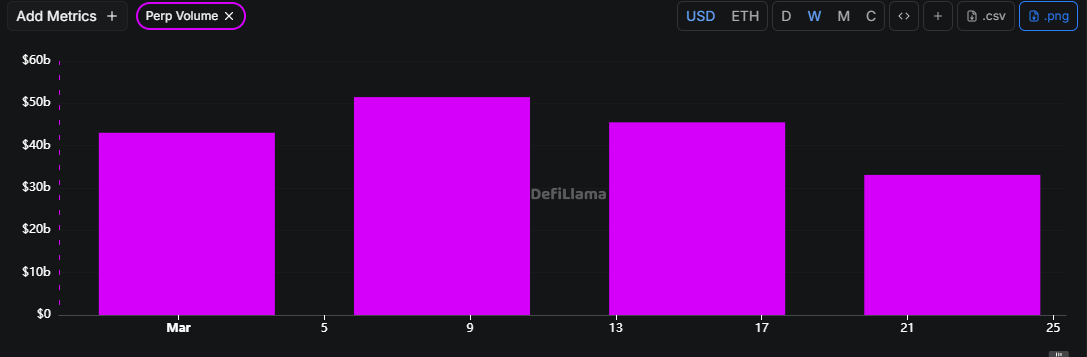
Source: DeFiLlama

Importantly, this shift is also catching the attention of major TradFi players.

JPMorgan analysts, for instance, point to traders chasing 24/7 oil exposure as the main driver behind the spike in Hyperliquid’s perp DEX volume, a gap TradFi markets still don’t cover. As a result, Hyperliquid is gaining an edge in capturing incremental flow and liquidity.

Notably, this on-chain activity is showing up in HYPE’s price action as well. On the monthly chart, HYPE is up roughly 30%, clearly diverging from other high-cap altcoins that are mostly printing single-digit gains. In short, the market is starting to price in this edge.

However, with HYPE now running into resistance around the $2.3k level, a strong case remains that macro FUD and crowded positioning are driving this move rather than a sustained trend. Consequently, if flows cool or positioning gets too crowded, it increases the risk of an unwind.

So the key question is: If we start to see large long squeezes and exits on Hyperliquid, could that flush act as a signal for a market reset and indicate when the broader crypto market flips back to risk-on?

Traders piling into oil on Hyperliquid raise the question of a reset

The conflict in the Middle East has thrown the global oil market into disarray.

According to the Kobeissi Letter, oil prices have jumped sharply since December, and Saudi Arabia’s prediction markets are calling for the war to last through April, with $180 tagged as the “base case” for oil. In short, the market is bracing for continued volatility and supply-driven moves.

In this setup, Lookonchain flagged a trader depositing 4.105 million USDC on Hyperliquid to open a 5x long on $20.19 Brent oil, showing how traders are chasing FOMO and using leverage to capture outsized returns in the oil market. The bigger picture, though? Moves like this underline Hyperliquid’s central role in enabling perp trades and explain why its DEX volume keeps hitting new highs.
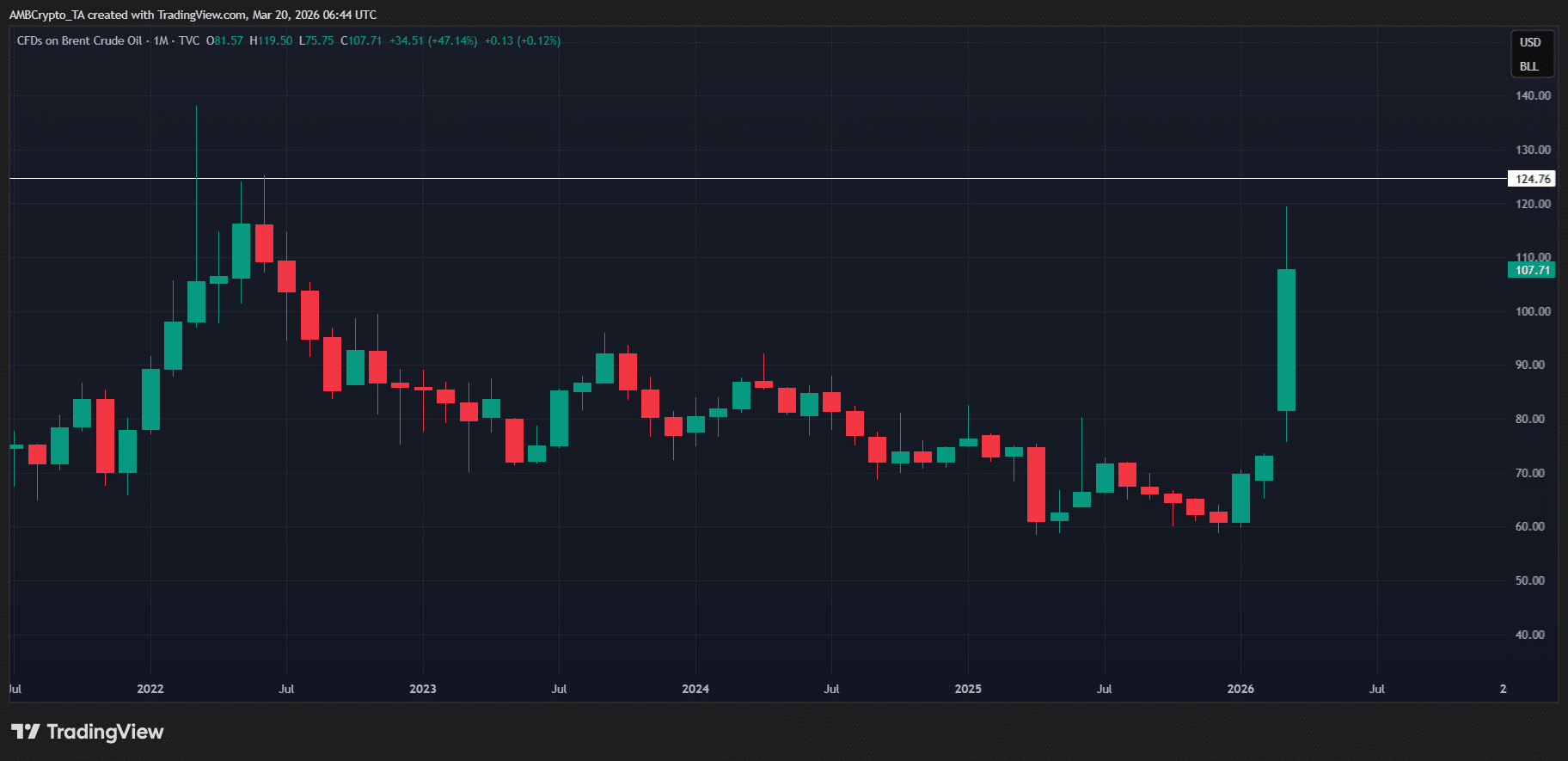
Source: TradingView (BRENT OIL/USD)

From a technical angle, these perp bets on Hyperliquid make total sense.

As the chart above shows, Brent Oil is up a massive 47% so far in March, marking its first 40%+ monthly rally since the COVID-19 crisis. Prices have already bounced back to 2022 levels around $110, with this trade’s liquidation set at $87.87, leaving the trader comfortably sitting on significant unrealized gains.

Meanwhile, the broader crypto market is still stuck around a $2.4 trillion market cap. Capital rotation into risk assets looks capped as traders chase oil momentum, with Hyperliquid standing out as the only altcoin posting double-digit gains.

According to AMBCrypto, this is a key trend to watch. The crypto market’s next risk-on move seems tied to long crowding on Hyperliquid. Once those positions start to unwind, it could signal geopolitical tensions easing and open the door for a broader risk-on rotation.


Final Summary

  • Middle East tensions are driving a supply shock in oil, fueling FOMO-driven longs on Hyperliquid and pushing HYPE up 30%, highlighting its central role in perp trading.
  • Brent oil rallies 47% in March while crypto remains stuck, showing that broader risk-on moves may hinge on potential unwind on Hyperliquid.


Preguntas relacionadas

QWhat is the main driver behind the spike in Hyperliquid's perp DEX volume according to JPMorgan analysts?

AJPMorgan analysts point to traders chasing 24/7 oil exposure as the main driver behind the spike in Hyperliquid's perp DEX volume, a gap that TradFi markets still don't cover.

QHow much has the price of HYPE increased on the monthly chart, and how does this compare to other altcoins?

AOn the monthly chart, HYPE is up roughly 30%, clearly diverging from other high-cap altcoins that are mostly printing single-digit gains.

QWhat is the 'base case' price target for oil according to Saudi Arabia's prediction markets mentioned in the article?

ASaudi Arabia's prediction markets are calling for the war to last through April, with $180 tagged as the 'base case' for oil.

QWhat specific example does Lookonchain provide to show how traders are chasing oil FOMO on Hyperliquid?

ALookonchain flagged a trader depositing 4.105 million USDC on Hyperliquid to open a 5x long on $20.19 Brent oil.

QAccording to the article, what could a potential unwind of long positions on Hyperliquid signal for the broader crypto market?

AA potential unwind of long positions on Hyperliquid could signal that geopolitical tensions are easing and open the door for a broader risk-on rotation in the crypto market.

Lecturas Relacionadas

Raising Interest Rates Is Not a Tech Killer, EPS Is: A Strategy for Discarding the Weak and Retaining the Strong After the AI Theme's Sharp Decline

**Summary: Rising Interest Rates Are Not the Killer of Tech; EPS Is: The "Keep the Strong, Ditch the Weak" Strategy After the AI Theme Plunge** The author argues that the sharp sell-off in tech and AI-related stocks, triggered by a strong US jobs report that heightened Fed rate hike fears, represents a "pullback to pick up passengers" rather than a "car crash." The true end of a tech bull market is not determined by an extra 25 basis point hike, but by industry overcapacity and the disproval of earnings per share (EPS) expectations. Historical analysis shows that during past rate hike cycles, the Nasdaq-100 often outperformed, provided EPS growth remained strong. The current phase is seen as a shift from a "broad narrative-driven rally" to a "focused verification stage" for AI. The investment strategy should be to "keep the strong, ditch the weak." * **Retain exposure** to high-conviction AI infrastructure leaders with clear order visibility, stable margins, strong cash flow, and upward EPS revisions (e.g., AI servers, advanced packaging, optical modules, key cloud suppliers). * **Reduce exposure** to high-beta, narrative-driven stocks with unclear profit paths (e.g., some quantum computing, space, or speculative chip stocks), especially on rebounds. Valuation concerns should focus on whether earnings can catch up to high multiples, not on high P/E alone. Crowded positioning signals a concentration into quality assets, not necessarily a market top. The upcoming Q2 earnings season will be a key validation point. The core principle is to hold stocks with proven EPS, while using macro events (CPI data, central bank meetings) to manage timing and risk.

marsbitHace 37 min(s)

Raising Interest Rates Is Not a Tech Killer, EPS Is: A Strategy for Discarding the Weak and Retaining the Strong After the AI Theme's Sharp Decline

marsbitHace 37 min(s)

The Largest IPO in History Ignites Heated Debate: Is SpaceX Worth $1.77 Trillion?

SpaceX's potential IPO is priced at $135 per share, aiming to raise $75 billion and valuing the company at approximately $1.77 trillion, which would make it the largest IPO in history. This valuation has sparked intense debate among investors. Bullish analysts, including major underwriters Goldman Sachs and Morgan Stanley, argue the valuation is justified by SpaceX's long-term potential. They see it not just as a rocket company but as a future leader in space infrastructure, with key growth drivers being Starlink satellite internet, low-cost rocket launches, and future AI-related ventures. They project revenues reaching hundreds of billions to trillions of dollars by 2030-2040. ARK Invest's model suggests a 2030 enterprise value could reach $2.5 trillion. Bearish analysts from independent research firms like Morningstar, PitchBook, and New Constructs contend the IPO price is excessively high, already pricing in unrealistic future growth. Using DCF and sum-of-the-parts models, they estimate fair value between $780 billion and $1.7 trillion, significantly below the IPO target. They highlight risks such as the speculative nature of AI projections, over-dependence on Elon Musk, high growth expectations, and corporate governance concerns. Trefis set a target price of just $79 per share. While both sides acknowledge SpaceX's unique position in commercial space, the core disagreement centers on whether the $135 share price offers a reasonable margin of safety or is overly optimistic. Despite the valuation controversy, reported strong demand for the IPO indicates significant market interest.

marsbitHace 2 hora(s)

The Largest IPO in History Ignites Heated Debate: Is SpaceX Worth $1.77 Trillion?

marsbitHace 2 hora(s)

After the Passage of the GENIUS Act and the CLARITY Act, What Is the Correct Architecture for On-Chain Yield?

The article discusses the evolution of on-chain credit, distinguishing three markets: overcollateralized crypto lending, unsecured lending (largely unsuccessful), and asset-backed credit (ABC). ABC, backed by identifiable real-world collateral with legal recourse, is identified as the fastest-growing category and the only one credibly addressing adverse selection—the core problem in credit where the riskiest borrowers self-select. Current growth in on-chain Real World Assets (RWAs), particularly tokenized private credit funds (e.g., Maple Finance, Centrifuge), is substantial but often merely "wraps" existing fund structures, inheriting their risks rather than solving adverse selection at the protocol level. The regulatory landscape is a key driver, with the US GENIUS Act (prohibiting stablecoin issuers from paying yield) and the proposed CLARITY Act (closing loopholes on indirect yield) set to redefine permissible yield-bearing products. This makes vaults (like ERC-4626) the critical architecture—they become the primary compliant vehicle for delivering yield, functioning as issuance, disclosure, distribution, and recovery mechanisms. The author's thesis is that the correct post-GENIUS/CLARITY architecture involves building ABC solutions where credit assessment, structure, and recovery are encoded directly into the smart contract vault layer, moving beyond mere tokenized fund wrappers to solve adverse selection fundamentally and ensure regulatory compliance.

Foresight NewsHace 3 hora(s)

After the Passage of the GENIUS Act and the CLARITY Act, What Is the Correct Architecture for On-Chain Yield?

Foresight NewsHace 3 hora(s)

Trading

Spot
Futuros
活动图片




