Original | Odaily Planet Daily (@OdailyChina)
Author | Golem (@web 3_golem)
"The two-day on-chain bull run is over"—this is the prevailing sentiment in the Meme community today.
Following the surge in October last year, Chinese Meme coins once again sparked a frenzy on BSC in January this year, giving rise to many community-favored tokens (related reading:From "Life K-Line" to "Laozi", a rundown of the top 5 hottest BSC "Chinese Memes"). However, according to GMGN data today, popular Chinese Memes have generally seen pullbacks. Within 24 hours, "I'm F*cking Coming" dropped by 30%, "Laozi" fell by 25%, "Life K-Line" declined over 20%, and "Manager Xiao Ni" plunged over 40%.
Every feast eventually ends, and Memes cool down particularly quickly. Last October, the Chinese Meme hype started during the National Day holiday and lasted a full month before fading. But this time, it ended so abruptly. What exactly went wrong?

Rejection of "Shandong-ology" Undermines Community Unity
This round of Chinese Meme hype was cold-started from a tweet by He Yi. On January 1st, He Yi posted on X with the caption "2026, I'm f*cking coming" to celebrate the New Year. A week later, the同名 Meme coin began to gain traction, eventually listing on Binance Alpha and igniting the Chinese Meme community.
However, along with this came widespread discussion in the community about "Crypto Shandong-ology: which way does the fish head face?"—pointing directly to a整套 Meme launch model on BSC revolving around CZ and He Yi. CZ and He Yi don’t need to personally direct or even know about these tokens; from developers to the community to the Binance alpha team, everyone automatically "gets enlightened." The fate of a Meme is decided by a single tweet.
In February 2025, CZ首次 interacted with a worthless on-chain test token TST on BSC, marking the雏形 of this Meme launch model on BSC. After subsequent small-cycle iterations like the dispute over CZ’s dog and the Dubai narrative, the community figured out the "social nuances" necessary for a BSC Meme hype cycle from cold start to peak.
To make money in such an ecosystem, put politely, one must learn from the top and the excellent; put bluntly, one "absolutely cannot stand upright."
"Is it really different this time?" As this Chinese Meme wave peaked again, countless bloggers asked on social media. This wasn’t just mere meme-ing; it genuinely reflected the psychological shadow left by this "Crypto Shandong-ology" since 2025.
When enough shadows accumulate, they form rejection. Some criticized the BSC ecosystem for going to any lengths to "suck up," blindly截取 content from CZ and He Yi’s tweets, even giving birth to tokens like "Mom," "Dad," and "Laozi," making Chinese Memes increasingly tacky.
Previously, Odaily Planet Daily also analyzed the community debate sparked by "I'm F*cking Coming" listing on Binance Alpha, calling it "a serious blow to genuine Chinese Meme culture" (related reading: How to evaluate the listing of "I'm F*cking Coming" on Binance?).
When rejection of "Crypto Shandong-ology" becomes widespread, searching for community Meme coins without the CZ/He Yi angle itself became a community force. Crypto blogger Honest Mai总 (X:@Michael_Liu93)直言, "Everyone is really tired of sucking up." (The blogger holds 1% of "Life K-Line" tokens)
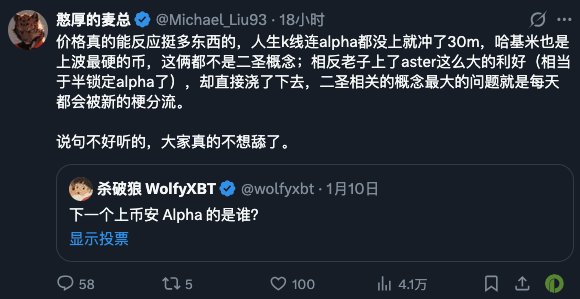
Regardless, such division ultimately harms the unity of the BSC Meme community. Capital cannot form a合力. When a community-consensus leader fails to emerge quickly, Meme sentiment rapidly dissipates.
Lack of External Liquidity
To sustain a small Meme cycle, there must be price increases, and to sustain increases, there must be new buying pressure exceeding selling pressure. A possible reason for the lack of staying power in this Chinese Meme wave is the absence of external liquidity injection. The market cap was primarily driven up by the Chinese community on BSC, without attracting buying from overseas communities or the Solana Meme community.
The Chinese Meme hype last October had an unprecedented reach. Many overseas Meme influencers sought help on X to join Chinese Meme communities; "Dagou WeChat groups" suddenly saw an influx of English-speaking degens. This wave also prompted other chains to court the Chinese Meme community: Base chain lead Jesse invited the community to build on Base, while Solana founder Toly and Solana Foundation president Lily Liu fueled the hype for the Solana Chinese Meme "Suolala."
This influence溢出 from the wealth effect of Chinese Meme coins translated into tangible on-chain buying power, prolonging the duration of the October hype.
But the January Chinese Meme hype lacked this externality, still revolving around CZ and He Yi’s tweets. The only Chinese Meme with some externality, "Life K-Line" (reportedly covered by CCTV on January 3rd), had its spotlight quickly overshadowed after "I'm F*cking Coming" listed on Alpha.
One piece of this lack of external liquidity: using language filters on X to search for posts and views about recent hot Chinese Memes (e.g., I'm F*cking Coming, Laozi, Small Shareholder) in English-speaking regions shows that, aside from exchange listing announcements with high views, discussion of these Memes in English is scarce.
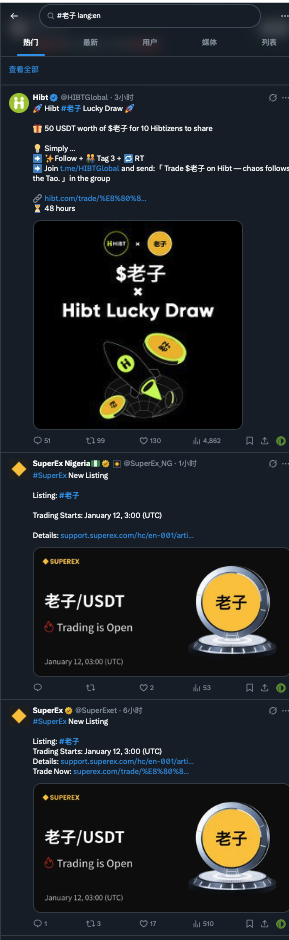
Hot posts about "Laozi" in the X English section are all exchange listing announcements
Chinese Memes Themselves Are No Longer Novel
A乒乓球 dropped from a height always bounces back lower each time.
Chinese Memes themselves are no longer a sufficiently attractive narrative.
Odaily Planet Daily asserted at the end of October last year that although the October Meme hype ended, Chinese Memes themselves would not die out but would become a fixed Meme category, with periodic hype cycles in the future. (Related reading:After Binance Life, Chinese Memes Evolve from Hits to a Sector)
This also means that if a Meme coin merely has a Chinese ticker and some "position-determines-view" logic for rising, it is destined not to last.
Since last October, the only Chinese Meme coins with lasting vitality are Binance Life and Hachimi. Tokens like Customer Service Xiao He, Cultivation, and Nailong have vanished into history. The representative Memes in this wave were all strongly tied to the "Shandong-ology" of CZ and He Yi and failed to develop an independent culture beyond the "Two Saints'" halo. Thus, they are注定 to lack the生命力 to survive beyond small Meme cycles, like any previous similar token (theoretically, Life K-Line doesn't belong here; its popularity was essentially sparked by the CCTV article).
When the Chinese Meme narrative first emerged, a Chinese Meme coin could rise simply due to novelty. Now, Chinese Memes have become an unremarkable, fixed category. As Chinese Memes fully integrate into the BSC Meme cycle assembly line, and as the market becomes increasingly familiar with this playbook, the ecosystem reverts to a "speed run" mode. The entire Meme cycle accelerates: cold start via "imperial decree," baiting continued interaction, listing on Binance Alpha, and finally, dumping...
This round of Chinese Memes is just a microcosm of that.