Cardano Leadership Structure Comes Under Scrutiny, Clouding Its Future – See Why

bitcoinistPublicado a 2026-04-20Actualizado a 2026-04-20

Resumen

Cardano is recognized as one of the most decentralized blockchains, yet recent criticism highlights its lack of clear leadership. Analyst Cardano Yoda argues that despite the introduction of on-chain governance—which involves DReps (governance decision-makers) and Pentad (leadership and execution)—the network remains centralized in practice. While DReps control treasury spending, they lack coordination and strategic direction, relying instead on founding entities like IOG, the Cardano Foundation, and EMURGO. This creates fragmented leadership and accountability issues. Yoda suggests that DReps should evolve into a more coordinated body, possibly through a board or DAOs, to define strategy and improve governance effectiveness. Enhanced cooperation between DReps, founding entities, and Intersect is essential for Cardano’s future leadership clarity and operational unity.

In the dynamic blockchain sector, the Cardano network is being flagged as the most decentralized blockchain by several crypto analysts, with security being a major part of this assertion. However, the highly decentralized network has been called out for its lack of clear leadership.

Unclear Cardano Leadership Raises Concerns In The Ecosystem

Recently, a fresh debate has been raised around the Cardano network, particularly involving its leadership state. A crypto pundit and ADA enthusiast, Cardano Yoda, argues that the leading network is lacking clear leadership. Once again, the focus is on how Cardano strikes a compromise between decentralization and the requirement for unified leadership.

The pundit stated that in the past, the network was centered around the IOGs, the Cardano Foundation, and EMURGO, and its founder, Charles Hoskinson, was considered the leader. However, after the introduction of on-chain governance, the model evolved, breaking into two parts. These include DReps (governance decision-making) and Pentad (leadership and execution), which go hand-in-hand to produce a unified platform.

While DReps decide on Treasury spending, they also grant legitimacy to the strategy that Pentad offers because DReps are not coordinated. Since they cannot define the strategy and prioritize, on-chain governance is still dependent on the founding entities, indicating that the network remains strongly centralized in leadership and execution. These entities can offer their experience, knowledge, and expertise, but DReps will set the path from the ground up.
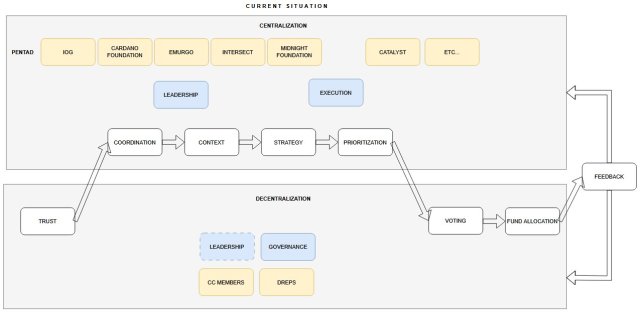
Source: Chart from Cardano Yoda on X

A strong player is intersect as it plays the role of coordinator, particularly preparing the budget framework process. Meanwhile, intersect is required to balance the role of facilitator and leader because it may not want to be a leader. However, being a leader means taking on responsibilities.

According to Yoda, on-chain governance is not the same as leadership, and Cardano does not have one. The issue is that it is difficult, if not impossible, to decentralize leadership and execution. A leader bears responsibility, which is diluted somewhere between Pentad and DReps, causing a fragmented network.

Despite this, Yoda still believes that leadership should not be dismissed because of decentralization. In the meantime, there may be a struggle for leadership, as new leaders may be born, or it might remain the same.

An Ideal Direction For Leadership

After carefully analyzing the Cardano network, Yoda claims that the logical direction for leadership is toward DReps because they have a stronger position and must be coordinated. With the emergence of a DReps board, they are expected to take responsibility for treasury spending, defining strategy, and prioritizing.

By using DAOs, DReps can be involved in the process of an effective execution. This is because they are responsible for supporting builders, ecosystem growth, innovation, marketing, and open-source activities, among others.

To have clear leadership, a more robust layer of cooperation between DReps, founding entities, and Intersect is required. However, this can only be built by a clearly defined coordination layer between DReps and sub-DAOs. Meanwhile, to create a dialogue between DReps and founding entities, the governance system must evolve.

Currently, communication is carried out through on-chain proposals, and may result in a rejected proposal regarding Summit and TOKEN2049 due to the diverse views of DReps and founding entities. Although it may not be easy, the goal remains finding a consensus on the future functioning because governance needs to be more effective.

ADA trading at $0.24 on the 1D chart | Source: ADAUSDT on Tradingview.com

Preguntas relacionadas

QWhat is the main concern raised about the Cardano network in the article?

AThe main concern is that despite being highly decentralized, the Cardano network lacks clear leadership, creating a fragmented system and raising questions about its future direction.

QAccording to the article, what are the two key parts of Cardano's governance model after the introduction of on-chain governance?

AThe two key parts are DReps (governance decision-making) and Pentad (leadership and execution).

QWhy does the article suggest that on-chain governance does not equate to leadership for Cardano?

ABecause leadership involves taking responsibility, which is currently diluted between Pentad and the uncoordinated DReps, making it difficult to decentralize leadership and execution effectively.

QWhat role does the entity 'Intersect' play in the Cardano ecosystem, as described in the article?

AIntersect acts as a coordinator, primarily in preparing the budget framework process, and is required to balance the roles of facilitator and leader.

QWhat does the article propose as the ideal direction for leadership to address Cardano's current issues?

AThe ideal direction is for leadership to move towards the DReps, who should be coordinated through a board to take responsibility for treasury spending, strategy, and prioritization, potentially using DAOs for effective execution.

Lecturas Relacionadas

Anthropic's IPO Launch: Commercial Miracle or Valuation Bubble?

Anthropic has confidentially filed for an IPO, led by Morgan Stanley and Goldman Sachs, potentially going public by October. Following its latest $650 billion funding round, its pre-IPO valuation stands at $965 billion, with projections reaching up to $2 trillion at listing, which would make it the highest-valued private company ever. The article, written by Fu Sheng, addresses skepticism that this represents an AI bubble akin to the 2000 dot-com crash. It argues the current situation differs fundamentally. Unlike the internet bubble era, which relied on speculative narratives with little revenue, Anthropic's valuation is backed by unprecedented, measurable financial performance. Key data points include: * **Revenue Growth:** ARR skyrocketed from $10 billion in early 2025 to $470 billion by May 2026, targeting $100 billion by year-end—a growth curve unmatched in business history. * **Profitability:** It achieved operating profitability in Q2 2026 with an estimated $5.6 billion profit. * **Efficiency:** With ~3,000 employees and ~$470 billion ARR, its revenue per employee exceeds $10 million. Products like Claude Code, launched less than a year ago, already generate $25 billion in annualized revenue. * **Enterprise Adoption:** It boasts a strong enterprise client base, with 8 of the Fortune 10 and over 1,000 large firms spending over $1 million annually on Claude. The valuation is framed using a traditional SaaS model (e.g., a 10x Price-to-Sales multiple on $100 billion revenue). The author contends the core question for analysts has shifted from "How big could this be?" to "How much is it earning and will earn next quarter?" The discussion extends beyond Anthropic to a broader paradigm shift: the transition from a "carbon-based" to a "silicon-based" economy. Companies are increasingly prioritizing investment in compute and AI capabilities over human resources, as these directly scale productivity and competitive advantage. Anthropic's IPO is thus positioned not just as a corporate milestone, but as a price anchor for this new economic era.

链捕手Hace 2 hora(s)

Anthropic's IPO Launch: Commercial Miracle or Valuation Bubble?

链捕手Hace 2 hora(s)

Near Returns to the AI Stage: Transformation into a Public Chain Due to 'Payroll Difficulties,' Agent and Privacy Emerge as New Growth Narratives

NEAR Returns to AI Origins: From Payroll Struggles to Blockchain, Now Focusing on AI Agents and Privacy NEAR Protocol's journey began not with grand blockchain ambitions, but from a practical hurdle: its AI startup founders, including Transformer paper co-author Illia Polosukhin, couldn't efficiently pay international developers in 2017. This led them to pivot and build a high-performance, scalable blockchain. After years navigating various crypto narratives like sharding and cross-chain interoperability, NEAR is now leveraging its AI roots to re-enter the AI arena. A key driver is its "NEAR Intents" layer, which abstracts complex cross-chain transactions. Users simply state their goal (e.g., swap BTC for ETH), and a solver network finds the optimal route. This system has processed over $20B in cross-chain volume, generating significant fee revenue. A major growth area is private transactions via "Confidential Intents/Swaps," which hide trade details until settlement to protect against MEV and front-running. Remarkably, private swaps recently accounted for over 40% of NEAR's transaction volume, highlighting strong demand but also potential regulatory scrutiny. With its AI-founder pedigree, NEAR is positioning itself at the intersection of blockchain, AI agents, and privacy, aiming to become infrastructure for the emerging agent economy while navigating the challenges of its rapid adoption.

marsbitHace 5 hora(s)

Near Returns to the AI Stage: Transformation into a Public Chain Due to 'Payroll Difficulties,' Agent and Privacy Emerge as New Growth Narratives

marsbitHace 5 hora(s)

Trading

Spot
Futuros

Artículos destacados

Cómo comprar ADA

¡Bienvenido a HTX.com! Hemos hecho que comprar Cardano (ADA) sea simple y conveniente. Sigue nuestra guía paso a paso para iniciar tu viaje de criptos.Paso 1: crea tu cuenta HTXUtiliza tu correo electrónico o número de teléfono para registrarte y obtener una cuenta gratuita en HTX. Experimenta un proceso de registro sin complicaciones y desbloquea todas las funciones.Obtener mi cuentaPaso 2: ve a Comprar cripto y elige tu método de pagoTarjeta de crédito/débito: usa tu Visa o Mastercard para comprar Cardano (ADA) al instante.Saldo: utiliza fondos del saldo de tu cuenta HTX para tradear sin problemas.Terceros: hemos agregado métodos de pago populares como Google Pay y Apple Pay para mejorar la comodidad.P2P: tradear directamente con otros usuarios en HTX.Over-the-Counter (OTC): ofrecemos servicios personalizados y tipos de cambio competitivos para los traders.Paso 3: guarda tu Cardano (ADA)Después de comprar tu Cardano (ADA), guárdalo en tu cuenta HTX. Alternativamente, puedes enviarlo a otro lugar mediante transferencia blockchain o utilizarlo para tradear otras criptomonedas.Paso 4: tradear Cardano (ADA)Tradear fácilmente con Cardano (ADA) en HTX's mercado spot. Simplemente accede a tu cuenta, selecciona tu par de trading, ejecuta tus trades y monitorea en tiempo real. Ofrecemos una experiencia fácil de usar tanto para principiantes como para traders experimentados.

1.5k Vistas totalesPublicado en 2024.12.10Actualizado en 2026.06.02

Cómo comprar ADA

Discusiones

Bienvenido a la comunidad de HTX. Aquí puedes mantenerte informado sobre los últimos desarrollos de la plataforma y acceder a análisis profesionales del mercado. A continuación se presentan las opiniones de los usuarios sobre el precio de ADA (ADA).

活动图片









