Why Do 85% of Token Launches Ultimately Become Expensive 'Funerals'?

marsbitPublicado a 2026-02-24Actualizado a 2026-02-24

Resumen

According to Arrakis Research, 85% of tokens launched in 2025 ended the year with negative returns, highlighting a systemic failure in token design rather than market conditions. Token Generation Events (TGEs) are not celebrations but "open gladiator arenas" where flawed economic models are exploited. Key failures include excessive Fully Diluted Valuations (FDV) over $1 billion, which had a 100% failure rate, and low initial circulation, leading to massive sell pressure upon unlocks. Only 9.4% of tokens that dropped in their first week recovered. The report identifies four critical success factors: 1. **Sybil Resistance:** Filtering out airdrop farmers (e.g., LayerZero’s efforts reduced initial sell-off). 2. **Revenue-Based Airdrops:** Treating airdrops as customer acquisition costs tied to real protocol usage. 3. **Ready Infrastructure:** Staking, governance, and custody must be operational at launch to provide utility and retain holders. 4. **Effective Market Makers:** Choosing transparent market-making services that provide liquidity depth, not artificial demand. The ultimate goal is achieving decentralization in development, governance, value distribution, and participation. Success requires building genuine demand through protocol utility, not marketing hype. Tokens must be designed to withstand inherent sell pressure from airdrop recipients, exchanges, and market makers from day one.

Written by: Eli5DeFi

Compiled by: AididiaoJP, Foresight News

Token launches in 2026 face a brutal reality.

It's not a celebration, nor is it a reward for your hard work building.

It's more like an 'open gladiator arena'—any flaw in your token economic model will be seized upon and publicly exploited by seasoned veterans with better models than yours.

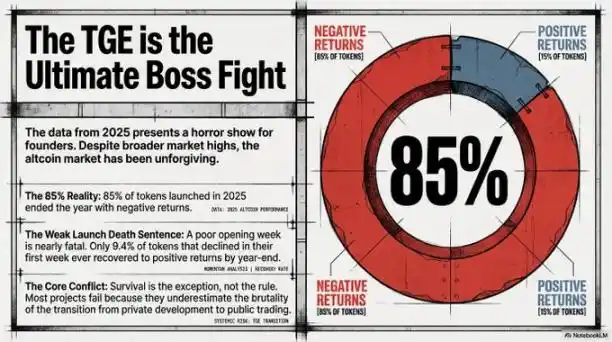
Arrakis Research compiled data from 2025, and the results are unequivocal: 85% of token launch projects ended the year with negative returns.

This can't be blamed on poor market conditions; a bear market doesn't specifically target tokens with poor tokenomics while sparing the well-designed ones.

This number is the market sounding an alarm for founders: most people are heading into a fight but have only prepared for a ribbon-cutting ceremony.
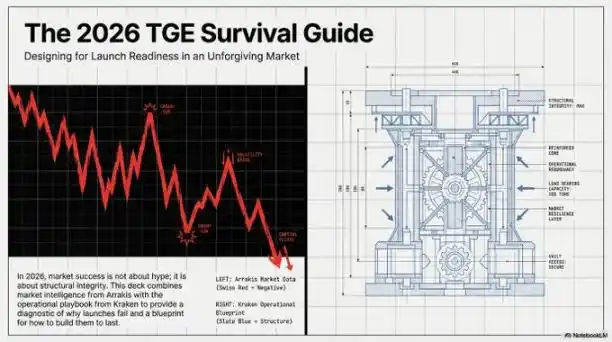
The good news? The surviving 15% aren't just lucky. They are meticulous, and their methods are replicable.

"Poor performance in the first week is basically a death sentence. Data shows that only 9.4% of tokens that fell in their first week managed to recover." — Arrakis Research

This statement is worth pondering.

Summary

  • Your token's failure isn't bad luck; it's because you didn't design it to succeed in the first place.
  • 85% of tokens launched in 2025 declined over the year. This is a design problem, not a market problem.
  • Launching with a Fully Diluted Valuation (FDV) exceeding $1 billion is essentially giving money to people who will never use your product, helping them 'cash out at the top'.
  • Staking, governance, and custody are not 'add-on features'; they are the token's immune system. Without them, the token collapses immediately upon launch.
  • Only 9.4% of tokens that fell in their first week recovered. The first week's performance essentially determines life or death.

The 'Physical Laws' Behind TGE

Here's a useful mental model, borrowing concepts from physics. Every token launch has two opposing forces:

  • Selling Pressure = Gravity. It exists objectively, is patient, and doesn't care about your grand vision.
  • Real Demand = Rocket Engine.

The issue isn't whether gravity exists (it always does), but whether your engine is powerful enough to escape it. Unfortunately, most teams build rockets without engines and then blame the planet's gravity.
Who Sells on Day One? (It's Not That They're Bad)

Many founders make a big mistake here: seeing selling as betrayal. It's not; it's simple math.

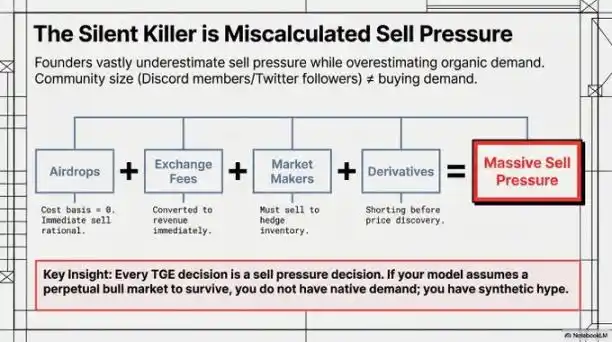
Airdrop users have a cost basis of zero. It's perfectly rational to convert something obtained for free into real money. Data shows that 80% of airdrop users sell their tokens within the first 24 hours of receiving them. This isn't disloyalty; it's human nature.

Centralized exchanges receive tokens as listing fees; this is their revenue. Liquidating their inventory is justified and reasonable.

If market makers are working on a 'loan model' partnership, to hedge risk and prepare stablecoins for quoting, they must also sell a portion of the borrowed tokens. This isn't betrayal either; it's a feature of the model you agreed to, with its inherent math.

Early short sellers act before the price stabilizes. They are veterans, often having been around longer than your project. They are not the problem; your failure to anticipate them is the problem.

Many projects design their tokens assuming the above actors don't exist. But they are real. Either you factor them in, or they will 'teach you a lesson'.
The Valuation Trap (How to Fool Yourself with Math)

The most expensive vanity item in crypto isn't profile pictures (PFPs); it's an outrageously high Fully Diluted Valuation (FDV).

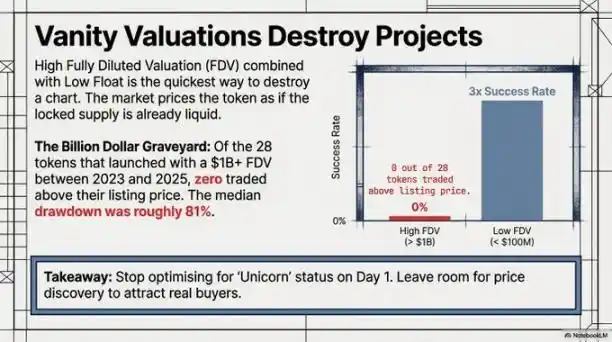
The common trick: the team releases only 5% of the tokens into circulation ('low float') but publicly claims an FDV of $1 billion.

The market does the math: is the price of the remaining 95% of locked tokens calculated as if they will 'never unlock'? But that's impossible; they will eventually be released. When that day comes, the price plummets like a 'ski jump'.

The data is staggering, and every founder should see it:
FDV at Launch

  • Above $1 billion: By year-end, not a single token was above its launch price. Median decline: 81%.
  • Below $100 million: The probability of performing well in the first month is 3 times higher than for tokens with an FDV over $500 million.

A 100% failure rate. Not 70%, not 90%, but 100%.

Yet founders keep doing it because '$1 billion FDV' looks great in press releases and makes early investors' paper gains look good before they can actually sell. Essentially, it's a 'pricing illusion' that the market mercilessly bursts.

Obsessing over launch day FDV is like judging a company's success by how pretty its PowerPoint is. It might impress those who don't look long-term. A lower valuation leaves room for genuine price discovery, enabling sustainable growth. Low-key launches often survive; vanity launches mostly die.

Four Talismans (The Things That Actually Work)

Arrakis summarized four key pillars that distinguish who survives from who just pays tuition. We add our own insights.

Talisman 1: Sybil — Filter Before Airdrop

A comparison of two cases makes it clear:
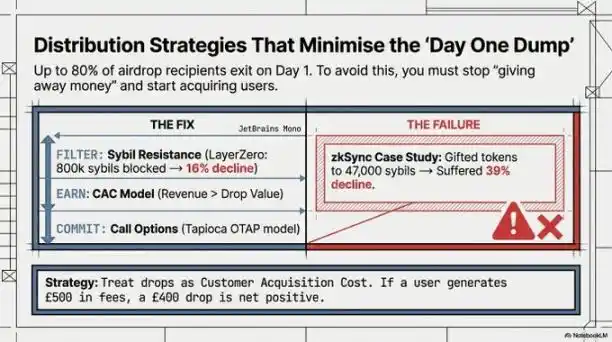
  • @LayerZero_Core put in the hard work, identifying 800,000 'Sybil addresses' (fake accounts farming the airdrop) before the token launch. These recipients would only sell immediately and never return. Result: only a 16% drop in the first month.
  • zkSync did little filtering, resulting in 47,000 Sybil addresses receiving the airdrop. Result: a 39% drop over the same period.

The difference between 16% and 39% is the price of not doing the homework.

Sybil resistance sounds tedious, but think clearly: you are paying for real users, not feeding parasites. Those airdrop farmers don't want your product; they only want your token. Make it costlier for those who don't use your product to get the token.

Talisman 2: Revenue-Based Airdrop — Treat Airdrop as 'Customer Acquisition Cost'

Change your perspective on airdrops: don't see them as 'community rewards', see them as 'customer acquisition cost'.
If a user contributed $500 in fees to your protocol, and you reward them with $400 worth of tokens. Even if they sell all tokens immediately, this 'acquisition' is still a net gain ($100 net profit). Real economic activity has already occurred; the token sell-off is just an entry in the ledger, not a disaster.

Talisman 3: Infrastructure Readiness — Don't Roll Out a Car Without an Engine

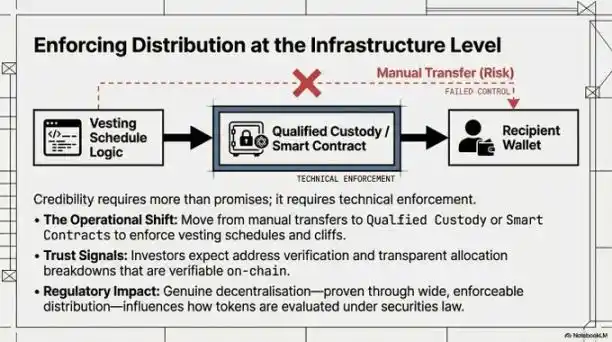
Staking and governance functionalities must be available the moment the token launches. Not 'coming soon', not 'in development', but 'available immediately'.

If not, the result will be:

Early supporters get the token and find they can neither stake it for yield nor participate in voting. Capital sits idle. Idle, non-yielding capital gets sold. This isn't disloyalty; it's basic investment logic.
Additionally, a qualified custody solution must be in place from day one. This is a hard requirement institutional investors will check. If custody is still just a 'multisig' without a compliant framework, large funds simply won't enter. This isn't being difficult; it's their risk management.

Talisman 4: Choosing the Right Market Maker — Understand the Service You're Buying

Market makers provide 'liquidity' (market depth), not 'demand' (buyers). This is crucial. Some founders hire market makers thinking they're hiring a 'price protection squad'. They only make existing buying and selling smoother; they can't conjure up buyers.

  • The 'Engagement Model' is more transparent and better.
  • The 'Loan Model' can be useful, but the market maker's own hedging needs inherently conflict with your goal of stabilizing the price.
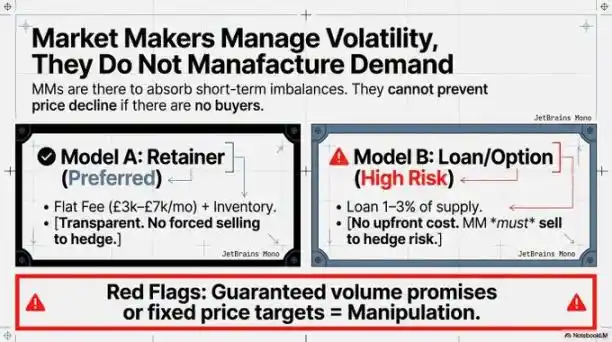
Danger signs when choosing a market maker:

  • Guaranteed volume targets
  • Unwilling to accept your terms
  • Promising to support the price under heavy selling pressure

These might indicate they plan to use wash trading (fake volume) instead of legitimate market making.

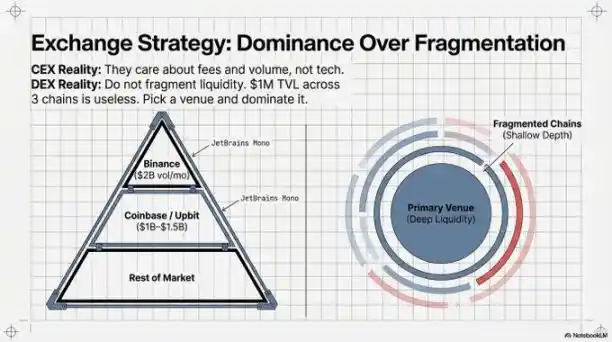
Liquidity should be concentrated. Spreading $1 million across three chains results in shallow 'depth' on each chain, unable to withstand any pressure. It's better to choose one main battlefield and create deep liquidity there. Depth in one place is better than thin coverage in three.
The Ultimate Goal: Decentralization

The infrastructure and distribution mentioned earlier are defensive measures. The real long-term goal is for the protocol to mature truly in four aspects:

  • Development Decentralization: Not just the core team can write code; third parties can also participate in development through grant programs.
  • Governance Decentralization: Transparent decision-making process, multi-party participation, proposals that are actually implemented.
  • Value Distribution Decentralization: Economic design allows more participants to benefit, not just enriching an internal circle.
  • Access Decentralization: Global users can participate in staking, voting, etc., through low-barrier, compliant means, not limited to crypto veterans.

The brilliance of the Arrakis framework lies here. A protocol that is only well-prepared at launch but does not advance true decentralization is merely postponing 'centralization risk', not solving it.

Final Thoughts

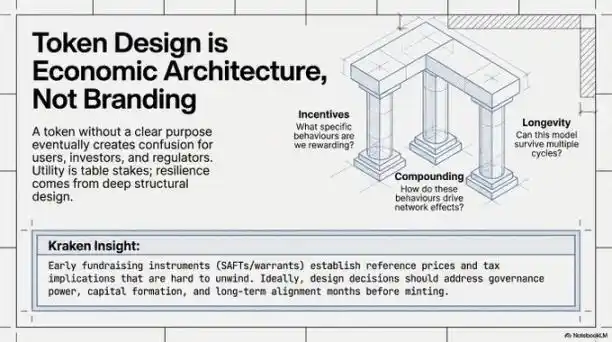
Arrakis's research is one of the most rigorous analyses of TGE in the first quarter of this year. The core argument is correct: a token launch is about deploying infrastructure, not running a marketing campaign.
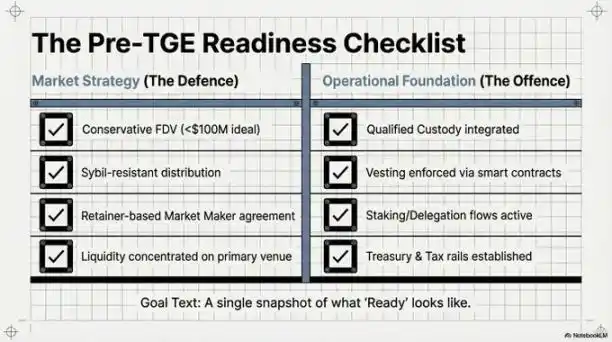
Teams that treat it as marketing often produce beautiful 'first-week charts', followed by a 'ski jump' decline. Teams that treat it as infrastructure—meticulously analyzing sell pressure sources, preparing months in advance, not chasing inflated FDV, filtering out airdrop farmers—they often become the surviving 15%.

We want to add one point: real demand for the token must come from the protocol's inherent utility, not from marketing hype. People must genuinely need this token to access the value created by the protocol. If the token's only use is 'governing a protocol no one uses', then even perfect Sybil resistance and compliant custody are useless. Governing something useless has no value.

Before thinking about how to launch, think about how to create real demand first.

Preguntas relacionadas

QAccording to the article, what percentage of token launches in 2025 ended with negative returns, and what is the primary reason for this failure rate?

A85% of token launches in 2025 ended with negative returns. The primary reason is not bad market conditions but flawed token design and economic models from the start.

QWhat is the critical mistake many founders make regarding the Fully Diluted Valuation (FDV) of their token at launch?

AThe critical mistake is launching with an excessively high FDV (e.g., over $1 billion), often with a very low circulating supply. This creates a 'pricing illusion' that is inevitably shattered when the remaining tokens unlock, leading to a massive price decline. The data shows a 100% failure rate for tokens launched with an FDV over $10 billion.

QWhat are the two opposing forces in the 'physics' model used to describe a Token Generation Event (TGE)?

AThe two opposing forces are Selling Pressure, which is likened to gravity—a constant, patient force—and Real Demand, which is likened to a rocket engine that must be powerful enough to overcome that gravity.

QName two of the four 'talismans' or key pillars identified by Arrakis Research that are crucial for a successful token launch.

ATwo of the four talismans are: 1) Sybil Resistance (filtering out fake users before the airdrop) and 2) Revenue-Based Airdrops (treating the airdrop as a customer acquisition cost rather than just a community reward).

QWhy is it essential for staking and governance functionalities to be available immediately at the token's launch, according to the article?

AStaking and governance must be available immediately because without them, capital from early supporters is idle and unproductive. Idle capital that isn't earning yield is far more likely to be sold, creating immediate and unsustainable selling pressure on the token.

Lecturas Relacionadas

SemiAnalysis Dissects Huawei's Kirin 9030: Process Technology Halted, So They Folded the Chip

SemiAnalysis has published a detailed teardown report on the HiSilicon Kirin 9030 Pro chipset found in Huawei's Mate 80 Pro. Fabricated using SMIC's most advanced N+3 node without EUV lithography, the analysis reveals significant technical achievements and strategic shifts. The report indicates SMIC's N+3 has achieved transistor density comparable to TSMC's N6 (113.4 vs 107.7 MTr/mm²), primarily through aggressive use of Self-Aligned Quadruple Patterning (SAQP) for its metal layers. This results in a notably small 32.5nm M0 metal pitch. However, SemiAnalysis notes this achievement comes with significantly higher process complexity, cost, and potential yield challenges compared to competitors using more advanced tools. The Kirin 9030 design maximizes this constrained density. While its GPU performance has improved ~70% and matches Qualcomm's 2022 flagship level, the CPU core's IPC lags behind current top-tier designs from Apple and Qualcomm, a gap attributed to the underlying manufacturing technology rather than design capability. Facing long-term restrictions on advanced tools, Huawei is charting a new path. The report highlights the company's "LogicFolding" roadmap, a 3D stacking technique aimed at shortening signal paths to boost performance and efficiency. The goal is to reach 5GHz frequency and a projected density of 295 MTr/mm² by 2031. SemiAnalysis concludes that export controls have not halted China's chip progress but have fundamentally altered its trajectory, making it more expensive and complex. This has spurred innovation in alternative areas like 3D stacking and domestic EDA tool development, with Huawei's supply chain also beginning to integrate Chinese memory from CXMT.

marsbitHace 35 min(s)

SemiAnalysis Dissects Huawei's Kirin 9030: Process Technology Halted, So They Folded the Chip

marsbitHace 35 min(s)

How Will the Price Move Before SpaceX's Next Share Unlock?

TL;DR Investors buying SPCX after SpaceX's IPO are not simply investing in a typical tech stock. It’s a high-valuation asset driven by Musk's narrative, Starlink, and space transport potential, but with a key twist: a very small initial float of ~4% has led to significant post-listing price appreciation. The current price action reflects a timing gap. Before the first lock-up expiration (estimated around August, subject to official confirmation), scarcity and high demand could continue to push prices up. Short-term bulls focus on low float, FOMO, and potential index inclusion. However, bears point to the supply dynamics that will change post-lockup. Existing shareholders still hold over 95% of shares, which will be released in stages starting from the first unlock window. This introduces future selling pressure from low-cost holders. The upcoming Q2 earnings report is a critical catalyst before the unlock. It will test whether the company's fundamentals can justify the current ~$2.1T valuation. Strong results could support the pre-unlock momentum, while weak figures could amplify concerns about future supply. The trading thesis is shifting from immediate scarcity ("can't buy enough") to evaluating future absorption capacity ("who will buy when more supply hits"). The path ahead hinges on the specifics of the unlock schedule, Q2 earnings performance, and whether anticipated passive index buying materializes.

marsbitHace 56 min(s)

How Will the Price Move Before SpaceX's Next Share Unlock?

marsbitHace 56 min(s)

Bitcoin Short-Term Bullish Structure Validated, HYPE Low-Entry Window Opens | Guest Analysis

**Market Analysis Summary (Week of June 2026)** **Overall Market Context:** The market environment is exceptionally complex, with the unexpected US-Iran agreement and the reopening of the Strait of Hormuz triggering a global asset repricing and significant volatility. This heightened noise underscores the importance of a structured analytical framework. **Bitcoin (BTC) Analysis & Strategy:** * **Current Status:** The price has climbed above $65,000, currently in a rebound phase (segment 38-39) following a complex 12-segment correction from the May high of $82,850. * **Key Levels:** * **Primary Resistance:** $69,500–$70,500. A successful breakout above $65,000 targets this zone. * **Primary Support:** $65,000 (immediate), followed by $59,000–$60,000 and $55,000. * **Weekly Outlook & Strategy:** The focus is on the confirmation of the $65,000 level. * **Bullish Scenario (Hold $65K):** A move toward the $69.5K–$70.5K resistance zone is anticipated, which is a potential area for initiating medium-term short positions. * **Bearish Scenario (Break below $65K):** A retest of the $60,000–$62,000 support range is likely. * **Medium-Term Strategy:** Currently neutral. Plan to establish short positions (up to 60% allocation) either in the $69.5K–$70.5K resistance zone upon signs of rejection, or on a confirmed breakdown below $65,000 and further below $59K–$60K. * **Short-Term Strategy:** Utilize 30% capital for scalping opportunities based on support/resistance levels, using 30/60-minute charts. **HYPE Analysis & Strategy:** * **Current Status:** The price has stabilized around $52 after a four-segment decline from the June high of $75.87 and is now in a rebound (segment 50-51). * **Key Levels:** * **Primary Resistance:** $62.50–$64.57. Watch for potential rejection here to form a lower high. * **Primary Support:** $52–$55.50, followed by $47–$49. * **Weekly Outlook & Strategy:** Adopt a "buy on dips, avoid chasing rallies" approach. * **Core View:** Monitor the price action and potential formation of a lower high ("endpoint 51") in the $62.50–$64.57 resistance zone. * **Short-Term Strategy:** Consider light long positions (max 30% allocation) if the price finds support and shows reversal signals in the $52–$54.50 or deeper $47–$49 support zones, confirmed by proprietary quantitative bottom signals. **Trade Review:** Last week's HYPE short-term long trade, executed based on proprietary "Price Difference" and "Momentum" model signals, yielded a profit of approximately 11.88%. The entry was near $54.39 and exit near $60.85. **Risk Management Reminder:** Always set an initial stop-loss upon entry. Move stop-loss to breakeven at +1% profit, then trail it upwards to lock in gains as the trade progresses. *Disclaimer: All analysis, models, and strategies are based on personal technical analysis for educational purposes only, not investment advice. The market carries inherent risk.*

Odaily星球日报Hace 1 hora(s)

Bitcoin Short-Term Bullish Structure Validated, HYPE Low-Entry Window Opens | Guest Analysis

Odaily星球日报Hace 1 hora(s)

Bitcoin Short-Term Bullish Structure Validated, HYPE Accumulation Window Opens | Guest Analysis

**Bitcoin and HYPE Market Analysis: Short-Term Outlook and Trading Strategies** This market analysis examines Bitcoin (BTC) and HYPE amid volatile conditions, providing short-term outlooks and specific trading strategies. **Key Outlooks:** * **Bitcoin (BTC):** Focus is on whether BTC's recent move above $65,000 holds. A successful breakout could lead to a test of the $69,500-$70,500 resistance zone, where medium-term short positions are considered. A failure, breaking below $65,000, may trigger a decline towards the $59,000-$60,000 support area. * **HYPE:** The token completed a four-wave correction and is now rebounding. The key resistance zone is $62.5-$64.57. The trading strategy is "buy on dips," looking for entry opportunities near the $52-$54.5 or deeper $47-$49 support zones, pending confirmation from proprietary models. **BTC Trading Strategy:** * **Medium-term:** Primarily looking to establish short positions (up to 60% allocated capital) if price rallies to the $69,500-$70,500 resistance area and shows signs of reversal. Alternative plans involve initiating shorts on a breakdown below $65,000. * **Short-term:** Allocate up to 30% capital for intraday "spread" trades based on support/resistance levels on 30/60-minute charts. **HYPE Trading Strategy:** * **Short-term:** Adopt a dip-buying approach. Consider light long positions (under 30% capital) when price tests key support levels ($52-$54.5 or $47-$49) and shows stabilization, confirmed by proprietary "Price Spread" and "Momentum Quant" models. **Trade Recap:** The analysis reviews a successful HYPE long trade from the previous week, executed at ~$54.39 and closed at ~$60.85 for an ~11.88% gain, based on signals from the aforementioned models. **Risk Management Emphasis:** The article stresses strict capital allocation (under 30-60%), immediate initial stop-loss placement, and a trailing stop-loss protocol to lock in profits as trades move favorably. ***Disclaimer:** All analysis, models, and strategies are for educational purposes based on technical analysis, not investment advice. Markets are volatile; trade with caution.*

marsbitHace 1 hora(s)

Bitcoin Short-Term Bullish Structure Validated, HYPE Accumulation Window Opens | Guest Analysis

marsbitHace 1 hora(s)

Trading

Spot
Futuros
活动图片





