Who is the 'Only Alternative' to SpaceX, Valued at Trillions?

marsbitPublicado a 2026-05-08Actualizado a 2026-05-08

Resumen

Rocket Lab (RKLB), considered by many as the "only alternative" to SpaceX, reported strong Q1 2026 results with revenue of $200.3M, beating expectations. Its stock has surged 240% over the past year. The company is seen as replicating SpaceX's proven path. Its small-lift Electron rocket is the world's only frequently and reliably launched vehicle in its class and has demonstrated reusability through ocean recovery. The key to its future growth, however, is the upcoming medium-lift Neutron rocket, designed to compete directly with SpaceX's Falcon 9. Neutron features innovative designs like the fixed, reusable "HungryHippo" payload fairing, aiming for greater efficiency. Like SpaceX with Starlink, Rocket Lab operates a dual business model of "Launch + Space Systems," with satellite components already generating nearly 70% of its revenue. While SpaceX's valuation is estimated at $1.75-$2 trillion, Rocket Lab's market cap is around $45 billion. This gap represents both the reality of SpaceX's dominance and the significant upside potential investors see in Rocket Lab if Neutron succeeds. The major risk is that Neutron's first flight, currently scheduled for late 2026, could face delays or failures—a common challenge in aerospace. Its success is critical for validating Rocket Lab's ambition to become the world's second provider of reusable medium-lift launch capability.

Author|Azuma(@azuma_eth)
After the U.S. stock market closed on May 8th, commercial aerospace company Rocket Lab (RKLB) announced a much better-than-expected Q1 2026 earnings report.

The financial report data showed that Rocket Lab's Q1 revenue reached $200.3 million, a significant year-on-year increase of 63.5%, higher than the expected $189 million; the Q2 revenue guidance was raised to $225-240 million, far exceeding analysts' expectations of $205 million. Although the operating loss of $56 million shows the company is still in a "cash-burning" mode, the adjusted gross margin has climbed to 43% (only 33.4% in the same period last year), indicating that the company's unit economics are significantly improving while scaling up — in simple terms, it's "burning money" more efficiently.

Boosted by the positive earnings report, RKLB rose nearly 7% after hours, and has gained a whopping 240% over the past year.

As SpaceX's century-level IPO approaches, commercial aerospace has become another hot theme in the U.S. stock market, with capital beginning to assign internet-level valuation imagination to the business of "building rockets." In this frenzy, apart from SpaceX, whose valuation is pointing to $1.75-2 trillion with significant pre-market premium, Rocket Lab, positioned as "the pure commercial aerospace stock most similar to SpaceX," has also become an alternative option in the eyes of many investors.

The 'Only Alternative' to SpaceX?

The reason Rocket Lab is seen as the current "only alternative" to SpaceX is that it is perfectly replicating the successful path already proven by SpaceX — first achieving commercial closure and reusable technology with a small rocket, then using a larger rocket to optimize costs and capture the core market.

Electron: The Dominant Player in the Small Rocket Segment

In the business of building rockets, PPT presentations are everywhere, but companies that can reliably launch rockets are few and far between. Currently, Rocket Lab's "Electron" is the world's only small launch vehicle achieving frequent and reliable commercial operation, and it is also the second most frequently launched rocket in the U.S., second only to SpaceX's "Falcon 9."

The "maturity" of Electron is reflected not only in its dozens of launch records and extremely high success rate but also in the implementation of its recovery technology. Rocket Lab has successfully retrieved the first-stage booster from the ocean multiple times and has even reused engines in subsequent launches. This mastery of engineering "reusability" technology is precisely the trump card weapon that allowed SpaceX to dominate the commercial aerospace market.

Neutron: The Falcon 9 Chaser

If the small rocket is Rocket Lab's entry ticket, then the medium-to-large rocket "Neutron" currently under development is the main engine for its charge towards a hundred-billion-dollar market cap.

Neutron is not simply a scaled-up version of Electron; it was designed from the outset with a strong "target" — to chase Falcon 9. Falcon 9 is currently the only commercially reusable medium-to-large rocket on the market, and SpaceX holds an absolute monopoly in this field.
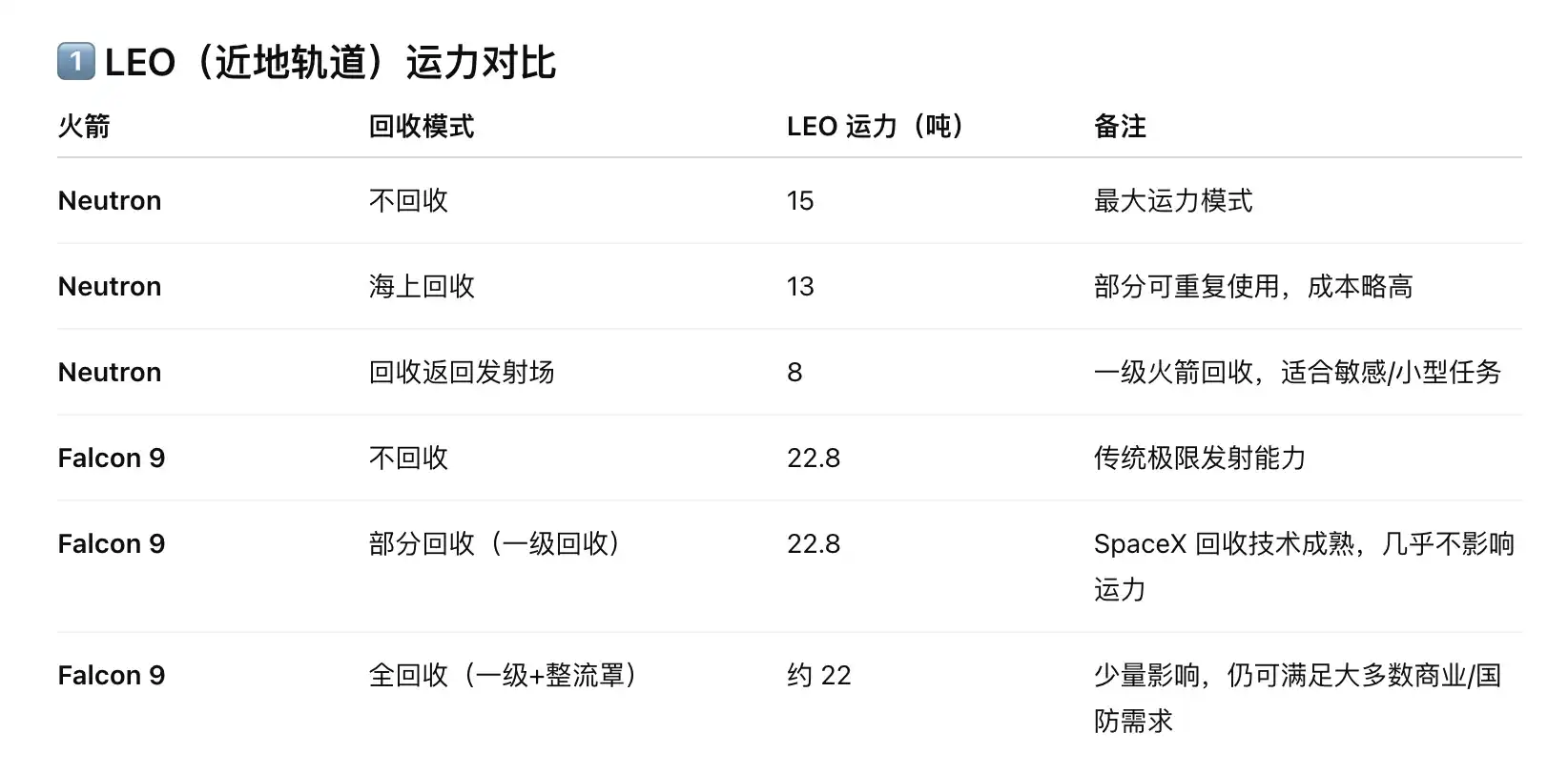
The biggest significance of Neutron's emergence is that it is expected to become the world's only second option that can compete with Falcon 9, although its designed payload capacity (approx. 8-15 tons) is still slightly inferior to Falcon 9. However, in engineering logic, it attempts to achieve a curved overtaking of its predecessor through "late-mover advantages" — with unique designs like the HungryHippo fairing and Archimedes engine, Neutron aims to surpass Falcon 9 in efficiency regarding fairing recovery and engine reusability.
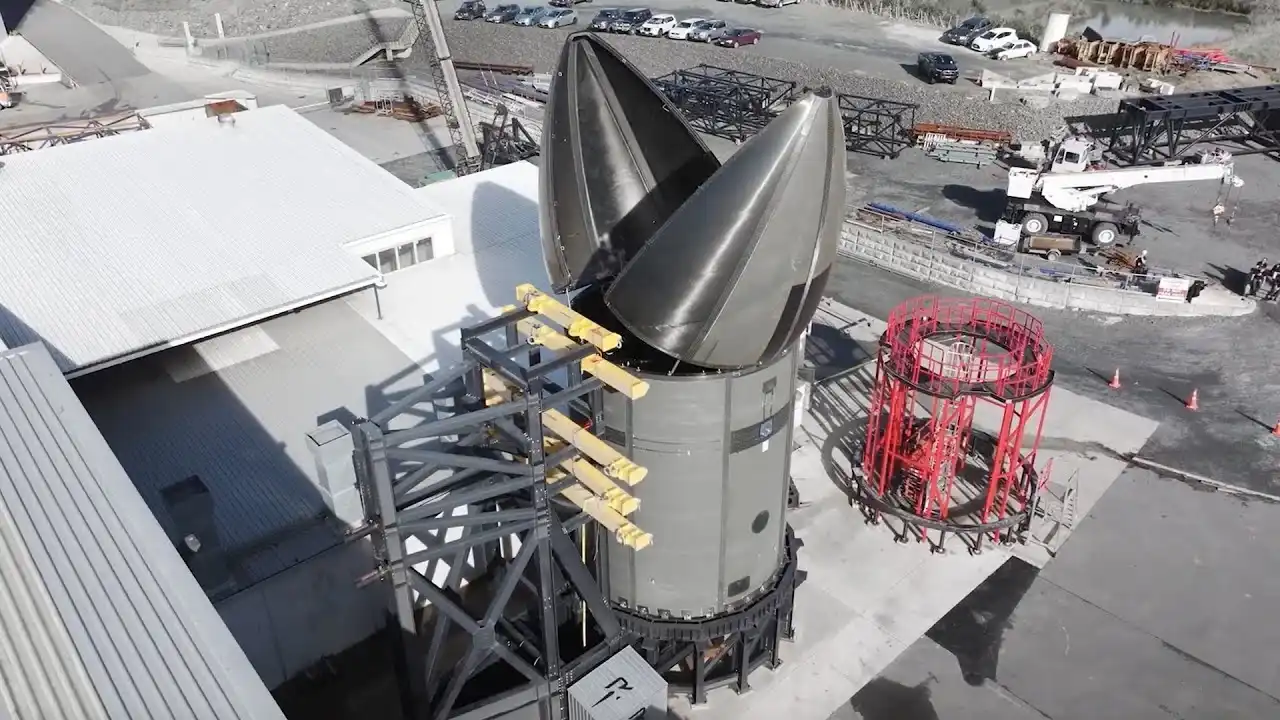
  • Odaily Note: HungryHippo is Neutron's most significant design highlight. Unlike SpaceX, which needs to retrieve millions of dollars worth of fairing debris from the sea after each launch, Neutron's fairing adopts a fixed, non-separating design connected to the first-stage booster. When releasing the second stage, it opens like a "hippopotamus mouth," closes after deployment, and lands with the first stage for recovery. This means the fairing avoids the complex process of at-sea recovery and post-landing reassembly; it's ready for refueling immediately after landing.

Judging from the disclosed testing progress, Rocket Lab is rapidly narrowing the generational gap with SpaceX in medium-to-large launch capabilities.

"Building Rockets" plus "Building Satellites": Replicating SpaceX's Ecological Loop

Just as SpaceX has Starlink, Rocket Lab is also building its own "launch + manufacturing" dual-drive ecosystem. Rocket Lab's "Space Systems" business (covering satellite platforms, laser communication, solar arrays, etc.) currently accounts for nearly 70% of its total revenue. This means that even during Neutron's R&D phase, Rocket Lab can still generate substantial revenue by selling satellite components.

This kind of "full industry chain" business model is almost unique to Rocket Lab in the public market, before SpaceX's own potential listing.

Huge Valuation Gap: A Reflection of Reality and an Investment Opportunity

Currently, SpaceX's private market valuation is as high as $1.75 to $2 trillion, while Rocket Lab's market cap has just surpassed $45 billion. The huge valuation gap objectively reflects the real-world status difference between the two companies, but this is precisely where investors see the most attractive "odds."

In the current global commercial aerospace field, the only company that can stably achieve frequent launches, reusability, high payload capacity, and low costs is SpaceX. Falcon 9's cost advantage has reached a level that makes most competitors despair, and this advantage is gradually forming a terrifying positive spiral — the cheaper, the more launches; the more launches, the more data; the more data, the faster the upgrades; the faster the upgrades, the cheaper it gets... This moat built by scale, data, and pace has left countless latecomers in awe.

But Rocket Lab's opportunity lies in the fact that, currently, Neutron appears to be the most promising reusable medium-to-large rocket to catch up with Falcon 9's pace. "The only choice after SpaceX" — this single label alone is compelling enough. Once Neutron successfully completes its maiden flight, Rocket Lab's valuation logic will completely shift from "a small rocket company" to "the world's second platform company with medium-to-large reusable rocket capability," poised to capture a large number of commercial contracts from SpaceX's hands. Therefore, the current market enthusiasm for Rocket Lab is largely a bet on the success probability of Neutron.

At this point in 2026, with SpaceX having broken through the trillion-dollar valuation ceiling, Rocket Lab, with a market cap of only about 2.5% of SpaceX's, clearly has more room for upside imagination.

Biggest Risk: "Neutron" Hasn't Flown Yet...

But there's still one big suspense — Can Neutron actually fly on schedule?

According to the latest disclosure, Neutron's maiden flight is scheduled for the end of 2026. However, looking back at history, no new rocket launch has ever proceeded without delays. The aerospace industry has a harsh reality — a PPT rocket ≠ a real rocket.

Historically, many rockets never flew; many rockets blew up on their first flight; and many rockets failed in their cost-control designs. Neutron has yet to make its first flight. If Neutron's R&D progress encounters setbacks or its maiden flight is delayed, the current market cap will face severe pressure tests, and even the best story will be hard to continue telling.


Preguntas relacionadas

QWhy is Rocket Lab considered the 'only alternative' to SpaceX in the commercial space sector?

ARocket Lab is seen as the primary alternative to SpaceX because it is replicating SpaceX's proven path to success. It established a viable commercial business with its small Electron rocket and reusability technology, and is now developing the Neutron medium-lift rocket to compete with SpaceX's Falcon 9. Additionally, Rocket Lab operates a dual business model of 'launch + manufacturing' similar to SpaceX's Starlink ecosystem.

QWhat was the market reaction to Rocket Lab's Q1 2026 earnings report?

AFollowing its Q1 2026 earnings report, Rocket Lab's stock (RKLB) rose nearly 7% in after-hours trading. The report showed revenue of $200.3 million, a 63.5% year-over-year increase, surpassing expectations of $189 million, and provided strong Q2 guidance.

QWhat is the key design feature of Rocket Lab's Neutron rocket that aims to surpass the Falcon 9's efficiency?

AA key efficiency feature of the Neutron rocket is its 'HungryHippo' fairing. Unlike SpaceX's fairings which separate and require sea recovery, Neutron's fairing is fixed and non-separating. It opens to release the second stage and then closes, allowing it to be recovered intact with the first stage, eliminating complex recovery and refurbishment processes.

QWhat is the primary risk currently facing Rocket Lab's growth story?

AThe primary risk for Rocket Lab is the development and first launch of its Neutron rocket. Scheduled for late 2026, any significant delays, technical failures, or cost overruns in Neutron's development could severely impact the company's valuation and growth narrative, as much of its future potential is tied to this vehicle.

QHow does Rocket Lab's current valuation compare to SpaceX's, and what opportunity does this present for investors?

ASpaceX's valuation is estimated at $1.75 to $2 trillion, while Rocket Lab's market capitalization is just over $45 billion. This massive gap reflects their current market positions but presents a significant opportunity for investors. If Rocket Lab's Neutron rocket succeeds, the company's valuation could be re-rated from a small-launch provider to the world's second platform with medium-lift reusable rocket capability, offering substantial upside potential.

Lecturas Relacionadas

From Banning Doubao to Embracing Honor: Why Did WeChat Suddenly 'Change Its Face'?

The article explores the sudden shift in WeChat's strategy towards AI assistants from mobile phone manufacturers, transitioning from strict opposition to active collaboration. For over a year, WeChat fiercely resisted attempts by phone AI assistants (like ByteDance's Doubao in late 2025) to control its features via GUI automation ("simulated clicking"), citing security and data control concerns. This stance created a significant barrier for system-level AI integration. Now, Tencent has initiated A2A (Agent-to-Agent) partnerships with major phone brands like Honor, Xiaomi, OPPO, and vivo. This model allows a phone's system AI (e.g., Honor's YOYO) to parse a user's voice command and send a structured request directly to WeChat's own internal AI agent via secure APIs. WeChat then executes the action (e.g., sending a message) and returns the result. The article attributes Tencent's "change of face" to strategic pressure. While leading in social app usage, Tencent trails rivals like ByteDance and Alibaba in standalone AI app popularity. WeChat, with its vast mini-program ecosystem, is Tencent's key asset for an AI comeback. The upcoming WeChat AI agent aims to handle tasks like booking and payments within the app. However, phone system assistants remain the primary AI entry point for most users. The A2A collaboration allows Tencent to extend WeChat's AI reach to this crucial system layer while maintaining control over its core functions and data. For phone manufacturers, embracing A2A is a pragmatic move. The GUI route proved unviable due to WeChat's blocks. A2A offers a compliant path to integrate a vital service, enhancing their AI assistants' usefulness. It allows them to focus on developing their own AI ecosystems for other services while cooperating on WeChat access. The collaboration is framed as a mutual, strategic necessity: Tencent gains a distribution channel, and manufacturers gain a key functionality. The partnership relies on a "dual authorization" mechanism for security, requiring both user and app consent for each action. While questions about long-term data privacy practices remain, experts note A2A is more secure and compliant than GUI automation. Ultimately, this cooperation is seen as a tentative, calculated truce. Tencent's long-term goal is to make WeChat an AI-powered "service OS." Phone manufacturers aim to make their system AI the central user interface. Their paths may converge or clash in the future, but for now, the A2A deal represents the opening chapter in the battle for the AI-era user入口, driven by necessity and strategic calculus on both sides.

marsbitHace 43 min(s)

From Banning Doubao to Embracing Honor: Why Did WeChat Suddenly 'Change Its Face'?

marsbitHace 43 min(s)

On-Chain Figures on the Eve of Kickoff: 1.6 Billion Traded Before the World Cup Even Begins

"On-Chain Numbers on the Eve of the World Cup: $1.6 Billion Traded Before Kick-off" Analysis of on-chain markets before the 2026 FIFA World Cup reveals significant crypto integration into football. The most striking figure is the approximately **$1.6 billion** in total trading volume on the single "World Cup Winner" contract on the Polymarket prediction market platform, accumulated before a single match was played. This represents explosive growth for a sector whose annual volume surged from ~$16B in 2024 to ~$64B in 2025. The ecosystem is maturing beyond speculation. Key developments include: 1) **Infrastructure upgrades** like Polymarket's migration to native, regulated USDC stablecoin for settlements; 2) **Reliable data oracles**, such as Chainlink, being used to resolve real-world match outcomes on-chain; and 3) **Official recognition**, with FIFA appointing its first-ever "Prediction Markets" partner. Over 100 contracts now cover everything from the outright winner to individual match results and even non-sporting risks like venue relocation. This evolution marks a fundamental shift. While crypto firms are absent from FIFA's top-tier sponsor list, the technology has deeply penetrated the tournament's financial and predictive infrastructure through regulated stablecoin settlements, decentralized oracles, and new official partnership categories. The regulatory landscape remains complex and varies by jurisdiction, but on-chain markets for the World Cup are already a multi-billion-dollar reality.

marsbitHace 1 hora(s)

On-Chain Figures on the Eve of Kickoff: 1.6 Billion Traded Before the World Cup Even Begins

marsbitHace 1 hora(s)

From SpaceX's IPO to the Future of Crypto: Which Crypto Sectors Will Host the Trillion-Dollar Narrative?

From the SpaceX IPO, which targets a $750 billion raise at a $1.77 trillion valuation, we can extrapolate capital flow trends relevant to crypto. The focus shifts from speculative narratives to foundational infrastructure and real-world asset (RWA) integration. Key crypto sectors poised to benefit include: 1. **AI Infrastructure**: The narrative is moving from consumer-facing AI applications to underlying, scarce resources like compute power and decentralized GPU networks (e.g., TAO, RENDER, AKT, IO). These protocols are positioning as the essential "picks and shovels" providers for the AI economy. 2. **Real-World Assets (RWA)**: Beyond tokenized treasury bonds, RWA's future lies in on-chain equity and pre-IPO assets like SpaceX. This could democratize access to high-growth assets and reshape global capital flows, benefiting infrastructure projects like ONDO, LINK, and Plume that facilitate issuance, data, and liquidity. 3. **Core Financial Infrastructure**: Stablecoins, payment networks, and DePIN (Decentralized Physical Infrastructure Networks) are critical for settling the future on-chain economy. Their role expands from internal trading tools to foundational layers for global finance, AI systems, and real-world asset networks, leading to potential value reassessment. In summary, the next cycle may prioritize long-term infrastructure value—AI compute, asset tokenization networks, and settlement layers—over short-lived application hype, mirroring the broader market's shift towards funding the foundational systems of the future.

marsbitHace 1 hora(s)

From SpaceX's IPO to the Future of Crypto: Which Crypto Sectors Will Host the Trillion-Dollar Narrative?

marsbitHace 1 hora(s)

Trading

Spot
Futuros
活动图片




