White Whale: A 'Doomed' Meme Coin's 500x Comeback in 30 Days?

Odaily星球日报Publicado a 2025-12-29Actualizado a 2025-12-29

Resumen

White Whale, a meme coin initially destined to fail, staged a dramatic 500x rally in under a month, surging from a sub-$100K market cap to over $57 million. Launched on Pump.fun on October 13, 2025, as an unauthorized fan-made token using the image of crypto KOL @TheWhiteWhaleV2, it began as a satirical “People’s Whale” meme critiquing market manipulation. It quickly faded into obscurity with near-zero activity. The turning point came on December 7, 2025, when @TheWhiteWhaleV2 unexpectedly announced he was taking over the project’s treasury and control to protect his reputation. He committed to reinvesting all creator fees back into the community, locked his own purchased tokens until 2063, and personally funded liquidity and incentives. On-chain analysts noted early signals of a rebound, including a sharp drop in top-holder supply and increased "smart money" inflow days before the announcement. The real price explosion occurred in late December, fueled by community trust in the KOL’s transparent and responsible management. White Whale’s revival is seen as a rare “anti-rug” narrative in a high-risk meme coin ecosystem, turning a potential scam into a story of redemption and community-led growth.

Original | Odaily Planet Daily (@OdailyChina)

Author | Ding Dang (@XiaMiPP)

This is the story of a meme coin that "should have died," but unexpectedly revived from the bottom after being nearly forgotten by the market.

White Whale surged nearly 500 times in less than a month, climbing from a market cap of less than $100,000 to a current temporary market cap of $57 million. The community is now calling for the next target: $100 million.

A Familiar Meme Coin Pattern: From Start to End

White Whale was launched on Pump.fun on October 13, 2025. It was originally created by a fan as a joke, "borrowing" the avatar and image of crypto KOL @TheWhiteWhaleV2. @TheWhiteWhaleV2 is a crypto OG on X with 828,000 followers. His avatar is a whale clad in armor with a stern and cold expression, in a serious and restrained style. He often shares trading philosophies and market insights. Perhaps because of this, fans see him as a positive "whale" symbol.
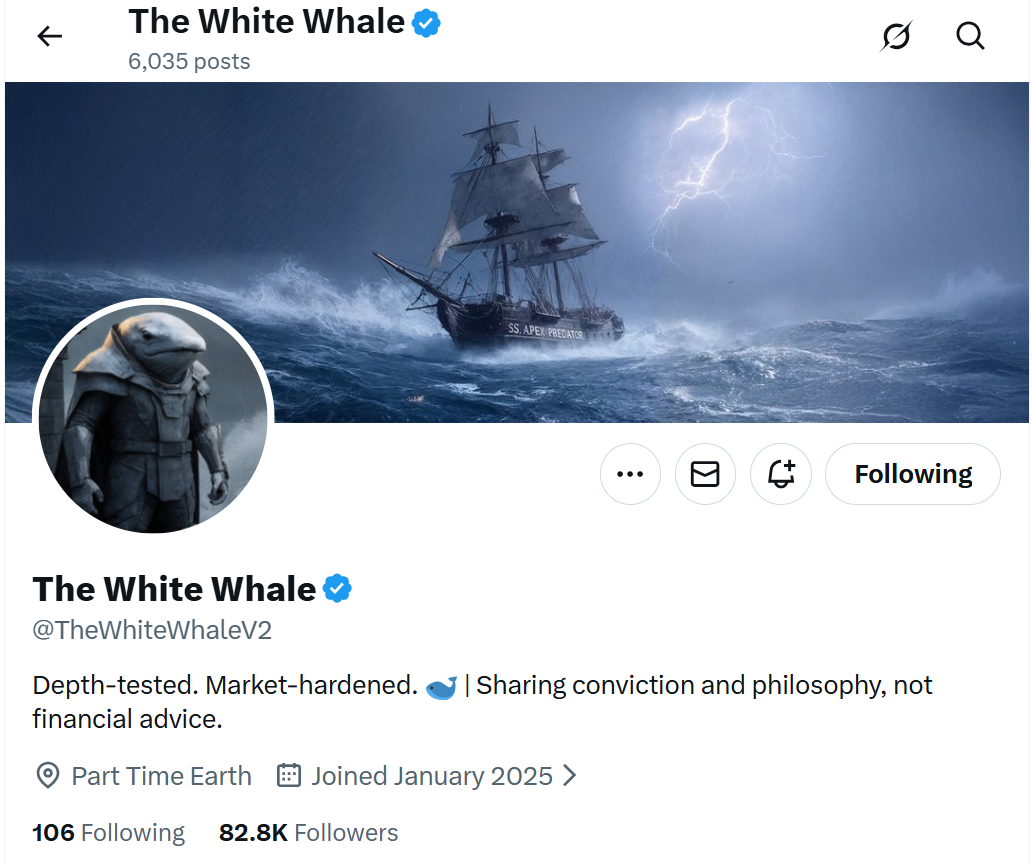
The initial narrative of the project was "The People's Whale," intended to satirize and resist manipulation by big whales or institutions in the crypto market, positioning itself as a tool for community counterattacks. But this was purely a fan's prank-like creation, without authorization or permission from @TheWhiteWhaleV2 himself. He even later tweeted that "this thing will die in 48 hours." And similar incidents of "borrowing avatars to issue coins" were not the first time for him.

This is exactly why it was originally "supposed" to be a dead meme coin. On Pump.fun, thousands of meme coins are born every day, and 99.9% of them die quickly; this coin was no exception. Shortly after its launch, the market cap briefly surged to around $100,000 after the curve binding, then quickly cooled off. From mid-October to early December, the price basically moved sideways, with trading volume near zero, almost forgotten. This is an ending the market has seen countless times.

A Dramatic Turnaround: The Whale's "Redemption" and Community Takeover

The turning point came on December 7, 2025.

@TheWhiteWhaleV2 himself suddenly posted an announcement: He officially took over the Treasury and control of this meme coin. The reason was simple: fans used his image and reputation without permission. He initially ignored it, but seeing that the coin had gained some (albeit small) popularity, he was worried that if a Rug Pull happened in the future, it would damage his reputation. So he decided to "step in personally" to protect the brand.

He emphasized that this was not a coin he created and that he initially even advised people not to buy it. But to control his own image and portrait rights, he had to take over.

Of course, that's not important.
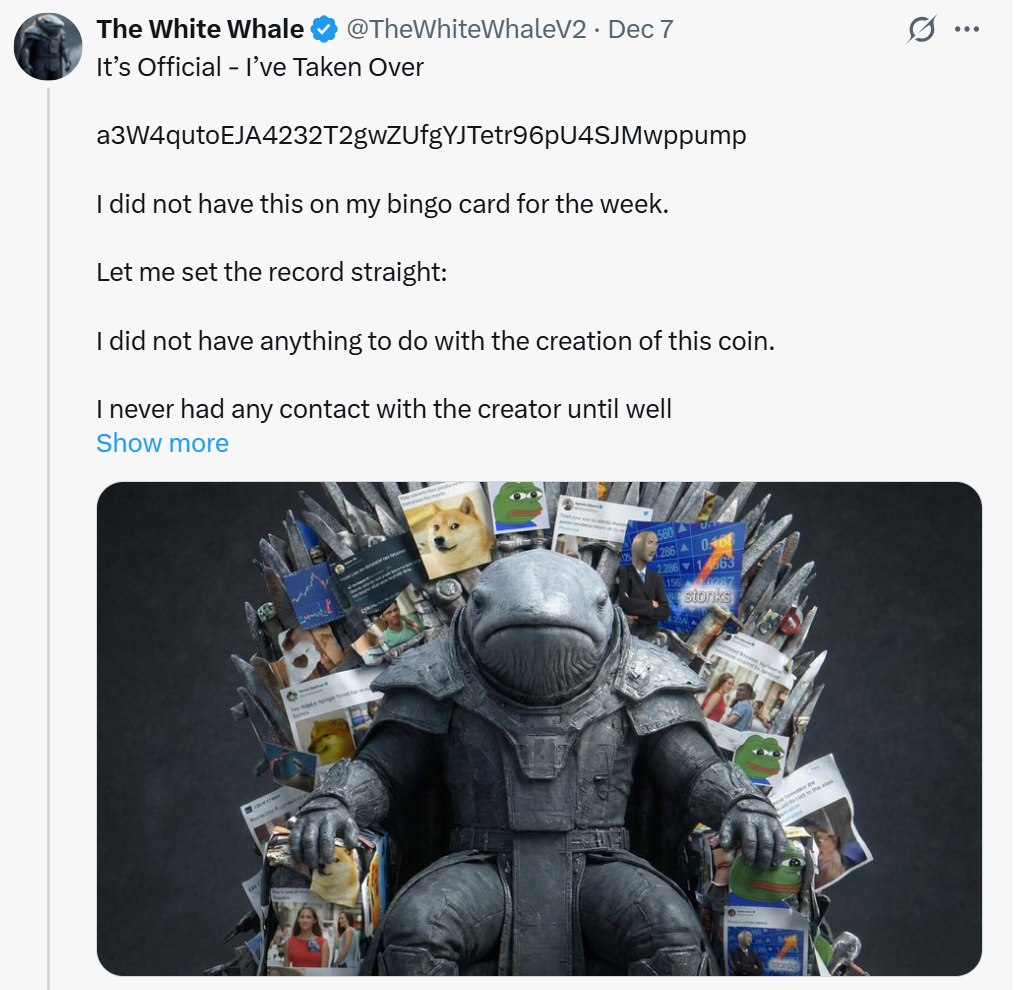
What is important is his promise: 100% of the creator revenue will be returned to the community, and he also bought some tokens as a memento, with the portion he bought never to be sold.

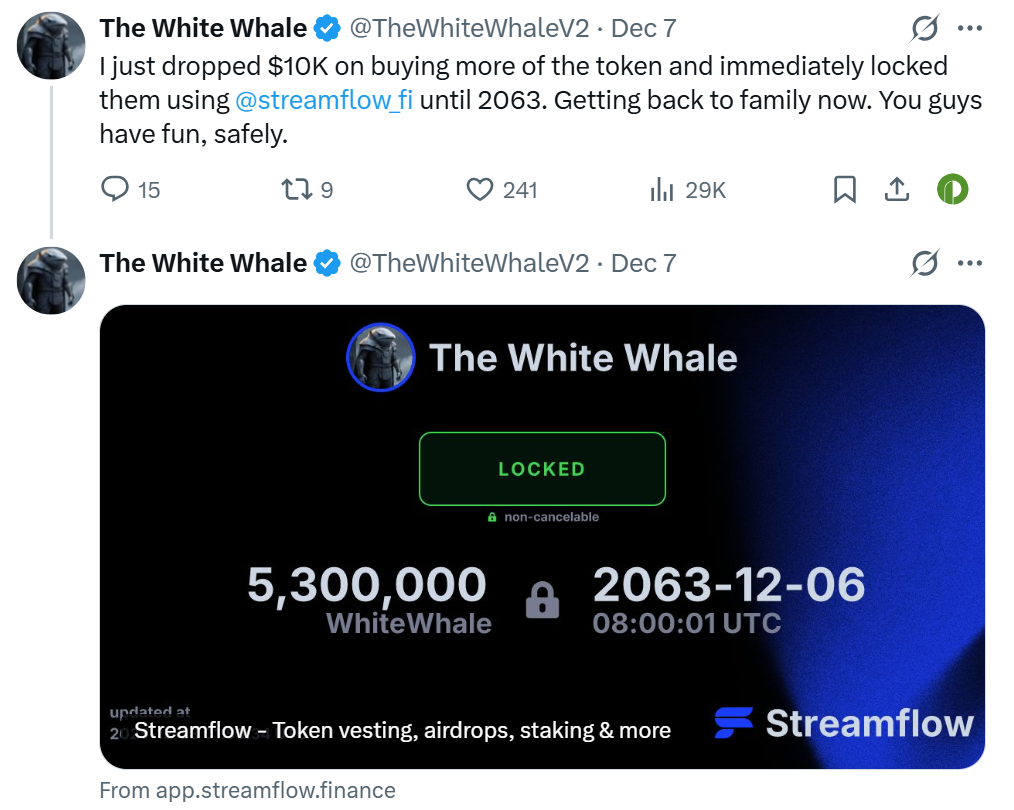
And he proved his sincerity with actions. On the day he announced the takeover, he spent $10,000 to buy 5.3 million tokens and locked them via the Streamflow protocol, with an unlock date set for 2063.
After that, he disclosed that he had already spent $130,000 to support the community, building a pool on Wasabi and adjusting the LP bandwidth to reduce volatility for holders, and using personal funds to incentivize community contributors.

It was these operations that gradually transformed what was originally a "fan prank" into a narrative sample about "good management" as understood by the community.

What Story Do the On-Chain Data Tell?

After White Whale surged 100 times, on-chain analyst @cryptorinweb3 revisited the token's indicator signals. According to the investigation, on December 2, @nansen_ai data showed that the token supply held by the top 100 holders suddenly dropped from 870 million to 140 million tokens. After checking the exchange labels, he found that this drop was mainly due to a significant amount of funds flowing back to the main liquidity pool (LP). He reminded that when you see such a change in the top 100 holdings, it is always a signal worth further investigation.

Then, on December 4, the "smart money inflow" indicator he set up in Discord was triggered, accompanied by an increase in trading volume.

On December 7, @TheWhiteWhaleV2 himself announced the official takeover. And starting from December 8, after excluding CEX/DEX wallets, the real top 100 holders increased their holdings by over 80%, while exchange supply remained stable.

Let's revisit White Whale's token performance: from the "smart money anomaly" on December 4 to the official takeover on December 7, White Whale's increase was only about 6 times, and it subsequently experienced a correction; the real explosion occurred in late December.

This, of course, is inseparable from sentiment and capital driving, but on the other hand, the responsible attitude and transparent on-chain operations demonstrated by @TheWhiteWhaleV2 himself form the foundation of the project.
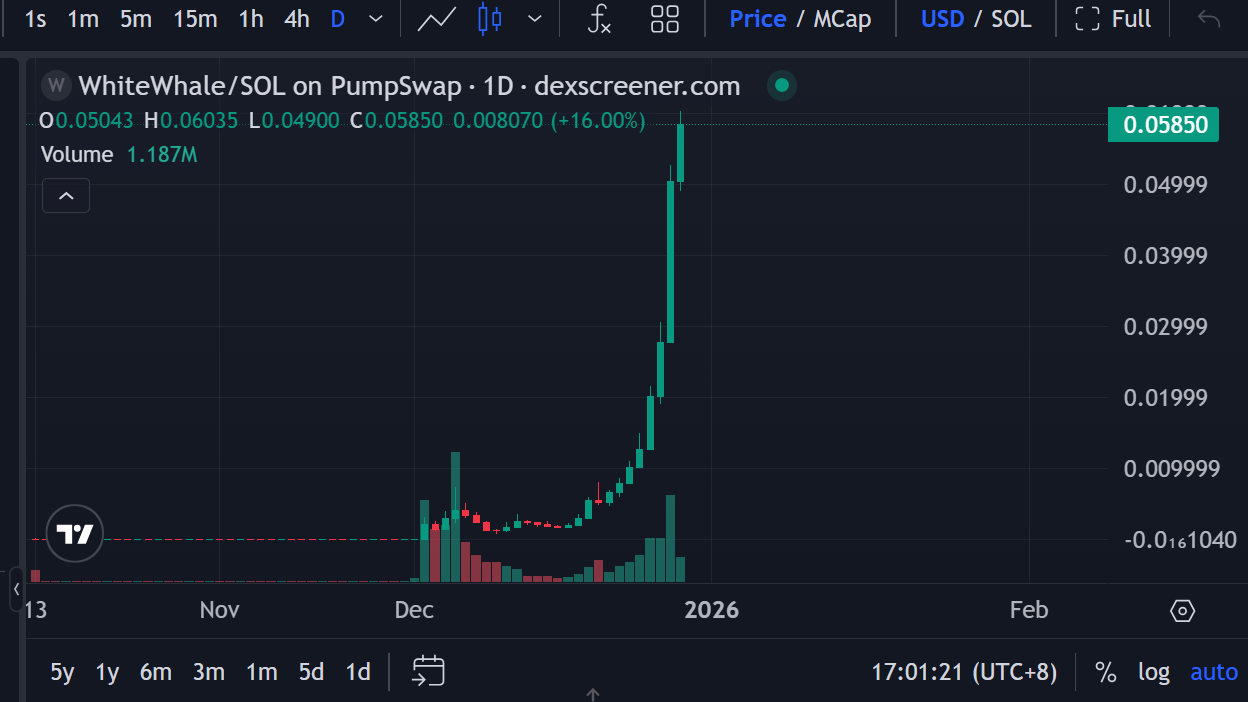
White Whale is essentially a microcosm of the Solana meme coin ecosystem: random, chaotic, high-risk. But the reason it survived and became popular is due to an unexpected positive turn: a nearly dead joke coin was taken over by the original figure in a "responsible, well-managed" manner, rebuilding trust and creating the most inspiring "anti-Rug" case at the end of 2025. Although we don't know how far it can go, in such a market known for short-term gambling, this in itself is rare enough.


Preguntas relacionadas

QWhat is White Whale and why was it initially considered a 'should-be-dead' meme coin?

AWhite Whale is a meme coin launched on Pump.fun on October 13, 2025, created by a fan using the image and persona of crypto KOL @TheWhiteWhaleV2 without authorization. It was considered 'should-be-dead' because it followed the typical meme coin pattern of rapid initial interest followed by near-zero trading volume and obscurity, with 99.9% of such coins dying quickly.

QWhat was the key turning point that led to White Whale's dramatic price surge?

AThe key turning point occurred on December 7, 2025, when @TheWhiteWhaleV2 announced he was taking over control of the meme coin's treasury and management to protect his reputation, promising to reinvest all creator earnings back into the community and locking his own purchased tokens until 2063.

QHow did @TheWhiteWhaleV2 demonstrate his commitment to the White Whale community after taking over?

AHe spent $13,000 of his own money to support the community, including purchasing tokens, building liquidity pools on Wasabi, adjusting LP bandwidth to reduce volatility, and incentivizing community contributors. He also locked his personal token purchase until 2063 via Streamflow protocol.

QWhat on-chain data signals indicated early smart money movement into White Whale before the major price surge?

AOn December 2, the top 100 holders' token supply dropped significantly from 870 million to 140 million tokens due to funds flowing back to the liquidity pool. On December 4, 'smart money inflow' indicators were triggered along with increased trading volume, and after December 8, the real top 100 holders (excluding CEX/DEX wallets) increased their holdings by over 80%.

QWhat makes White Whale's story unique in the context of Solana's meme coin ecosystem?

AWhite Whale represents a rare 'anti-rug' case where a nearly dead meme coin was revitalized through responsible management and transparency when the original persona took control to protect his reputation, transforming a random joke coin into a narrative about good governance in a typically high-risk environment.

Lecturas Relacionadas

Silicon Valley 'Startup Guru' Steve Hoffman: Web3 + AI Could Be a Trap

Silicon Valley investor and "Godfather of Startups" Steve Hoffman warns that combining Web3 with AI is likely a trap, not a promising venture. In an interview, Hoffman argues that while AI is a foundational technology touching all industries, Web3 adds complexity, friction, and regulatory risk without solving mainstream consumer or business needs. He advises founders to focus on deep, specialized applications where startups can out-iterate giants, rather than on generic features easily replicated by large tech companies. Hoffman observes that Silicon Valley will lead foundational AI research, while China excels at rapid, large-scale application and commercialization, particularly in robotics. He stresses that AI-driven autonomous agents capable of collaborative, multi-step tasks are 2-4 years away, which will cause significant job displacement. The solution is not to slow AI but to redesign business models around human-AI collaboration and reform social systems like education and retraining. For startups, Hoffman recommends focusing on vertical, expertise-heavy domains to build defensibility. He sees major opportunities in AI fraud detection and cybersecurity. Key founder mindsets include systemic thinking over feature-focus, relentless customer centricity, building adaptive teams, and deeply understanding AI's capabilities and limits. Hoffman is also leading a non-profit initiative to establish university centers aimed at training future leaders in responsible, human-value-aligned AI innovation.

marsbitHace 1 hora(s)

Silicon Valley 'Startup Guru' Steve Hoffman: Web3 + AI Could Be a Trap

marsbitHace 1 hora(s)

Token Inefficient, Economy Tokenless

The article "Tokens Aren't Economical, Economics Aren't Tokenized" analyzes a pivotal shift in the AI industry from a technology-driven narrative to one dominated by capital efficiency. It highlights two concurrent trends: a severe capital shortage due to the exorbitant and recurring costs of compute (e.g., OpenAI's high burn rate) and a wave of corporate spin-offs where major tech companies are separating their AI units (like Kuaishou's Kling and Baidu's Kunlunxin). The core argument is that AI's "anti-internet" business model, where user growth increases costs rather than profits, has created a disconnect between high valuations and actual cash flow. Spin-offs address this by allowing AI assets to be valued independently. Within a parent company, they are seen as cost centers, but as standalone entities, they are priced based on their growth potential and scarcity in the primary market, leading to massive valuation premiums (e.g., Kling's estimated value tripling post-spin-off). The industry is at an inflection point, moving from "model worship" to "value realization." The competition is evolving from a pure compute (GPU) race to a broader focus on systemic efficiency and full-stack engineering (involving CPUs and orchestration) to achieve viable commercialization. The year 2026 is framed as a critical moment where the industry must definitively answer how to economically translate AI capability into tangible business value, reshaping the sector's future power structure.

marsbitHace 1 hora(s)

Token Inefficient, Economy Tokenless

marsbitHace 1 hora(s)

Crossing the 'Memory Wall': The Wafer-Level Revolution and Computing Power Routes in the AI Inference Era

In 2026, a historic shift occurred in AI as major cloud providers' inference spending surpassed training spending for the first time, signaling a move from "building large models" to "using large models." This shifts the core challenge from computing power to the "memory wall"—the bottleneck of data movement (model weights, activations, KV Cache) between external DRAM and processors, where energy and latency from data transfer far exceed computation itself. Companies like Nvidia face GPU idle time due to bandwidth limits. In contrast, Cerebras Systems adopts a radical "wafer-scale" approach with its Wafer-Scale Engine (WSE). Instead of cutting a silicon wafer into many chips, Cerebras uses almost the entire wafer as one massive chip (WSE-3). This design provides 44GB of on-chip SRAM, delivering memory bandwidth thousands of times higher than traditional HBM (e.g., 21 PB/s vs. Nvidia B200). For LLM inference, weights are streamed layer-by-layer from external MemoryX storage to the chip, avoiding HBM bottlenecks. This results in token generation speeds 1.5–5 times faster than Nvidia's B200 in some models and significant advantages in first-token latency and long-context tasks. Additionally, Cerebras's architecture offers much lower interconnect power consumption (0.15 pJ/bit vs. GPU's ~10 pJ/bit). However, Cerebras faces challenges: SRAM scaling has slowed with advanced nodes, limiting future capacity gains; the chip requires specialized liquid cooling and custom software stacks; and its external I/O bandwidth (150 GB/s) is low compared to NVLink, hindering multi-system scaling for very large models. Competition is intensifying. Major players are pursuing three paths: 1) Developing proprietary inference ASICs (e.g., Google TPU, Microsoft Maia), 2) Leveraging advanced packaging (e.g., TSMC's SoW) to democratize wafer-scale-like integration, potentially eroding Cerebras's process advantage within a few years, and 3) Exploring optical interconnects for ultimate bandwidth. Commercially, Cerebras is transitioning from a hardware vendor to a service provider, facing the immense challenge of building high-power, specialized data centers to meet large contracts (e.g., 250MW/year from 2026–2028). In conclusion, the AI inference era presents a fundamental architectural trade-off. Cerebras opts for extreme physical optimization for low-latency, single-task performance, while Nvidia prioritizes versatility and massive cluster throughput. The path forward remains uncertain, with technology and business models still evolving in the race toward advanced AI.

marsbitHace 1 hora(s)

Crossing the 'Memory Wall': The Wafer-Level Revolution and Computing Power Routes in the AI Inference Era

marsbitHace 1 hora(s)

Has Bitcoin's 'Rebound Ended', Officially Entering the Late Bear Market Phase?

**Title: Has Bitcoin's Rebound Ended, Entering the Late Bear Market Phase?** **Summary:** Bitcoin's price has declined by 13% this week, signaling a potential return to late-stage bear market conditions. The price fell to around $67k, positioned between the Realized Price and Realized Cap Weighted Average. For the first time since early 2022, the Short-Term Holder cost basis has dropped below this key average, confirming a hallmark of late-cycle bear markets. Profitability metrics have collapsed sharply. The 7-day average of the Realized Profit/Loss ratio plummeted from a local high of 3.16 to 0.29, mirroring the February panic sell-off. Critically, the 90-day average never breached the threshold of 2, indicating the recent rally to $82k was a bear market bounce, not a structural shift. Realized losses surged to $1.35 billion daily, with $770 million coming from Long-Term Holders selling at a loss. This accelerating redistribution of supply from weak to strong hands is a necessary but ongoing process for a market bottom. The rally stalled almost precisely at the aggregate cost basis (~$83k) of US spot Bitcoin ETF investors, turning that level into strong resistance and leaving the average ETF holder underwater again. Spot market flows have turned decisively negative, showing sellers are dominating order books despite the price drop. While a significant futures long liquidation event cleared over $400 million in leverage, providing a potential reset, sustained spot demand is yet to materialize. Options markets continue to price in higher future volatility (Implied Volatility) than recent price action (Realized Volatility) has shown, with a persistent skew towards put options, indicating ongoing demand for downside protection. In conclusion, multiple metrics point to a fragile market structure. Resistance at the ETF cost basis, accelerating realized losses, dominant spot selling, and cautious options pricing all suggest the bear market trend persists. A sustainable recovery likely requires a resurgence of spot demand, ETF holders returning to profit, and a clear reduction in selling pressure.

marsbitHace 1 hora(s)

Has Bitcoin's 'Rebound Ended', Officially Entering the Late Bear Market Phase?

marsbitHace 1 hora(s)

Trading

Spot
Futuros

Artículos destacados

Qué es MEME 2.0

Memecoin 2.0: El Ascenso de $MEME 2.0 en el Mundo de las Criptomonedas Introducción En el panorama siempre cambiante de las criptomonedas, ha surgido un nuevo contendiente. Memecoin 2.0, simbolizada como $MEME 2.0, lleva el concepto de las monedas meme a un emocionante nuevo nivel. Como un subproducto del Memecoin original, este proyecto ha capturado la atención de la comunidad cripto al cambiar el enfoque de los incentivos financieros típicos a una experiencia comprometida y entretenida. Operando en la blockchain de Ethereum, Memecoin 2.0 redefine audazmente la participación de la comunidad en la esfera cripto. ¿Qué es Memecoin 2.0, $MEME 2.0? En su núcleo, Memecoin 2.0 es un proyecto de criptomoneda que prioriza el espíritu comunitario y la diversión asociada con la cultura meme. A diferencia de las criptomonedas convencionales, que se concentran en casos de uso prácticos y beneficios tangibles, Memecoin 2.0 se distingue al abrazar el lado más liviano de la moneda digital. El proyecto existe sin promesas de utilidad, un mapa estructurado o retornos financieros, enfocándose en cambio en fomentar una comunidad vibrante centrada en memes y en el disfrute compartido. Al hacerlo, aprovecha la creciente tendencia de la cultura meme en el espacio en línea, convirtiéndose en un jugador único en el mundo de los activos digitales. Creador de Memecoin 2.0, $MEME 2.0 A pesar de la extensa investigación sobre los orígenes de Memecoin 2.0, la identidad explícita de su creador sigue siendo desconocida. Esta anonimidad no es inusual en la comunidad cripto, donde muchos proyectos son liderados por individuos o grupos que prefieren permanecer en las sombras. La falta de información disponible públicamente sobre el creador podría verse como un movimiento estratégico, poniendo el foco en la participación comunitaria en lugar de la notoriedad individual dentro del espacio. Inversores de Memecoin 2.0, $MEME 2.0 La información sobre los inversores o el respaldo financiero de Memecoin 2.0 es escasa. Esta ausencia de detalles puede sugerir que el proyecto es autofinanciado o que su enfoque en la comunidad en lugar de las estructuras de inversión tradicionales ha atraído a un tipo diferente de apoyo. Dado que el mundo de las monedas meme generalmente involucra una participación más de base en lugar de inversión institucional, este enfoque está alineado con la ética de los proyectos impulsados por la comunidad. ¿Cómo Funciona Memecoin 2.0, $MEME 2.0? Memecoin 2.0 opera completamente en la blockchain de Ethereum, capitalizando sus robustas características de seguridad y escalabilidad. Al aprovechar las fortalezas de Ethereum, Memecoin 2.0 puede ofrecer un entorno seguro para las interacciones de los usuarios, asegurando que las transacciones sean tanto eficientes como rentables. Uno de los atributos únicos de Memecoin 2.0 radica en su estructura impulsada por la comunidad. El valor y la popularidad del token $MEME 2.0 derivan de la participación activa de sus usuarios, en vez de de una utilidad inherente. Este diseño refuerza el enfoque del proyecto en el aspecto de entretenimiento de las criptomonedas, lo que implica que la risa y la participación comunitaria son las verdaderas monedas que impulsan su éxito. Además, el proyecto encaja dentro del ecosistema más amplio de las monedas meme, donde el valor de cada moneda meme oscila basado en la cultura, tendencias y la participación de la comunidad, en lugar de principios económicos tradicionales. Cronología de Memecoin 2.0, $MEME 2.0 Para entender mejor la evolución y los hitos de Memecoin 2.0, aquí hay una cronología que destaca eventos significativos en su historia: 2024: Se reconoce la creación de Memecoin 2.0 como una ramificación del Memecoin original, estableciéndose dentro del contexto próspero de las monedas meme mientras opera en la blockchain de Ethereum. 13 de julio de 2024: Memecoin 2.0 se posiciona oficialmente como una moneda meme centrada en la comunidad en la red de Ethereum, enfatizando su enfoque centrado en el entretenimiento que invita a los usuarios a participar y crecer. Puntos Clave Sobre Memecoin 2.0, $MEME 2.0 Varios rasgos críticos definen a Memecoin 2.0: Enfoque Centrado en la Comunidad: La misión principal de Memecoin 2.0 es crear una experiencia comunitaria divertida y atractiva, capitalizando en el disfrute colectivo derivado de la cultura memética. Construido sobre Ethereum: Operar en la blockchain de Ethereum proporciona al proyecto una infraestructura esencial que garantiza seguridad y escalabilidad. Falta de Utilidad o Hoja de Ruta: En un notable desvío de las criptomonedas tradicionales, Memecoin 2.0 no promete características utilitarias ni retornos financieros, reafirmando su compromiso con la participación comunitaria y el compromiso social. Enfoque en la Cultura Memética: Al abrazar los aspectos humorísticos y culturales del fenómeno meme, Memecoin 2.0 proporciona una plataforma para que los usuarios interactúen con cripto tanto fuera de línea como en línea. Contexto Adicional: La Importancia de las Monedas Meme Las monedas meme han surgido como una clase distinta de criptomonedas, a menudo impulsadas por el humor y un enfoque desenfadado para el comercio. Estas monedas generalmente carecen de una utilidad significativa o hojas de ruta de desarrollo, atrayendo a los usuarios con la promesa de diversión, interacción comunitaria y relevancia cultural. En el panorama del ecosistema cripto más amplio, las monedas meme reviven la importancia de la participación comunitaria, revirtiendo enfoques únicamente motivados por el lucro. Proyectos como Memecoin 2.0 inauguran una era donde el entretenimiento puede armonizar con las aspiraciones financieras, convirtiendo la blockchain en un parque de diversiones para la creatividad y la interacción social. Conclusión Memecoin 2.0, o $MEME 2.0, encarna una nueva ola de criptomonedas que prioriza la participación comunitaria sobre estructuras financieras rígidas. Con un enfoque en el humor y la interacción social, capitaliza sobre la fascinación que rodea la cultura meme. Al operar en la blockchain de Ethereum, Memecoin 2.0 aprovecha las capacidades de la tecnología mientras se mantiene firme en su compromiso con el valor de entretenimiento de la moneda digital. A medida que el espacio alrededor de las criptomonedas continúa evolucionando, Memecoin 2.0 sirve como un testimonio de la noción de que el futuro de los activos digitales podría depender, en gran medida, de experiencias compartidas, risas y sólidas conexiones comunitarias. En el mundo impredecible de las criptomonedas, quizás la alegría pueda ser tan valiosa como la ganancia financiera tradicional.

95 Vistas totalesPublicado en 2024.04.04Actualizado en 2024.12.03

Qué es MEME 2.0

Cómo comprar MEME

¡Bienvenido a HTX.com! Hemos hecho que comprar Memeland (MEME) sea simple y conveniente. Sigue nuestra guía paso a paso para iniciar tu viaje de criptos.Paso 1: crea tu cuenta HTXUtiliza tu correo electrónico o número de teléfono para registrarte y obtener una cuenta gratuita en HTX. Experimenta un proceso de registro sin complicaciones y desbloquea todas las funciones.Obtener mi cuentaPaso 2: ve a Comprar cripto y elige tu método de pagoTarjeta de crédito/débito: usa tu Visa o Mastercard para comprar Memeland (MEME) al instante.Saldo: utiliza fondos del saldo de tu cuenta HTX para tradear sin problemas.Terceros: hemos agregado métodos de pago populares como Google Pay y Apple Pay para mejorar la comodidad.P2P: tradear directamente con otros usuarios en HTX.Over-the-Counter (OTC): ofrecemos servicios personalizados y tipos de cambio competitivos para los traders.Paso 3: guarda tu Memeland (MEME)Después de comprar tu Memeland (MEME), guárdalo en tu cuenta HTX. Alternativamente, puedes enviarlo a otro lugar mediante transferencia blockchain o utilizarlo para tradear otras criptomonedas.Paso 4: tradear Memeland (MEME)Tradear fácilmente con Memeland (MEME) en HTX's mercado spot. Simplemente accede a tu cuenta, selecciona tu par de trading, ejecuta tus trades y monitorea en tiempo real. Ofrecemos una experiencia fácil de usar tanto para principiantes como para traders experimentados.

211 Vistas totalesPublicado en 2024.12.12Actualizado en 2026.06.02

Cómo comprar MEME

Discusiones

Bienvenido a la comunidad de HTX. Aquí puedes mantenerte informado sobre los últimos desarrollos de la plataforma y acceder a análisis profesionales del mercado. A continuación se presentan las opiniones de los usuarios sobre el precio de MEME (MEME).

活动图片













