Which Way the Fish Head Points, There's Also Shandong-Style Learning in the Crypto World

marsbitPublicado a 2026-01-08Actualizado a 2026-01-08

Resumen

The article "Where the Fish Head Points: The 'Shandong Rule' in Crypto" uses the metaphor of a Shandong dining custom — where the fish head is oriented towards the guest of honor — to critique the culture of influence and favor-seeking in the crypto industry, particularly around Binance. It highlights how a casual New Year’s tweet by Binance co-founder He Yi, saying “我踏马来了” (I’ve arrived), quickly led to the creation and listing of a meme token with the same name on Binance Alpha — without any direct instruction from her. The author argues that this reflects a deeper cultural issue: instead of transparent, rule-based processes, success increasingly depends on anticipating and pleasing key decision-makers. The piece contrasts this with sectors like AI, where technical merit drives advancement, and suggests that crypto’s reliance on insider access and social signaling — rather than innovation — may signal industry decline. While He Yi may not be directly involved, the system incentivizes sycophancy and information asymmetry, making “reading the room” more valuable than building value.

Written by: Curry, Deep Tide TechFlow

There's a rule at Shandong banquet tables: when the fish is served, the head must point toward the seat of honor.

Whoever it points to is the main guest and must drink first. This isn't written down anywhere, but everyone in Shandong knows it. No one teaches it; you just pick it up.

Recently, someone drew a picture called "Crypto Circle Shandong-Style Learning." A group of people sit around a table eating fish, with Yi He in the seat of honor, and KOLs, the listing team, and editors gathered on either side.

The caption: When Binance lists a coin, the fish head must point toward Yi He.

On January 1, Yi He posted a New Year's tweet. Riding a white horse by the sea, with a caption:

I'm fucking coming.

A fine New Year's greeting—"fucking coming," the Year of the Horse, with a bit of homophonic wit.

Today, Binance Alpha listed a new coin called "I'm Fucking Coming." It was community-made, with no direct connection to Yi He.

But look at this chain: Sister Yi posts a tweet, the community creates a coin, Alpha lists it.

No one needs to give any orders in between.

Last year, Binance was chased and criticized over "girlfriend coins," accused of shady listing practices and利益输送 (interest transfer). Yi He responded several times, saying they were reflecting, adjusting, and even created Alpha as a screening pool.

In December, she also tweeted saying, don't try to find angles in our official tweets, we won't pay attention to these kinds of Memes anymore.

Twenty-eight days later, her New Year's tweet became a new coin on Alpha.

What was the problem with girlfriend coins? It was about backdoor deals, favoritism,利益输送 (interest transfer).

These require evidence, a trail, a specific "girlfriend."

But "I'm Fucking Coming" doesn't need any of that.

No backdoor, no favoritism, no利益输送. Sister Yi posted a picture, and the people below just started moving on their own.

This perhaps touches on the essence of Shandong-style learning: The leader doesn't need to say anything; you have to figure it out yourself.

Some in the community commented that Alpha is now just a tool for currying favor, its purpose is to make Sister Yi happy.

Crude wording, but it describes an atmosphere.

When a platform's direction starts revolving around someone's social media, when "which coin to list" becomes "guess what she likes," rules cease to matter.

What matters is揣摩 (speculation/figuring out).

Some put it more harshly: If you want to know if an industry has a future, ask one question—In this industry, do people who are good at flattery succeed more easily than people who are good at doing things?

If the answer is "yes," then this industry is on the decline.

In the crypto world, this trick really works. And the most successful ones, everyone knows who the flattery should be directed toward.
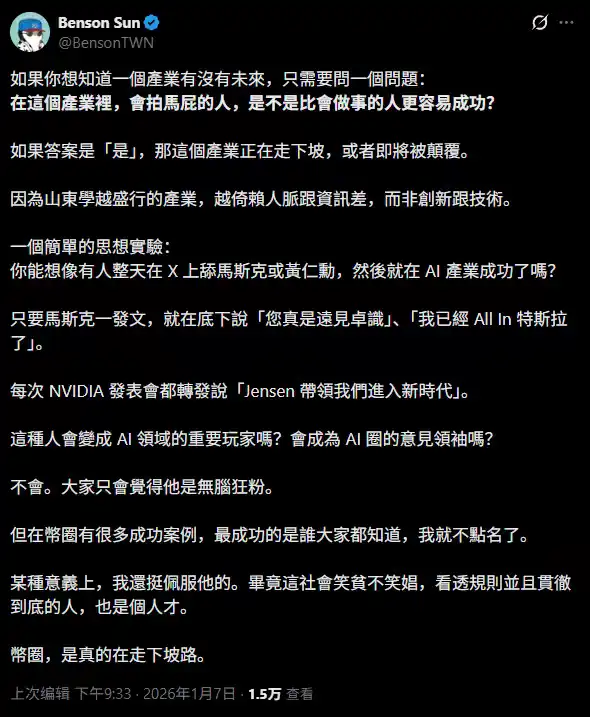
The core resources in the AI circle are technology and products; you have to deliver. Jensen Huang won't give you GPUs just because you call him daddy every day.

The core resources in the crypto circle are listing rights, traffic, who knows the news first. These things aren't in the code; they're in people's hands.

Things in people's hands must be obtained through human methods.

The more prevalent Shandong-style learning is, the more it relies on connections and information asymmetry, not innovation and technology.

Yi He might not even know about this. A small MEME worth a few million market cap isn't enough to bother the Co-CEO.

But that's precisely the problem.

She doesn't need to know. The fish head will turn by itself.

This is really much more efficient than girlfriend coins.

Girlfriend coins at least required a girlfriend. Shandong-style learning only requires an atmosphere.

And those who see through this set of rules and implement them thoroughly are, in a sense, also talented.

After all, in this society, people laugh at the poor, not the prostitute.

Preguntas relacionadas

QWhat is the core concept of 'Shandong Study' in the crypto world as described in the article?

AThe core concept of 'Shandong Study' in the crypto world refers to an unwritten rule where individuals or groups instinctively align their actions to please key figures in power, such as Binance's He Yi, without explicit instructions. It emphasizes intuition and揣摩 (speculation) over formal rules, particularly in contexts like token approvals on platforms.

QHow did the meme token '我踏马来了' (I'm Coming on Horseback) get listed on Binance Alpha according to the article?

AThe meme token '我踏马来了' was created by the community after He Yi, Binance's co-CEO, posted a New Year's tweet with the phrase '我踏马来了' and an image of herself on a horse. The community independently developed and listed the token on Binance Alpha, without direct involvement or instructions from He Yi, demonstrating the 'Shandong Study' phenomenon.

QWhat criticism does the article level against the crypto industry's reliance on 'Shandong Study' dynamics?

AThe article criticizes that such dynamics prioritize flattery and connections over innovation and technology, suggesting that an industry where 'bootlicking' is more rewarded than actual work is in decline. It highlights how resources like token listing privileges and information asymmetry are controlled by people rather than code, leading to a culture of揣摩 (speculation) rather than merit-based success.

QHow does the 'Shandong Study' approach differ from the previous '闺蜜币' (close-friend coin) issue at Binance?

AThe '闺蜜币' issue involved alleged backdoor dealings and explicit利益输送 (benefit transfers) through personal relationships, requiring evidence of specific connections. In contrast, 'Shandong Study' operates implicitly—no direct orders or relationships are needed; instead, participants intuitively act to align with the preferences of powerful figures like He Yi, creating a self-driven culture of compliance without formal corruption.

QWhat broader implication does the article suggest about power and decision-making in crypto platforms like Binance?

AThe article implies that decision-making in crypto platforms can become overly centralized around key individuals, where informal influence and social media activity shape outcomes like token listings. This shifts focus from transparent, rule-based systems to a culture of揣摩 (speculation) and alignment with personal whims, potentially undermining innovation and fairness in the industry.

Lecturas Relacionadas

Apple's Desired On-Device AI Sees a Dark Horse Emerge: The First Cognitive Model is Born, 4B Matches GPT-5.4

A Chinese company, Tomorrow's Journey (Nextie), has introduced what it is calling the industry's first "cognitive model" for edge devices. Named New Journey Alpha, this 4-billion-parameter model reportedly matches the performance of trillion-parameter giants like GPT-5.4 in group intelligence tasks such as debate and collective decision-making. The development follows Andrej Karpathy's vision of stripping vast factual knowledge from large language models to retain only a smaller "cognitive core" capable of reasoning, planning, and knowing its own limits. This approach directly addresses the soaring computational costs and token expenses hindering AI's widespread deployment, as highlighted by incidents like Amazon shutting down an internal AI tool due to prohibitive costs. Trained via reinforcement learning on a corpus of academic papers from 1800-2020 to enhance generalization, the model enables three key advancements: 1) Improved decision quality in multi-agent systems, 2) Drastically reduced compute costs, allowing for cost-effective cloud or on-device (e.g., MacBook) deployment, and 3) The feasibility of "proactive" AI agents that act autonomously without user prompts, unlocking new commercial possibilities beyond today's reactive models. Built by the former Microsoft Xiaoice team—known for creating a 3.6B model that outperformed a 65B Llama model—the company is now focusing on the multi-agent systems sector, a field gaining significant investor interest. The model's economic impact is profound; by achieving high-level performance with minimal parameters, it fundamentally alters the cost structure of AI services, challenging the prevailing model of ever-larger parameter counts.

marsbitHace 50 min(s)

Apple's Desired On-Device AI Sees a Dark Horse Emerge: The First Cognitive Model is Born, 4B Matches GPT-5.4

marsbitHace 50 min(s)

OpenAI's 'Blueprint for the Future': Making AI Beneficial for Every Person on the Planet

A new transformative technology emerges every few generations. OpenAI draws a parallel with the advent of electricity in the 1920s, which initially brought convenience but ultimately enabled unprecedented progress in medicine, engineering, and living standards by empowering people to create new possibilities. AI is poised to recreate this phenomenon. Its true significance lies not in the technology itself, but in what people can achieve with it—from understanding a medical bill or starting a business to aiding scientific discovery. OpenAI believes AI should be universally accessible, allowing everyone to use it according to their own needs. This future, however, is not guaranteed. While transformative tech can centralize power, OpenAI's philosophy is that AI must serve humanity, augmenting human capabilities and broadly distributing its benefits. The company's first commitment is to build AI for human service, aiming to empower the many rather than concentrate power in a few. Safety, alignment with human intent, and oversight are paramount. OpenAI is optimistic about AI's potential to expand human welfare but remains clear-eyed about risks. The goal is to help people achieve more, not to replace them. Full automation is not the desired future; human judgment, values, and direction will become even more critical. OpenAI outlines three core goals: 1. Build automated AI researchers to accelerate and increasingly automate the research process itself, maintaining close human collaboration. The internal projection is that by March 2028, a significant portion of their research will be conducted by AI systems working alongside human researchers. 2. Accelerate economic development by advancing science, boosting productivity, and fostering growth, while ensuring the fruits are widely shared. 3. Provide a personal AGI for everyone on Earth, allowing individuals to benefit from this transformative technology in their own way. The company is entering its third phase, moving from foundational AGI research (Phase 1) to product deployment and learning from real-world use (Phase 2). The current challenge is making advanced AI abundant, affordable, safe, practical, and usable for all individuals and organizations. OpenAI concludes that a widely distributed power structure leads to a more resilient, adaptable, and free society. A positive AI future should not be controlled by a handful of entities but built, benefited from, and owned by many. If realized correctly, AI can become a cornerstone for enhancing global productivity, creativity, scientific advancement, and economic opportunity, fulfilling the mission to ensure AGI benefits all of humanity.

marsbitHace 1 hora(s)

OpenAI's 'Blueprint for the Future': Making AI Beneficial for Every Person on the Planet

marsbitHace 1 hora(s)

Arthur Hayes' New Article: AI Bubble Nears Bursting, Crypto Market Faces Short-Term Pressure

In a new essay, Arthur Hayes argues that the AI market bubble is approaching a rupture, which will place significant short-term pressure on crypto assets. He identifies rising oil prices, a trio of massive tech IPOs (SpaceX, Anthropic, OpenAI), and potential anti-AI political rhetoric from Trump as the three key catalysts for a correction. Hayes posits that the prolonged blockage of the Strait of Hormuz will drive energy prices higher, increasing operational costs for data centers and squeezing AI company profits. Simultaneously, the market may struggle to absorb the upcoming wave of multi-trillion dollar tech IPOs. Furthermore, with high inflation hurting his election chances, Trump could pivot to attacking the AI sector with proposals for heavy taxation and regulation to win over voters, spooking the market. Hayes notes that nearly all new dollar liquidity since 2022 has flowed into the AI sector, leaving little for Bitcoin, explaining its recent underperformance. He believes an AI stock crash would trigger a broad risk-off sentiment and credit contraction, dragging down crypto in the near term. Consequently, his fund, Maelstrom, has sold all AI-related stocks and non-core cryptocurrencies, retaining only Bitcoin and Ethereum while building positions in traditional energy stocks. He anticipates Bitcoin will bottom and resume its bull run only after the AI bubble pops and a new monetary easing cycle begins.

marsbitHace 1 hora(s)

Arthur Hayes' New Article: AI Bubble Nears Bursting, Crypto Market Faces Short-Term Pressure

marsbitHace 1 hora(s)

Trading

Spot
Futuros
活动图片





