When the Spreads Reach 50%: The Rise of Pre-Market Crypto-Stock Arbitrage

比推Publicado a 2026-03-16Actualizado a 2026-03-16

Resumen

In the context of the crypto bear market, a new arbitrage opportunity is gaining traction: pre-IPO stock tokenization trading across different platforms. The article highlights significant price discrepancies—sometimes exceeding 50%—for high-profile companies like Kalshi, Polymarket, and SpaceX (xAI) on platforms such as PreStocks, Jarsy, and Tessera. These gaps, driven by varying trading mechanisms and liquidity conditions, reveal a strong market demand for a unified platform that bridges traditional and crypto pre-market trading. The piece argues that building such an intermediary could capitalize on these arbitrage opportunities, especially with a wave of major IPOs expected in 2026, while generating revenue through trading fees and liquidity provision.

Author: Wenser, Odaily Planet Daily

Editor: Hao Fangzhou

Original Title: Spreads Exceeding 50%, The Pre-Market Crypto-Stock Arbitrage Market to Become a New Business in the Crypto Bear Market


Not long ago, Mysten Labs CEO evan.sui shared his views on the "bear market." He mentioned that he does not agree with the so-called "the bear market is great, keep building" argument. In fact, the bear market is not "great"; packaging it as good for everyone overlooks the real costs (such as discouraging builders and users). Many retail investors and excellent teams will face cash flow breaks and have to exit, ultimately harming the long-term development of the crypto industry.

However, data evidence is inconsistent with this view. A report released by Lattice VC in October 2024 showed that at that time, over 80% of crypto startups that announced seed round financing during the 2022 bear market were still building. In other words, if project parties can ensure relative stability in personnel and funds, the bear market is indeed more conducive to project construction and development. As for the reasons, perhaps it's because project parties focus more on product development and experience optimization during a bear market; or perhaps the bear market trains project parties in various abilities to survive. In short, being in a crypto bear market, project parties determined to start a business might instead find a way out of desperation and carve their own path of development.

In view of this, we will explore the potential employment tracks and project directions in this cycle through a series of articles titled "Crypto Bear Market Startup Guide." If crypto projects are born and grow rapidly in the future as a result, Odaily Planet Daily also welcomes project parties to discuss cooperation.

Today, let's first talk about the hottest potential entrepreneurial direction at the moment besides prediction markets—the pre-market price difference market for crypto and stocks.

The Real Demand of the Pre-Market Crypto-Stock Market: Platform Differentiation and Liquidity Bridge

As an intermediate bridge connecting the crypto market and the traditional financial market, crypto-stock trading platforms have not only received high attention and active participation from crypto project parties, but global leading securities platforms including Nasdaq and the New York Stock Exchange have also ventured into it, aiming to capture the incremental market while further activating liquidity in the traditional financial market.

Furthermore, not only have listed cryptocurrency concept stocks undergone tokenization and on-chain contract transformation, but many hot concept stocks that have not yet IPOed have also been highly sought after by both the crypto market and the traditional financial market, thus giving rise to several pre-market stock tokenization trading platforms.

Considering that the capital market is about to welcome a wave of US listings this year, including OpenAI, Anthropic, SpaceX (xAI), Kalshi, Polymarket, OKX, Kraken, and a series of AI model companies, commercial aerospace companies, prediction market platforms, and crypto exchanges, 2026 is undoubtedly a "big year for IPOs."

Against the backdrop of the crypto market falling intermittently with occasional rebounds and the stock market rising everywhere节节攀升, the heat of the pre-market stock trading market further corroborates the above view—there is strong demand for pre-market trading of hot concept stocks in both the crypto market and the traditional financial market.

This is the main reason for the emergence of pre-market stock trading platforms such as PreStocks, Jarsy, and Tessera. Additionally, compared to pre-market stock trading markets in the traditional financial market such as Hiive and Nasdaq Private Market, the trading methods, purchase quotas, and entry barriers of the crypto pre-market trading market are more flexible, and the premiums are relatively higher, so many users participate enthusiastically.

But just as the same token can have different degrees of price differences on different exchanges, before the pre-market stock market temporarily introduces a mechanism similar to an oracle, whatever the reason, we can clearly see that the pricing of the same underlying stock on the different platforms mentioned above has certain price differences.

Based on the above information, we can make a judgment—the crypto market still lacks one or more "bridge platforms between pre-market stock trading markets."

This is probably a necessary step to push stock tokenization and pre-market stock tokenization further forward—a unified comprehensive platform covering pre-market trading in both traditional financial markets and crypto markets.

Below, we will take the 2 leading prediction market platforms Kalshi and Polymarket, which are recently seeking $20 billion in financing, and SpaceX (xAI), valued at $1.25 trillion, as examples to discuss the feasibility and real demand of this "entrepreneurial direction."

Comparing Pre-Market Spreads of PreStocks, Jarsy, Tessera 3 Major Platforms: Maximum Spread Rate Exceeds 50%, Price Difference Up to Nearly $150

Kalshi Pre-Market Spread: Up to $148, Spread Rate About 37%

Taking the Kalshi pre-market trading market as an example, its prices on different platforms are as follows—

PreStocks platform, the pre-market price of the stock token is about $397; (Compared to the $369 we mentioned one month ago in the article "Kalshi Trading Volume Continues to Break New Highs, What is a Reasonable Pre-Market Stock Price?" (https://www.odaily.news/zh-CN/post/5209330), it has increased by nearly $30, a increase of 7.6%)
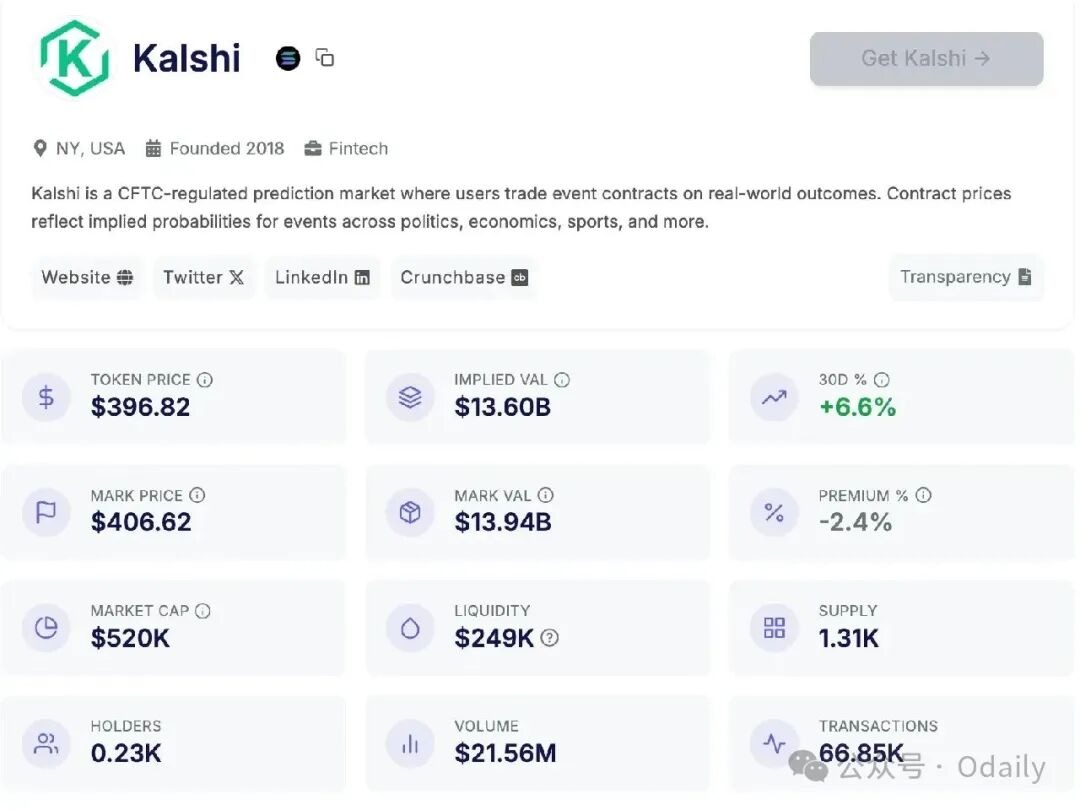
Jarsy platform, the pre-market stock price is quoted at about $545. (Compared to the $504 we mentioned one month ago in the article "Kalshi Trading Volume Continues to Break New Highs, What is a Reasonable Pre-Market Stock Price?" (https://www.odaily.news/zh-CN/post/5209330), it has increased by over $40, a increase of 8.1%)

In other words, the pre-market stock price of Kalshi has a spread of up to $148 between the two major trading platforms (Odaily Planet Daily Note: Considering that the two platforms adopt an order book trading mechanism and an on-chain liquidity token trading mechanism respectively, we are only making an abstract comparison here, temporarily not involving specific asset delivery forms, the same below). If calculated based on the $360 price of the traditional financial market pre-market trading platform Hiive, the pre-market spread is even as high as $185.

Polymarket Pre-Market Spread: Up to $94, Spread Rate Over 50%

Taking the Polymarket pre-market trading market as an example, its prices on different platforms are as follows—

PreStocks platform, the pre-market price of the stock token is about $186 (Odaily Planet Daily Note: up 23% in the past 30 days);
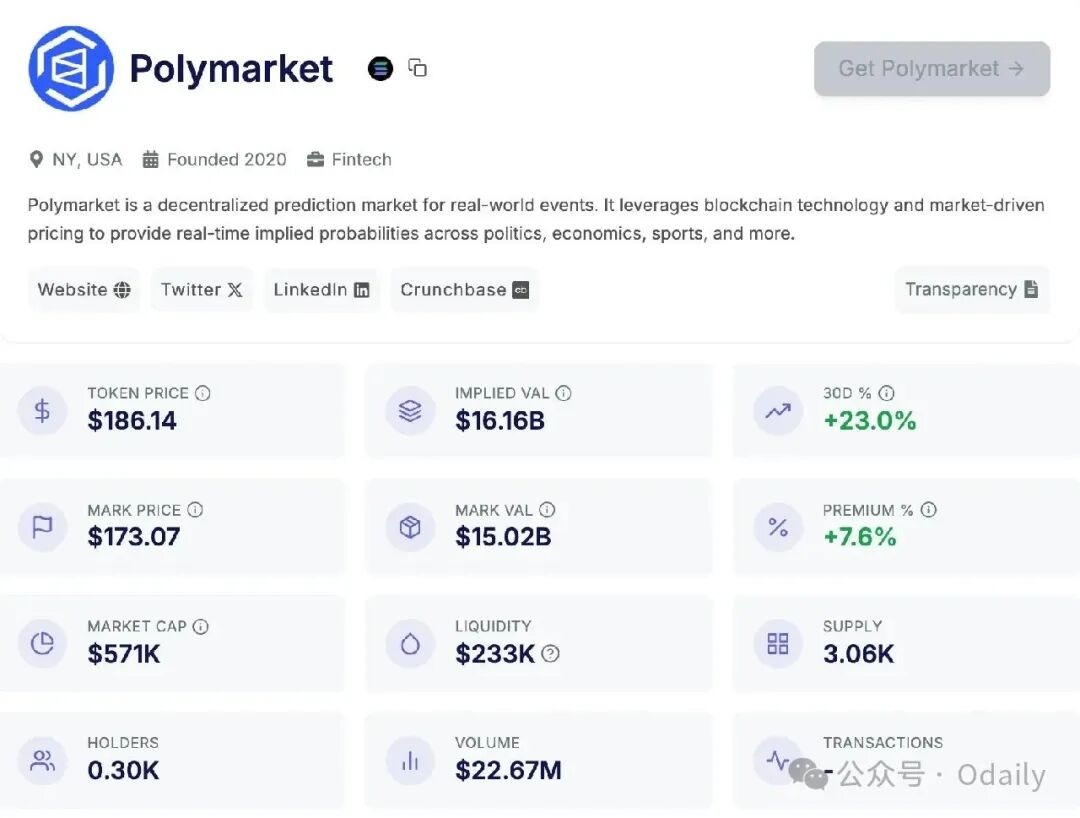
Jarsy platform, the pre-market stock price is quoted at about $280.

In other words, the pre-market stock price of Polymarket has a spread of about $94 between the 2 major platforms, with a spread rate of about 50.5%.

SpaceX(xAI) Pre-Market Spread: About $75, Spread Rate 12.7%

Taking SpaceX(xAI) as an example, its prices on different platforms are as follows—

PreStocks platform, the pre-market price of the stock token is about $666 (Odaily Planet Daily Note: up 4.1% in the past 30 days);
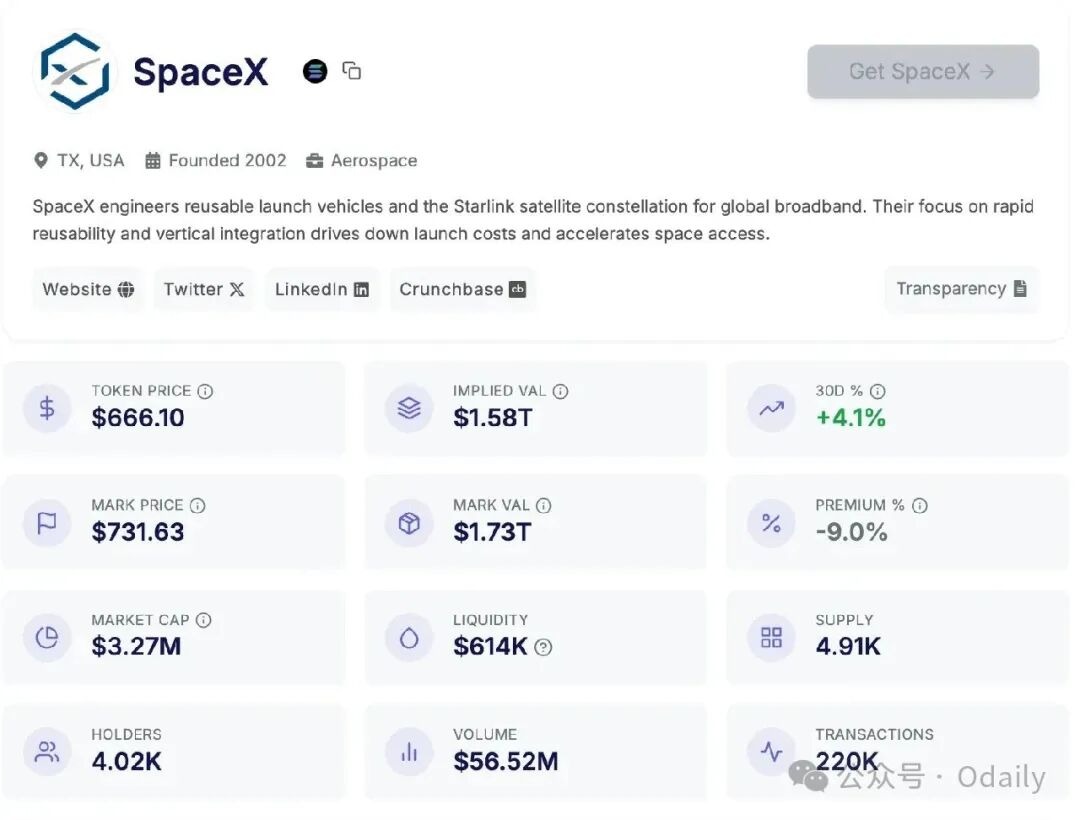
Tessera platform, the pre-market price of the stock token is temporarily reported at about $591 (Odaily Planet Daily Note: up about 14.5% in the past 30 days).
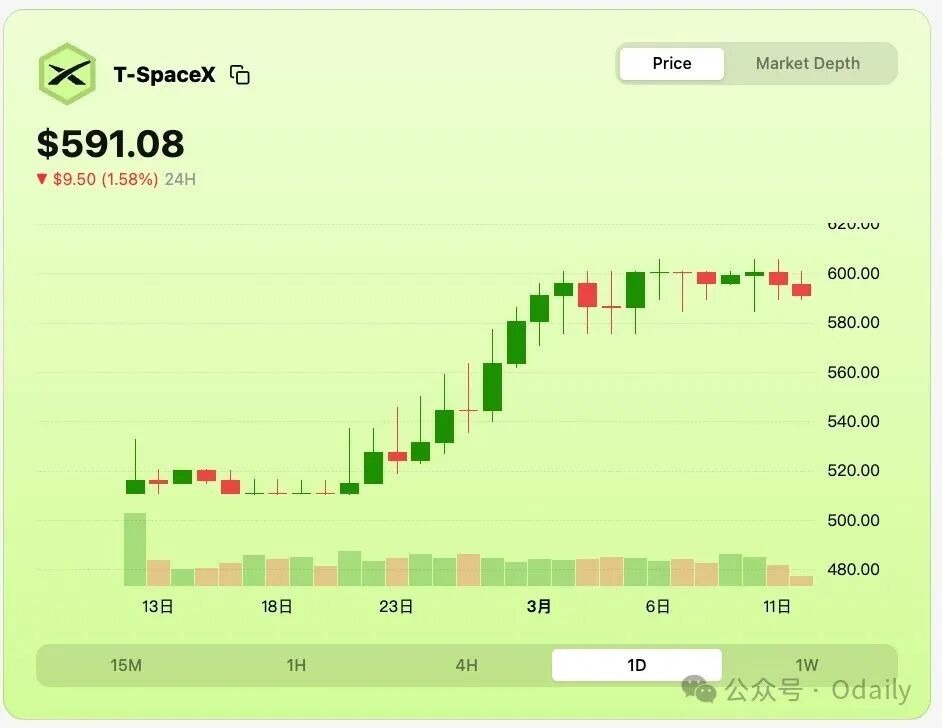
In other words, the pre-market stock price of SpaceX has a spread of about $75 between the 2 major platforms, with a spread rate of about 12.7%.

In summary, based on existing pre-market trading platforms, it might be possible to build a crypto-stock pre-market spread market to meet the trading demand and speculation demand of the market after having sufficient pre-market tokens or pre-market equity capital.

Of course, considering that the current market liquidity remains within the million-dollar level, the main business model of this platform may lie in transaction fees or LP fees, as well as the realization of price differences from the platform's own investment quotas.


Twitter:https://twitter.com/BitpushNewsCN

Bitpush TG Communication Group:https://t.me/BitPushCommunity

Bitpush TG Subscription: https://t.me/bitpush

Original link:https://www.bitpush.news/articles/7619997

Preguntas relacionadas

QWhat is the main topic of the article regarding the crypto bear market?

AThe article discusses the emergence of a new potential business opportunity in the crypto bear market: the pre-market price arbitrage market for tokenized stocks, where significant price differences (spreads) exist across different trading platforms.

QWhich companies are mentioned as examples to illustrate the price differences in the pre-market stock trading platforms?

AThe article mentions Kalshi, Polymarket, and SpaceX (xAI) as examples to illustrate the price differences on platforms like PreStocks, Jarsy, and Tessera.

QWhat was the largest price difference (spread) mentioned for Polymarket's pre-market stock, and what was the spread rate?

AFor Polymarket, the largest price difference mentioned was $94, with a spread rate of approximately 50.5%.

QAccording to the article, what is the proposed solution to address the price differences across various pre-market trading platforms?

AThe article suggests building a bridge platform or a unified comprehensive platform that connects pre-market trading in both traditional financial markets and crypto markets to arbitrage the price differences.

QWhat reason does the article give for the emergence of platforms like PreStocks, Jarsy, and Tessera?

AThese platforms emerged due to the high demand from both crypto and traditional financial markets for pre-market trading of hot concept stocks, especially with the upcoming IPO boom in 2026 involving companies like OpenAI, Anthropic, SpaceX, and others.

Lecturas Relacionadas

KOL's Perspective: Why Is SOL Set to Rise from This Point?

**Summary: Why SOL is Positioned for Growth at This Level** The article argues that SOL is poised for an upward move from its current price point, citing several key factors. Primarily, SOL has just broken out of a 4-month consolidation phase. This breakout signals a return of risk appetite to the broader crypto market, as SOL is seen as a key indicator of overall crypto health. The token's ownership has reportedly shifted from short-term traders and tourists to long-term accumulators, leading to low volume. Any meaningful increase in trading activity could thus trigger significant upward momentum. Fundamental strengths include strong institutional adoption, integration with DeFi and RWAs (Real-World Assets), and the potential benefits from the Clarity Act. Despite its high volatility—having dropped 70% from its all-time high but still up 12x from its bear market low—SOL is highlighted as one of the few tokens from the last cycle to reach new highs. It boasts a robust ecosystem of applications, users, and protocols. Future catalysts include the expected influx of AI developers following the Miami Accelerate conference, which focused on AI on Solana. Furthermore, Solana is positioned as the premier chain for memecoin activity, a trend expected to continue and drive network usage and fees. The article concludes that recent price action reflects a healthy transfer to long-term holders, setting the stage for growth.

marsbitHace 46 min(s)

KOL's Perspective: Why Is SOL Set to Rise from This Point?

marsbitHace 46 min(s)

Those Pre-Bitcoin PoW Protocols Have Recently Been Reimplemented

This article details a recent surge in replicating pre-Bitcoin Proof-of-Work (PoW) protocols, specifically focusing on Hal Finney's 2004 RPOW (Reusable Proofs of Work). Within five days in May 2026, multiple independent builders in the Bitcoin/cypherpunk community launched projects inspired by this early electronic cash proposal. The initiative began with Fred Krueger's `rpow2.com`, a centralized but auditable system that replaced RPOW's original IBM 4758 hardware with Ed25519 signatures. Initially a faithful replica, it later adopted Bitcoin-like features (21M supply cap, difficulty adjustment) and a controversial 5.24% founder allocation. This sparked rapid forks, including `rpow4.com` which incorporated full Bitcoin parameters, a prediction market (`rpowmarket.com`), and a DEX (`rpow2swap.com`). Concurrently, Mike In Space created a prototype of Wei Dai's 1998 b-money proposal (`b-money.replit.app`), pushing the historical exploration even further back. The article contrasts these centralized, server-dependent experiments with Bitcoin's core innovation of decentralized, trustless consensus. It also highlights a parallel development: the `HASH` project on Ethereum, which uses smart contract hooks to enable a purely fair-launch, browser-mineable PoW token with 0% allocations to team or VCs. The collective activity is framed as a meme-driven, educational exploration of cypherpunk history rather than a serious financial movement, with all projects heavily disclaiming any investment value.

marsbitHace 51 min(s)

Those Pre-Bitcoin PoW Protocols Have Recently Been Reimplemented

marsbitHace 51 min(s)

South Korean Exchanges 'Battle' Regulators, Challenging the Boundaries of Enforcement and Legislation

South Korea's cryptocurrency industry is engaged in a rare, direct confrontation with regulators. The Financial Intelligence Unit (FIU), the primary anti-money laundering (AML) watchdog, has recently imposed heavy penalties on major exchanges like Upbit and Bithumb for alleged violations involving unregistered overseas VASPs and AML procedures. However, exchanges are now actively challenging these actions in court and through industry associations. In a significant shift, the Seoul Administrative Court ruled in favor of Upbit's operator, Dunamu, overturning part of an FIU-ordered business suspension. The court found the FIU's penalty criteria and justification insufficiently clear. Similarly, the court suspended the enforcement of a six-month business suspension against Bithumb pending a final ruling, citing potential irreversible harm to the exchange. Beyond legal battles, the industry is contesting proposed legislative amendments. The Digital Asset eXchange Alliance (DAXA) strongly opposes a draft rule that would mandate Suspicious Transaction Reports (STRs) for all crypto transfers over 10 million KRW (~$6,800). DAXA argues this "poison pill" clause violates legal principles and would overwhelm the STR system, increasing reports from 63,000 to an estimated 5.45 million annually for major exchanges, thereby crippling effective AML monitoring. This conflict highlights a structural tension in South Korea's crypto governance: comprehensive digital asset laws are still developing, while regulators rely heavily on AML enforcement. The industry's move from passive compliance to active legal and legislative challenges signifies a new phase, pressing for clearer rules and more proportionate enforcement. While short-term disputes may intensify, this clash could ultimately lead to a more mature and sustainable regulatory framework for South Korea's vibrant crypto market.

marsbitHace 1 hora(s)

South Korean Exchanges 'Battle' Regulators, Challenging the Boundaries of Enforcement and Legislation

marsbitHace 1 hora(s)

After 50x Storage Surge, Justin Sun Always Looks to the Next Decade

Sun Yuchen, known for his controversial stunts like a $30 million lunch with Warren Buffett (canceled due to a kidney stone) and eating a $6.2 million duct-taped banana, is often overshadowed by a significant fact: his decade-long track record of spotting major investment trends. In 2016, he famously advised young people to invest in Bitcoin, Nvidia, Tesla, and Tencent instead of buying property. A hypothetical $20,000 investment in Nvidia and Tesla from that list would now be worth over 50 million RMB. His latest major call was on November 6, 2025, predicting a "50x storage opportunity" tied to the AI boom, which materialized with Sandisk's stock surging nearly 50-fold by 2026. Looking ahead, Sun now focuses on the next frontier: Physical AI. He identifies four key areas: 1. **Embodied AI/Robotics**: He sees this reaching its "iPhone moment," with companies like UBTech and Galaxy General leading in commercialization. 2. **Drones**: Viewed as the first commercially viable form of Physical AI, revolutionizing sectors from warfare (e.g., AeroVironment's Switchblade) to logistics. 3. **Spatial Computing**: Beyond VR, it's about AI understanding physical space, a foundational technology for robotics and autonomous systems, exemplified by Apple's Vision Pro. 4. **Space Exploration**: After a 2025 suborbital flight with Blue Origin, Sun advocates for space as the ultimate frontier, discussing blockchain's potential role in space asset management and data transactions. His investment philosophy involves betting on entire, inevitable trends rather than single companies. For robotics, he sees Tesla (the body/manufacturer) and Nvidia (the brain/AI platform) as complementary plays. In defense drones, he highlights companies making tanks obsolete (AeroVironment) and those augmenting fighter jets (Kratos). For space, he participated in Blue Origin's flight and anticipates SpaceX's potential IPO to redefine the sector's valuation. Sun Yuchen's vision frames the next two decades not as a revolution in information flow (like the internet), but in the fundamental operation of the physical world through AI-powered robots, autonomous systems, and spatial intelligence, ultimately extending human and AI activity into space. While many still focus on conventional assets, he continues to look toward the next technological horizon.

marsbitHace 2 hora(s)

After 50x Storage Surge, Justin Sun Always Looks to the Next Decade

marsbitHace 2 hora(s)

Trading

Spot
Futuros
活动图片





