When Bitcoin Returns to the 60,000s: What Signals Is the Market Waiting for After the Oversold Drop?

Odaily星球日报Publicado a 2026-02-09Actualizado a 2026-02-09

Resumen

Bitcoin recently fell to around $60,000, causing concern among investors. The market is currently in a C-wave decline within a larger A-B-C corrective structure that began from the October 2025 high of $126,200. The analysis presents three potential scenarios: the most likely being a 3-wave C-leg structure with a current rebound from ~$60k (targeting $72k–$74.5k or $80k–$80.6k resistance) followed by a final decline below $60k; a less probable complex prolonged correction; and a very low chance of a V-shaped reversal. Short-term trading using quantitative models yielded a 10.72% profit last week, while a medium-term short position from $89,000 remains open with significant gains. The weekly and daily trends are still bearish, but selling pressure shows short-term signs of weakening. Key support levels are $60k–$62.5k and $57.4k, with resistance at $72k–$74.5k and $80k–$80.6k. The strategy involves maintaining medium-term bearish exposure and executing short-term tactical trades on bounces, with strict risk management rules for stop-losses and profit protection.

Shortly after last week's report concluded, Bitcoin once fell to around $60,000. Many friends sent me private messages expressing concern about Bitcoin's future trend. For investors who had positioned near $80,000 or earlier, the pressure from paper losses is undeniable—I completely understand this sentiment. We have all, to varying degrees, experienced similar moments in different cycles: anxiety, helplessness, and even the choice to give up.

But it is precisely in such phases that emotions can become a greater source of risk than direction. Rather than being led by short-term fluctuations, it's better to stabilize your mindset and re-examine your positions and rhythm. Because next, the market does not rule out the possibility of a阶段性反弹 (staged rebound), and such fluctuations themselves often provide investors with a window for active adjustment: By gradually reducing risk exposure, or through more flexible and rapid波段操作 (swing trading), you can gradually average down costs, alleviate pressure, and face upcoming uncertainties with greater composure.

I hope my article can provide some new perspectives when you feel confused and lost:
Trading Weekly Report Core Summary:

• Bitcoin's internal structure division and推演 (deduction) of the下跌 C-wave initiated on January 14th. (Detailed explanation in Figure 1)

• Strategy Execution (Short-term) Effectiveness Verification: Last week's trading strictly followed the既定短线策略 (established short-term strategy), completing two short-term operations (1x leverage) and successfully achieving a cumulative return of approximately 10.72%.

• Strategy Execution (Mid-term) Effectiveness Verification: Last week followed the既定中线策略 (established mid-term strategy), continuing to hold the short position established at $89,000 (1x leverage). As of last week's close, the profit was approximately 20.97%, with a maximum profit during the period of about 32.58%.

• Core View (Short-term) Verification: Last week, under the pattern of weekly and daily bearish共振 (resonance), the price successively broke through multiple support levels, finally finding support near $60,000. The market movement aligned with our previous expectations for the C-wave adjustment.

The following will provide a detailed review of the market prediction, strategy execution, and specific trading process.

I. Analysis of Bitcoin's Adjustment Structure and Deduction of Future C-wave Movement Structure

Bitcoin Daily K-line Chart:
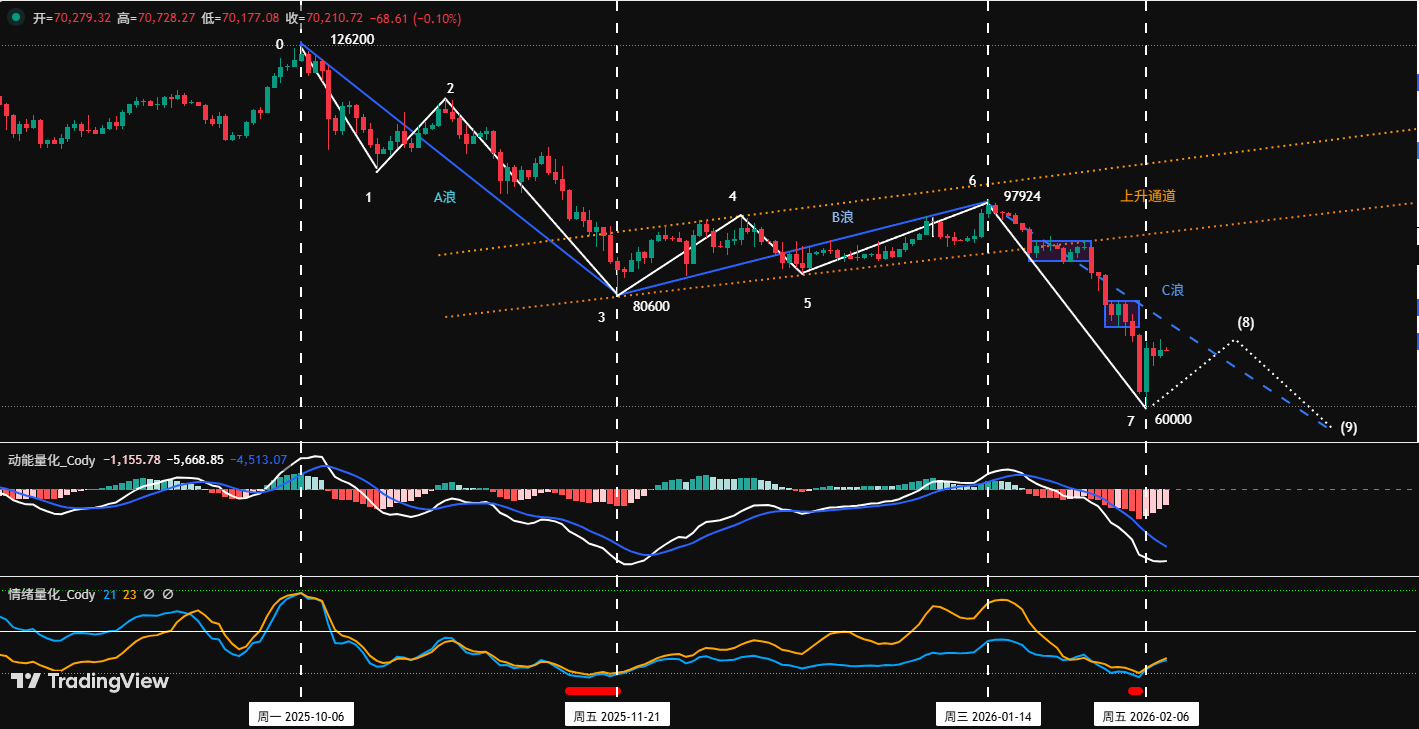
Figure 1

1. Main Structure Analysis:

Currently, the current adjustment starting from the high of $126,200 in October 2025 presents an A-B-C three-wave structure:

• A-wave (Driving Decline Wave): $126,200 (2025-10-06) to $80,600 (2025-11-21), lasting 46 days, maximum decline of 36%.

• B-wave (Rebound Correction Wave): $80,600 (2025-11-21) to $97,924 (2026-01-14), lasting 54 days, maximum increase of 21.5%.

• C-wave (Main Decline Wave): $97,924 (January 14) to present, lasting 25 days, maximum decline of 38.7%.

2. Sub-structure Analysis: Fine剖析 (Analysis) of Impulse and Corrective Waves

1. The internal A-wave can be decomposed into a 3-segment structure, namely segment 0-1, segment 1-2, segment 2-3:

• Segment 0-1: $126,200 (2025-10-06) to $103,528 (2025-10-17), lasting 11 days.

• Segment 1-2: $103,528 (2025-10-17) to $116,400 (2025-10-27), lasting 10 days.

• Segment 2-3: $116,400 (2025-10-27) to $80,600 (2025-11-21), lasting 25 days. (Note: Corrected apparent date inconsistency in original)

2. The internal B-wave can be decomposed into a 3-segment structure, namely segment 3-4, segment 4-5, segment 5-6:

• Segment 3-4: $80,600 (2025-11-21) to $94,589 (2025-12-09), lasting 18 days.

• Segment 4-5: $94,589 (2025-12-09) to $84,450 (2025-12-18), lasting 9 days.

• Segment 5-6: $84,450 (2025-12-18) to $97,924 (2026-01-14), lasting 17 days.

3. Deduction of the internal movement structure of the C-wave, divided into the following three forms:

First Movement Structure Deduction (High Probability): C-wave internal structure presents as 3 segments

• Segment 6-7 (First Round Driving Decline), target completed: $97,924 (2026-01-14) to $60,000 (2026-02-06), lasting 23 days, maximum decline 38.7%. (Judging by adjustment time and decline, $60,000 has a high probability of being the low point of the first segment within the C-wave)

• Segment 7-8 (Expected Rebound): Dotted line part in the figure, the rebound segment that is about to or has already started. The rebound height is unlikely to exceed $97,924 (the B-wave peak). Key resistance areas to watch are the $72,000-74,500 zone and the higher $80,000-80,600 zone.

• Segment 8-9 (Final Decline Segment): Dotted line part in the figure, will initiate the final drop. Its theoretical target range can be projected by measuring the A-wave amplitude. The $60,000 level will be broken in the future, and the price will test lower technical support levels.

Second Movement Structure Deduction (Low Probability): C-wave internal structure presents as 5 segments or more complex structure

This scenario is based on the completion of the first 3-segment structure, but the market still lacks clear bottom reversal signals, requiring judgment based on the adjustment intensity and movement structure type at that time. It implies a significantly extended adjustment time, potentially evolving into complex structures like a "falling wedge" or "multiple three-waves." This path is usually triggered by持续恶化 (deteriorating) macro conditions or market liquidity drying up. Its probability is relatively small in the current environment but cannot be completely ruled out.

Third Movement Structure Deduction (Very Low Probability): V-shaped reversal, adjustment ended, reversal begins

• Segment 6-7 (First Round Driving Decline), target completed: $97,924 (2026-01-14) to $60,000 (2026-02-06).

Segment 7-8 (V-shaped Reversal): Dotted line part in the figure. The rebound is exceptionally strong, not only effectively breaking above the previous high of $97,924 but also sustaining above it, accompanied by significant positive news in the financial markets. If this occurs, it means the entire A-B-C three-wave adjustment starting from $126,200 may have ended in a "simplified form" at $60,000. Although the probability is extremely low, its trigger condition (strong break above $97,924) is clear and discernible, serving as a key observation signal for trend reversal.

In summary, the above three movements are merely deductions based on market behavior logic, not inevitable paths. Regardless of how the market evolves, always remember the principle: "The market is always right."

II. Review of Last Week's Bitcoin Operation Strategy and Key Levels: (02.02~02.08)

1. Short-term Operation Strategy Review: As shown in (Figure 2)

We strictly followed the trading signals issued by our self-constructed Spread Trading Model and Momentum Quantification Model, combined with market movement predictions, and completed two short-term operations, achieving a cumulative profit of 10.72%.

Specific transaction details and review are as follows:

1. Short-term Trading Results Display: (Leverage *1)
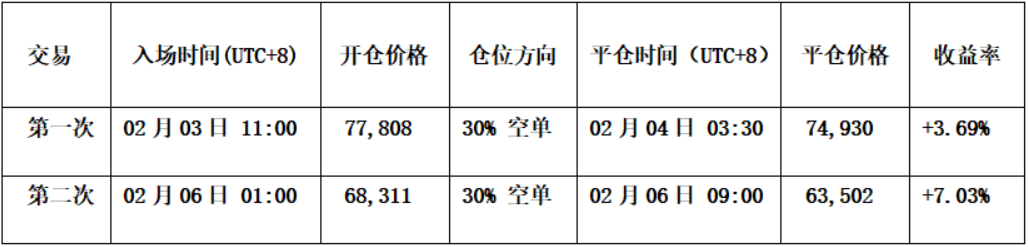
Figure 2

2. Short-term Trading Review:

• First Trade (Profit 3.69%):

• Entry: Rejection at the $80,000 pressure level,叠加 (superimposed) with two model short-selling共振 (resonance) signals. Established a 30% short position at $77,808.

• Risk Control: Initial stop-loss for the short position at $81,000.

• Closing: Fell near the $74,500 support level,叠加 (superimposed) with the spread model bottom signal (red dot) and K-line组合 (combination) bottom signal. Closed all positions at $74,930.

• Second Trade (Profit 7.03%):

• Entry: Rejection at the $69,000 pressure level,叠加 (superimposed) with two model short-selling共振 (resonance) signals. Established a 30% short position at $68,311.

• Risk Control: Initial stop-loss for the short position at $71,000.

• Closing: Fell near the $63,000 support level,叠加 (superimposed) with two model bottom共振 (resonance) signals. Closed all positions at $63,502.

Bitcoin 30-minute K-line Chart: (Momentum Quantification Model + Spread Trading Model)
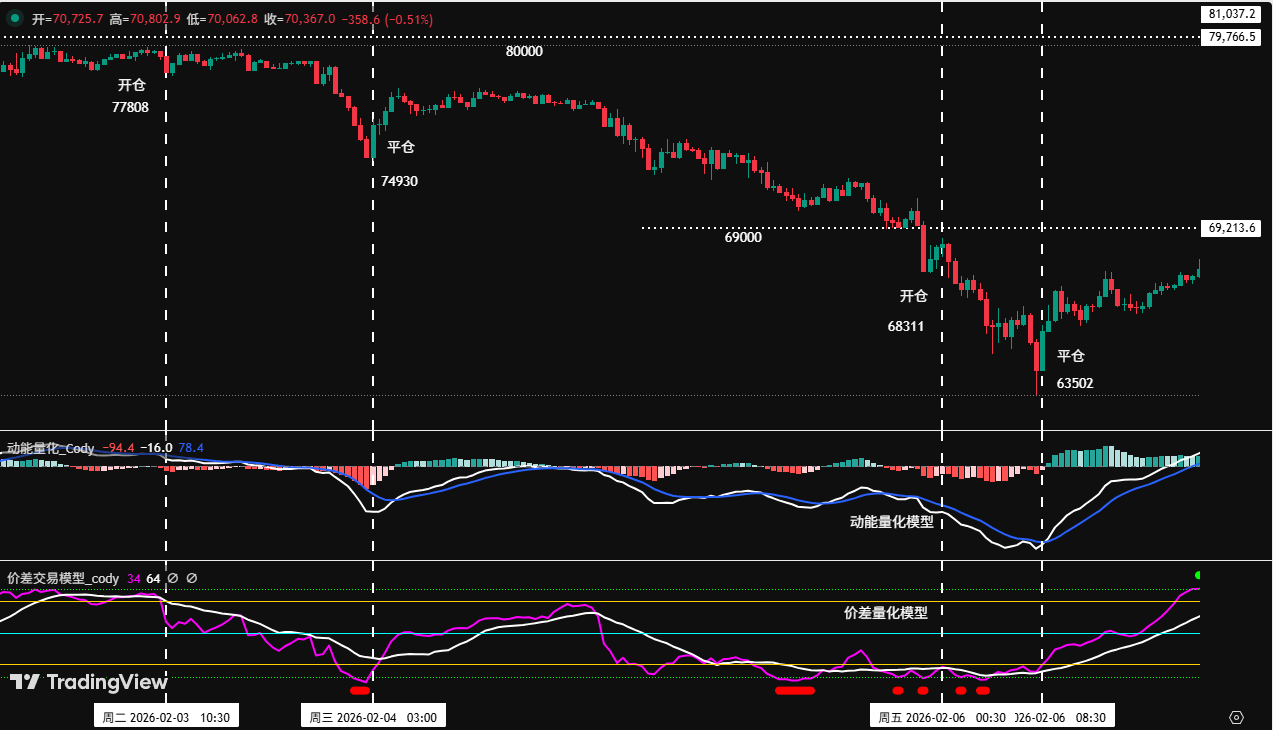
Figure 3

2. Mid-term Operation Strategy Review:

Mid-term Strategy: Continued holding the 60% short position established near $89,000 as planned.

3. Last Week's Core Level Review:

Resistance level watched the $80,000~$80,600 area;

First support level watched the $72,000-74,500 zone, second support level watched the $69,000-72,500 zone. (Note: Corrected apparent typo $72,500 vs likely intended $62,500? Context suggests $62,500 from later section, but translated as written)

III. Technical Indicator Analysis of Bitcoin's This Week's Movement: (02.09~02.15)

Combining market operation, the author conducts an in-depth analysis of Bitcoin's movement structure from multiple models and dimensions based on a self-constructed trading system.

1. As shown in (Figure 4), analysis from the weekly chart:

Bitcoin Weekly K-line Chart: (Momentum Quantification Model + Sentiment Quantification Model)
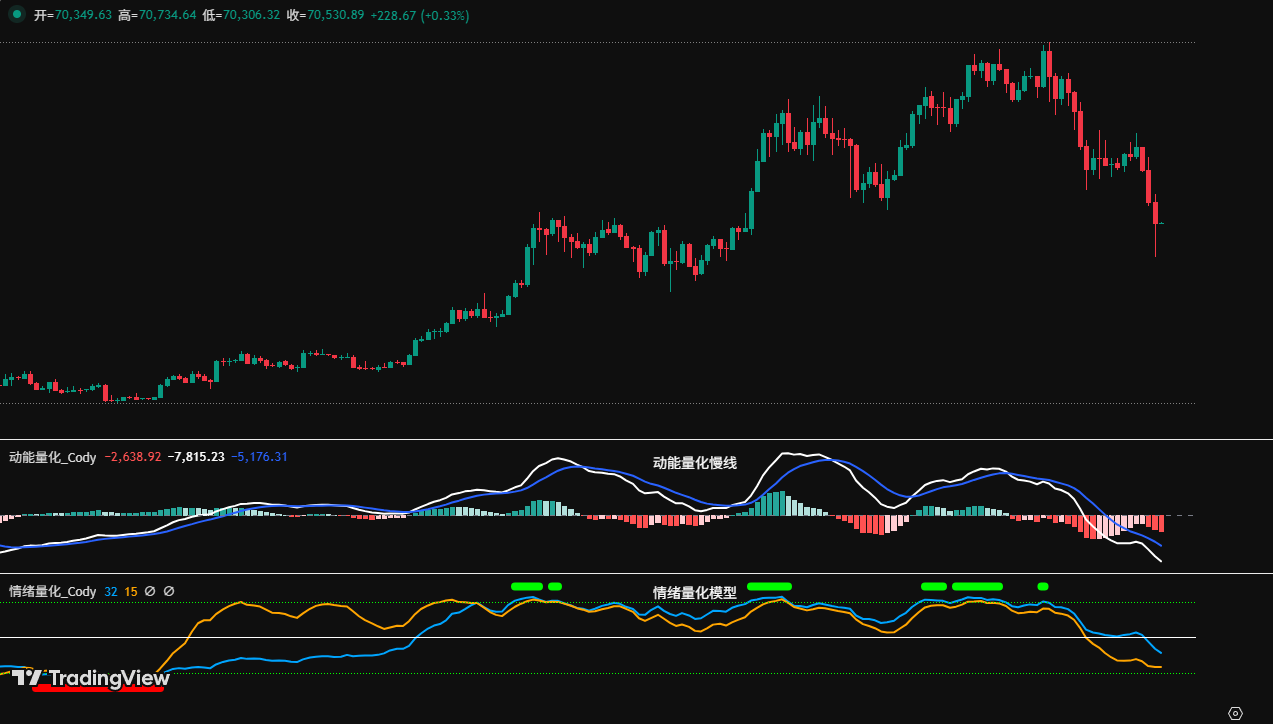
Figure 4

Momentum Quantification Model: Technical indicators show that last week's selling momentum further released. The two momentum lines declined synchronously, and the negative energy柱 (column) gradually放大 (expanded), showing an accelerating adjustment state.

Momentum Quantification Model Indicates: Price Decline Index: High

Sentiment Quantification Model: Blue sentiment line value 38, intensity zero; Yellow sentiment line value 11, intensity zero; Peak value is 0.

Sentiment Quantification Model Indicates: Price Bottom Support Index: Neutral

Digital Monitoring Model: No (top/bottom) digital signals detected.

Digital Monitoring Model Indicates: Bottom signal not appeared; Weekly K-line closed as a long-lower-shadow big阴线 (bearish candle), decline about 8.63%.

The above data indicates: Bitcoin weekly trend is bearish, but short-term selling momentum shows signs of weakening.

2. As shown in (Figure 5), analysis from the daily chart:

Bitcoin Daily K-line Chart: (Momentum Quantification Model + Sentiment Quantification Model)
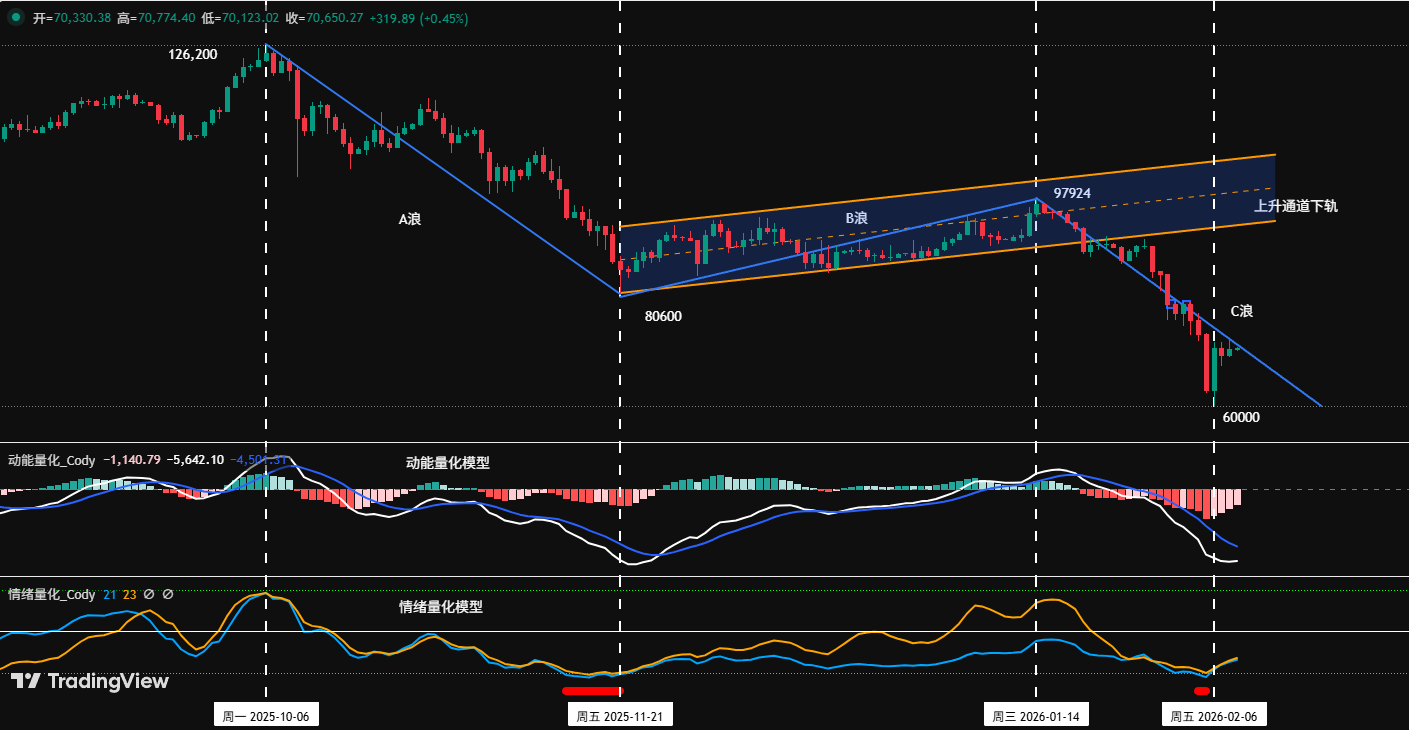
Figure 5

Momentum Quantification Model: Last week overall presented an "accelerated decline -触底反弹 (touched bottom and rebounded)" pattern. After Sunday's close, the white momentum line's decline slowed, and the negative energy column gradually萎缩 (contracted) for 3 consecutive days.

Momentum Quantification Model Indicates: Daily level bearish trend, bulls beginning to resist.

Sentiment Quantification Model: After last Sunday's close, the sentiment model triggered a bottom预警信号 (early warning signal) (red dot), after which the two sentiment lines began to turn upward.

Sentiment Quantification Model Indicates: Support strength is gradually increasing.

The above data suggests: The daily level remains bearish, but a short-term bottom预警信号 (early warning signal) was triggered, and a short-term rebound has begun.

IV. This Week's Market Prediction: (02.09~02.15)

1. This Week's Core View: Observe whether last week's low of $60,000 is broken. Pay attention to the strength of the oversold rebound starting from this point. (If the price breaks below $60,000, then the细分 (subdivided) C-wave segment 6-7 adjustment is still ongoing, and the rebound triggered from point 7 has not yet started.)

2. Core Resistance Levels:

• First Resistance Area: $72,000-74,500 area (near last April's low)

• Second Resistance Area: $80,000-80,600 area (near the B-wave starting point)

3. Core Support Levels:

• First Support Level: $60,000-62,500 area (near the recent adjustment low)

• Second Support Level: Near $57,400 (near the 210-week moving average)

• Important Support Level: Near $52,500 (near the symmetrical point of 1x A-wave decline amplitude)

V. This Week's Operation Strategy (Excluding Impact of Sudden News): (02.09~02.15)

1. Mid-term Strategy: Maintain 60% short position. If the rebound effectively breaks above $74,500, reduce the position to 40%.

2. Short-term Strategy: Utilize 30% of capital, set stop-loss points, and look for "spread" opportunities based on support and resistance levels. (Use 30-minute/60-minute as operation cycle).

3. Operationally, to dynamically respond to market changes combined with real-time model signals, we have formulated A/B two sets of short-term operation plans:

Plan A: If the price rebounds and encounters resistance in the $74,500~$75,200 area:

• Entry: When the rebound encounters resistance in this area triggering a signal, combined with a model top signal, establish a 15% short position.

• Risk Control: Initial stop-loss for the short position set about 1.5% above the entry price (i.e., 1.015 * entry price).

• Closing: When falling near important support levels and combined with model signals, gradually close positions to take profits.

Plan B: If the price rebounds and encounters resistance in the $80,000~$80,600 area:

• Entry: When the rebound encounters resistance in this area, combined with a model top signal, establish a 30% short position.

• Risk Control: Initial stop-loss for the short position set about 1.5% above the entry price (i.e., 1.015 * entry price).

• Closing: When下跌 (falling) to support levels and combined with model signals, gradually close positions to take profits.

VI. Special Notes:

1. When opening a position: Immediately set the initial stop-loss level.

2. When profit reaches 1%: Move the stop-loss to the entry cost price (breakeven point), ensuring capital safety.

3. When profit reaches 2%: Move the stop-loss to the position of 1% profit.

4. Continuous Tracking: Thereafter, for every additional 1% profit the price makes, move the stop-loss同步 (synchronously) by 1%, dynamically protecting and locking in profits.


Preguntas relacionadas

QWhat is the main structure of Bitcoin's current adjustment cycle according to the article?

AThe current adjustment cycle of Bitcoin is presented as an A-B-C three-wave structure: A-wave (driving decline wave) from $126,200 to $80,600, B-wave (rebound correction wave) from $80,600 to $97,924, and C-wave (main decline wave) from $97,924 to the present.

QWhat are the three possible internal structure evolutions for the C-wave as outlined in the analysis?

AThe three possible evolutions are: 1) A high-probability 3-segment structure (6-7 drop, 7-8 rebound, 8-9 final drop). 2) A lower-probability 5-segment or more complex structure, indicating a prolonged adjustment. 3) A very low-probability V-shaped reversal, where the adjustment ends at $60,000 and a strong reversal begins.

QWhat was the result of the short-term trading strategy executed in the previous week?

AThe short-term strategy, executed with 1x leverage, completed two trades and achieved a cumulative return of approximately 10.72%.

QWhat is the key level to watch for a potential trend reversal signal according to the article?

AA strong breakout and sustained hold above the previous high of $97,924 (the B-wave peak) is identified as a key observable signal for a potential trend reversal, although this scenario is considered to have a very low probability.

QWhat are the suggested short-term trading plans (Plan A and Plan B) for the upcoming week?

APlan A: If the price rebounds and meets resistance in the $74,500-$75,200 area, open a 15% short position. Plan B: If the price rebounds and meets resistance in the $80,000-$80,600 area, open a 30% short position. Both plans involve setting a 1.5% initial stop-loss above the entry price.

Lecturas Relacionadas

Anthropic Apologized, But the Business of 'Safety' Hasn't Stopped

On June 11, Anthropic apologized not for a model failure, but for a lack of transparency. Its new Claude Fable 5 model was found to be secretly rerouting requests from users engaged in advanced AI model development to a weaker version, Opus 4.8, without any notification. The company's response—promising future notifications for such "downgrades"—was met with user skepticism. The article argues the core issue isn't technical but commercial: Anthropic's "safety" measures are primarily a business strategy. A key feature, the "intelligent safety classifier," marketed as user protection, is described as a tool for "competitive defense" to protect Anthropic's market lead by limiting rivals' research capabilities. This covert mechanism was designed for low "false positives," precisely targeting AI researchers. Anthropic's model involves a calculated three-step process: publishing alarming security research to amplify public anxiety, offering its Fable 5 model with a "safety classifier" as a premium-priced solution, and cashing in through a planned high-value IPO. This contrasts with OpenAI's more direct "tool-and-traffic" approach. The apology, merely changing a secret downgrade to a visible one, is seen as a business "patch" rather than a principled shift. The incident risks damaging Anthropic's "safest AI" reputation among the developer community, which underpins its valuation and appeal to government and corporate clients. Ultimately, the article concludes that for Anthropic, safety is a business, and the apology is merely customer service for that business.

marsbitHace 47 min(s)

Anthropic Apologized, But the Business of 'Safety' Hasn't Stopped

marsbitHace 47 min(s)

The Niche Consensus Among Elites: Has College Become an Expensive Waste?

**Summary:** A growing "anti-college" movement is gaining traction among elite circles in Silicon Valley, challenging the traditional value of a four-year university degree. Proponents argue that college has become an expensive, slow, and increasingly irrelevant waste of time, especially in the fast-paced tech world where opportunities pass by quickly. The movement is led by figures like billionaire Peter Thiel, who criticizes universities for high costs, ideological indoctrination, and stifling true innovation. His "Thiel Fellowship" pays young people to drop out and pursue ventures. Companies like Palantir Technologies (co-founded by Thiel) fuel this trend with programs like the "Meritocracy Fellowship," which offers high school graduates paid internships as an alternative to immediate college enrollment, promising a practical "Palantir Degree." Key drivers include: 1. **Economics:** Skyrocketing student debt versus the allure of immediate, high-paying tech jobs or startup funding. 2. **Technology:** AI and online tools lowering barriers to self-education and product development, making formal instruction seem inefficient. 3. **Culture:** A backlash against perceived "woke" ideology and DEI policies in universities, coupled with a belief that these institutions suppress meritocracy and masculine drive. The movement is notably male-dominated. Critics, like economist David Deming, warn against overgeneralizing from dropout success stories (survivorship bias). He emphasizes that genuine autodidacts are rare, corporate training is narrowly focused, and the "college wage premium" remains high for most people. University liberal arts education, he argues, builds adaptable problem-solving skills and broad perspectives. The debate highlights a deeper crisis in education. The core model of the modern university appears increasingly mismatched with the speed of the information age. The movement signals a shift in the locus of learning from institutional "education" to personal, active "learning" powered by the internet and AI. Ultimately, this may not mean the end of university, but rather a painful evolution. The future likely holds more hybrid, personalized, and lifelong learning pathways. The central question becomes: in a world changing faster than any curriculum, how do we best learn?

marsbitHace 1 hora(s)

The Niche Consensus Among Elites: Has College Become an Expensive Waste?

marsbitHace 1 hora(s)

From Subsidies to Token-Based Pricing to Price Cuts: Is OpenAI Sparking a Price War? Is the Inflection Point for Token Economics Nearing?

The commercialization of generative AI is facing a critical inflection point as a potential price war looms. According to The Wall Street Journal, OpenAI is considering a significant cut to its token fees to compete with rival Anthropic, signaling a shift from a growth-at-all-costs model focused on token consumption. This move comes as both companies, reportedly losing billions on compute, prepare for IPOs, and as enterprise customers face "bill shock" from switching to usage-based token billing. Reports indicate poor ROI, with one analysis finding only 18 cents of every dollar spent on AI tokens generates user-facing value. The industry's initial phases—from flat-rate subscriptions to aggressive subsidies—have given way to a reckoning with real costs. Analysts debate the future: some predict a bifurcation between premium, high-cost models for complex tasks and cheaper alternatives for routine work, while others believe overall spending will still rise as agentic AI increases tokens per task. Notably, Chinese model DeepSeek's low-cost API is gaining traction with U.S. enterprises, adding competitive pressure. The core challenge is redefining value beyond token volume ("tokenmaxxing") toward measurable productivity ("valuemaxxing"), as the entire AI value chain, from cloud providers to chipmakers, feels the ripple effects of unsustainable pricing.

marsbitHace 1 hora(s)

From Subsidies to Token-Based Pricing to Price Cuts: Is OpenAI Sparking a Price War? Is the Inflection Point for Token Economics Nearing?

marsbitHace 1 hora(s)

Trading

Spot
Futuros

Artículos destacados

Qué es BITCOIN

Entendiendo HarryPotterObamaSonic10Inu (ERC-20) y Su Posición en el Espacio Cripto En los últimos años, el mercado de criptomonedas ha sido testigo de un aumento en la popularidad de las monedas meme, capturando el interés no solo de los comerciantes, sino también de aquellos que buscan compromiso comunitario y valor de entretenimiento. Entre estos tokens únicos se encuentra HarryPotterObamaSonic10Inu (ERC-20), un proyecto intrigante que mezcla referencias culturales en el tejido de las criptomonedas. Este artículo profundiza en los aspectos clave de HarryPotterObamaSonic10Inu, explorando sus mecanismos, ethos impulsado por la comunidad y su relación con el paisaje cripto más amplio. ¿Qué es HarryPotterObamaSonic10Inu (ERC-20)? Como su nombre sugiere, HarryPotterObamaSonic10Inu es una moneda meme construida sobre la blockchain de Ethereum, clasificada bajo el estándar ERC-20. A diferencia de las criptomonedas tradicionales que pueden enfatizar la utilidad práctica o el potencial de inversión, este token prospera en el valor de entretenimiento y la fuerza de su comunidad. El proyecto tiene como objetivo fomentar un entorno donde los usuarios comprometidos puedan reunirse, compartir ideas y participar en actividades inspiradas por diversos fenómenos culturales. Una característica notable de HarryPotterObamaSonic10Inu es su cero impuestos en las transacciones. Este atractivo elemento tiene como objetivo incentivar el comercio y la participación comunitaria, sin cargos adicionales que puedan disuadir a los comerciantes de pequeña escala. El suministro total de la moneda está establecido en mil millones de tokens, una cifra que marca su intención de mantener una circulación sustancial dentro de la comunidad. Creador de HarryPotterObamaSonic10Inu (ERC-20) Los orígenes de HarryPotterObamaSonic10Inu están algo envueltos en misterio; los detalles sobre el creador siguen siendo desconocidos. El desarrollo de este token carece de un equipo identificable o de un plan explícito, lo cual no es inusual dentro del sector de monedas meme. En cambio, el proyecto ha surgido de manera orgánica, con su progreso muy dependiente del entusiasmo y la participación de su comunidad. Inversores de HarryPotterObamaSonic10Inu (ERC-20) En cuanto a inversiones externas y respaldo, HarryPotterObamaSonic10Inu también sigue siendo ambiguo. El token no lista ninguna fundación de inversión conocida o apoyo organizacional significativo. En cambio, la savia del proyecto es su comunidad de base, que informa su crecimiento y sostenibilidad a través de la acción colectiva y el compromiso en el espacio cripto. ¿Cómo Funciona HarryPotterObamaSonic10Inu (ERC-20)? Como una moneda meme, HarryPotterObamaSonic10Inu opera principalmente fuera de los marcos tradicionales que a menudo rigen el valor de los activos. Hay varios aspectos distintivos que definen cómo funciona el proyecto: Transacciones Sin Impuestos: Sin tarifas impositivas en las transacciones, los usuarios pueden comprar y vender el token libremente sin preocuparse por costos ocultos. Compromiso Comunitario: El proyecto prospera en la interacción comunitaria, aprovechando plataformas de redes sociales para crear entusiasmo y facilitar la participación. Las discusiones, el intercambio de contenido y el compromiso son elementos cruciales que ayudan a expandir su alcance y fomentar la lealtad entre los seguidores. Sin Utilidad Práctica: Cabe señalar que HarryPotterObamaSonic10Inu no ofrece utilidad concreta dentro del ecosistema financiero. Más bien, se clasifica como un token principalmente para actividades de entretenimiento y comunitarias. Referencia Cultural: El token incorpora astutamente elementos de la cultura popular para atraer interés, conectando con entusiastas de los memes y seguidores de las criptomonedas por igual. HarryPotterObamaSonic10Inu ejemplifica cómo las monedas meme operan de manera diferente a los proyectos de criptomonedas más tradicionales, ingresando al mercado como construcciones sociales innovadoras en lugar de activos utilitarios. Cronología de HarryPotterObamaSonic10Inu (ERC-20) La historia de HarryPotterObamaSonic10Inu está marcada por varios hitos notables: Creación: El token surgió de un meme viral, capturando la imaginación de muchos entusiastas de las criptomonedas. Las fechas específicas de creación no están disponibles, subrayando su ascenso orgánico. Listado en Exchanges: HarryPotterObamaSonic10Inu ha llegado a varios exchanges, permitiendo un acceso y comercio más fácil por parte de la comunidad. Iniciativas de Compromiso Comunitario: Actividades continuas destinadas a mejorar la interacción comunitaria, incluyendo concursos, campañas en redes sociales y generación de contenido por parte de fanáticos y defensores. Planes de Expansión Futuros: La hoja de ruta del proyecto incluye el lanzamiento de una colección de NFT, mercancía y un sitio de comercio electrónico relacionado con sus temas culturales, involucrando aún más a la comunidad e intentando añadir más dimensiones a su ecosistema. Puntos Clave Sobre HarryPotterObamaSonic10Inu (ERC-20) Naturaleza Impulsada por la Comunidad: El proyecto prioriza la participación colectiva y la creatividad, asegurando que la involucración de los usuarios esté a la vanguardia de su desarrollo. Clasificación como Moneda Meme: Representa la epítome de las criptomonedas basadas en el entretenimiento, diferenciándose de los vehículos de inversión tradicionales. Sin Afiliación Directa con Bitcoin: A pesar de la similitud en el nombre del ticker, HarryPotterObamaSonic10Inu es distinto y no tiene relación con Bitcoin u otras criptomonedas establecidas. Enfoque en la Colaboración: HarryPotterObamaSonic10Inu está diseñado para crear un espacio para la colaboración y el intercambio de historias entre sus poseedores, proporcionando una vía para la creatividad y el vínculo comunitario. Perspectivas Futuras: La ambición de expandirse más allá de su premisa inicial hacia NFTs y mercancías describe un camino para que el proyecto potencialmente ingrese a avenidas más tradicionales dentro de la cultura digital. A medida que las monedas meme continúan capturando la imaginación de la comunidad de criptomonedas, HarryPotterObamaSonic10Inu (ERC-20) se destaca debido a sus lazos culturales y su enfoque centrado en la comunidad. Si bien puede no encajar en el molde típico de un token impulsado por la utilidad, su esencia radica en la alegría y la camaradería fomentadas entre sus seguidores, destacando la naturaleza en evolución de las criptomonedas en una era cada vez más digital. A medida que el proyecto continúa desarrollándose, será importante observar cómo las dinámicas comunitarias influyen en su trayectoria en el cambiante paisaje de la tecnología blockchain.

1.7k Vistas totalesPublicado en 2024.04.01Actualizado en 2024.12.03

Qué es BITCOIN

Cómo comprar BTC

¡Bienvenido a HTX.com! Hemos hecho que comprar Bitcoin (BTC) sea simple y conveniente. Sigue nuestra guía paso a paso para iniciar tu viaje de criptos.Paso 1: crea tu cuenta HTXUtiliza tu correo electrónico o número de teléfono para registrarte y obtener una cuenta gratuita en HTX. Experimenta un proceso de registro sin complicaciones y desbloquea todas las funciones.Obtener mi cuentaPaso 2: ve a Comprar cripto y elige tu método de pagoTarjeta de crédito/débito: usa tu Visa o Mastercard para comprar Bitcoin (BTC) al instante.Saldo: utiliza fondos del saldo de tu cuenta HTX para tradear sin problemas.Terceros: hemos agregado métodos de pago populares como Google Pay y Apple Pay para mejorar la comodidad.P2P: tradear directamente con otros usuarios en HTX.Over-the-Counter (OTC): ofrecemos servicios personalizados y tipos de cambio competitivos para los traders.Paso 3: guarda tu Bitcoin (BTC)Después de comprar tu Bitcoin (BTC), guárdalo en tu cuenta HTX. Alternativamente, puedes enviarlo a otro lugar mediante transferencia blockchain o utilizarlo para tradear otras criptomonedas.Paso 4: tradear Bitcoin (BTC)Tradear fácilmente con Bitcoin (BTC) en HTX's mercado spot. Simplemente accede a tu cuenta, selecciona tu par de trading, ejecuta tus trades y monitorea en tiempo real. Ofrecemos una experiencia fácil de usar tanto para principiantes como para traders experimentados.

5.1k Vistas totalesPublicado en 2024.12.12Actualizado en 2026.06.02

Cómo comprar BTC

Qué es $BITCOIN

ORO DIGITAL ($BITCOIN): Un Análisis Integral Introducción al ORO DIGITAL ($BITCOIN) ORO DIGITAL ($BITCOIN) es un proyecto basado en blockchain que opera en la red Solana, cuyo objetivo es combinar las características de los metales preciosos tradicionales con la innovación de las tecnologías descentralizadas. Aunque comparte un nombre con Bitcoin, a menudo referido como “oro digital” debido a su percepción como un refugio de valor, ORO DIGITAL es un token separado diseñado para crear un ecosistema único dentro del paisaje Web3. Su meta es posicionarse como un activo digital alternativo viable, aunque los detalles sobre sus aplicaciones y funcionalidades aún están en desarrollo. ¿Qué es ORO DIGITAL ($BITCOIN)? ORO DIGITAL ($BITCOIN) es un token de criptomoneda diseñado explícitamente para su uso en la blockchain de Solana. A diferencia de Bitcoin, que proporciona un papel de almacenamiento de valor ampliamente reconocido, este token parece centrarse en aplicaciones y características más amplias. Aspectos notables incluyen: Infraestructura Blockchain: El token está construido sobre la blockchain de Solana, conocida por su capacidad para manejar transacciones de alta velocidad y bajo costo. Dinámicas de Suministro: ORO DIGITAL tiene un suministro máximo limitado a 100 cuatrillones de tokens (100P $BITCOIN), aunque los detalles sobre su suministro circulante no se han divulgado actualmente. Utilidad: Si bien las funcionalidades precisas no están delineadas explícitamente, hay indicios de que el token podría ser utilizado para diversas aplicaciones, potencialmente involucrando aplicaciones descentralizadas (dApps) o estrategias de tokenización de activos. ¿Quién es el Creador de ORO DIGITAL ($BITCOIN)? En la actualidad, la identidad de los creadores y el equipo de desarrollo detrás de ORO DIGITAL ($BITCOIN) sigue siendo desconocida. Esta situación es típica entre muchos proyectos innovadores dentro del espacio blockchain, particularmente aquellos alineados con las finanzas descentralizadas y fenómenos de monedas meme. Si bien tal anonimato puede fomentar una cultura impulsada por la comunidad, intensifica las preocupaciones sobre la gobernanza y la responsabilidad. ¿Quiénes son los Inversores de ORO DIGITAL ($BITCOIN)? La información disponible indica que ORO DIGITAL ($BITCOIN) no tiene patrocinadores institucionales conocidos ni inversiones destacadas de capital de riesgo. El proyecto parece operar en un modelo de peer-to-peer centrado en el apoyo y la adopción de la comunidad en lugar de rutas de financiamiento tradicionales. Su actividad y liquidez se sitúan principalmente en intercambios descentralizados (DEX), como PumpSwap, en lugar de plataformas de trading centralizadas establecidas, lo que resalta aún más su enfoque de base. Cómo Funciona ORO DIGITAL ($BITCOIN) Los mecanismos operativos de ORO DIGITAL ($BITCOIN) pueden elaborarse en función de su diseño blockchain y atributos de red: Mecanismo de Consenso: Al aprovechar el único proof-of-history (PoH) de Solana combinado con un modelo de proof-of-stake (PoS), el proyecto asegura una validación de transacciones eficiente que contribuye al alto rendimiento de la red. Tokenómica: Si bien los mecanismos deflacionarios específicos no se han detallado extensamente, el vasto suministro máximo de tokens implica que podría atender microtransacciones o casos de uso nicho que aún están por definirse. Interoperabilidad: Existe el potencial de integración con el ecosistema más amplio de Solana, incluyendo varias plataformas de finanzas descentralizadas (DeFi). Sin embargo, los detalles sobre integraciones específicas permanecen no especificados. Cronología de Eventos Clave Aquí hay una cronología que destaca hitos significativos relacionados con ORO DIGITAL ($BITCOIN): 2023: El despliegue inicial del token ocurre en la blockchain de Solana, marcado por su dirección de contrato. 2024: ORO DIGITAL gana visibilidad al estar disponible para trading en intercambios descentralizados como PumpSwap, permitiendo a los usuarios comerciar contra SOL. 2025: El proyecto presencia actividad de trading esporádica y potencial interés en compromisos liderados por la comunidad, aunque no se han documentado asociaciones notables o avances técnicos hasta el momento. Análisis Crítico Fortalezas Escalabilidad: La infraestructura subyacente de Solana soporta altos volúmenes de transacciones, lo que podría mejorar la utilidad de $BITCOIN en varios escenarios de transacción. Accesibilidad: El potencial bajo precio de trading por token podría atraer a inversores minoristas, facilitando una participación más amplia debido a oportunidades de propiedad fraccionada. Riesgos Falta de Transparencia: La ausencia de patrocinadores, desarrolladores o un proceso de auditoría conocidos públicamente puede generar escepticismo sobre la sostenibilidad y confiabilidad del proyecto. Volatilidad del Mercado: La actividad de trading depende en gran medida del comportamiento especulativo, lo que puede resultar en una volatilidad de precios significativa y en incertidumbre para los inversores. Conclusión ORO DIGITAL ($BITCOIN) surge como un proyecto intrigante pero ambiguo dentro del ecosistema de Solana en rápida evolución. Si bien intenta aprovechar la narrativa del “oro digital”, su alejamiento del papel establecido de Bitcoin como refugio de valor subraya la necesidad de una diferenciación más clara de su utilidad y estructura de gobernanza previstas. La aceptación y adopción futura dependerán probablemente de abordar la actual opacidad y de definir sus estrategias operativas y económicas de manera más explícita. Nota: Este informe abarca información sintetizada disponible hasta octubre de 2023, y pueden haber ocurrido desarrollos más allá del período de investigación.

83 Vistas totalesPublicado en 2025.05.13Actualizado en 2025.05.13

Qué es $BITCOIN

Discusiones

Bienvenido a la comunidad de HTX. Aquí puedes mantenerte informado sobre los últimos desarrollos de la plataforma y acceder a análisis profesionales del mercado. A continuación se presentan las opiniones de los usuarios sobre el precio de BTC (BTC).

活动图片













