When Big Money Seriously Enters the Market, How Does the Liquidity Bottleneck of RWA Manifest?

比推Publicado a 2026-01-16Actualizado a 2026-01-16

Resumen

When large capital enters the market, the liquidity bottlenecks of Real-World Asset (RWA) tokenization become evident. Tokenized assets, such as gold (e.g., PAXG, XAUT) and stocks (e.g., TSLAx, NVDAx), suffer from significant slippage and shallow market depth compared to traditional markets like CME. For instance, a $4 million trade in tokenized gold can incur up to 150 basis points of slippage, while traditional markets show negligible impact even at $20 million. Decentralized exchanges (DEXs) exacerbate the issue, with trades sometimes facing premiums as high as 68% or persistent slippage of 25–50 basis points. Liquidity shortages also destabilize market structure, causing price volatility and cascading effects like cross-platform liquidations, as seen with PAXG on Binance triggering $9 million in liquidations on Hyperliquid. These problems stem from structural constraints: high minting/redemption fees, slow redemption cycles (T+1 to T+5), and capital inefficiencies for market makers. Without deep, reliable liquidity, tokenized assets struggle to scale, hindering their use as collateral or in DeFi. The solution requires a new market structure that integrates off-chain liquidity, eliminates redemption delays, and avoids fragmenting liquidity across platforms. Tokenization itself isn’t flawed, but the current market infrastructure fails to support it at scale.

Author: @ballsyalchemist

Translator: Ding Dang

Original Title: When Big Money Starts Getting Serious, the Liquidity Issues of RWA Become Apparent


Liquidity is the prerequisite for an asset to gain confidence. When the market has sufficient depth, large amounts of capital can be smoothly absorbed, whales can freely build positions, and assets can be used as reliable collateral. This is because lenders know that they can exit at any time if needed. However, if the asset itself lacks liquidity, the situation is the opposite. Shallow liquidity struggles to attract users, and insufficient users further compress trading depth, eventually forming a self-reinforcing "liquidity depletion cycle."

Tokenization was initially highly anticipated: it was seen as a key tool to enhance capital liquidity, unleash the financial utility of DeFi, and bridge on-chain and off-chain assets. Ideally, traditional financial markets worth trillions of dollars would be brought on-chain, allowing anyone to trade freely, use assets as collateral for loans, and combine and innovate in ways that are difficult to achieve in the traditional financial system through DeFi.

However, the reality is that beneath the surface prosperity, most tokenized assets operate in extremely fragile, illiquid markets that cannot support meaningful capital scales. The "liquidity" that is a prerequisite for financial composability and practical utility has not been truly realized. These issues are not noticeable in small transactions, but once capital attempts to move at scale, the hidden costs and risks quickly emerge.

The Current Reality of Liquidity

The first hidden cost of tokenized assets is reflected in slippage.

Taking tokenized gold as an example, the chart below compares the expected slippage of major centralized exchanges and traditional gold markets at different trade sizes, and the difference is clear.
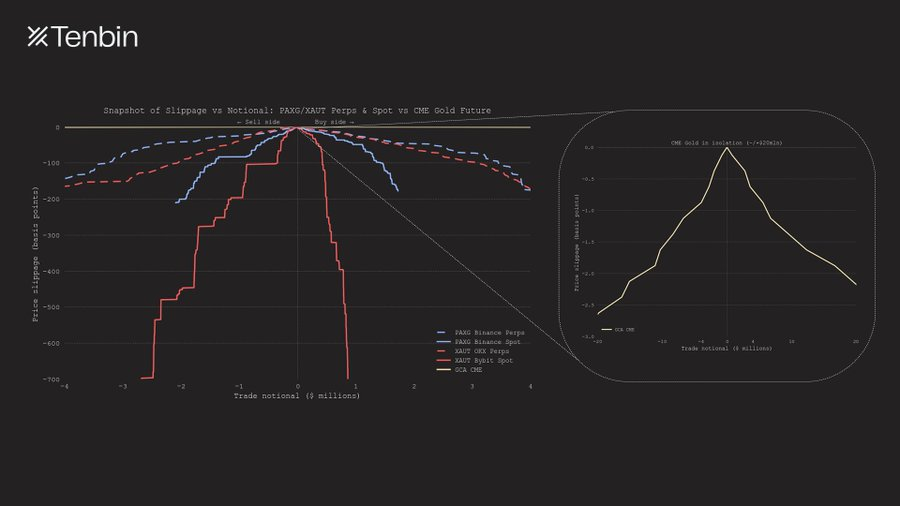
PAXG / XAUT Perpetual vs. Spot vs. CME Deliverable Gold Futures: Trade Size and Slippage

As trade size increases, the slippage for PAXG and XAUT perpetual contracts rises rapidly and exponentially. At a nominal trade size of about $4 million, slippage approaches 150 basis points. In contrast, CME's slippage curve is almost flush with the horizontal axis, barely noticeable.

At the spot market level, the liquidity constraints of PAXG and XAUT are even more apparent. Even when selecting the most liquid spot trading venues for each, the effective depth provided by their order books on either the buy or sell side is less than $3 million. This liquidity ceiling is directly reflected in the curve "cutting off" prematurely at smaller trade sizes.

The right side separately shows CME's slippage curve; its nearly flat shape intuitively reflects the depth advantage of traditional markets. Even for trade sizes far exceeding $4 million, the expected slippage remains highly stable. A $20 million gold futures trade has a price impact of even less than 3 basis points. In terms of magnitude, CME's liquidity depth is far beyond that of any comparable product in the crypto market.

This difference has direct consequences. In deep traditional markets, even large trades have almost negligible price impact; in the shallow markets of tokenized assets, the same operation immediately incurs significant costs, and the difficulty of closing positions increases rapidly with size. The daily average trading volume comparison below clearly shows this gap, and this issue is not unique to the gold market but applies to other assets as well.
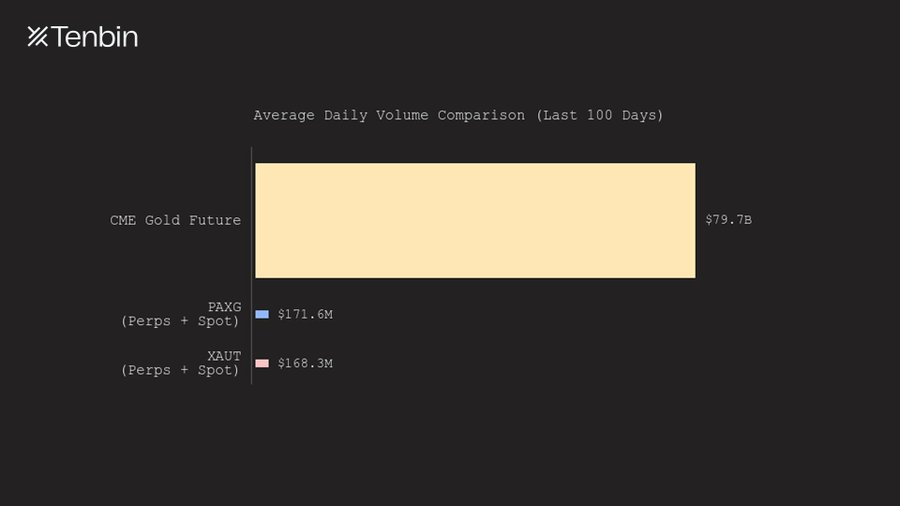
CME Gold Futures vs. PAXG / XAUT Perpetual and Spot: Daily Trading Volume Comparison

The above discussion mainly focuses on CEXs. So, if we switch to AMM DEXs, does the situation improve? The answer is恰恰相反, it only gets worse.

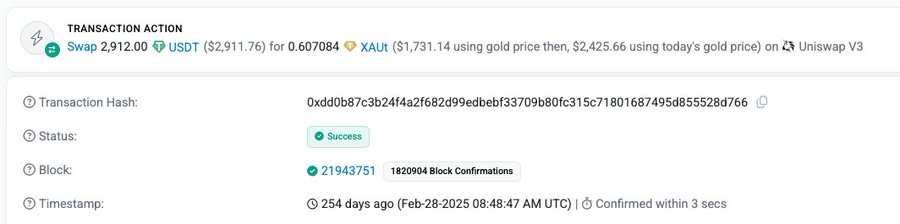
For example, in a February 2025 XAUT transaction, a user spent 2,912 USDT but only obtained XAUT worth about $1,731 at the real gold price at the time, effectively paying a whopping 68% premium for this trade.
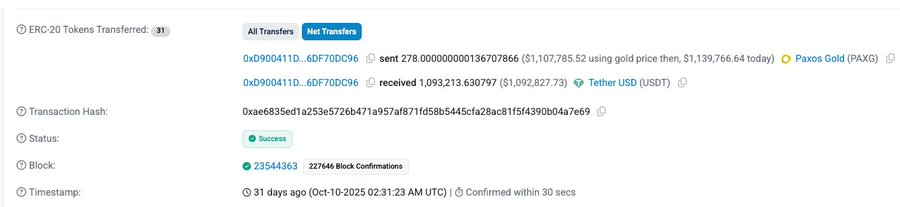
In another transaction, a user exchanged PAXG worth about $1.107 million (at the then gold price) for 1.093 million USDT, with a slippage of about 1.3%. Although the slippage is not as extreme as the former, it is still unacceptably high when price impact in traditional markets is typically measured in single-digit basis points.
Furthermore, over the past six months or so, the average slippage for XAUT and PAXG trades on Uniswap has consistently remained in the 25–35 basis point range, and even exceeded 50 basis points during certain periods.
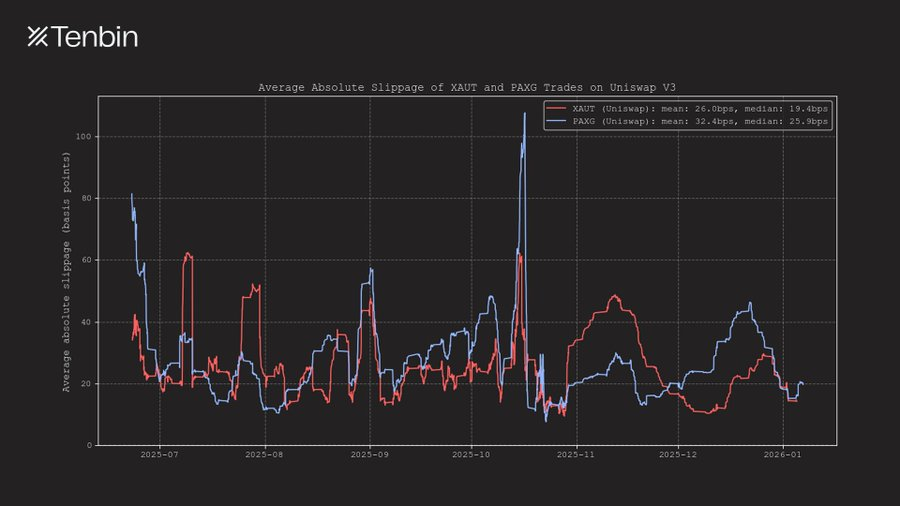
Average Absolute Slippage for XAUT and PAXG on Uniswap V3

This article chooses gold as the primary analysis object because it is currently the largest non-dollar, non-credit tokenized asset on-chain. But the same problems also appear in the tokenized stock market.
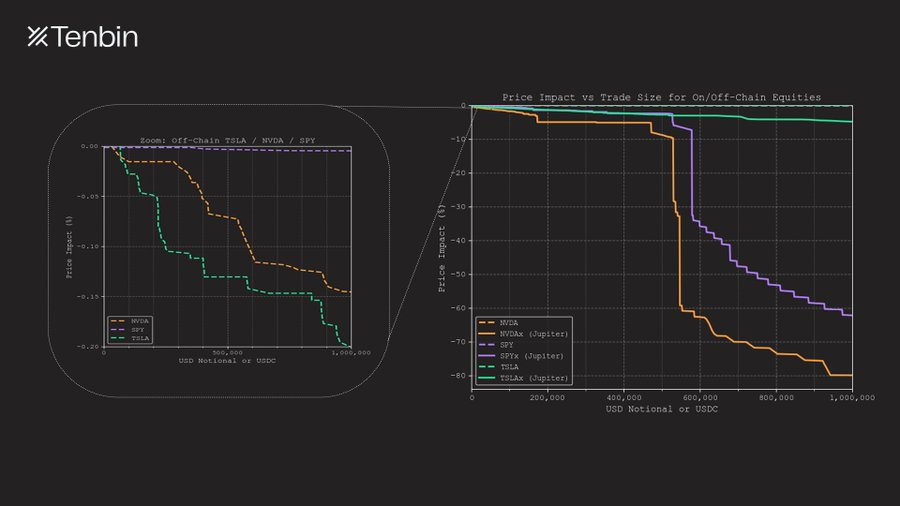
NVDAx / TSLAx / SPYx vs. Nasdaq NVDA / TSLA / SPY: Trade Size and Slippage

TSLAx and NVDAx are among the top tokenized stocks by market cap. On Jupiter, a $1 million TSLAx trade has a slippage of about 5%; while NVDAx's slippage is as high as 80%, almost rendering it untradeable. In contrast, in traditional markets, a trade of the same size in Tesla or Nvidia stock has a price impact of only 18 basis points and 14 basis points respectively (this doesn't even include off-exchange liquidity like dark pools).

These costs are easily overlooked in small trades but become unavoidable once trade sizes increase. Insufficient liquidity directly translates into actual losses.

Why is the Tokenized Market More Dangerous?

The problems brought by insufficient liquidity are not limited to transaction costs; they can directly破坏 the market structure itself.

When market liquidity is thin, the price discovery mechanism becomes fragile, order book noise increases significantly, and oracle data sources are affected by this noise. In highly interconnected systems, even极小规模的交易 can trigger巨大的连锁反应.
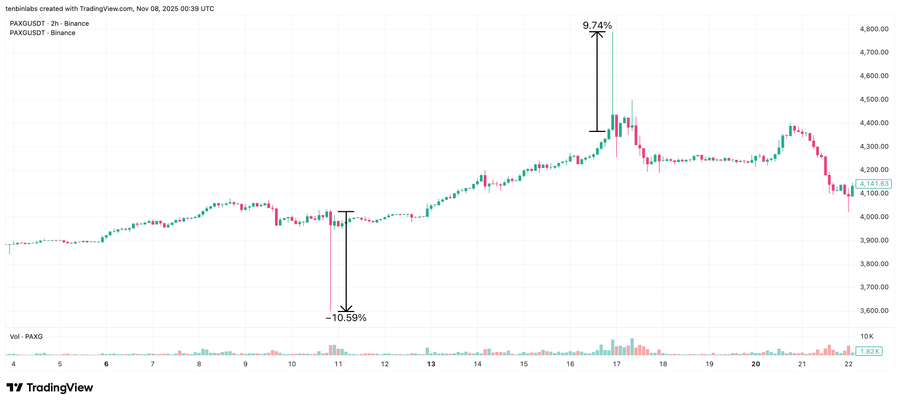
In mid-October 2025, PAXG on the Binance spot market experienced two明显的"anomalous" events within a week. On October 10th, the price dropped 10.6%; on October 16th, it surged 9.7%. Both fluctuations quickly returned to their original levels, almost certainly not caused by fundamental changes but rather a direct manifestation of order book fragility.

Because the tokenized asset ecosystem is highly interconnected, this instability is not confined to a single exchange. Binance spot holds the highest weight in Hyperliquid's oracle construction, so during these two anomalous fluctuations, $6.84 million in long positions and $2.37 million in short positions were liquidated on Hyperliquid, with the liquidation规模甚至超过了 Binance itself.

This result is concerning. It shows that a single illiquid market is enough to amplify and propagate volatility across multiple trading venues. In extreme cases, this structure could even increase the risk of oracle manipulation. Even traders who never participated in the original spot market may passively suffer losses due to liquidations, price distortions, and widening spreads.

Ultimately, all these issues stem from the same fact: the primary market lacks real, scalable liquidity.
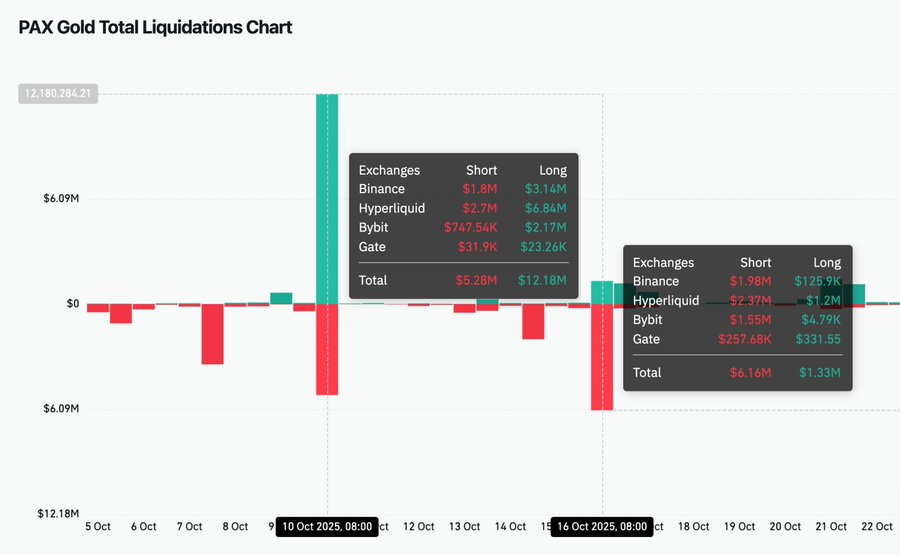
PAXG Liquidation Chart on Coinglass

Insufficient Liquidity is a Structural Problem

The lack of liquidity for tokenized assets is a structural problem.

Liquidity does not automatically appear just because an asset is tokenized. It relies on the continuous supply from market makers, who themselves are subject to strict capital constraints. They allocate capital to markets where inventory can be turned over efficiently, risks can be continuously hedged, and positions can be exited with minimal time and cost friction.

Most tokenized assets恰恰 fail to meet these key requirements.

First, for market makers to provide liquidity, they must first complete asset minting. But in reality, minting itself comes with explicit costs. Issuers typically charge minting and redemption fees ranging from 10–50 basis points;同时, the minting process often involves operational coordination, KYC checks, and settlement through custodians or brokers, rather than direct on-chain execution. Market makers need to advance funds and wait for several hours or even days to actually obtain the tokenized asset.

Second, even after inventory is generated, it cannot be redeemed instantly. The redemption周期 for most tokenized assets is measured in "hours or days," not seconds. Common redemption rules are T+1 to T+5, accompanied by daily or weekly quota limits. For larger positions, a complete exit often takes several days or even longer.

From a market maker's perspective, such inventory is largely equivalent to "low-liquidity assets" that cannot be quickly recovered and redeployed.

To maintain market depth, market makers must hold inventory over a longer周期, continuously bear price volatility risk and hedge, while waiting for redemption to complete. During this time, the same capital could have been deployed to other crypto markets—where little inventory is needed, hedging is continuous, and positions can be closed at any time. Precisely because of this, the opportunity cost is particularly high in the crypto market.

Faced with this trade-off, rational liquidity providers naturally choose to allocate capital to other markets.

The existing market structure is also insufficient to solve this problem. AMMs transfer inventory risk to liquidity providers but do not eliminate redemption constraints; while order book-based trading venues fragment market makers' liquidity across multiple exchanges, further weakening overall depth.

The final result is持续不足的流动性, forming a vicious cycle. Insufficient liquidity discourages participation, and lack of participation in turn further削弱 liquidity. The entire tokenized asset ecosystem is thus trapped in this cycle.

A New Market Structure

Insufficient liquidity is a structural obstacle restricting the scaled development of tokenized assets.

Shallow market depth cannot support practically meaningful position sizes, and the fragile market structure amplifies and transmits local volatility to different protocols and trading venues. Assets that cannot be exited smoothly under predictable conditions自然也难以 serve as credible collateral. Under the current mainstream tokenization model, liquidity is chronically constrained, and capital efficiency remains low.

For tokenized assets to truly become usable at scale, the market structure itself must change.

What if the price discovery and liquidity supply of assets could be directly mapped from off-chain markets, rather than being rediscovered and cold-started on-chain? What if users could acquire tokenized assets at any trade size without forcing market makers to hold low-liquidity inventory long-term? What if the redemption mechanism were fast enough, with clear paths and no restrictions?

Asset tokenization has not failed due to the technical path of "putting assets on-chain."

Where it has truly failed is that the market structure supporting these assets was never truly established.


Twitter:https://twitter.com/BitpushNewsCN

Bitpush TG Discussion Group:https://t.me/BitPushCommunity

Bitpush TG Subscription: https://t.me/bitpush

Original Link:https://www.bitpush.news/articles/7603514

Preguntas relacionadas

QWhat is the main liquidity challenge faced by tokenized real-world assets (RWA) when large capital enters the market?

AThe main challenge is the significant slippage and high transaction costs due to shallow liquidity. Large trades cause exponential increases in slippage, making it difficult to execute sizable transactions without substantial price impact, unlike in deep traditional markets like CME where slippage remains minimal even for large trades.

QHow does the liquidity of tokenized gold (e.g., PAXG/XAUT) compare to traditional gold markets in terms of slippage?

ATokenized gold markets exhibit much higher slippage compared to traditional markets. For instance, a $4 million trade in PAXG/XAUT perpetual contracts can incur nearly 150 basis points of slippage, while CME gold futures show almost negligible slippage even for trades exceeding $20 million, with price impact as low as 3 basis points.

QWhat structural issues cause liquidity shortages in tokenized asset markets?

ALiquidity shortages are structural due to high minting/redemption fees (10-50 bps), slow redemption processes (T+1 to T+5), and operational delays. Market makers face capital constraints, inventory risks, and opportunity costs, as they cannot quickly redeem or redeploy capital, leading to rational allocation of liquidity to more efficient crypto markets instead.

QHow did liquidity fragmentation in tokenized markets lead to cross-platform volatility, as seen with PAXG in October 2025?

AIn October 2025, PAXG experienced sharp price swings on Binance due to thin order books. This volatility propagated to other platforms like Hyperliquid through oracle dependencies, causing $6.84 million in long liquidations and $2.37 million in short liquidations, demonstrating how fragile liquidity in one market can amplify risks across interconnected ecosystems.

QWhy do automated market makers (AMMs) like Uniswap worsen liquidity issues for tokenized assets?

AAMMs exacerbate liquidity problems because they concentrate inventory risk on liquidity providers without solving redemption constraints. For example, XAUT trades on Uniswap saw extreme premiums (e.g., 68% in one case) and consistently high average slippage of 25-35 basis points, making them inefficient for large-scale transactions compared to traditional markets.

Lecturas Relacionadas

South Korean Exchanges 'Battle' Regulators, Challenging the Boundaries of Enforcement and Legislation

South Korea's cryptocurrency industry is engaged in a rare, direct confrontation with regulators. The Financial Intelligence Unit (FIU), the primary anti-money laundering (AML) watchdog, has recently imposed heavy penalties on major exchanges like Upbit and Bithumb for alleged violations involving unregistered overseas VASPs and AML procedures. However, exchanges are now actively challenging these actions in court and through industry associations. In a significant shift, the Seoul Administrative Court ruled in favor of Upbit's operator, Dunamu, overturning part of an FIU-ordered business suspension. The court found the FIU's penalty criteria and justification insufficiently clear. Similarly, the court suspended the enforcement of a six-month business suspension against Bithumb pending a final ruling, citing potential irreversible harm to the exchange. Beyond legal battles, the industry is contesting proposed legislative amendments. The Digital Asset eXchange Alliance (DAXA) strongly opposes a draft rule that would mandate Suspicious Transaction Reports (STRs) for all crypto transfers over 10 million KRW (~$6,800). DAXA argues this "poison pill" clause violates legal principles and would overwhelm the STR system, increasing reports from 63,000 to an estimated 5.45 million annually for major exchanges, thereby crippling effective AML monitoring. This conflict highlights a structural tension in South Korea's crypto governance: comprehensive digital asset laws are still developing, while regulators rely heavily on AML enforcement. The industry's move from passive compliance to active legal and legislative challenges signifies a new phase, pressing for clearer rules and more proportionate enforcement. While short-term disputes may intensify, this clash could ultimately lead to a more mature and sustainable regulatory framework for South Korea's vibrant crypto market.

marsbitHace 48 min(s)

South Korean Exchanges 'Battle' Regulators, Challenging the Boundaries of Enforcement and Legislation

marsbitHace 48 min(s)

After 50x Storage Surge, Justin Sun Always Looks to the Next Decade

Sun Yuchen, known for his controversial stunts like a $30 million lunch with Warren Buffett (canceled due to a kidney stone) and eating a $6.2 million duct-taped banana, is often overshadowed by a significant fact: his decade-long track record of spotting major investment trends. In 2016, he famously advised young people to invest in Bitcoin, Nvidia, Tesla, and Tencent instead of buying property. A hypothetical $20,000 investment in Nvidia and Tesla from that list would now be worth over 50 million RMB. His latest major call was on November 6, 2025, predicting a "50x storage opportunity" tied to the AI boom, which materialized with Sandisk's stock surging nearly 50-fold by 2026. Looking ahead, Sun now focuses on the next frontier: Physical AI. He identifies four key areas: 1. **Embodied AI/Robotics**: He sees this reaching its "iPhone moment," with companies like UBTech and Galaxy General leading in commercialization. 2. **Drones**: Viewed as the first commercially viable form of Physical AI, revolutionizing sectors from warfare (e.g., AeroVironment's Switchblade) to logistics. 3. **Spatial Computing**: Beyond VR, it's about AI understanding physical space, a foundational technology for robotics and autonomous systems, exemplified by Apple's Vision Pro. 4. **Space Exploration**: After a 2025 suborbital flight with Blue Origin, Sun advocates for space as the ultimate frontier, discussing blockchain's potential role in space asset management and data transactions. His investment philosophy involves betting on entire, inevitable trends rather than single companies. For robotics, he sees Tesla (the body/manufacturer) and Nvidia (the brain/AI platform) as complementary plays. In defense drones, he highlights companies making tanks obsolete (AeroVironment) and those augmenting fighter jets (Kratos). For space, he participated in Blue Origin's flight and anticipates SpaceX's potential IPO to redefine the sector's valuation. Sun Yuchen's vision frames the next two decades not as a revolution in information flow (like the internet), but in the fundamental operation of the physical world through AI-powered robots, autonomous systems, and spatial intelligence, ultimately extending human and AI activity into space. While many still focus on conventional assets, he continues to look toward the next technological horizon.

marsbitHace 1 hora(s)

After 50x Storage Surge, Justin Sun Always Looks to the Next Decade

marsbitHace 1 hora(s)

The Billionaires Behind the Most Expensive Midterm Election in History

"The Most Expensive Midterm Elections and Their Billionaire Backers" This analysis details the unprecedented scale of spending in the 2026 midterm elections, highlighting the key billionaire donors shaping the political landscape. Jeff Yass, founder of Susquehanna International Group, has contributed over $81 million, ranking third among individual donors behind George Soros ($102.6M) and Elon Musk ($84.8M). Yass is a major donor to Trump's MAGA Inc. and supports school choice and various candidates. Overall, federal committees have raised over $4.7 billion this cycle, with political ad spending projected to reach $10.8 billion. Republican-aligned groups are significantly out-raising their Democratic counterparts. "Dark money" from undisclosed sources continues to grow. The core stakes involve control of Congress and policy direction for Trump's final term. Donors are also motivated by specific issues: Sergey Brin and Chris Larsen are funding opposition to a proposed California wealth tax and supporting crypto-friendly policies. Other top donors include OpenAI's Greg Brockman and his wife Anna ($50M total to MAGA Inc. and an AI-focused PAC), Richard Uihlein ($45.3M to conservative causes), venture capitalists Marc Andreessen and Ben Horowitz (each over $44M to crypto/AI PACs and MAGA Inc.), Miriam Adelson ($42.6M to GOP leadership PACs), Paul Singer ($33.9M), and Diane Hendricks ($25.8M to MAGA Inc.). The article notes that the peak fundraising period is still ahead, with major primaries approaching.

marsbitHace 1 hora(s)

The Billionaires Behind the Most Expensive Midterm Election in History

marsbitHace 1 hora(s)

The Largest IPO in History Is Approaching, Surpassing SpaceX, 28 Years of AI Self-Iteration, Countdown to Intelligence Explosion

"Anthropic Nears Trillion-Dollar IPO, Fueled by Explosive Growth and 2028 'Intelligence Explosion' Warning Anthropic is considering a deal valuing the AI company near $1 trillion, potentially leading to one of the largest IPOs ever and surpassing SpaceX. Its revenue has skyrocketed, with Annual Recurring Revenue (ARR) reaching $45 billion in May 2026—a 500% increase in just five months. This vertical growth curve is attributed to its key products, Claude Code and Cowork, dominating AI coding and enterprise collaboration. Beyond commercial success, co-founder Jack Clark issued a pivotal warning in an interview: there is a greater than 50% chance that by the end of 2028, AI systems will achieve recursive self-improvement—the ability to autonomously build a 'better version' of themselves, initiating an 'intelligence explosion.' This prophecy underpins the company's astronomical valuation, as the market prices in the potential for transformative and disruptive AI. Further signaling its ambition, Anthropic formed a $1.5 billion joint venture with Goldman Sachs and Blackstone, aiming to disrupt traditional consulting firms like McKinsey by deploying Claude AI for complex strategic work. This move tests AI's capacity to replace high-level cognitive labor, a precursor to its predicted autonomous evolution. The narrative presents a dual future: unprecedented economic opportunity alongside significant risks like economic restructuring and security threats. Anthropic's meteoric rise and Clark's 2028 prediction frame the coming years as a countdown to a potential technological singularity."

marsbitHace 2 hora(s)

The Largest IPO in History Is Approaching, Surpassing SpaceX, 28 Years of AI Self-Iteration, Countdown to Intelligence Explosion

marsbitHace 2 hora(s)

Trading

Spot
Futuros
活动图片





