What Were Crypto KOLs Talking About in the Last 24 Hours!

比推Publicado a 2026-02-14Actualizado a 2026-02-14

Resumen

Summary of "What Were Crypto KOLs Talking About in the Last 24 Hours!" The article compiles trending discussions among crypto influencers, primarily from X (formerly Twitter), covering several key topics: 1. **False Rumor About Eileen Gu**: A claim that the athlete Eileen Gu joined Benchmark was debunked. Comments highlighted her controversial public perception, dual identity, and the fact that, as a U.S. citizen, she is subject to U.S. global taxation on her earnings. 2. **KOLs' Bitcoin Buying Range**: Many Key Opinion Leaders (KOLs) identified $40,000-$50,000 as an ideal range to buy Bitcoin. Replies expressed that a drop to this level would be reasonable based on historical patterns, but a further decline could shatter market confidence. Some were skeptical, predicting targets would shift lower if prices fell. 3. **Ethereum's Stagnant Price**: The phrase "Eight years later, still $1900" was used to describe Ethereum's perceived lack of progress, causing frustration among its supporters ("Ethereum soldiers"). 4. **Hong Kong Conference Insights**: The article included multiple images from a Hong Kong crypto conference, though the specific content of the discussions was not detailed in the text. 5. **Prevailing Market Sentiment**: A mood of pessimism was noted in the industry, with some participants choosing to leave the market while others advocated for patience and waiting for a market reversal ("mean reversion"). A comment pointed out the increasing "siphoning effect...

Editor's Note: The following discussions are personal opinions and do not constitute investment advice. Information compiled from X.

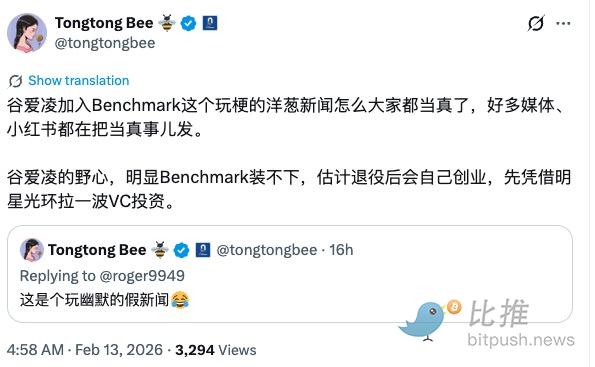
Eileen Gu Joining Benchmark? Fake!

Popular Replies:

Next step: HTX Co-CEO, TRON Global Ambassador lol

She's been getting roasted these past few days—criticized in Chinese circles, called out in English circles, one moment representing Americans, the next representing Chinese!

Fun fact: Eileen Gu is a U.S. citizen, and the U.S. government taxes globally. So, 40% of every dollar she earns in China goes to the U.S. government!

90% of KOLs' Bottom-Buying Range is $40K-$50K?

Popular Replies:

You're right on point. Actually, if it really drops to $40K-$50K, it would be reasonable. History is there, everyone gets it. The fear is if it drops to $20K-$30K or even lower—that would shatter all faith.

Hahaha, a couple of months ago they were shouting $60K. If it really drops to $40K-$50K, they'll start yelling $30K-$40K.

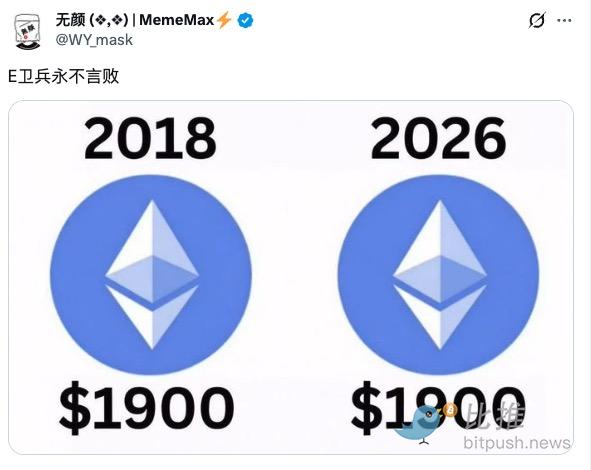
"Eight Years, Still $1900"—ETH Maximalists Collective Meltdown
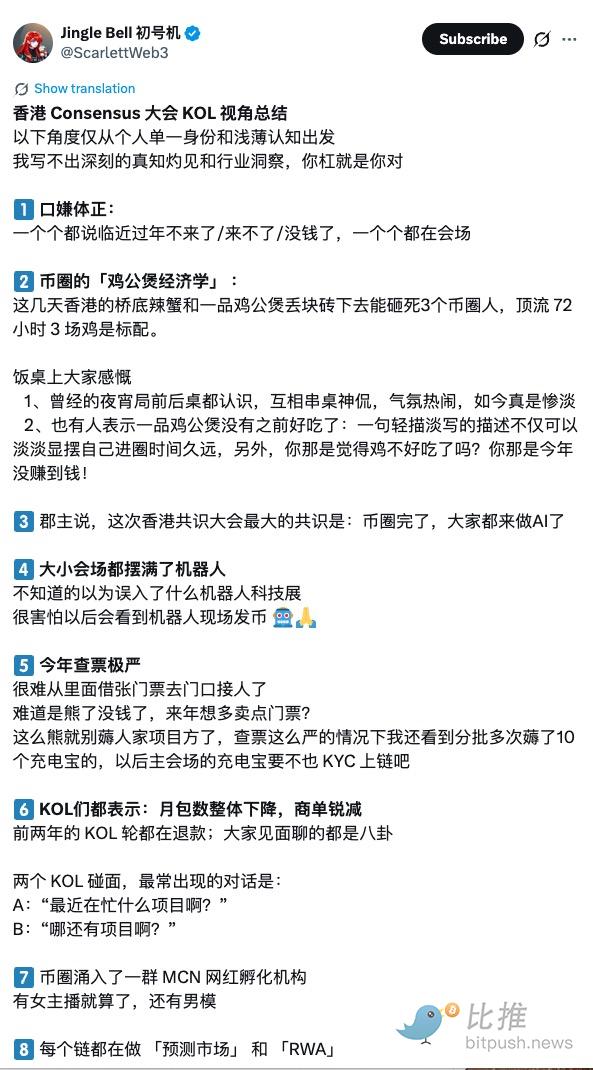
Hong Kong Conference Essay Extravaganza


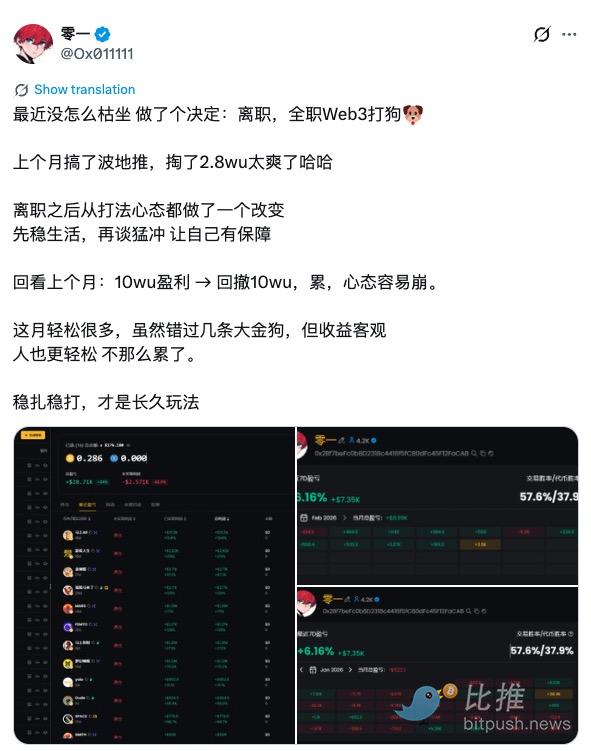
Pessimism Pervades the Industry—Some Flee, Others Hold Firm
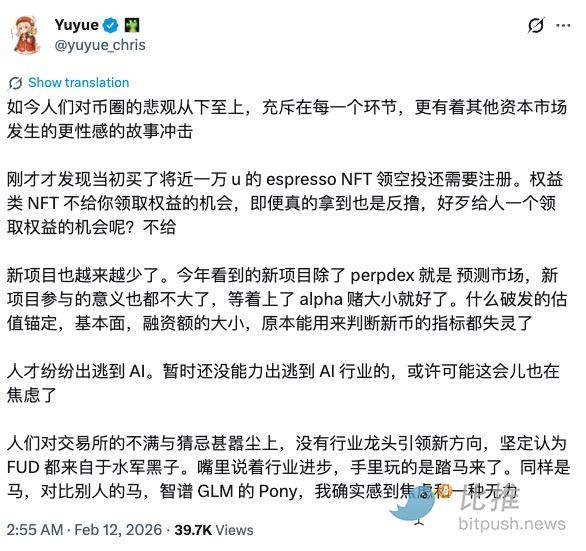
Popular Replies:

Extremes reverse—wait for the mean reversion. Right now, it's about resting. The sooner you rest up, the more advantage you'll have;

Just wait it out;

The AI circle's siphon effect should become particularly strong this year.


Twitter:https://twitter.com/BitpushNewsCN

Bitpush TG Discussion Group:https://t.me/BitPushCommunity

Bitpush TG Subscription: https://t.me/bitpush

Original link:https://www.bitpush.news/articles/7612025

Lecturas Relacionadas

Investors Are Now Hunting for AI Projects on Bilibili and Xiaohongshu

Investors Turn to Bilibili and Xiaohongshu to Source AI Projects The AI hardware boom is in full swing in 2025, with a surge in smart wearables like AI glasses, rings, toys, and companion robots. This frenzy has investors scrambling, not just sifting through business plans, but actively hunting for promising "under-the-radar" projects on youth and tech-enthusiast content platforms like Bilibili and Xiaohongshu. The logic is straightforward: for consumer-facing AI hardware, genuine user demand and potential pitfalls are often revealed earlier in public discussions, comments, and critiques on these communities than in formal pitches. As one industry insider notes, these products must ultimately be tested and understood by real people. This shift highlights a crucial challenge in the sector: user education. The success of AI hardware depends on moving beyond mere efficiency gains to fulfilling higher-order needs like "unleashing personal creativity." Products must convince users they are natural, unobtrusive additions to daily life. Early hype, as seen with devices like the Rabbit R1, often fades if the product fails to clearly solve real-world problems, leading to high return rates and market rejection. The market is now entering a shakeout phase. 2026 is seen as a year of commercial validation. Some projects have already stalled or been canceled due to market resistance, lack of differentiation, or financial woes. However, the long-term opportunity remains vast, with forecasts predicting a multi-trillion dollar global AI hardware market by 2030. The competition is intensifying. With giants like OpenAI and Meta preparing their own hardware, and Chinese companies launching diverse AI-powered products, the battle for user attention, product excellence, and market understanding is just beginning. The core principle endures: in the AI era, it remains a user-sovereign market.

marsbitHace 11 min(s)

Investors Are Now Hunting for AI Projects on Bilibili and Xiaohongshu

marsbitHace 11 min(s)

"Agents' Last Exam", Claude Fable 5 Actually Loses to GPT 5.5

Surprisingly, in the newly released "Agents' Last Exam" (ALE) benchmark from UC Berkeley, GPT-5.5 has outperformed the recently launched and highly-regarded Claude Fable 5. ALE tests AI agents on their ability to perform real-world tasks across 55 professional domains—such as 3D modeling in Siemens NX, creating game scenes in Unreal Engine, and visual effects work in Adobe After Effects—by granting them full GUI and command-line access. In the core task completion rate ranking, GPT-5.5 configurations secured the top two spots (24.0% and 23.0%), while Claude Fable 5 with Claude Code came in third (22.0%). Notably, the highest pass rate was only 24%, and the most difficult "Last-Exam" tier saw most top models, including GPT-5.5 and Fable 5, scoring zero. The benchmark also revealed significant cost and efficiency gaps: Fable 5 spent over four times more money than GPT-5.5's most expensive configuration for a slightly lower score, and was much slower. ALE differs from previous knowledge-based benchmarks by evaluating practical "ability to do" rather than static knowledge retrieval. Its tasks are derived from real expert projects, automatically scored, and designed to prevent cheating through a rotating pool of private challenges. The results suggest that high performance on traditional benchmarks does not necessarily translate to proficiency in complex, open-ended real-world work. The study also notes that agents often fail by prematurely declaring tasks complete without proper verification, and that no single model excels uniformly across all diverse domains.

marsbitHace 17 min(s)

"Agents' Last Exam", Claude Fable 5 Actually Loses to GPT 5.5

marsbitHace 17 min(s)

Trading

Spot
Futuros
活动图片