"Weekly Editor's Picks" is a functional column by Odaily Planet Daily. While Planet Daily covers a vast amount of real-time information weekly, it also publishes many high-quality in-depth analyses. However, these might get lost in the information flow and hot news, passing you by.
Therefore, our editorial team will select some quality articles worth spending time to read and collect from the content published in the past 7 days every Saturday. From perspectives like data analysis, industry judgment, and opinion sharing, we aim to bring new inspiration to you in the crypto world.
Now, let's read together:

Investment & Entrepreneurship
2025 Asset Review: Why Did Bitcoin Significantly Underperform Gold and US Stocks?
When the growth curve of silicon-based intelligence is steeper than the scarcity curve of "digital reserves," the global excess liquidity will first flow to productive assets with non-linear growth potential, rather than purely digital assets.
Gold hedges against system collapse, while Bitcoin is currently viewed more by the market as an overflow of system liquidity. US stocks are in a parabolic acceleration phase driven by AI. ETFs are weakening Bitcoin's volatility.
Why is the US Embracing Crypto? The Answer Might Lie in the $37 Trillion Massive Debt
Stablecoins handle distribution, Bitcoin handles absorption; the US is using crypto assets to dilute debt pressure.
2025: The Darkest Year for the Crypto Market, Also the Dawn of the Institutional Era
Crypto market's paradigm shift from retail speculation to institutional allocation, core data shows institutional holdings at 24%, retail exit at 66% — handover completed, new rules arrive.
Long-term practitioners and investors don't predict short-term prices; they identify structural trends.
MSTR: Buy the Dip or Wait? Three Key Questions About Strategy You Must Understand
Strategy's "cash flow crisis" can likely be delayed until the second half of 2027.
MSCI is conducting public consultation and will announce the final decision by January 15 next year (also the final moment to offload MSTR stock).
Over 80% of New Tokens Peak at TGE, The Root Cause and Cure for Web3's False Prosperity Here
Only 15% of tokens have seen their FDV increase compared to TGE. The median token FDV has fallen 71% since issuance (median market cap down 67%).
High funding amounts, active communities, exchange listings—these criteria generally used to screen project quality—have little impact on token performance.
To survive in 2026, projects better: set funding targets between $300K - $5M; set listing price between $0.01 to $0.05; prioritize product; be able to explain in one sentence why the token exists; ignore vanity metrics; embrace industry realism; if unable to scale independently, find an acquirer.
Also recommended:
Five Major Institutions Outline the 2026 Crypto Blueprint: Are Crypto "Super Apps" Coming? Is the "Four-Year Cycle" Ending?
New Theory on Crypto Four-Year Cycle: I Asked Seven Senior Practitioners What Stage We're In Now
2025 Investment Survey: Nearly 60% Profitable Overall, Over 60% Are Seasoned Veterans
Pantera Capital: 12 Predictions for the 2026 Crypto Market
Crypto World's Brutal Coming-of-Age: 2024-2025 Crypto Index Review
redphone 2026 Prophecy: Silicon Era Dawns, Crypto Becomes "Last Free Port"
Stablecoins
85% of Trading Volume Controlled by a Thousand Wallets: The Hidden Centralized Landscape of Stablecoin Payments
The top 1000 wallets contribute about 84% of the trading volume, showing highly concentrated characteristics.
Prediction Markets
Kalshi's First Research Report Released: How Collective Wisdom Crushes Wall Street Think Tanks in Predicting CPI
The more complex the prediction environment, the higher the win rate of collective consensus.
Airdrop Opportunities & Interaction Guides
Hot Sectors, New Interaction Opportunities: Three Prediction Markets Favored by YZi Labs
Brevis Token Launch Imminent: 32.2% Community Incentives, Airdrop Registration Coming Soon
Popular Interaction Collection | PiP World Testnet Token Trading; ETHGas Earn Points (Dec 26)
Meme
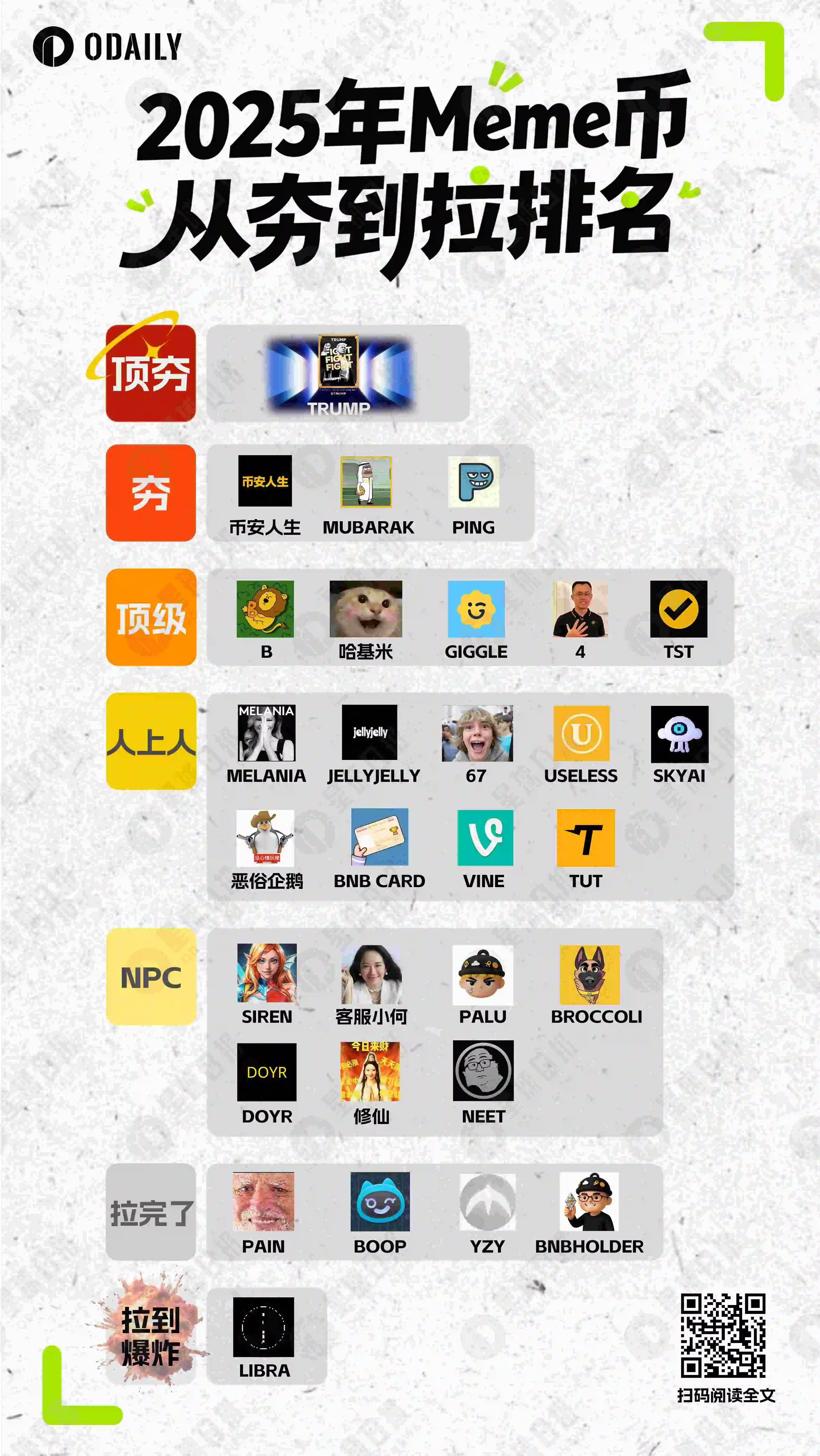
2025 Meme Coin "From Boom to Bust" Ranking
Bitcoin
2025 Bitcoin Protocol Layer Comprehensive Review
In 2025, Bitcoin's technical evolution shows three core characteristics: defense pre-positioning (against quantum threats), functional layering, and infrastructure decentralization.
Ethereum & Scaling
ETHGas and the Birth of Block Space Pricing
ETHGas redefines Ethereum block space from transaction fees fluctuating with demand to a pricable resource. Through block space futures and pre-confirmation mechanisms, it allows large-scale users to lock in cost and time certainty in advance.
By introducing block space futures and pre-confirmations backed by validators, ETHGas brings a structure similar to traditional financial markets to Ethereum, enabling applications and institutions to plan, hedge, and operate in a more certain environment.
ETHGas sends an important signal about Ethereum's evolution direction: Ethereum is moving from a pure technical protocol to a settlement layer centered on economic management, where time and block space begin to have explicit value.
Also recommended "Ethereum's 'Second-Level' Evolution: From Fast Confirmations to Settlement Compression, How Does Interop Eliminate Waiting Time?".
Multi-Ecosystem
The Economic Calculus Behind Polymarket's Exodus from Polygon
Polymarket plans to migrate from Polygon and launch an Ethereum Layer2 network called POLY. Polymarket's choice to leave Polygon isn't entirely surprising. One is the hot application layer representative, the other is a declining old base layer; there's already a mismatch in market heat and value expectations between them. Building its own Layer2 network can help Polymarket tailor the underlying features according to its platform needs, allowing for more flexible adaptation to future upgrades and iterations.
Besides contributing economically to Polygon (about 1/4), Polymarket also revitalizes stablecoins and adds behavioral value to retained users.
Polymarket TGE is approaching, making now the optimal time to migrate.
CeFi & DeFi
Crypto Super App Revolution: When Coinbase and Others Break Financial Boundaries
Last week, Coinbase launched a new product touted as the "Future of Finance." One app enables five major functions: 5x24 stock trading, centralized exchange and on-chain crypto trading, futures and perpetual contract trading, prediction markets, all equipped with an AI financial analyst. All functions are operable via mobile, and users' single account balance can be instantly switched between different asset classes.
This is not mere feature stacking; it breaks the artificially drawn boundaries between financial asset classes due to regulation and technical limitations. The core driver behind this change is: funds scattered across different apps are essentially idle funds. Platforms that consolidate liquidity are more efficient. As for the asset discovery challenge, it leverages social trading (built-in dynamic news feed).
Coinbase and Robinhood are gradually becoming new types of banks.
Why Do DeFi Users Reject Fixed Rates?
TradFi has credit markets, DeFi relies on money markets.
Lenders need a premium to lock funds, but borrowers are unwilling to pay this fee. This is why fixed-rate markets continually evolve into one-sided markets. Floating-rate markets win because they align with participants' actual behavior. They are money markets for liquid funds, not credit markets for long-term assets.
DeFi protocols design credit products using money market assumptions, then deploy them into a liquidity-oriented ecosystem; the mismatch between user assumptions and actual capital behavior keeps fixed-rate borrowing a niche market.
From Aave to Ether.fi: Who Captures the Most Value in the On-Chain Credit System?
On Aave and SparkLend, the interest fees vaults pay to lending protocols actually exceed the revenue the vaults themselves generate. This fact directly challenges the mainstream narrative of "distribution is king." Aave not only earns more than the various vaults built on top of it, but even more than the asset issuers used for lending, such as Lido and Ether.fi.
Viewed alone, lending seems like a low-margin business; but placed within the complete credit stack, it is the layer with the strongest value capture capability relative to all other participants—vaults, issuers, distribution channels.
Second-Biggest Holder Cuts Losses and Liquidates, Can AAVE Still Be Bought Amid Deep Divisions?
Fee flow controversy sparks heated debate: who does the Aave brand truly belong to? If you believe Aave Labs will remain highly aligned with Aave DAO's long-term interests, and the current friction is more of a communication and process misstep, then the emotionally driven price pullback might be a good entry window; but if you think this controversy exposes not an occasional problem, but a structural矛盾 (contradiction) of long-unclear rights between team and protocol, lacking institutional constraints, then this storm might just be the beginning.
As DeFi matures, protocol revenue becomes substantial, and brands and frontends begin to hold commercial value, some inherent structural contradictions between protocol and product, team and community, will surface.
Also recommended: "From Option Derivatives to Prediction Markets, A Quick Look at Coinbase's 2025 Crypto Acquisition Landscape".
Weekly Hotspot Recap
In the past week, US Treasury Secretary pushed for "Main Street and Wall Street merger," integrating cryptocurrency into the mainstream financial system;
Additionally, regarding policy and macro markets: Shenyang police cracked an illegal foreign exchange case, involved personnel sold BTC and USDT to Mexican drug cartels; Victory Securities: Bans virtual asset account buy operations from mainland China IP addresses; Caixin: Issuance and use of U Cards within China carries special legal risks; White House and US Department of Energy jointly launch "Project Genesis," CoreWeave, NVIDIA, OpenAI, xAI, etc., selected as first batch of companies; US ends previous administration's investigation into China chip trade, will not impose additional tariffs on Chinese chips for next 18 months; Wall Street's 15 major investment bank outlooks summarized by AI as "precarious," JPMorgan warns of AI bubble risk;
Regarding views and voices: Etherealize co-founder: Crypto industry must make substantial progress before Trump leaves office; Pantera partner outlook for 2026: Tokenized gold, stablecoin payments, etc., may reshape crypto industry structure; Michael Saylor: Supports free use of Bitcoin network but opposes modifying the underlying protocol; Polymarket determines Trump's claimed Trump Gold Card sales are "fake"; VanEck: Recent Bitcoin miner capitulation may signal bottom nearing; CryptoQuant CEO comments on Tom Lee's personal view contradicting his fund's: Possibly because Tom Lee is in sell-side research, has to be bullish; Arthur Hayes: Altseason always exists, investors misjudge because they don't hold the rising assets; Hurun Report: High-net-worth individuals' willingness to increase digital currency investments heats up, 25% intend to increase allocation in the next year; Vitalik prediction: Bug-free code might appear within the next 15 years;
Regarding institutions, large companies, and top projects: JPMorgan's 2026 US stock core recommendation list: Crypto industry completely absent, and only Google remains from AI Magnificent Seven; [Micro]Strategy increases cash reserves and pauses Bitcoin purchases; Ethereum plans two hard forks in 2026, L1 Gas limit may increase to 200 million; Kalshi: Launches Kalshi Research and provides internal data to researchers;
Data-wise: Spot gold, silver hit new highs; Bitcoin miner revenue down 11% since mid-October, facing capitulation risk; Ethereum has become the global dollar liquidity settlement layer, processing approximately $90-100 billion in stablecoin transfers daily; Ethena stablecoin USDe market cap has nearly halved since the "10/11 crash";
Security-wise: Trust Wallet extension compromised; A 23-year-old man impersonated Coinbase staff to scam users out of $16 million in cryptocurrency; Quantum computing won't cause cryptocurrency collapse in 2026 but beware of "harvest now, decrypt later" risk...... Well, another rollercoaster week.
Attached is the portal to the "Weekly Editor's Picks" series.
See you in 2026~