Weekend Market Watch by TradeXYZ | Two Consecutive Weeks of TACO

marsbitPublicado a 2026-08-03Actualizado a 2026-08-03

Resumen

For two consecutive weekends, market focus has centered on the US-Iran situation. This weekend began with escalating tensions, as reports emerged of a US-ordered military strike and alleged Iranian drone attacks. However, on Sunday morning, the US called off the planned action, citing requests from regional nations and conditional on a swift agreement. On TradeXYZ, oil contracts (WTI) reacted sharply, plummeting from around $85.5 to below $79, a drop exceeding 8%, as war risk premiums unwound. In contrast, the S&P 500 index rose about 0.8%, trading on the de-escalation. However, uncertainty remains as the specifics of any shipping corridor agreement for the Strait of Hormuz are unresolved. Precious metals saw initial gains, with spot gold briefly surpassing $4080, but those gains narrowed after futures market open. In equities, the weekend saw a broad rally. The tech-heavy "Mag 7" group advanced, though Apple underperformed peers due to concerns over its service growth and China market. The memory chip sector was notably strong. Overall, markets initially priced in the reduced immediate conflict risk, pressuring oil and supporting stocks. However, traders remain cautious, leaving room for volatility if geopolitical signals shift again.

Crude Oil & Indices

At the start of this weekend, U.S.-Iran tensions were still escalating.

On Friday, U.S. officials revealed that Trump had ordered a new large-scale strike against Iran, with operations potentially starting over the weekend and energy infrastructure also being possible targets. Iran, for its part, claimed that drone attacks had hit the Ahmed Al-Jaber Air Base in Kuwait, and that two oil tankers passing through the Strait of Hormuz under U.S. military escort were also attacked. Neither claim was confirmed by Kuwait or the U.S. at the time.

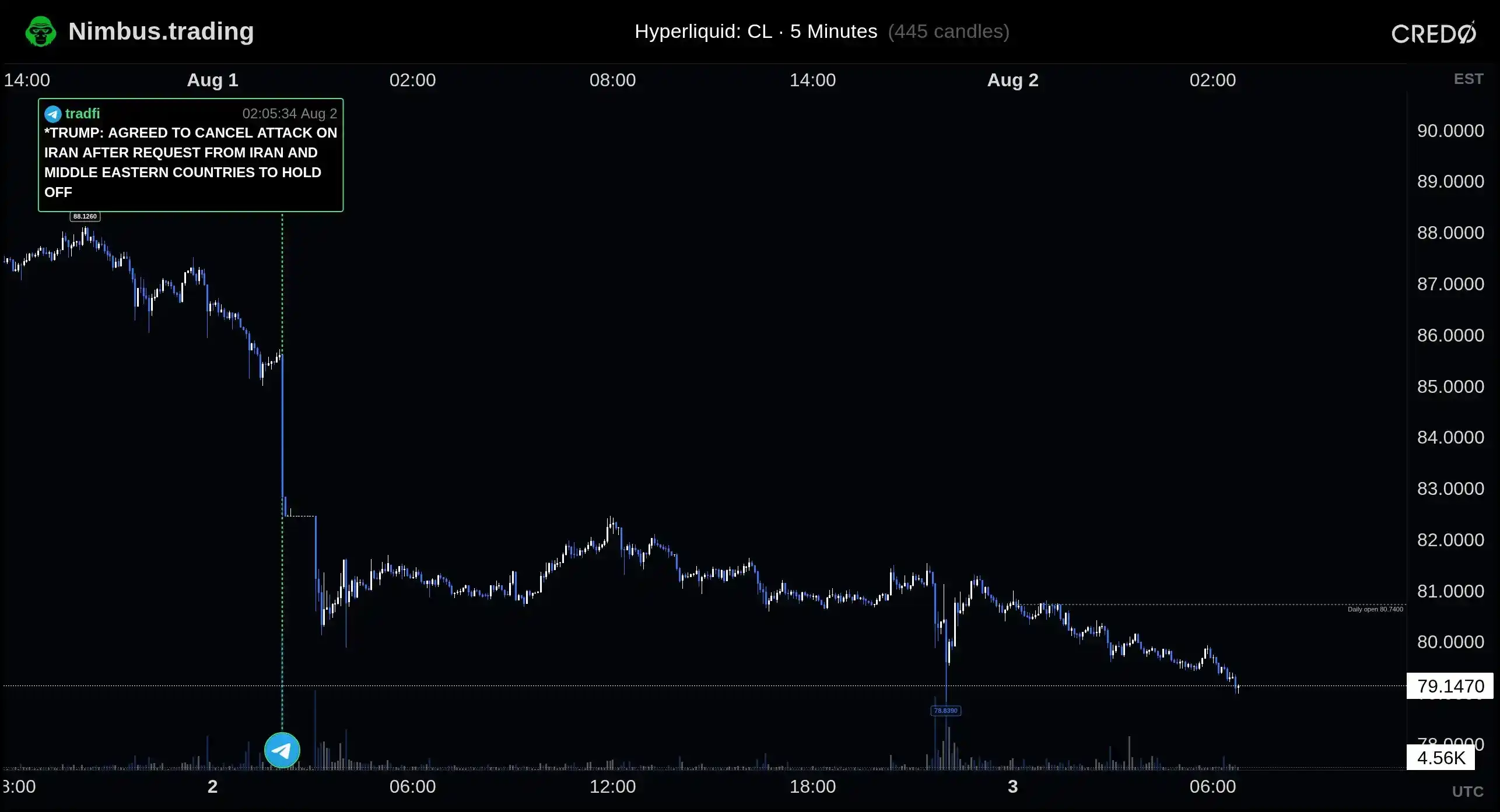
At 10 a.m. on Sunday, Trump suddenly called off the operation. He stated that, at the request of Iran, Saudi Arabia, the UAE, Qatar, and others, the U.S. canceled the planned strike on the condition that all parties could quickly reach an agreement, with Israel also joining this commitment.

On TradeXYZ, crude oil contracts rapidly fell from around $85.5 to below $83 following the news, and subsequently continued to drop to around $79.
The S&P 500, meanwhile, rose from around 7470 points to above 7500, later touching 7535 points at one point.
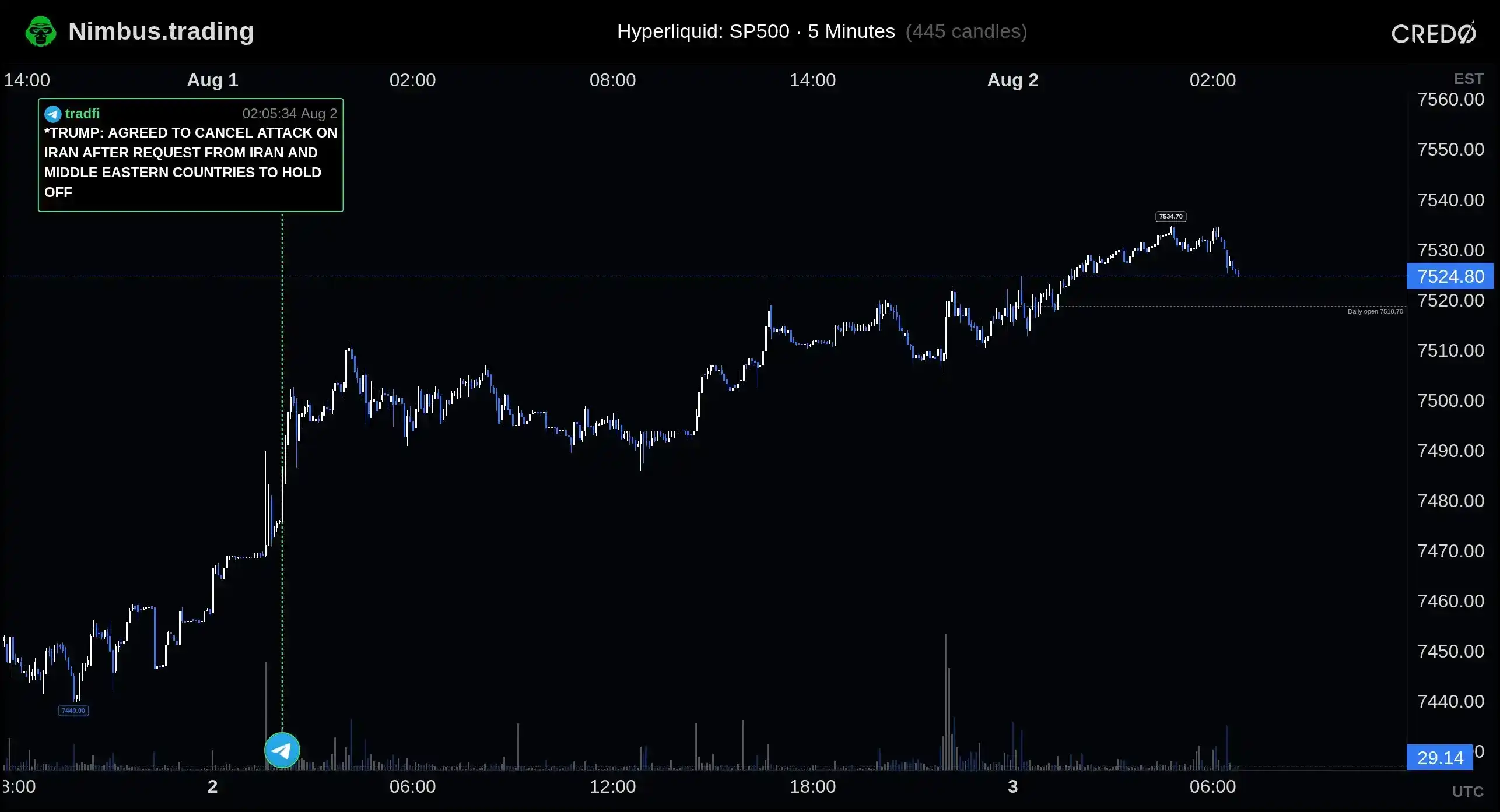
By the later part of the weekend, CL and Brent contracts had both fallen by over 8%, while the S&P 500 gained about 0.8%. Crude oil gave back the war and supply disruption risk premium that had been building up the previous day, while equities directly traded the cancellation of the large-scale strike.
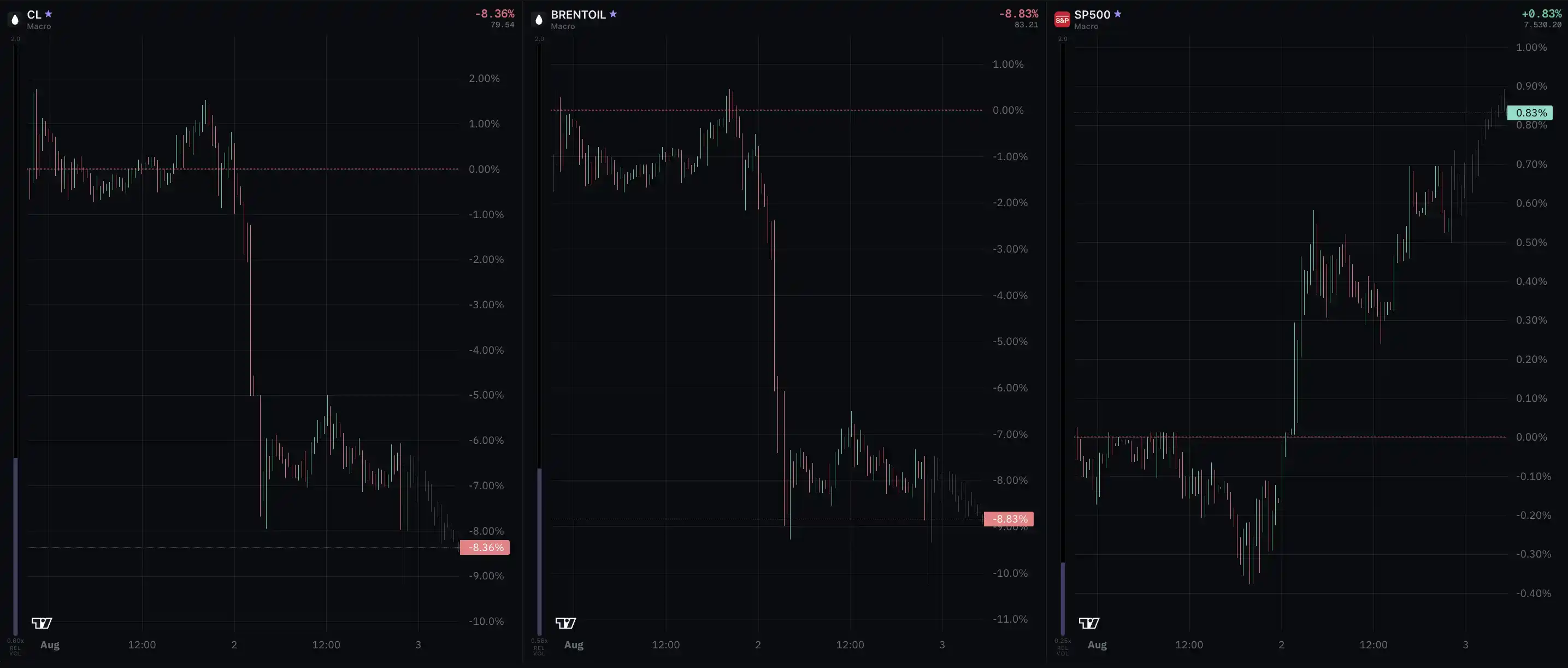
However, the agreement Trump mentioned has not yet materialized. He claimed that arrangements for the Strait of Hormuz are close to being finalized, and Iran's foreign minister also stated that consultations with Oman are in their final stages; yet, an Iranian Foreign Ministry spokesperson emphasized that the two sides discussed new shipping routes and were not directly negotiating the closure or opening of the strait. The issue of whether ships need to pay fees also remains unresolved.

The oil price around $79 reflects the cancellation of the airstrike but has not yet factored in the full resumption of navigation through the Strait of Hormuz.

Precious Metals
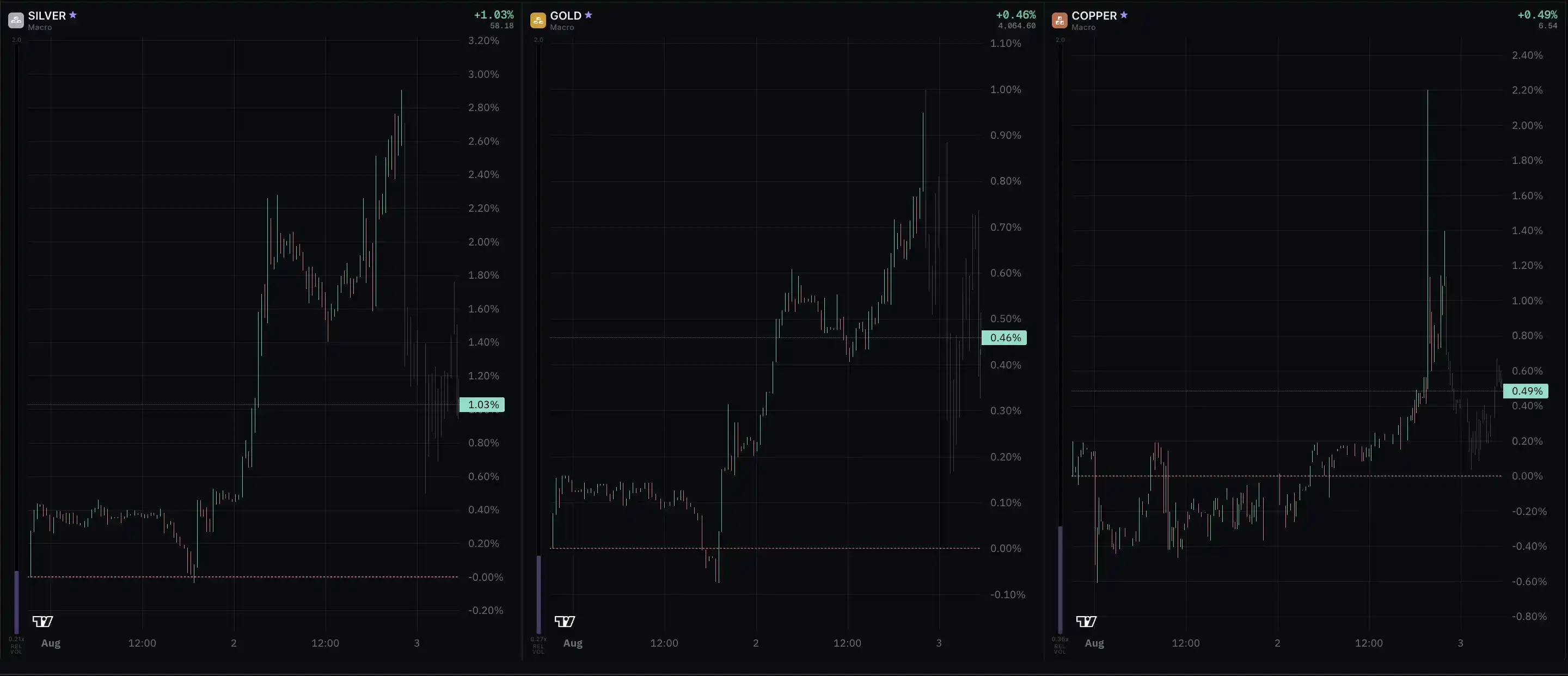
Influenced by the easing of U.S.-Iran tensions, spot gold briefly broke above $4,080 at the open. In subsequent TradeXYZ windows, gold rose about 0.5% and silver about 1%. Both moved lower after futures opened but then rebounded, with their gains significantly narrowing compared to the weekend levels.

Individual Stocks
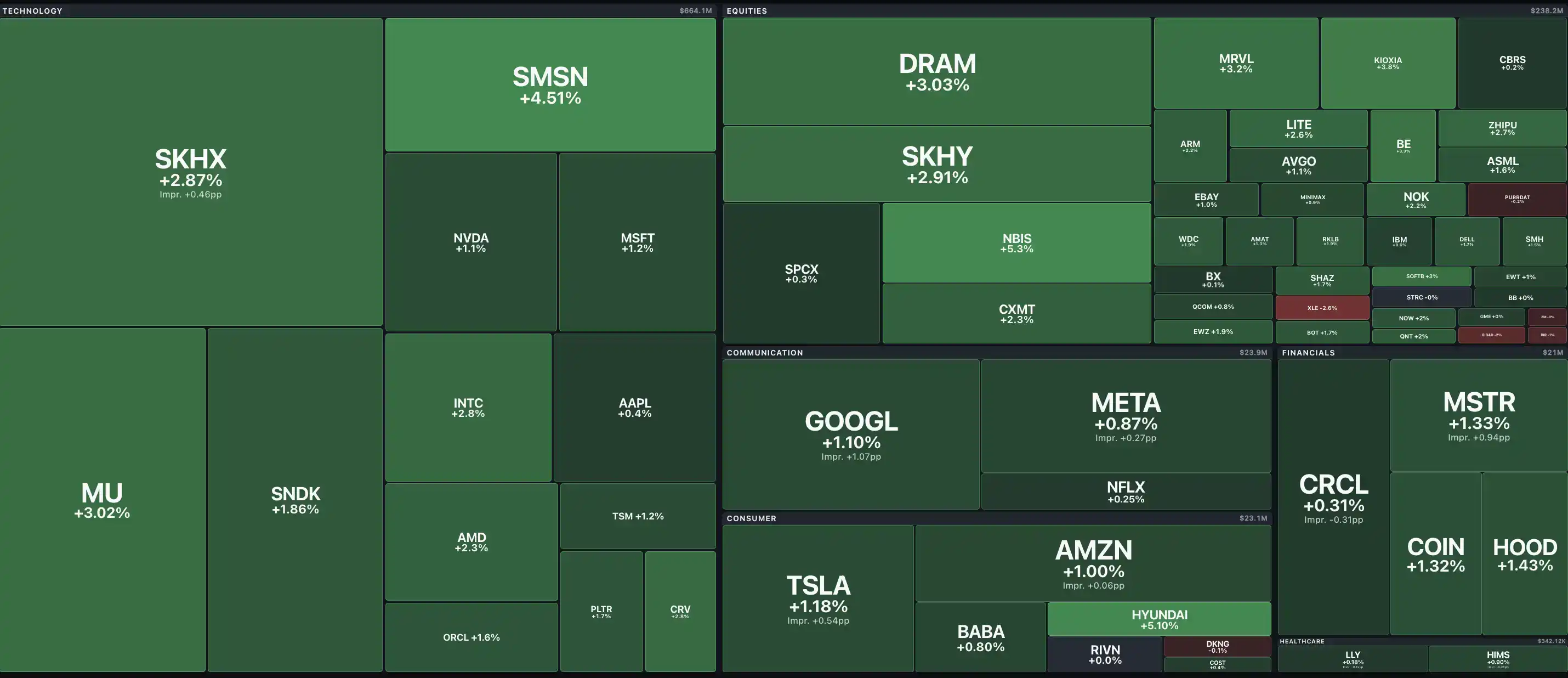
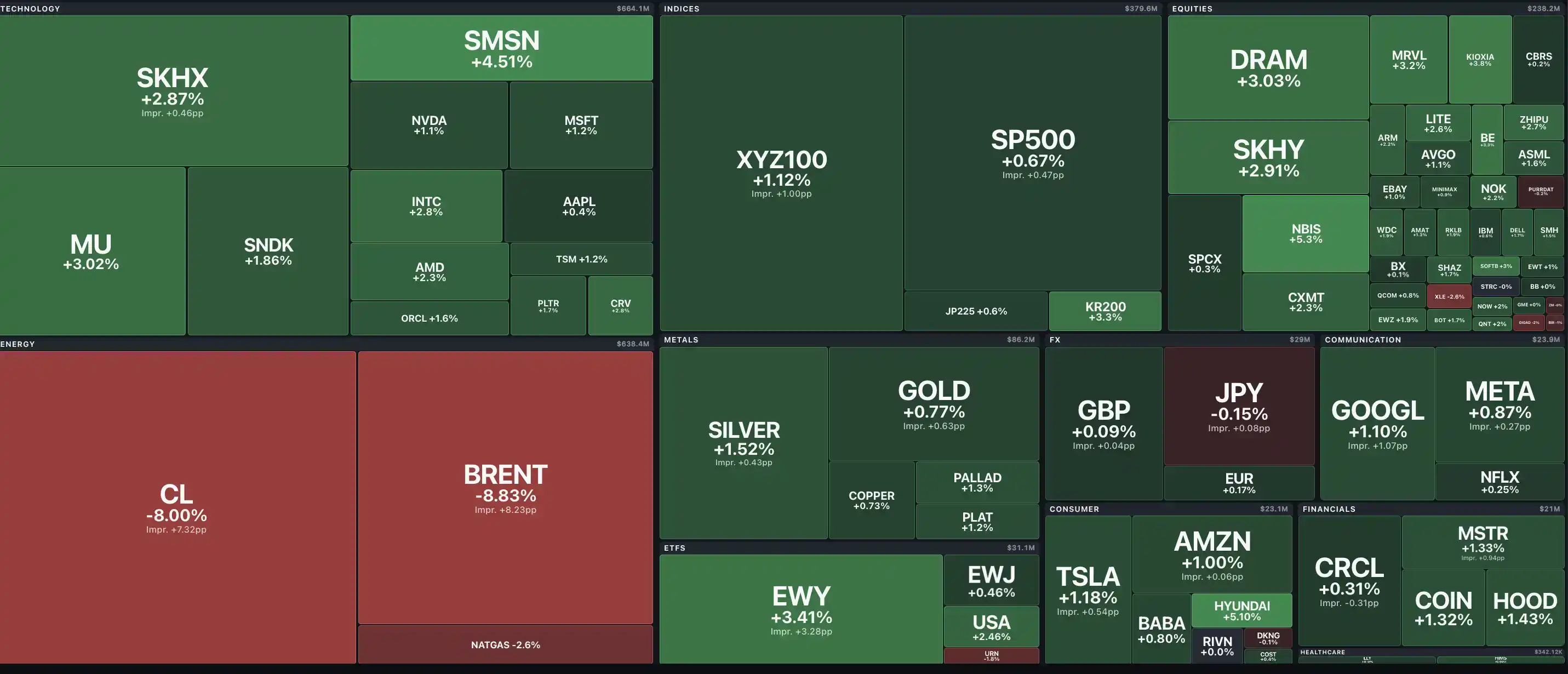
Individual stocks generally rose over the weekend, with tech, communications, consumer, and crypto-related stocks seeing varying degrees of recovery.

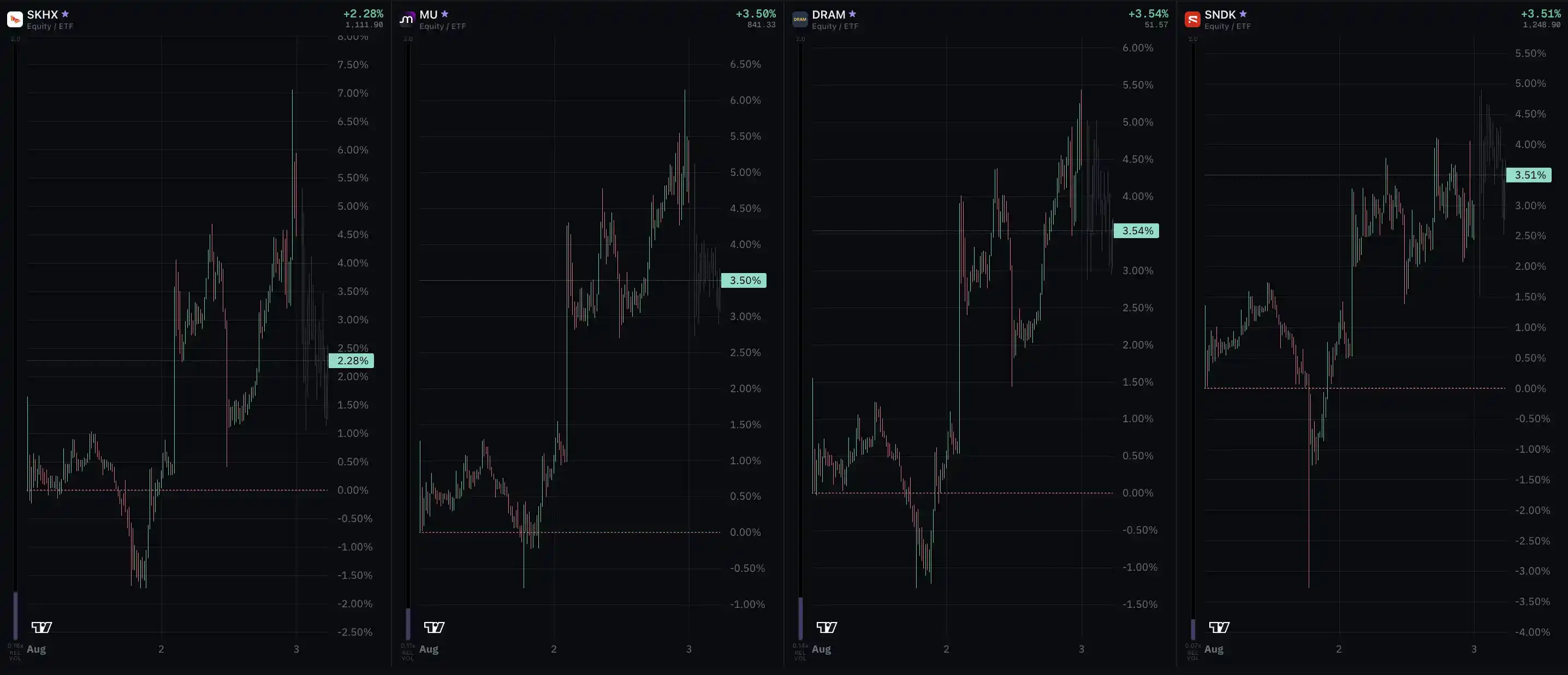
The memory sector performed strongly, with an overall gain of about 3.5%. SK Hynix's South Korean shares surged early but then pulled back, showing some relative weakness compared to peers in the same sector.
The divergence within the Mag7 was concentrated in Apple.

Excluding Apple, the other six companies gained about 1.4% to 2.0% subsequently, while Apple rose only about 0.4%. Although Apple's late-July earnings exceeded expectations, the slowdown in Services growth, weakness in the China market, and supply chain constraints weighed on its performance over the weekend.
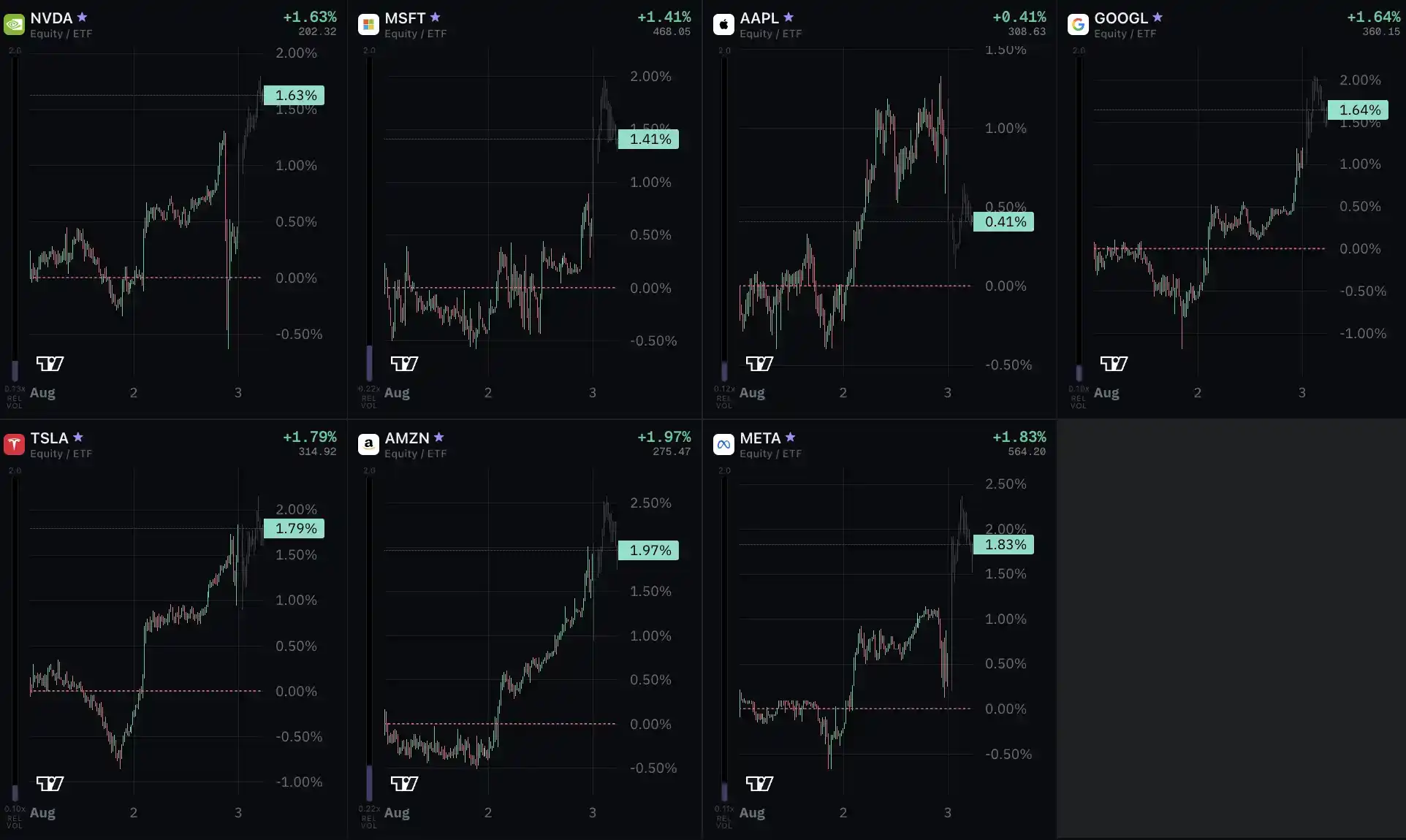
The market is currently choosing to first believe Trump's cancellation of the strike, while not completely dropping its guard against a recurrence of hostilities. As long as the next signal of war does not appear, crude oil's risk premium will remain under pressure, and equities and tech stocks will continue to enjoy this brief window of recovery.


Preguntas relacionadas

QHow did oil prices react on TradeXYZ after Trump called off strikes against Iran over the weekend?

AOil contracts on TradeXYZ dropped sharply from around $85.5 to below $83, and later continued to fall to near $79, with both CL and Brent contracts losing over 8% for the weekend.

QWhat was the impact on the S&P 500 index following the cancellation of the planned military strikes?

AThe S&P 500 index rose from about 7470 points to above 7500 points, and later reached as high as 7535 points, finishing the weekend with a gain of approximately 0.8%.

QHow did precious metals like gold and silver perform on TradeXYZ after the de-escalation news?

ASpot gold briefly broke above $4080 at the open. On TradeXYZ, gold gained about 0.5% and silver gained about 1% in the subsequent window, though their gains narrowed significantly after futures opened.

QWithin the Mag7 stocks, which company showed a notably weaker performance over the weekend and why?

AApple showed notably weaker performance, gaining only about 0.4% compared to 1.4%-2.0% gains for the other six Mag7 companies. This was due to concerns over slowing services growth, a weak Chinese market, and supply chain constraints despite its late-July earnings beat.

QWhat factor does the article suggest is still pressuring oil's risk premium, and what would allow equities to continue their recovery?

AThe article suggests that as long as no new signals of conflict emerge, oil's risk premium will remain under pressure. Equities and tech stocks can continue their brief recovery window during this period.

Lecturas Relacionadas

In-depth: The Foreign Guest Genspark

The article "The Foreign Guest: Genspark" investigates the identity and business practices of AI startup Genspark, which presents itself as a Palo Alto-based "AI Costco" offering a subscription bundle of over 70 models and numerous AI agent tools. Despite its official Silicon Valley narrative, Genspark's founding team has deep roots in Chinese tech giant Baidu, a history systematically downplayed in its branding. The company actively cultivates an image as an elite US firm, heavily publicizing partnerships and endorsements from OpenAI, Anthropic, and Microsoft, while distancing itself from the Chinese AI community and obscuring its connections to Chinese investors and open-weight models (like those from DeepSeek, Moonshot AI, and MiniMax) that power its services. Genspark's core strategy involves rapidly cloning and integrating successful AI product concepts (e.g., from Perplexity, Manus, Plaud) into its unified platform, supported by aggressive marketing, including Super Bowl ads and paid native content in publications like The Wall Street Journal. Critically, the article suggests a significant portion of its engineering and product development is conducted by a team in Beijing, operating outside its official US corporate structure. This duality allows Genspark to leverage Chinese talent and models for efficiency and cost reduction while constructing a public facade as a purely American success story. The piece concludes that Genspark's most effective agent is its own corporate identity, meticulously engineered to obscure its Chinese underpinnings and be perceived solely as a Silicon Valley company.

marsbitHace 15 min(s)

In-depth: The Foreign Guest Genspark

marsbitHace 15 min(s)

Debate: Korean Workers Fear Unemployment, While Musk Envisions a Society 'Without Work'?

While South Korean auto workers fear job losses from robotics, Elon Musk envisions a future where AI and robots render most work optional. This article explores the growing tension between immediate anxieties over automation and long-term visions of a post-work society. The piece begins with recent strikes at Hyundai's Korean plants, where unions, amid standard wage negotiations, also sought job guarantees against advancing robotics—specifically mentioning Boston Dynamics' Atlas. This reflects how anxiety about technological displacement is emerging even before robots are fully capable of replacing skilled labor on assembly lines. The author argues that while current robotics still struggle with the nuanced, experiential knowledge of veteran workers, the *perception* of imminent replacement is fueling social conflict prematurely. This modern "Luddite" sentiment is compared to the 19th-century English textile workers who smashed machines. Historically, Luddites weren't simply anti-technology; they were protesting the rapid devaluation of their skills and the unequal distribution of productivity gains. Similarly, today's workers ask who will bear the cost of transition and share in the new wealth created by machines. In contrast, figures like Elon Musk propose an optimistic endpoint: with AI and robotics driving extreme abundance, the link between work and survival could break. He suggests concepts like "Universal High Income" could allow society to share the technological bounty, transforming work from a necessity into a choice. The core challenge, however, lies in the transition. The author notes that technology's benefits diffuse slowly, while its disruptive costs—job losses, skill obsolescence—can be concentrated and immediate. The risk is a painful interim period where productivity gains are captured by a few before new social contracts, safety nets, and retraining systems are established. The conclusion calls for proactive governance. Just as past industrial revolutions gave rise to labor standards and social safety nets, the robotics era needs its own frameworks. These should address job transition support, distribution of productivity gains, safety liability, and ethical deployment. Embracing such "constraints" is not opposition to progress but a necessary step to ensure technology benefits society broadly. The discussion sparked by Hyundai's workers, therefore, is not premature but essential.

marsbitHace 28 min(s)

Debate: Korean Workers Fear Unemployment, While Musk Envisions a Society 'Without Work'?

marsbitHace 28 min(s)

CATL Invests in a 00s Graduate from Harbin Institute of Technology

Contemporary Amperex Technology Co., Limited (CATL) has exclusively invested in the Pre-A round of RoboParty, a company founded by 22-year-old Huang Yi. A former student at Harbin Institute of Technology, Huang built a bipedal humanoid robot in his dorm room and later dropped out to launch RoboParty in Shanghai. The company focuses on developing a fully open-source platform for humanoid robots, combining self-developed hardware, operating systems (Party OS), and foundational models. RoboParty's strategy emphasizes open-source collaboration to accelerate development and build a developer ecosystem, positioning itself as foundational infrastructure for embodied AI. Since its 2025 founding, the team—composed largely of top-tier university graduates—has secured six funding rounds in eight months, with investors including Matrix Partners, Xiaomi, and now CATL. This investment by CATL's corporate venture arm signals strong industry confidence in RoboParty's potential for real-world manufacturing and complex scenarios. Huang Yi prioritizes technological excellence and developer community growth over rapid commercialization. The company has already garnered significant interest from developers and research institutions globally. With a focus on continuous, rapid iteration and open innovation, RoboParty aims to prove the versatility of humanoid robots and drive the field toward an open-source future.

marsbitHace 31 min(s)

CATL Invests in a 00s Graduate from Harbin Institute of Technology

marsbitHace 31 min(s)

Will SpaceX's First Quarterly Report Rescue Its Stock Price Under the Pressure of 1.2 Billion Shares Unlocking?

SpaceX is set to release its first quarterly earnings report since going public, a key test for its stock which has declined 20% from its IPO price. Approximately 9.12 billion shares are set to unlock on August 6, with an additional 3.19 billion following a week later, creating potential selling pressure from early investors. A strong report may be the only catalyst to reverse the downtrend. The report will cover three segments: Space, Connectivity (Starlink), and AI. The AI business, centered on the merged xAI, is the biggest uncertainty. While it generated $818 million in revenue last quarter, it also reported a $2.5 billion operating loss and $7.7 billion in capital expenditures. New data center rental agreements with Anthropic and Google, particularly the substantial $1.25 billion monthly deal with Anthropic, add significant revenue variability this quarter. Investors await guidance on AI's future outlook and the timeline for launching AI computing satellites via Starship. Starlink remains the stable profit driver, ending last quarter with 10.3 million subscribers. Key metrics will be user growth, average revenue per user (ARPU), and enterprise/government contract backlogs. The Space segment, which posted a $657 million operating loss last quarter, will be scrutinized for updates on Starship development following its 13th test flight and the pace of Falcon 9 launches, many of which support internal Starlink deployment. Wall Street expects Q2 revenue of around $6.9 billion and EBITDA of $2.1 billion. However, as this is the first earnings report, analyst forecasts lack a historical baseline and could see significant variance. With a current market cap of ~$1.4 trillion and a high valuation, the market's reaction post-earnings will hinge on the report's strength, the magnitude of post-lockup selling, and ongoing investor concerns.

marsbitHace 31 min(s)

Will SpaceX's First Quarterly Report Rescue Its Stock Price Under the Pressure of 1.2 Billion Shares Unlocking?

marsbitHace 31 min(s)

Trading

Spot
活动图片