SpaceX is about to release its first quarterly financial report since going public, presenting a critical test for the market.
SpaceX will announce its second-quarter results after the market close on Wednesday, August 4th, Eastern Time. As of Monday's opening, its stock price has declined for four consecutive weeks, dropping approximately 20% from the IPO price of $135 and falling 46% cumulatively from its closing high of $201.80 on June 16th.
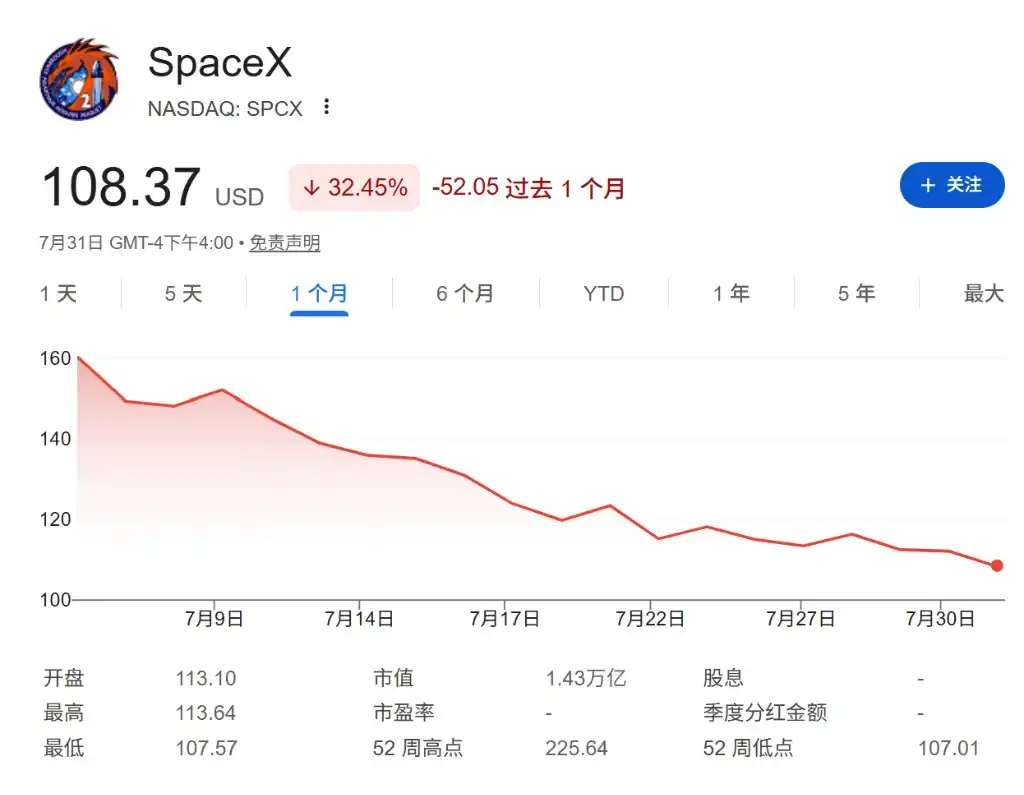
In a preview report, Cantor Fitzgerald analyst Colin Canfield noted, "There may be extreme deviation in earnings expectations for the initial quarter," suggesting that the direction of performance is nearly impossible to gauge from the outside.
Simultaneously, unlocking pressure looms over the stock price. Approximately 912 million shares will become eligible for public trading on August 6th, with another roughly 319 million shares unlocking about a week later. This means potential selling pressure from early investors cannot be ignored, and market attention will focus on the stock's reaction on Thursday and Friday—a strong earnings report might be the only catalyst to break the losing streak.
AI Business Has Huge Revenue Potential, But Highest Uncertainty
SpaceX's financial report discloses three main business segments: Space, Connectivity, and Artificial Intelligence (AI). The AI segment is the biggest question mark this quarter.
The core asset of the AI business is xAI, which SpaceX completed merging with in February of this year. xAI currently operates two land-based data centers: Colossus I in Tennessee and Colossus II in Mississippi. In the first quarter, the AI business generated $818 million in revenue but recorded a $2.5 billion operating loss, with capital expenditures reaching $7.7 billion.
Entering the second quarter, a significant variable emerged on the revenue side. SpaceX has signed AI data center leasing agreements with Anthropic and Google. The agreement with Anthropic amounts to $1.25 billion monthly and began ramping up between May and June; the Google agreement has not yet commenced. This means the actual revenue for the AI business this quarter has significant elasticity, and the direction of profit margins along with the pace of new capital expenditures is equally difficult to predict.
Guidance most anticipated by investors includes: the company's outlook for the AI business in the second half of this year and for 2027, as well as the projected timeline for advancing the concept of using Starship to deploy low-cost AI computing satellites into orbit.
Starlink: User Growth is the Core Metric
The Connectivity business, Starlink, is SpaceX's most stable profit engine. At the end of the first quarter, Starlink subscription users reached 10.3 million, more than doubling from 5 million 12 months prior; the segment achieved $11.4 billion in revenue and $4.4 billion in operating profit for the quarter.
In this quarter's report, user growth data will be a key market focus. Colin Canfield expects the company to disclose the Average Revenue Per User (ARPU) metric and the contract backlog for enterprise and government businesses. These data points will help investors assess the commercialization depth and future growth space of Starlink.
Space Business: Starship Progress Under Scrutiny
The Space segment carries SpaceX's core technology narrative. In the first quarter, this segment achieved $4.1 billion in revenue, an operating loss of $657 million, and $1.1 billion in new capital expenditures for property, plant, and equipment. In the second quarter, Falcon 9 completed approximately 36 launches, with the majority serving its own Starlink constellation deployment; such launches are not counted as revenue for the Space segment.
Progress on Starship is also closely watched. In July, Starship completed its 13th flight test. Investors will seek updates on the timing of the 14th test and the scale of the company's continued investment in this rocket—Starship is the key launch vehicle for future commercial payload launches and AI satellite deployment.
Earnings Expectations and Market Outlook
Wall Street currently estimates SpaceX's total Q2 revenue to be approximately $6.9 billion, with Earnings Before Interest, Taxes, Depreciation, and Amortization (EBITDA) around $2.1 billion; full-year revenue expectations are $39 billion, with EBITDA expectations of $17.3 billion. Colin Canfield is relatively optimistic about this quarter, expecting results to beat expectations accompanied by positive guidance.
However, the reference value of these forecasts is questionable. As this is SpaceX's first quarterly report since going public, analysts lack historical data for calibration, making significant deviations in the actual numbers possible.
The stock price movement is equally full of variables. The supply pressure from unlocking shares, market concerns about Elon Musk's divided attention, and the valuation debate itself—at a current market cap of approximately $1.4 trillion, it trades at about 35 times the estimated 2026 revenue—will all be key factors influencing the market's post-earnings reaction. For investors, this weekend could be extremely volatile.