Vitalik's Vision for the Next Evolution of On-Chain Finance: How to Reconstruct DeFi with an 'Options Mindset'?

marsbitPublicado a 2026-06-09Actualizado a 2026-06-09

Resumen

Vitalik Buterin recently proposed a conceptual shift for DeFi: replacing traditional Collateralized Debt Positions (CDPs) and forced liquidations with an options-based mechanism. This aims to address key vulnerabilities in current DeFi lending. The traditional CDP model, foundational to protocols like MakerDAO and Aave, allows users to borrow against collateral but relies on real-time oracles and triggers sudden, mandatory liquidations during price volatility. This can cause cascading sell-offs, oracle manipulation risks, and significant MEV extraction, exacerbating market stress. Vitalik's alternative envisions splitting an asset like 1 ETH into two complementary components: one offering stable/index-like exposure and the other absorbing the opposite risk/reward. Instead of a hard liquidation threshold, a user's exposure to the target asset would gradually and smoothly deviate (following a near-quadratic curve) as the collateral price moves. The system would primarily depend on "slow oracles" for periodic settlement rather than instant price feeds. Key potential benefits include: the elimination of abrupt, forced liquidations; drastically reduced reliance on vulnerable real-time oracles; and inherent resistance to certain MEV exploits centered on liquidation auctions. The article posits that for Ethereum DeFi to maintain its relevance amid competition from faster, cheaper chains, it must compete on sophisticated financial engineering and robustness—not just transaction s...

If you've been in the industry for more than one cycle, you've undoubtedly witnessed this recurring scene:

During extreme market conditions, prices flash crash, oracles deliver distorted prices, liquidation bots swarm in, and a batch of positions gets liquidated in a chain reaction within minutes. The selling pressure continues to cascade downward, eventually evolving into a liquidity run on the entire ecosystem. Starting from the "312" event in 2020, through subsequent crashes like "519" and "1011", forced liquidations have consistently been the most criticized trigger.

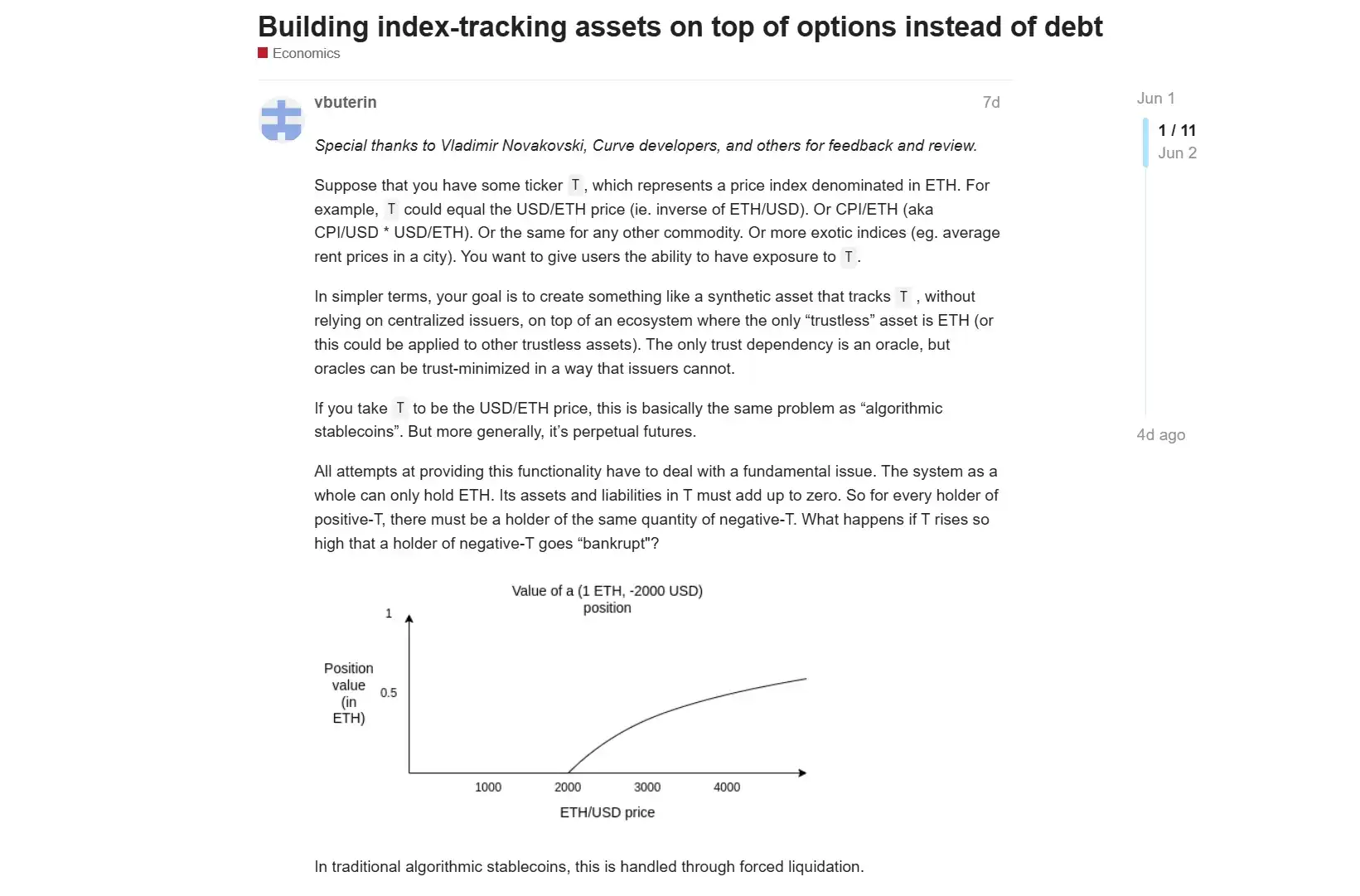
Facing this dilemma, Vitalik Buterin published a research concept earlier this month titled Building index-tracking assets on top of options instead of debt, posing a rather disruptive question: Can DeFi replace the traditional CDP (Collateralized Debt Position) and forced liquidation model with an option-based mechanism?

According to Vitalik's conception, the core advantage of this design is the potential use of "slow oracles" to replace real-time oracles, thereby significantly reducing the risk of oracle manipulation. A user's exposure to the index would deviate from the target in a smooth (approximately quadratic) manner, rather than experiencing instantaneous forced liquidation.
I. The Achilles' Heel of Traditional DeFi

Before discussing Vitalik's new line of thinking, it's necessary to revisit why "CDP + forced liquidation" became the core model of DeFi, and why it also became its weakness.

As is well known, represented by classic lending protocols like MakerDAO/Sky, Aave, and Compound, one of the most important early financial innovations in DeFi was allowing users to collateralize on-chain assets to borrow another asset.

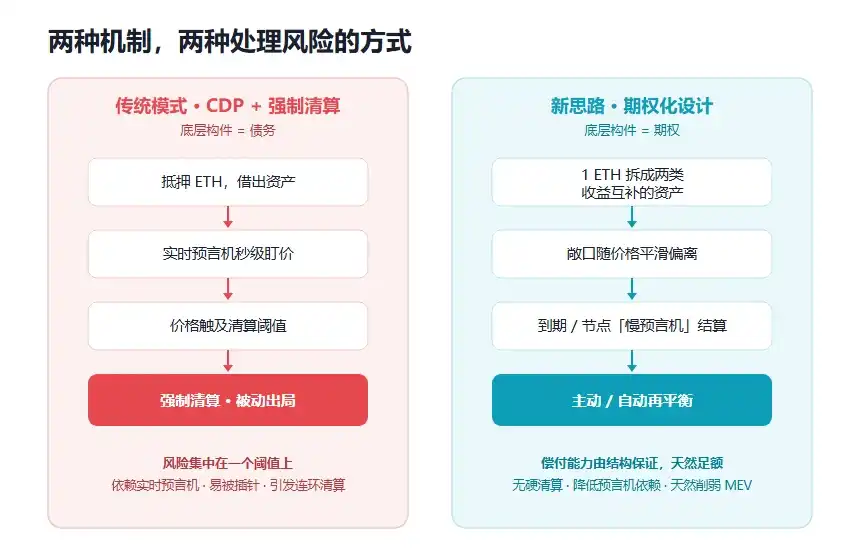
This mechanism can be simply understood as users depositing assets like ETH into a protocol, obtaining a borrowing limit. As long as the collateral value remains sufficiently high, the position is safe; however, once the collateral price falls below a certain threshold, the protocol triggers a liquidation, selling the collateral to repay the debt and protect the system's solvency.

It may seem mundane today, but this mechanism was crucial for early DeFi. It transformed assets like ETH from "passively held" into "reusable" financial base assets for the first time, enabling them to enter more complex systems like lending, leverage, stablecoins, and yield strategies.

It can be said that CDPs and lending protocols laid the earliest and most critical foundation for DeFi's composability.

However, its problems are also evident:

  • Forced liquidation relies on real-time and highly reliable oracles: Protocols must rely on external oracles for second-by-second price feeds. If an oracle experiences delays, manipulation, extreme network congestion, or if certain assets themselves have insufficient liquidity, the protocol may execute liquidations based on temporarily distorted prices.
  • Forced liquidation amplifies pressure during extreme market conditions: When collateral prices fall rapidly, liquidators and MEV bots compete intensely for liquidation opportunities. The concentrated selling of collateral further exacerbates market pressure, potentially triggering a liquidity run across the entire ecosystem.
  • Illusion of liquidity: Traditional lending protocols assume "the market will always have sufficient liquidity to absorb liquidation selling pressure." However, in truly extreme market environments, liquidity can evaporate instantly. This leads to a situation where the price falls further, fewer people are willing to take on the risk, making liquidations harder to complete smoothly. If a protocol cannot promptly handle bad positions, it may be left with bad debt.

So, objectively speaking, CDP + forced liquidation is not a flawed design. It was an extremely important and effective foundational module in early DeFi. However, as DeFi has entered a stage of larger capital scale and more complex structures, the costs of this model have become increasingly prominent:

It concentrates risk highly on a single liquidation threshold—before the threshold is triggered, everything seems normal; once it's touched, users often have no choice but to passively endure the outcome.

II. Vitalik's New Approach: Reconstructing Lending with an 'Options Mindset'

Vitalik's new approach essentially seeks to change the underlying way DeFi handles risk.

We can summarize his thinking in one sentence: Could DeFi stop using "debt" as its foundational component and instead use "options" as its foundational component?

Because the foundation of the traditional CDP model is debt. Users borrow assets, and there must be a mechanism to ensure the debt is always sufficiently collateralized. Once collateral becomes insufficient, the protocol can only resort to forced liquidation to prevent system bad debt.

The design based on options takes a completely different approach. It doesn't have users create a debt that must be protected in real-time. Instead, it breaks down the underlying asset into a set of complementary contracts. Simply put, 1 ETH can be split into two types of assets: one closer to a stable or index-tracking exposure, and the other bearing the opposite risk and return. Regardless of price movements, the combined returns of these two assets always correspond to the underlying 1 ETH.
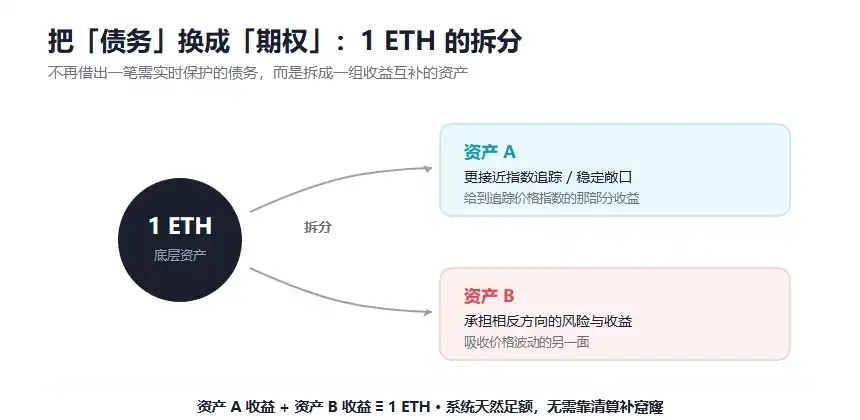
This means the system no longer needs to suddenly force-liquidate a user at a specific price point. In the traditional liquidation model, a user might be abruptly liquidated when the price hits the line. In the option-based model, users face a gradual deviation of their exposure from the target, requiring rebalancing at an appropriate time. Here's a more accessible analogy to understand this:

  • The traditional model (CDP) is like you pledging $10,000 worth of ETH to a lending protocol, borrowing $5,000. The protocol monitors the price via an oracle; once ETH falls to a critical point, it directly sells your ETH without a second thought, charging you a hefty fee. You have no right to appeal.
  • In the new option-based model, you pledge ETH and still receive $5,000, but this isn't called a loan. Its form is more like a time-bound "right": before the agreed-upon time, no matter how much ETH falls, your position won't be liquidated mid-way—the initiative always remains in your hands. At expiration, if the price recovers, you can redeem your collateral; if the price falls, you can simply choose not to exercise the option, letting the protocol take the collateral. You've already secured the $5,000 in hand, rather than being "cleaned out" by a wick in your sleep.

Of course, this is a simplified analogy to aid understanding. Vitalik's original design is closer to a combination of "holding deep in-the-money options and gradually rolling them to lower strike prices as the price approaches."
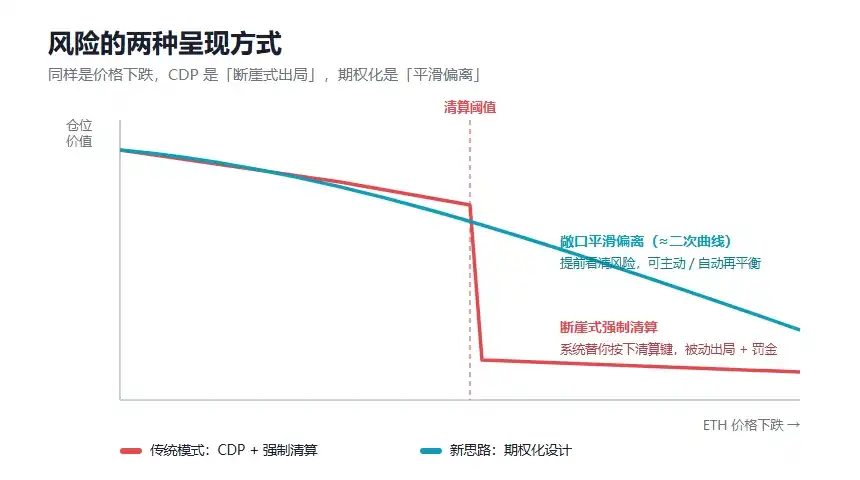
Overall, the former is more like "the system presses the liquidation button for the user," while the latter is more like "the user sees the risk curve in advance and decides when to adjust the position themselves." This shift in mechanism will undoubtedly bring profound changes to DeFi on several levels:

  • No more 'hard liquidation': Since borrowing positions are transformed into options with a time cycle, the protocol no longer needs to set a "liquidation line that explodes immediately upon touch." Users no longer need to anxiously watch the charts daily and won't be force-liquidated in their sleep due to a single malicious wick.
  • Significantly reduced reliance on oracles: The new mechanism drastically reduces dependence on high-frequency, real-time oracle price feeds. The protocol only needs to settle at expiration or specific time nodes. This directly reduces the space for hackers to launch attacks using "flash loans + oracle manipulation."
  • Inherently anti-MEV properties: Without instantaneous forced liquidation, on-chain gas wars triggered by "cascading liquidations" will no longer occur. MEV bots lose their most lucrative liquidation arbitrage scenario. Value created by the protocol is more likely to flow back to users and LPs, rather than being extracted by arbitrageurs and sequencers.

The significance of this change goes far beyond "more safety."

Because the future users DeFi aims to serve include not just high-risk traders, but also more ordinary users and real payment scenarios. For these groups, what truly matters often isn't pushing capital efficiency to the extreme, but rather whether they retain choice during extreme market conditions and can avoid being forcibly kicked out of the system by a short-term fluctuation.

III. Do Users Still Need Ethereum DeFi?

This question has become more pertinent today.

With the rise of emerging ecosystems like Hyperliquid, users are seeing another form of DeFi product. They can offer faster matching experiences, interactions closer to centralized exchanges, more concentrated liquidity, and more direct fulfillment of trading needs.

This represents real competitive pressure for Ethereum.

If we only compare transaction speed, fees, and front-end experience, Ethereum mainnet and some traditional DeFi protocols may not always hold the advantage. Users won't automatically believe a protocol is better just because it's deployed on Ethereum, nor will they ignore cheaper and more convenient alternatives just because a product is more "orthodox."

Therefore, Ethereum DeFi needs to re-answer the question: Why do users still need Ethereum DeFi?

The answer certainly can't just be "because Ethereum is the most secure" or "because Ethereum has the largest TVL." The truly compelling answer should stem from more fundamental financial design capabilities.
In the author's opinion, if Ethereum DeFi is to remain the core arena of on-chain finance, it cannot merely stay at replicating traditional financial products to simply increase leverage efficiency. It must build advantages in more challenging areas, such as more transparent risk boundaries, more robust oracle mechanisms, fewer forced system actions, stronger user autonomy, and protocol structures that can better withstand extreme scenario testing.

In other words, the competitive focus for the next generation of Ethereum DeFi might no longer be about who can make users earn more, but about who can help users avoid being passively forced out in complex financial environments and truly understand the risks they are taking.

For ordinary users, the option-based DeFi design proposed by Vitalik might still seem distant and may not quickly mature into products. However, the direction it signals is clear: DeFi shouldn't only pursue higher yields; it should also pursue clearer, more explainable, and more manageable risk structures.

In Conclusion

To be realistic, after frequent security incidents, a common voice asks: Since DeFi has so many risks, does it mean on-chain finance itself is not viable?

This judgment might be overly simplistic.

The problem with DeFi doesn't lie in the direction of "decentralization" itself, but in the fact that many products haven't truly completed the evolution from high-risk experiments to robust financial infrastructure. The industry has been too accustomed to proving value with growth and TVL, while relatively underestimating risk design and resilience in extreme scenarios.

The new approach proposed by Vitalik precisely serves as a reminder to the industry: The evolution of DeFi isn't just about porting old finance onto the chain. It's about leveraging the programmable and composable characteristics of the chain to design new risk structures that traditional finance might not easily achieve.

If we only compete on speed and speculative efficiency, Ethereum can hardly win. Ethereum must return to its foundational narrative: security, decentralization, and bottom-up innovation in financial paradigms.

This, perhaps, is the real opportunity for Ethereum DeFi.

Preguntas relacionadas

QWhat is the core problem with the traditional CDP and forced liquidation model in DeFi, as highlighted in the article?

AThe core problem is its reliance on real-time, reliable oracles. If the oracle price is manipulated, delayed, or inaccurate, it can trigger forced liquidations based on distorted data. This creates a highly concentrated risk point where users can be instantly liquidated during market volatility, exacerbating selling pressure and potentially leading to cascading liquidations and liquidity crises within the ecosystem.

QAccording to Vitalik Buterin's proposal, how does an 'option-based' mechanism differ fundamentally from the traditional CDP model?

AThe fundamental difference is in the underlying financial primitive. The CDP model is based on *debt*, requiring constant over-collateralization and forced liquidation if the collateral value falls below a threshold. The option-based model decomposes the underlying asset (e.g., 1 ETH) into complementary financial contracts (like options), creating one asset with stable/index-tracking exposure and another bearing the opposing risk/reward. It eliminates the hard liquidation threshold, gradually shifting the user's exposure in a smoother, non-instantaneous way.

QWhat are the key potential benefits of adopting an option-based design for DeFi protocols, as mentioned in the text?

AKey benefits include: 1) The elimination of instantaneous 'hard liquidations,' giving users more control and time to manage their positions. 2) A significantly reduced dependency on high-frequency, real-time oracles, minimizing risks of oracle manipulation and attacks. 3) Inherent resistance to certain types of MEV (Maximal Extractable Value), as it removes the lucrative, gas-bidding清算套利场景 triggered by cascading liquidations. 4) A clearer, more manageable risk structure for users.

QThe article suggests Ethereum DeFi needs a new competitive edge beyond just speed and fees. What does it propose as the future focus for Ethereum DeFi?

AThe article proposes that the future competitive edge for Ethereum DeFi should lie in superior *underlying financial design capability*. This includes creating protocols with more transparent risk boundaries, more robust oracle mechanisms, fewer强制性强制性的 system actions, stronger user autonomy, and structures that are more resilient in extreme scenarios. The focus shifts from maximizing capital efficiency/yield to providing clearer, more explainable, and more manageable risk structures.

QWhat is the broader implication or lesson that Vitalik Buterin's proposal is trying to convey about the evolution of DeFi, according to the article's conclusion?

AThe broader implication is that DeFi's evolution should not merely involve replicating traditional financial products on-chain. Instead, it should leverage the programmable and composable nature of blockchains to design *novel risk structures* that are difficult or impractical to implement in traditional finance. For Ethereum specifically, its opportunity lies in returning to its foundational narrative of security, decentralization, and底层层的底层层的金融范式创新, rather than competing solely on transaction speed or投机效率.

Lecturas Relacionadas

La Liga Team Bets $1 Million Against Themselves Before Match: Does Using Prediction Markets for Insurance Comply with Sports Regulations?

A Spanish La Liga club, reportedly Osasuna, purchased insurance against relegation and was linked to a transaction of over $1 million on the prediction market platform Kalshi, betting against its own victory in a crucial season-ending match. While Osasuna confirmed buying €1.2 million insurance for a potential €6 million payout in case of relegation through broker Howden, it did not confirm involvement with Kalshi. The reported trade involved intermediaries like Game Point Capital and Greenlight Commodities, with quant firm Susquehanna as the counterparty. This incident highlights the blurring line between financial hedging and gambling in prediction markets. Such markets allow trading on future event outcomes, like sports results. In the US, Kalshi operates as a regulated event contract market under the CFTC. However, Spanish authorities recently initiated penalties against Kalshi and Polymarket, considering their activities unlicensed gambling. The case raises core questions about prediction markets: who can trade, how insider information is handled, and whether participants can influence outcomes, especially in sports where results are human-driven. While leagues like La Liga and Serie A have partnered with Polymarket in North America, the regulatory clash and potential for conflicts of interest, as seen in this club's alleged transaction, present significant challenges as prediction markets evolve toward institutional risk management.

Foresight NewsHace 1 min(s)

La Liga Team Bets $1 Million Against Themselves Before Match: Does Using Prediction Markets for Insurance Comply with Sports Regulations?

Foresight NewsHace 1 min(s)

From Shouting 150 Dollars to Liquidating HYPE in Just Three Days, How Much Credibility Does Arthur Hayes Have Left?

How much of Arthur Hayes's market credibility remains? Recently, the "godfather of crypto perpetual swaps" and BitMEX co-founder has faced public criticism, including accusations from on-chain investigator ZachXBT about creating exit liquidity for his followers. Starting last week, Hayes executed multiple sudden sell-offs. He had repeatedly publicly predicted the HYPE token would reach $150. After a $100,000 bet defending Hyperliquid on June 1st, he announced just three days later that he had completely sold his HYPE and NEAR holdings, successfully exiting near the peak. He also sold ZEC and WLD. His sale of WLD appeared to be a classic "pump and dump" maneuver. On June 3rd, he publicly set a $10 target for WLD, causing its price to surge over 35%. By June 6th, he announced he had sold his WLD, citing "anomalous" SpaceX pre-IPO price action, which triggered a sharp price drop. On June 9th, Hayes published a lengthy article explaining his actions, citing factors like rising energy costs and a potential AI bubble burst. Consequently, his family office, Maelstrom, now holds positions in US energy producers and only core crypto assets BTC and ETH, having sold AI-related stocks and non-core cryptocurrencies. This pattern is not new. In 2025, he similarly touted HYPE before selling it at what turned out to be a cycle peak, only to repurchase it at the next cycle's low. Similar scenarios played out with tokens like ETHFI and ENA. Long-term observers have developed a strategy: ignore Hayes's public statements but closely monitor his on-chain actions—be cautious following his buys, but decisively follow his sells. If he continues these tactics, especially as seen with the WLD case, his market credibility risks being permanently damaged. As Hayes himself admitted in his latest article, "I remain an unapologetic gambler."

marsbitHace 19 min(s)

From Shouting 150 Dollars to Liquidating HYPE in Just Three Days, How Much Credibility Does Arthur Hayes Have Left?

marsbitHace 19 min(s)

Fundraising is Like a Strange Dance: The 'Absurd Drama' of Silicon Valley Founders' Capital Raises

The article details a series of absurd and revealing anecdotes shared by Silicon Valley founders about their venture capital fundraising experiences, sparked by Greg Isenberg's story of pitching to a sleeping a16z partner. Founders describe surreal pitch meetings: one faced a barefoot, peanut-eating investor who offered triple the requested amount after 30 seconds; another performed a pitch in a VC's parked car; a founder discovered his audience understood no English beyond "yes." These stories highlight the often irrational and performative nature of fundraising. Beyond the absurdity, darker power imbalances are exposed. Stories include investors suggesting founders fire co-founders for their equity, blatant market misjudgments, disrespectful behavior from LPs, and discriminatory remarks. A debate also emerges around "Sequoia's" practice of splitting a round into two valuations. However, the thread isn't solely critical. Positive counter-narratives celebrate supportive VCs who offered crucial advice during crises, respected founders' timelines, and showed simple gestures of respect—like a partner personally fetching coffee before a major pitch. Ultimately, the collective sharing acts as a pressure release, illustrating that fundraising is a complex dance of power, trust, and sometimes sheer theater. It underscores that beyond capital, mutual respect and integrity remain the most enduring foundations of the founder-investor relationship.

marsbitHace 33 min(s)

Fundraising is Like a Strange Dance: The 'Absurd Drama' of Silicon Valley Founders' Capital Raises

marsbitHace 33 min(s)

Trading

Spot
Futuros

Artículos destacados

Qué es $S$

Entendiendo SPERO: Una Visión General Completa Introducción a SPERO A medida que el panorama de la innovación continúa evolucionando, la aparición de tecnologías web3 y proyectos de criptomonedas juega un papel fundamental en la configuración del futuro digital. Un proyecto que ha atraído la atención en este campo dinámico es SPERO, denotado como SPERO,$$s$. Este artículo tiene como objetivo reunir y presentar información detallada sobre SPERO, para ayudar a entusiastas e inversores a comprender sus fundamentos, objetivos e innovaciones dentro de los dominios web3 y cripto. ¿Qué es SPERO,$$s$? SPERO,$$s$ es un proyecto único dentro del espacio cripto que busca aprovechar los principios de descentralización y tecnología blockchain para crear un ecosistema que promueva la participación, la utilidad y la inclusión financiera. El proyecto está diseñado para facilitar interacciones de igual a igual de nuevas maneras, proporcionando a los usuarios soluciones y servicios financieros innovadores. En su esencia, SPERO,$$s$ tiene como objetivo empoderar a los individuos al proporcionar herramientas y plataformas que mejoren la experiencia del usuario en el espacio de las criptomonedas. Esto incluye habilitar métodos de transacción más flexibles, fomentar iniciativas impulsadas por la comunidad y crear caminos para oportunidades financieras a través de aplicaciones descentralizadas (dApps). La visión subyacente de SPERO,$$s$ gira en torno a la inclusividad, buscando cerrar brechas dentro de las finanzas tradicionales mientras aprovecha los beneficios de la tecnología blockchain. ¿Quién es el Creador de SPERO,$$s$? La identidad del creador de SPERO,$$s$ sigue siendo algo oscura, ya que hay recursos públicos limitados que proporcionan información de fondo detallada sobre su(s) fundador(es). Esta falta de transparencia puede derivarse del compromiso del proyecto con la descentralización, una ética que muchos proyectos web3 comparten, priorizando las contribuciones colectivas sobre el reconocimiento individual. Al centrar las discusiones en torno a la comunidad y sus objetivos colectivos, SPERO,$$s$ encarna la esencia del empoderamiento sin señalar a individuos específicos. Como tal, comprender la ética y la misión de SPERO sigue siendo más importante que identificar a un creador singular. ¿Quiénes son los Inversores de SPERO,$$s$? SPERO,$$s$ cuenta con el apoyo de una diversa gama de inversores que van desde capitalistas de riesgo hasta inversores ángeles dedicados a fomentar la innovación en el sector cripto. El enfoque de estos inversores generalmente se alinea con la misión de SPERO, priorizando proyectos que prometen avances tecnológicos sociales, inclusión financiera y gobernanza descentralizada. Estas fundaciones de inversores suelen estar interesadas en proyectos que no solo ofrecen productos innovadores, sino que también contribuyen positivamente a la comunidad blockchain y sus ecosistemas. El respaldo de estos inversores refuerza a SPERO,$$s$ como un contendiente notable en el dominio de proyectos cripto que evoluciona rápidamente. ¿Cómo Funciona SPERO,$$s$? SPERO,$$s$ emplea un marco multifacético que lo distingue de los proyectos de criptomonedas convencionales. Aquí hay algunas de las características clave que subrayan su singularidad e innovación: Gobernanza Descentralizada: SPERO,$$s$ integra modelos de gobernanza descentralizada, empoderando a los usuarios para participar activamente en los procesos de toma de decisiones sobre el futuro del proyecto. Este enfoque fomenta un sentido de propiedad y responsabilidad entre los miembros de la comunidad. Utilidad del Token: SPERO,$$s$ utiliza su propio token de criptomoneda, diseñado para servir diversas funciones dentro del ecosistema. Estos tokens permiten transacciones, recompensas y la facilitación de servicios ofrecidos en la plataforma, mejorando la participación y la utilidad general. Arquitectura en Capas: La arquitectura técnica de SPERO,$$s$ apoya la modularidad y escalabilidad, permitiendo la integración fluida de características y aplicaciones adicionales a medida que el proyecto evoluciona. Esta adaptabilidad es fundamental para mantener la relevancia en el cambiante paisaje cripto. Participación de la Comunidad: El proyecto enfatiza iniciativas impulsadas por la comunidad, empleando mecanismos que incentivan la colaboración y la retroalimentación. Al nutrir una comunidad sólida, SPERO,$$s$ puede abordar mejor las necesidades de los usuarios y adaptarse a las tendencias del mercado. Enfoque en la Inclusión: Al ofrecer tarifas de transacción bajas e interfaces amigables para el usuario, SPERO,$$s$ busca atraer a una base de usuarios diversa, incluyendo a individuos que anteriormente pueden no haber participado en el espacio cripto. Este compromiso con la inclusión se alinea con su misión general de empoderamiento a través de la accesibilidad. Cronología de SPERO,$$s$ Entender la historia de un proyecto proporciona información crucial sobre su trayectoria de desarrollo y hitos. A continuación se presenta una cronología sugerida que mapea eventos significativos en la evolución de SPERO,$$s$: Fase de Conceptualización e Ideación: Las ideas iniciales que forman la base de SPERO,$$s$ fueron concebidas, alineándose estrechamente con los principios de descentralización y enfoque comunitario dentro de la industria blockchain. Lanzamiento del Whitepaper del Proyecto: Tras la fase conceptual, se lanzó un whitepaper completo que detalla la visión, los objetivos y la infraestructura tecnológica de SPERO,$$s$ para generar interés y retroalimentación de la comunidad. Construcción de Comunidad y Primeras Interacciones: Se realizaron esfuerzos de divulgación activa para construir una comunidad de primeros adoptantes y posibles inversores, facilitando discusiones en torno a los objetivos del proyecto y obteniendo apoyo. Evento de Generación de Tokens: SPERO,$$s$ llevó a cabo un evento de generación de tokens (TGE) para distribuir sus tokens nativos a los primeros seguidores y establecer liquidez inicial dentro del ecosistema. Lanzamiento de la dApp Inicial: La primera aplicación descentralizada (dApp) asociada con SPERO,$$s$ se puso en marcha, permitiendo a los usuarios interactuar con las funcionalidades centrales de la plataforma. Desarrollo Continuo y Alianzas: Actualizaciones y mejoras continuas a las ofertas del proyecto, incluyendo alianzas estratégicas con otros actores en el espacio blockchain, han moldeado a SPERO,$$s$ en un jugador competitivo y en evolución en el mercado cripto. Conclusión SPERO,$$s$ se erige como un testimonio del potencial de web3 y las criptomonedas para revolucionar los sistemas financieros y empoderar a los individuos. Con un compromiso con la gobernanza descentralizada, la participación comunitaria y funcionalidades diseñadas de manera innovadora, allana el camino hacia un paisaje financiero más inclusivo. Como con cualquier inversión en el espacio cripto que evoluciona rápidamente, se anima a los posibles inversores y usuarios a investigar a fondo y participar de manera reflexiva con los desarrollos en curso dentro de SPERO,$$s$. El proyecto muestra el espíritu innovador de la industria cripto, invitando a una mayor exploración de sus innumerables posibilidades. Mientras el viaje de SPERO,$$s$ aún se desarrolla, sus principios fundamentales pueden, de hecho, influir en el futuro de cómo interactuamos con la tecnología, las finanzas y entre nosotros en ecosistemas digitales interconectados.

72 Vistas totalesPublicado en 2024.12.17Actualizado en 2024.12.17

Qué es $S$

Qué es AGENT S

Agent S: El Futuro de la Interacción Autónoma en Web3 Introducción En el paisaje en constante evolución de Web3 y las criptomonedas, las innovaciones están redefiniendo constantemente cómo los individuos interactúan con las plataformas digitales. Uno de estos proyectos pioneros, Agent S, promete revolucionar la interacción humano-computadora a través de su marco agente abierto. Al allanar el camino para interacciones autónomas, Agent S busca simplificar tareas complejas, ofreciendo aplicaciones transformadoras en inteligencia artificial (IA). Esta exploración detallada profundizará en las complejidades del proyecto, sus características únicas y las implicaciones para el dominio de las criptomonedas. ¿Qué es Agent S? Agent S se presenta como un marco agente abierto innovador, diseñado específicamente para abordar tres desafíos fundamentales en la automatización de tareas informáticas: Adquisición de Conocimiento Específico del Dominio: El marco aprende inteligentemente de diversas fuentes de conocimiento externas y experiencias internas. Este enfoque dual le permite construir un rico repositorio de conocimiento específico del dominio, mejorando su rendimiento en la ejecución de tareas. Planificación a Largo Plazo de Tareas: Agent S emplea planificación jerárquica aumentada por la experiencia, un enfoque estratégico que facilita la descomposición y ejecución eficiente de tareas complejas. Esta característica mejora significativamente su capacidad para gestionar múltiples subtareas de manera eficiente y efectiva. Manejo de Interfaces Dinámicas y No Uniformes: El proyecto introduce la Interfaz Agente-Computadora (ACI), una solución innovadora que mejora la interacción entre agentes y usuarios. Utilizando Modelos de Lenguaje Multimodal de Gran Escala (MLLMs), Agent S puede navegar y manipular diversas interfaces gráficas de usuario sin problemas. A través de estas características pioneras, Agent S proporciona un marco robusto que aborda las complejidades involucradas en la automatización de la interacción humana con las máquinas, preparando el terreno para una multitud de aplicaciones en IA y más allá. ¿Quién es el Creador de Agent S? Si bien el concepto de Agent S es fundamentalmente innovador, la información específica sobre su creador sigue siendo elusiva. El creador es actualmente desconocido, lo que resalta ya sea la etapa incipiente del proyecto o la elección estratégica de mantener a los miembros fundadores en el anonimato. Independientemente de la anonimidad, el enfoque sigue siendo en las capacidades y el potencial del marco. ¿Quiénes son los Inversores de Agent S? Dado que Agent S es relativamente nuevo en el ecosistema criptográfico, la información detallada sobre sus inversores y patrocinadores financieros no está documentada explícitamente. La falta de información disponible públicamente sobre las bases de inversión u organizaciones que apoyan el proyecto plantea preguntas sobre su estructura de financiamiento y hoja de ruta de desarrollo. Comprender el respaldo es crucial para evaluar la sostenibilidad del proyecto y su posible impacto en el mercado. ¿Cómo Funciona Agent S? En el núcleo de Agent S se encuentra una tecnología de vanguardia que le permite funcionar de manera efectiva en diversos entornos. Su modelo operativo se basa en varias características clave: Interacción Humano-Computadora Similar a la Humana: El marco ofrece planificación avanzada de IA, esforzándose por hacer que las interacciones con las computadoras sean más intuitivas. Al imitar el comportamiento humano en la ejecución de tareas, promete elevar las experiencias de los usuarios. Memoria Narrativa: Empleada para aprovechar experiencias de alto nivel, Agent S utiliza memoria narrativa para hacer un seguimiento de las historias de tareas, mejorando así sus procesos de toma de decisiones. Memoria Episódica: Esta característica proporciona a los usuarios una guía paso a paso, permitiendo que el marco ofrezca apoyo contextual a medida que se desarrollan las tareas. Soporte para OpenACI: Con la capacidad de ejecutarse localmente, Agent S permite a los usuarios mantener el control sobre sus interacciones y flujos de trabajo, alineándose con la ética descentralizada de Web3. Fácil Integración con APIs Externas: Su versatilidad y compatibilidad con varias plataformas de IA aseguran que Agent S pueda encajar sin problemas en ecosistemas tecnológicos existentes, convirtiéndolo en una opción atractiva para desarrolladores y organizaciones. Estas funcionalidades contribuyen colectivamente a la posición única de Agent S dentro del espacio cripto, ya que automatiza tareas complejas y de múltiples pasos con una intervención humana mínima. A medida que el proyecto evoluciona, sus posibles aplicaciones en Web3 podrían redefinir cómo se desarrollan las interacciones digitales. Cronología de Agent S El desarrollo y los hitos de Agent S pueden encapsularse en una cronología que resalta sus eventos significativos: 27 de septiembre de 2024: El concepto de Agent S fue lanzado en un documento de investigación integral titulado “Un Marco Agente Abierto que Usa Computadoras Como un Humano”, mostrando las bases del proyecto. 10 de octubre de 2024: El documento de investigación fue puesto a disposición del público en arXiv, ofreciendo una exploración profunda del marco y su evaluación de rendimiento basada en el benchmark OSWorld. 12 de octubre de 2024: Se lanzó una presentación en video, proporcionando una visión visual de las capacidades y características de Agent S, involucrando aún más a posibles usuarios e inversores. Estos marcadores en la cronología no solo ilustran el progreso de Agent S, sino que también indican su compromiso con la transparencia y la participación comunitaria. Puntos Clave Sobre Agent S A medida que el marco Agent S continúa evolucionando, varios atributos clave destacan, subrayando su naturaleza innovadora y potencial: Marco Innovador: Diseñado para proporcionar un uso intuitivo de las computadoras similar a la interacción humana, Agent S aporta un enfoque novedoso a la automatización de tareas. Interacción Autónoma: La capacidad de interactuar de manera autónoma con las computadoras a través de GUI significa un salto hacia soluciones informáticas más inteligentes y eficientes. Automatización de Tareas Complejas: Con su metodología robusta, puede automatizar tareas complejas y de múltiples pasos, haciendo que los procesos sean más rápidos y menos propensos a errores. Mejora Continua: Los mecanismos de aprendizaje permiten a Agent S mejorar a partir de experiencias pasadas, mejorando continuamente su rendimiento y eficacia. Versatilidad: Su adaptabilidad en diferentes entornos operativos como OSWorld y WindowsAgentArena asegura que pueda servir a una amplia gama de aplicaciones. A medida que Agent S se posiciona en el paisaje de Web3 y criptomonedas, su potencial para mejorar las capacidades de interacción y automatizar procesos significa un avance significativo en las tecnologías de IA. A través de su marco innovador, Agent S ejemplifica el futuro de las interacciones digitales, prometiendo una experiencia más fluida y eficiente para los usuarios en diversas industrias. Conclusión Agent S representa un audaz avance en la unión de la IA y Web3, con la capacidad de redefinir cómo interactuamos con la tecnología. Aunque aún se encuentra en sus primeras etapas, las posibilidades para su aplicación son vastas y atractivas. A través de su marco integral que aborda desafíos críticos, Agent S busca llevar las interacciones autónomas al primer plano de la experiencia digital. A medida que nos adentramos más en los reinos de las criptomonedas y la descentralización, proyectos como Agent S sin duda desempeñarán un papel crucial en la configuración del futuro de la tecnología y la colaboración humano-computadora.

477 Vistas totalesPublicado en 2025.01.14Actualizado en 2025.01.14

Qué es AGENT S

Cómo comprar S

¡Bienvenido a HTX.com! Hemos hecho que comprar Sonic (S) sea simple y conveniente. Sigue nuestra guía paso a paso para iniciar tu viaje de criptos.Paso 1: crea tu cuenta HTXUtiliza tu correo electrónico o número de teléfono para registrarte y obtener una cuenta gratuita en HTX. Experimenta un proceso de registro sin complicaciones y desbloquea todas las funciones.Obtener mi cuentaPaso 2: ve a Comprar cripto y elige tu método de pagoTarjeta de crédito/débito: usa tu Visa o Mastercard para comprar Sonic (S) al instante.Saldo: utiliza fondos del saldo de tu cuenta HTX para tradear sin problemas.Terceros: hemos agregado métodos de pago populares como Google Pay y Apple Pay para mejorar la comodidad.P2P: tradear directamente con otros usuarios en HTX.Over-the-Counter (OTC): ofrecemos servicios personalizados y tipos de cambio competitivos para los traders.Paso 3: guarda tu Sonic (S)Después de comprar tu Sonic (S), guárdalo en tu cuenta HTX. Alternativamente, puedes enviarlo a otro lugar mediante transferencia blockchain o utilizarlo para tradear otras criptomonedas.Paso 4: tradear Sonic (S)Tradear fácilmente con Sonic (S) en HTX's mercado spot. Simplemente accede a tu cuenta, selecciona tu par de trading, ejecuta tus trades y monitorea en tiempo real. Ofrecemos una experiencia fácil de usar tanto para principiantes como para traders experimentados.

969 Vistas totalesPublicado en 2025.01.15Actualizado en 2026.06.02

Cómo comprar S

Discusiones

Bienvenido a la comunidad de HTX. Aquí puedes mantenerte informado sobre los últimos desarrollos de la plataforma y acceder a análisis profesionales del mercado. A continuación se presentan las opiniones de los usuarios sobre el precio de S (S).

活动图片