USDT Volume Hit A Record $4.4 Trillion In Q4 2025, Tether Report Shows

bitcoinistPublicado a 2026-02-06Actualizado a 2026-02-06

Resumen

Tether's Q4 2025 report reveals record-breaking growth for USDT, with on-chain transfer volume surging to $4.4 trillion. The number of users grew by 35.2 million, reaching a total of 534.5 million, marking the eighth consecutive quarter of adding over 30 million users. Active users hit an all-time high of 24.8 million. Retail transaction volume also reached a new peak of 2.2 billion, with 88.2% being under $1,000. Despite a bearish crypto market in October, USDT's market cap grew to $187.3 billion, and it outperformed the broader market, gaining 3.5% while major cryptocurrencies declined. Bitcoin was trading around $65,800, down over 9% in 24 hours.

A new report from Tether shows USDT saw growth in several metrics during the last quarter of 2025, including a new record in transfer volume.

Tether’s USDT Set A New Transfer Volume Record In Q4 2025

USDT issuer Tether has released its market report for Q4 2025 and it shows several new records for the largest stablecoin by market cap. First, the number of USDT users increased by 35.2 million during the period, taking the total to 534.5 million.
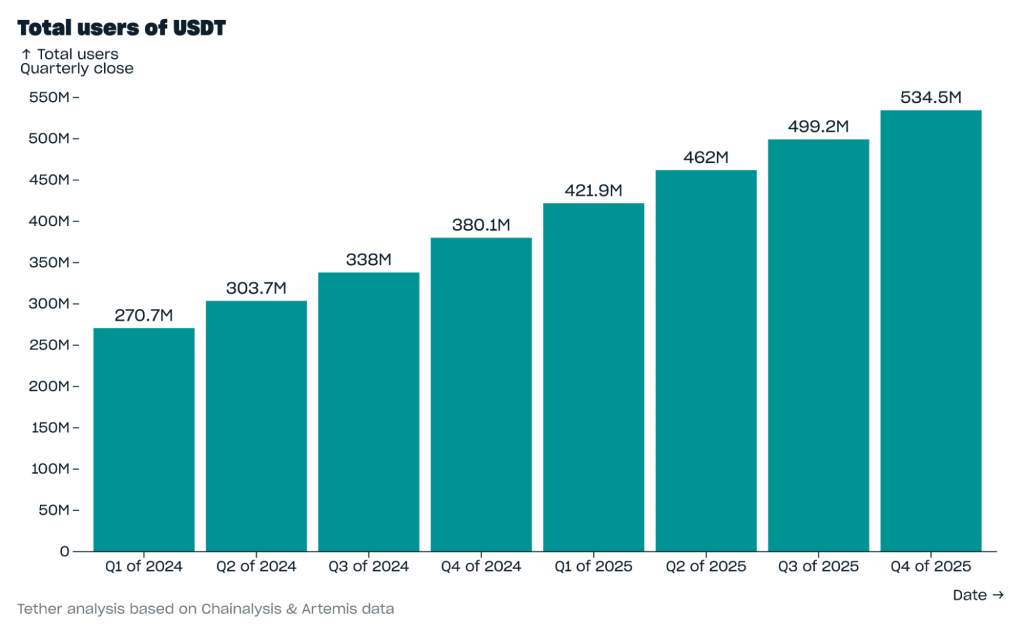
The quarterly growth in USDT users over the last couple of years | Source: Tether

In this count, Tether has included both the users who have received and used USDT for at least 24 hours on-chain, as well as the estimates of users that have received the stablecoin on centralized platforms like exchanges.

From the above chart, it’s visible that Q4 2025 was the eighth consecutive quarter in which Tether’s stablecoin saw growth of more than 30 million users. In terms of active users, the quarter set a new all-time high (ATH) with an average of 24.8 million users receiving USDT at least once inside a 30-day rolling window. “This accounts for 68.4% of all stablecoin monthly active users,” noted the report.

On-chain transfer volume also set a new ATH in this quarter, hitting a value of $4.4 trillion following a jump of $248.6 billion.
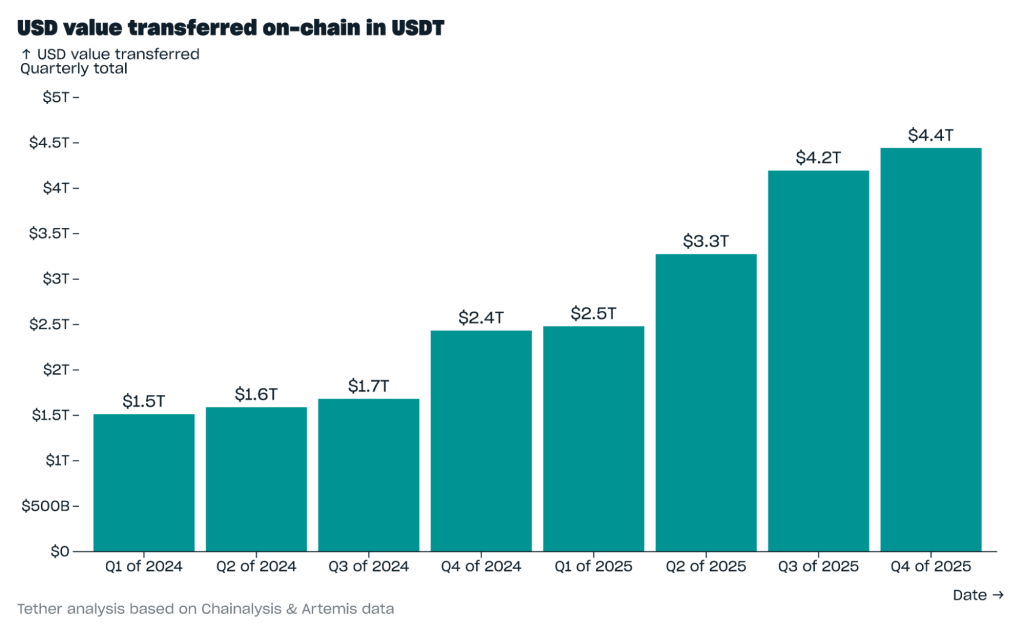
The stablecoin's transaction volume saw a notable rise over the past year | Source: Tether

As displayed in the chart, the USDT transfer volume stood at just $1.7 trillion in Q3 2024, so the sharp jump to $4.4 trillion since then indicates demand for using the stablecoin has seen a notable boost. “Of this $4.4T quarterly total, $2.8T (63.6%) was in transactions where USD₮ was the only asset transferred, and $1.6T (36.4%) was in transactions where multiple assets were transferred (typically in DeFi swaps),” said the report.

There has also been growth in transaction demand among the retail investors, as the number of transfers involving the stablecoin jumped by $313.1 million in Q4 to a new ATH of 2.2 billion. 88.2% of these transactions involved a sum less than $1,000.

The capital invested in the stablecoin itself also saw an increase during the quarter, with the market cap hitting $187.3 billion after inflows of $12.4 billion.
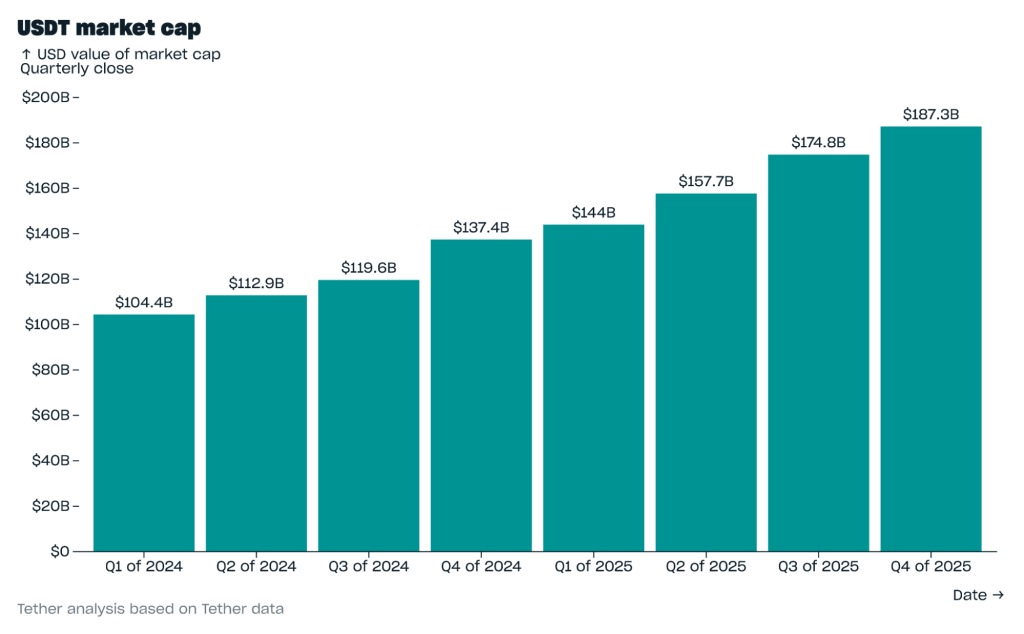
Looks like the token's market cap has seen steady growth | Source: Tether

The growth in the USDT market cap occurred despite the fact that the wider cryptocurrency market saw a bearish transition in October. That said, the downturn still affected the token to some degree as before the market slowdown, its monthly market cap growth rate was sitting at 4.9%, which declined in the aftermath of the liquidation squeeze of October 10th.

Overall, between October 10th and today, USDT has been among the more resilient cryptocurrencies, being up 3.5% while the combined sector has lost more than a third of its market cap. In the same period, USDC, the second largest stablecoin, has seen a drop of 2.6%.

Bitcoin Price

At the time of writing, Bitcoin is trading around $65,800, down more than 9% over the last 24 hours.

The price of the coin seems to have been crashing | Source: BTCUSDT on TradingView


Preguntas relacionadas

QWhat was the total USDT transfer volume in Q4 2025 according to Tether's report?

AThe total USDT transfer volume in Q4 2025 was $4.4 trillion.

QHow many USDT users were there in total by the end of Q4 2025?

AThere were 534.5 million USDT users by the end of Q4 2025.

QWhat percentage of the $4.4 trillion transfer volume involved transactions where USDT was the only asset transferred?

A63.6% of the $4.4 trillion transfer volume involved transactions where USDT was the only asset transferred.

QHow did the market cap of USDT change during Q4 2025, and what was its final value?

AThe market cap of USDT increased by $12.4 billion during Q4 2025, reaching a final value of $187.3 billion.

QWhat was the Bitcoin price mentioned in the article, and how much did it change in the last 24 hours?

ABitcoin was trading around $65,800 at the time of writing, down more than 9% over the last 24 hours.

Lecturas Relacionadas

The AI Agent Era Accelerates Its Arrival: Questflow Defines a New Paradigm of Financial Intelligence with On-Chain AI Brokerage

The AI Agent era is accelerating, with the CB Insights AI 100 list highlighting global investment confidence. The focus has shifted from whether AI works to its speed of deployment and ability to manage complex workflows, with autonomous AI Agents driving this transformation. At the forefront is Questflow, a Singapore-based startup redefining financial intelligence through its on-chain AI brokerage. Unlike tools that merely provide data dashboards, Questflow deploys AI Agents that proactively scan markets, form judgments, and execute trades via a conversational interface—operating 24/7 without requiring manual confirmation for each decision. This embodies the new AI paradigm of agents capable of executing multi-step workflows autonomously. Questflow's mission is to democratize institutional-grade trading intelligence. Historically reserved for the ultra-wealthy, this capability is now accessible starting from just $1 through Questflow's "AI Clone + Copy Trade" model. The platform charges only a 1% execution fee, aligning its incentives directly with users and eliminating traditional management or performance fees. The timing is opportune, aligning with key trends identified by CB Insights: the scalable deployment of AI Agents, accelerated AI adoption in financial services, and the maturation of on-chain infrastructure. With robust liquidity on platforms like Hyperliquid and Polymarket, alongside advancements in AI reasoning and non-custodial wallet security, Questflow is positioned to merge the roles of broker, fund, and exchange into a single, accessible platform for millions.

链捕手Hace 34 min(s)

The AI Agent Era Accelerates Its Arrival: Questflow Defines a New Paradigm of Financial Intelligence with On-Chain AI Brokerage

链捕手Hace 34 min(s)

Why Pricing Social Interactions is Doomed to Fail?

Titled "Why Putting a Price on Social Interaction Is Doomed to Fail," this article critiques attempts to monetize social networks directly through SocialFi models, arguing their inevitable failure stems from a fundamental misunderstanding of media dynamics. Using Marshall McLuhan's theory of "hot" and "cold" media, the author posits that social networks are inherently "cold" media. Their value isn't contained in individual posts but is co-created through user participation, interpretation, and fragmented, ongoing interaction (e.g., replies, shares). This ambiguity and need for user involvement are core to their function. The article asserts that SocialFi projects like Friend.tech failed because introducing real-time, tradable financial pricing (a definitive "hot" signal) into this "cold" environment doesn't add a layer—it replaces the medium's essence. The unambiguous price signal overshadows and nullifies the nuanced, participatory social signal. Users become traders, not participants, and when speculative profits vanish, the underlying social ecosystem—never genuinely cultivated—collapses entirely. This principle extends beyond crypto. The author argues platforms like Twitter have gradually "heated up" through metrics (likes, retweets counts, algorithmically defined value), shifting users from participants to performers and eroding organic engagement. The solution isn't to abandon capital but to manage its entry point. Successful models like Substack, Patreon, or Bandcamp allow capital to "condense" at specific, isolated nodes (e.g., subscriptions, one-time payments) without permeating and "heating" every social interaction. They preserve the core "cold," participatory medium while enabling monetization at designated boundaries. The NFT boom and bust serves as a stark parallel: the ancient "cold" medium of collecting (valued for story, community, gradual accumulation) was rapidly destroyed by platforms that introduced real-time floor prices, rarity scores, and trading dashboards, transforming collectors into speculators and vaporizing cultural value when prices fell. The core lesson: "Liquidity equals heat." Injecting high liquidity and definitive pricing into a "cold" participatory medium doesn't optimize it; it fundamentally alters and destroys its value-creating mechanism. The future lies not in pricing every social gesture but in finding precise, non-invasive points for capital to condense without overheating the entire ecosystem.

marsbitHace 42 min(s)

Why Pricing Social Interactions is Doomed to Fail?

marsbitHace 42 min(s)

Trading

Spot
Futuros
活动图片




