US Watchdogs Submit Crypto, Prediction Markets Rule Plans For White House Review

bitcoinistPublicado a 2026-03-06Actualizado a 2026-03-06

Resumen

US financial regulators, the SEC and CFTC, have submitted rule proposals to the White House for review, aiming to regulate crypto assets and prediction markets. The SEC’s proposal focuses on applying federal securities laws to crypto assets, potentially establishing a taxonomy for clearer classification and oversight. The CFTC also advanced a rulemaking notice for prediction markets, seeking to set clear standards. Both agencies are collaborating under "Project Crypto" to ensure coherent regulation, prevent market fragmentation, and encourage innovation within U.S. jurisdiction. Officials emphasized the need for clear rules to avoid driving markets offshore.

The Securities and Exchange Commission (SEC) and the Commodities Futures Trading Commission (CFTC) have submitted rule proposals to the White House to oversee the crypto industry and prediction markets, advancing their efforts to provide clarity and regulate emerging markets.

SEC Advances Crypto Taxonomy Plans

This week, Wall Street’s main financial regulators, the SEC and the CFTC, stepped up their efforts to provide formal rules and fully establish a welcoming approach by presenting their rule plans for crypto assets and prediction markets to the White House for review, Bloomberg reported on Wednesday.

Independent agencies such as the SEC and the CFTC weren’t previously mandated to submit new rules to the White House for review, the news media outlet noted. However, in 2025, the Trump administration announced that all executive branch agencies, including US financial regulators, were expected to comply with this requirement.

The White House’s Office of Information and Regulatory Affairs (OIRA) website shows that the agency received a crypto regulatory measure from the SEC on Tuesday regarding the “Application of the Federal Securities Laws to Certain Types of Crypto Assets and Certain Transactions Involving Crypto Assets.”

Bloomberg reported that the commission-level guidance could be related to the taxonomy of crypto assets. An agency spokesperson pointed to previous comments from the SEC’s Chairman Paul Atkins.

Last month, Atkins proposed developing formal guidelines for token classification, in line with the crypto market structure bill, emphasizing that regulatory clarity for digital assets is long overdue.

The agency was set to examine a token taxonomy to define digital assets more accurately and clarify the rules that apply. This could establish categories for crypto assets, determining SEC or CFTC oversight and influencing how firms register, disclose information, and operate.

The SEC’s Chair has advocated for Congress to enact legislation for “future-proof” measures, but has also acknowledged that the agency has substantial authority to proceed with regulations if the market structure bill fails to advance.

CFTC-SEC Push To Foster Regulated Innovation

Notably, the CFTC has also been collaborating with the SEC to bring “coordination, coherence, and a unified approach to the federal oversight of crypto asset markets” through their joint “Project Crypto” initiative.

The sister agencies recently outlined their plan to clarify jurisdictional boundaries, eliminate redundant compliance requirements, and reduce regulatory fragmentation through their collaboration.

CFTC Chairman Michael Selig explained that the agencies aim to ensure that “innovation takes root on American soil, under American law, and in service of American investors, customers, and businesses.”

As part of these efforts, the CFTC submitted an advance notice of proposed rulemaking (ANPR) on prediction markets on Monday, according to the OIRA website. The measure, currently under White House review, could set clear standards for the emerging market, which has exploded in popularity over the past year, but has also faced strong scrutiny in several US states.

On Tuesday, the CFTC chief pledged to establish “very clear standards as to what can be self-certified in our markets and what cannot and how to evaluate the different products that are offered in the space.”

Speaking at the Milken Institute’s Future of Finance conference, Selig noted that, as seen with the crypto industry, the more regulators try to block these markets, the more they move offshore.

“So my view on this stuff is that we’ve got to set the right rules and regulations for it here in the United States, or otherwise, we’re just going to have black markets offshore,” the regulator affirmed.
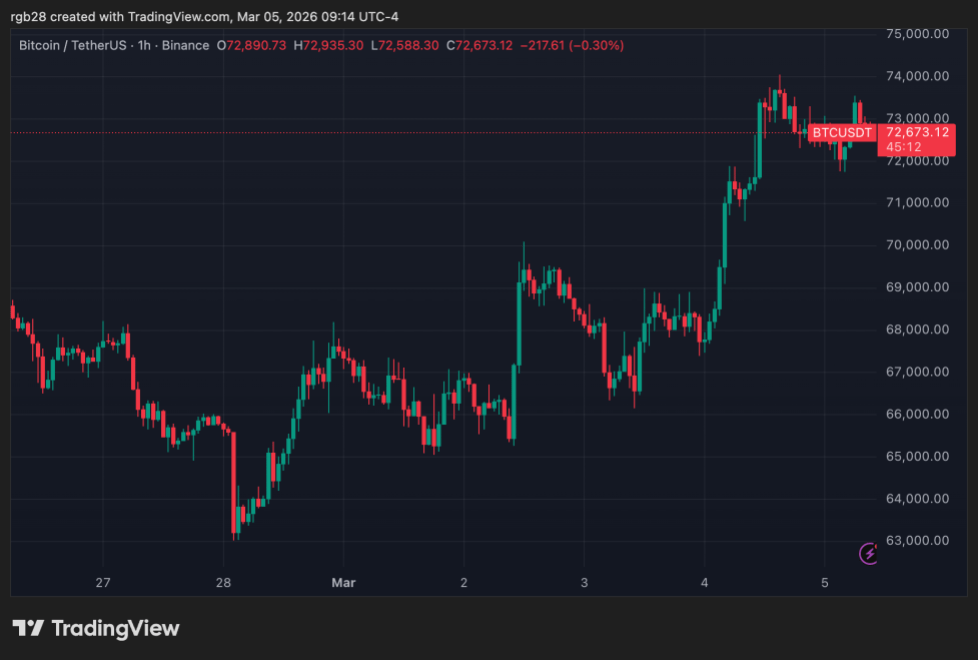
Bitcoin (BTC) trades at $72,673 in the one-week chart. Source: BTCUSDT on TradingView


Criptos en tendencia

Preguntas relacionadas

QWhat two US agencies have submitted rule proposals to the White House for the crypto industry and prediction markets?

AThe Securities and Exchange Commission (SEC) and the Commodities Futures Trading Commission (CFTC).

QWhat is the name of the White House office that is reviewing the crypto regulatory measures?

AThe White House’s Office of Information and Regulatory Affairs (OIRA).

QAccording to the article, what did the SEC submit a measure regarding?

AThe 'Application of the Federal Securities Laws to Certain Types of Crypto Assets and Certain Transactions Involving Crypto Assets.'

QWhat is the name of the joint initiative through which the CFTC and SEC are collaborating on crypto oversight?

AProject Crypto.

QWhat did CFTC Chairman Michael Selig argue happens when regulators try to block markets like crypto and prediction markets?

AHe argued that the more regulators try to block these markets, the more they move offshore, creating black markets offshore.

Lecturas Relacionadas

In Jinjiang, Fujian, a Storage Super Unicorn Lies Quiet

In Fujian's Jinjiang, a city known for sportswear, lies a quiet semiconductor giant: Fujian Jinhua Integrated Circuit Co. (JHICC). Once a promising domestic DRAM manufacturer alongside Yangtze Memory and ChangXin Memory Technologies (CXMT), its journey was derailed in 2018 when the U.S. placed it on an Entity List and filed criminal charges for alleged trade secret theft. This halted production for years. A turning point came in February 2024 when a U.S. federal court found JHICC not guilty. However, it had lost crucial time. While CXMT soared to become a top-valued A-share company in 2024, JHICC, with an estimated valuation of 80 billion RMB, was just restarting. Its current output is primarily customized DDR4 chips, not the advanced DDR5/HBM demanded for AI, but it still benefits from the broader memory chip upcycle. JHICC's story is tied to Chen Zhengkun, a veteran engineer who left Micron to lead the venture. Founded in 2016 with state-backed funding, JHICC partnered with Taiwan's UMC to develop DRAM technology. Rapid progress was cut short by the U.S. actions, which Micron initiated, partly due to its heavy reliance on the Chinese market. Post-sanctions, Chen's team worked to rebuild the production line with reduced reliance on U.S. technology. According to its records, JHICC achieved small-scale production and revenue growth under immense pressure. It now focuses on the stable "niche" DRAM market (e.g., TVs, routers) with a monthly capacity of ~40,000 wafers, aiming for 60,000 by 2026. It holds over 1,000 patents but remains on the Entity List. For Jinjiang, investing in JHICC was a bold industrial leap. The local government provided unwavering financial and logistical support during the crisis, helping the company survive. JHICC has become the anchor for a growing local semiconductor cluster. Though its scale lags behind domestic peers, JHICC's persistence symbolizes a hard-won foothold in a global market long dominated by Samsung, SK Hynix, and Micron. Having missed one boom, it seeks a place in the new AI-driven memory supercycle.

marsbitHace 1 hora(s)

In Jinjiang, Fujian, a Storage Super Unicorn Lies Quiet

marsbitHace 1 hora(s)

Trading

Spot

Artículos destacados

Cómo comprar HOUSE

¡Bienvenido a HTX.com! Hemos hecho que comprar Housecoin (HOUSE) sea simple y conveniente. Sigue nuestra guía paso a paso para iniciar tu viaje de criptos.Paso 1: crea tu cuenta HTXUtiliza tu correo electrónico o número de teléfono para registrarte y obtener una cuenta gratuita en HTX. Experimenta un proceso de registro sin complicaciones y desbloquea todas las funciones.Obtener mi cuentaPaso 2: ve a Comprar cripto y elige tu método de pagoTarjeta de crédito/débito: usa tu Visa o Mastercard para comprar Housecoin (HOUSE) al instante.Saldo: utiliza fondos del saldo de tu cuenta HTX para tradear sin problemas.Terceros: hemos agregado métodos de pago populares como Google Pay y Apple Pay para mejorar la comodidad.P2P: tradear directamente con otros usuarios en HTX.Over-the-Counter (OTC): ofrecemos servicios personalizados y tipos de cambio competitivos para los traders.Paso 3: guarda tu Housecoin (HOUSE)Después de comprar tu Housecoin (HOUSE), guárdalo en tu cuenta HTX. Alternativamente, puedes enviarlo a otro lugar mediante transferencia blockchain o utilizarlo para tradear otras criptomonedas.Paso 4: tradear Housecoin (HOUSE)Tradear fácilmente con Housecoin (HOUSE) en HTX's mercado spot. Simplemente accede a tu cuenta, selecciona tu par de trading, ejecuta tus trades y monitorea en tiempo real. Ofrecemos una experiencia fácil de usar tanto para principiantes como para traders experimentados.

319 Vistas totalesPublicado en 2025.04.27Actualizado en 2026.06.02

Cómo comprar HOUSE

Discusiones

Bienvenido a la comunidad de HTX. Aquí puedes mantenerte informado sobre los últimos desarrollos de la plataforma y acceder a análisis profesionales del mercado. A continuación se presentan las opiniones de los usuarios sobre el precio de HOUSE (HOUSE).

活动图片












