US Stock Transfer Agent Leader Acquired by Crypto Exchange, Accelerating Stock Tokenization

链捕手Publicado a 2026-05-09Actualizado a 2026-05-09

Resumen

Crypto exchange Bullish announces $4.2 billion acquisition of Equiniti, a major Wall Street transfer agent. This deal, occurring amidst a heated race for tokenizing traditional securities, targets the core of stock ownership records. Equiniti maintains shareholder registries for nearly 3,000 public companies, including giants like Berkshire Hathaway, handling dividends and corporate actions. The strategic move aims to bridge legacy finance with blockchain by securing the critical "system of record" needed for legally compliant, native tokenized stocks, rather than derivatives. The acquisition follows rapid 2026 developments: ICE (NYSE parent) announcing a 24/7 tokenized securities platform, SEC approving Nasdaq's tokenized stock pilot, and NYSE partnering with Securitize. Bullish, led by ex-NYSE president Tom Farley, positions itself as a neutral infrastructure player by owning Equiniti's extensive client network and regulatory licenses across multiple exchanges. The combined entity projects 20% annual growth for its tokenization business. This signals a convergence of crypto and traditional finance, where control over foundational infrastructure like transfer agencies will define the next era of capital markets, enabling real-time settlement, fractional trading with stablecoins, and global accessibility.

Author: Chloe, ChainCatcher

On May 5, 2026, crypto asset trading platform Bullish (NYSE: BLSH) announced it will acquire Equiniti, a company that can be called the "backstage nervous system" of the entire U.S. stock market on Wall Street, from private equity firm Siris Capital for $4.2 billion. Upon the news, Bullish's stock price surged, at one point rising about 20%.
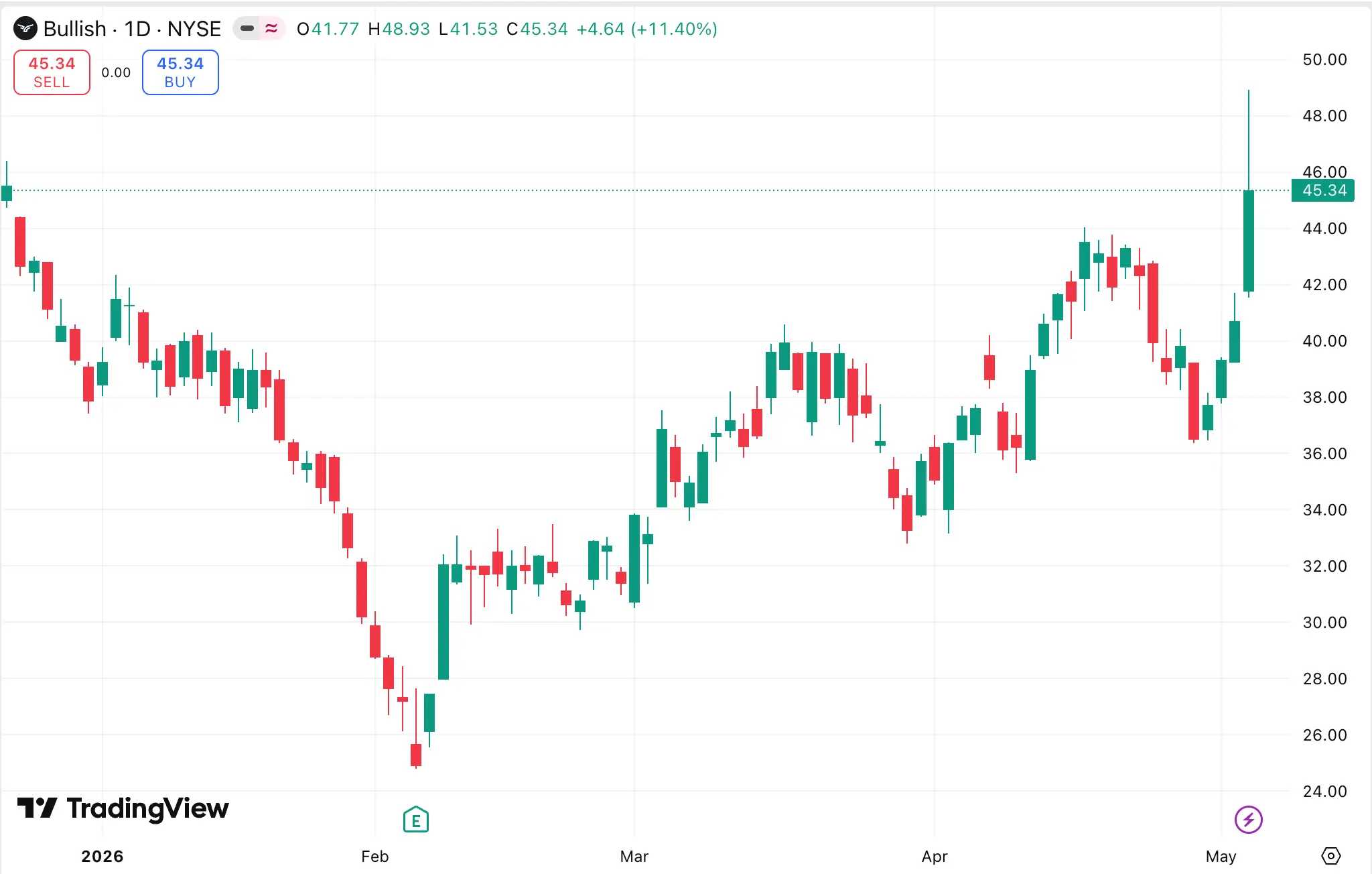
Bullish's acquisition of Equiniti aims to leverage the role of a Transfer Agent to enter the competition and cooperation between traditional exchanges and cryptocurrency platforms. Now, when Wall Street's oldest infrastructure begins to be acquired by crypto exchanges, what exactly is this arms race competing for? And who will be the winner?

Wall Street Tokenization Race Enters Fierce Stage

Equiniti serves nearly 3,000 listed companies globally, handles records for 20 million shareholders, and processes $500 billion in dividends and payment flows annually, making it a well-known "transfer agent institution" on Wall Street. The shareholder register of the well-known Berkshire Hathaway is maintained by it, Rolls-Royce's dividends are paid by it, making Equiniti one of the choices for many traditional enterprises.

When a crypto exchange is willing to spend $4.2 billion (including $1.85 billion in assumed debt and approximately $2.35 billion in Bullish stock consideration) to acquire such a financial infrastructure company, it represents far more than a simple M&A story. It is a key signal flare indicating that Wall Street's Tokenization race has entered a fierce stage.

Why Buy Equiniti? Is the Transfer Agent the "Final Piece of the Puzzle" for Tokenization?

To understand the strategic significance of this deal, one must first grasp a concept: the real bottleneck for Tokenized Securities is not on the issuance side, but on the registration side.

In traditional capital markets, when a company issues stock, the entity that truly records "who owns how many shares" is not the exchange, nor the broker, but the transfer agent. It is responsible for:

  • Maintaining the shareholder register (who the shareholders are, how many shares they hold)

  • Handling dividend and interest payments

  • Managing corporate actions like stock splits, stock buybacks, mergers

  • Completing the legal registration of ownership when stocks change hands

In other words, the transfer agent is the legal "System of Record" for a listed company's shareholder records. In most major markets, this role is mandatory for listed companies.

Why Has This Become a Key Competitive Point in the Tokenization Track?

Over the past few years, the market has seen many attempts at "tokenized stocks." Carlos Domingo, CEO of Securitize, once pointed out the problem in one sentence: most so-called tokenized stocks today are actually just derivatives or price-tracking tools, not true native equity issued on the blockchain.

True "on-chain native securities" require a regulated, legally recognized transfer agent that can update the shareholder register in real-time on the blockchain, handle compliance restrictions, and execute dividend distributions.

Bullish CEO Tom Farley (former NYSE President) mentioned in the deal statement: Tokenization is the most important infrastructure shift for capital markets in the next 25 years, and to implement it at an institutional scale, three conditions must be met, including end-to-end tokenization services, a unified ledger, and large-scale issuer relationships. Acquiring Equiniti gives Bullish a stronger foothold on Wall Street.

The combined company is expected to generate approximately $1.3 billion in adjusted revenue in 2026, with over $500 million in adjusted EBITDA (excluding capital expenditures). More notably, the company expects overall revenue to grow at an annual rate of 6%–8% from 2027 to 2029, while the tokenization and blockchain business itself is expected to grow at a high annual rate of 20%.

This means Bullish is betting not on how much profit Equiniti's existing traditional business will generate, but rather using this infrastructure, built over 30 years of client relationships and regulatory licenses, as a "springboard" to penetrate the $70 trillion U.S. stock market.

The timing of this deal is extremely precise. Looking back at the first four months of 2026, the tokenization timeline has been advancing almost week by week:

January 19: NYSE Parent ICE Announces Building Tokenized Trading Platform

Intercontinental Exchange (ICE), parent company of the NYSE, announced it will develop a brand new platform for trading tokenized securities and on-chain settlement:

  • 24/7 Trading: Breaking the 9:30–16:00 time limit of U.S. stocks

  • Real-time On-chain Settlement: Replacing the current T+1 settlement

  • Ordering by Dollar Amount: Supporting fractional share trading

  • Stablecoins as Funding Source: Allowing crypto funds to directly enter the stock market

This platform will combine NYSE's existing Pillar matching engine with a blockchain backend settlement system and support settlement and custody across multiple chains.

March 18: SEC Approves Nasdaq Tokenized Stock Pilot

The U.S. Securities and Exchange Commission (SEC), in Release No. 34-105047, approved the proposal submitted by Nasdaq in September 2025. After approval, eligible Nasdaq market participants can choose to settle Russell 1000 component stocks and ETFs tracking the S&P 500 and Nasdaq 100 in either tokenized form or traditional form.

Notably, Nasdaq's strategy differs from NYSE's. Nasdaq is integrating tokenization into the existing exchange, allowing traders to choose between traditional equity or tokenized forms on the backend; NYSE is building a separate digital trading platform from scratch, even bypassing DTCC and settling directly on the blockchain.

March 24: NYSE and Securitize Sign MOU to Co-build Tokenization Infrastructure

Less than a week after the SEC approved Nasdaq's proposal, NYSE immediately announced signing a memorandum of understanding with Securitize, backed by BlackRock and Ark Invest, to cooperate on developing infrastructure for the digital trading platform.

Securitize, an SEC-registered transfer agent, will become one of the first companies eligible to mint tokenized stocks and ETFs on this platform. This cooperation also includes designing a "Digital Transfer Agent Program" to set standards for other transfer agents entering the tokenization market.

May 5: Bullish Offers $4.2 Billion to Acquire Equiniti

Looking at this timeline side by side reveals something particularly interesting: Bullish is not just acquiring a transfer agent; it is aiming to secure a neutral infrastructure position that is "cross-platform, not biased towards any one side" before the NYSE/Nasdaq competition unfolds further.

Equiniti serves 3,000 issuers and has business dealings with NYSE, Nasdaq, London Stock Exchange, Hong Kong Exchange, etc. Acquiring it means simultaneously holding client lists and regulatory compliance licenses from both NYSE and Nasdaq sides.

This is Not "Crypto vs. Wall Street," But Their Convergence

A few years ago, we were still discussing "whether crypto can replace traditional finance." But these deals in 2026 tell us the real story is: traditional financial infrastructure is being renovated onto the blockchain track. And in this process, whoever holds the licenses and the clients will define the capital markets for the next 25 years.

Bullish's acquisition of Equiniti essentially ties together the "20th-century shareholder register" with "21st-century smart contracts." Once this bridge is built, institutional investors can trade Apple stock on weekends, retail investors can buy fractional ETF shares with USDC, listed companies can see real-time changes in their shareholder structure, and cross-border equity transactions can shorten from T+2 to a few seconds.

NYSE plans to launch in the second half of 2026, Nasdaq's pilot is already approved, and Bullish-Equiniti is expected to complete the transaction in early 2027. The next 18 months will be a critical window to judge whether this tokenization revolution is "real or hype." For investors, four things are worth closely tracking: first, the progress of SEC approval for NYSE's digital trading platform; second, the integration execution of Bullish-Equiniti, especially the acceptance of tokenization services by Equiniti's existing clients; third, the next moves of crypto exchanges like Coinbase and Kraken in terms of "institutionalization" and "compliance"; finally, whether Securitize and Equiniti will move towards cooperation or competition.

$4.2 billion is a heavy bet for Bullish. But for Wall Street, this is just the prologue of the tokenization story.


Preguntas relacionadas

QWhat is the strategic significance of the cryptocurrency exchange Bullish acquiring the transfer agent Equiniti for $4.2 billion?

AThe acquisition allows Bullish to acquire a regulated, legally-recognized transfer agent—the 'system of record' for shareholder ownership in traditional capital markets. This provides a crucial foothold and legal bridge to issue 'natively on-chain securities' rather than just derivative trackers, positioning Bullish to accelerate large-scale tokenization of the $70 trillion U.S. stock market.

QAccording to the article, what is the core bottleneck for true tokenized securities?

AThe true bottleneck lies not in the issuance but in the registration/record-keeping side. Genuine 'natively on-chain securities' require a regulated transfer agent to maintain the legal shareholder registry, handle compliance restrictions, and execute corporate actions like dividends directly on the blockchain.

QHow does the article differentiate between the tokenization strategies of NYSE (via ICE) and Nasdaq?

ANasdaq is integrating tokenized settlement into its existing exchange infrastructure, allowing market participants to choose traditional or tokenized settlement for eligible securities on the backend. In contrast, NYSE (via ICE) is building a separate, new digital trading platform for tokenized assets that aims for 24/7 trading and real-time on-chain settlement, potentially bypassing traditional intermediaries like the DTCC.

QWhat key development timeline related to stock tokenization does the article outline for early 2026?

AThe article outlines a rapid sequence: 1) Jan 19: ICE (NYSE parent) announces a new tokenized securities trading platform. 2) Mar 18: SEC approves Nasdaq's tokenized stock settlement pilot. 3) Mar 24: NYSE signs an MOU with Securitize to co-develop digital trading infrastructure. 4) May 5: Bullish announces the $4.2B acquisition of Equiniti.

QWhat does the article suggest the Bullish-Equiniti deal represents in the broader context of financial markets?

AThe deal signifies that the narrative is no longer 'crypto versus Wall Street' but a convergence. Traditional financial infrastructure is being rebuilt on blockchain rails. It represents a strategic move to bridge '20th-century shareholder registries' with '21st-century smart contracts' to redefine capital markets, with control over regulatory licenses and client relationships being key to defining the next era.

Lecturas Relacionadas

Gensyn AI: Don't Let AI Repeat the Mistakes of the Internet

In recent months, the rapid growth of the AI industry has attracted significant talent from the crypto sector. A persistent question among researchers intersecting both fields is whether blockchain can become a foundational part of AI infrastructure. While many previous AI and Crypto projects focused on application layers (like AI Agents, on-chain reasoning, data markets, and compute rentals), few achieved viable commercial models. Gensyn differentiates itself by targeting the most critical and expensive layer of AI: model training. Gensyn aims to organize globally distributed GPU resources into an open AI training network. Developers can submit training tasks, nodes provide computational power, and the network verifies results while distributing incentives. The core issue addressed is not decentralization for its own sake, but the increasing centralization of compute power among tech giants. In the era of large models, access to GPUs (like the H100) has become a decisive bottleneck, dictating the pace of AI development. Major AI companies are heavily dependent on large cloud providers for compute resources. Gensyn's approach is significant for several reasons: 1) It operates at the core infrastructure layer (model training), the most resource-intensive and technically demanding part of the AI value chain. 2) It proposes a more open, collaborative model for compute, potentially increasing resource utilization by dynamically pooling idle GPUs, similar to early cloud computing logic. 3) Its technical moat lies in solving complex challenges like verifying training results, ensuring node honesty, and maintaining reliability in a distributed environment—making it more of a deep-tech infrastructure company. 4) It targets a validated, high-growth market with genuine demand, rather than pursuing blockchain integration without purpose. Ultimately, the boundaries between Crypto and AI are blurring. AI requires global resource coordination, incentive mechanisms, and collaborative systems—areas where crypto-native solutions excel. Gensyn represents a step toward making advanced training capabilities more accessible and collaborative, moving beyond a niche controlled by a few giants. If successful, it could evolve into a fundamental piece of AI infrastructure, where the most enduring value in the AI era is often created.

marsbitHace 2 hora(s)

Gensyn AI: Don't Let AI Repeat the Mistakes of the Internet

marsbitHace 2 hora(s)

Why is China's AI Developing So Fast? The Answer Lies Inside the Labs

A US researcher's visit to China's top AI labs reveals distinct cultural and organizational factors driving China's rapid AI development. While talent, data, and compute are similar to the West, Chinese labs excel through a pragmatic, execution-focused culture: less emphasis on individual stardom and conceptual debate, and more on teamwork, engineering optimization, and mastering the full tech stack. A key advantage is the integration of young students and researchers who approach model-building with fresh perspectives and low ego, prioritizing collective progress over personal credit. This contrasts with the US culture of self-promotion and "star scientist" narratives. Chinese labs also exhibit a strong "build, don't buy" mentality, preferring to develop core capabilities—like data pipelines and environments—in-house rather than relying on external services. The ecosystem feels more collaborative than tribal, with mutual respect among labs. While government support exists, its scale is unclear, and technical decisions appear driven by labs, not state mandates. Chinese companies across sectors, from platforms to consumer tech, are building their own foundational models to control their tech destiny, reflecting a broader cultural drive for technological sovereignty. Demand for AI is emerging, with spending patterns potentially mirroring cloud infrastructure more than traditional SaaS. Despite challenges like a less mature data industry and GPU shortages, Chinese labs are propelled by vast talent, rapid iteration, and deep integration with the open-source community. The competition is evolving beyond a pure model race into a contest of organizational execution, developer ecosystems, and industrial pragmatism.

marsbitHace 3 hora(s)

Why is China's AI Developing So Fast? The Answer Lies Inside the Labs

marsbitHace 3 hora(s)

3 Years, 5 Times: The Rebirth of a Century-Old Glass Factory

Corning, a 175-year-old glass company, is experiencing a dramatic revival as a key player in AI infrastructure, driven by surging demand for high-performance optical fiber in data centers. AI data centers require vastly more fiber than traditional ones—5 to 10 times as much per rack—to handle high-speed data transmission between GPUs. This structural demand shift, coupled with supply constraints from the lengthy expansion cycle for fiber preforms, has created a significant supply-demand gap. Nvidia has invested in Corning, along with Lumentum and Coherent, in a $4.5 billion total commitment to secure the optical supply chain for AI. Corning's competitive edge lies in its expertise in producing ultra-low-loss, high-density, and bend-resistant specialty fiber, which is critical for 800G+ and future 1.6T data rates. Its deep involvement in co-packaged optics (CPO) with partners like Nvidia further solidifies its position. While not the largest fiber manufacturer globally, Corning's revenue from enterprise/data center clients now exceeds 40% of its optical communications sales, and it has secured multi-year supply agreements with major hyperscalers including Meta and Nvidia. Financially, Corning's optical communications revenue has surged, doubling from $1.3 billion in 2023 to over $3 billion in 2025. Its stock price has risen nearly 6-fold since late 2023. Key future catalysts include the rollout of Nvidia's CPO products and the scale of undisclosed customer agreements. However, risks include high current valuations and potential disruption from next-generation technologies like hollow-core fiber. The company's long-term bet on light over electricity, maintained even through the telecom bubble crash, is now being validated by the AI boom.

marsbitHace 4 hora(s)

3 Years, 5 Times: The Rebirth of a Century-Old Glass Factory

marsbitHace 4 hora(s)

Trading

Spot
Futuros
活动图片