US Senate Targets Fall 2026 Release for Crypto Tax Bill Amid CLARITY Act Push

TheNewsCryptoPublicado a 2026-06-24Actualizado a 2026-06-24

Resumen

U.S. Senators are targeting Fall 2026 for the potential release of a dedicated cryptocurrency tax bill. Senator Steve Daines revealed that Republicans have already developed a framework for the legislation, which aligns closely with recent crypto tax proposals from the House of Representatives. The Senate Finance Committee's move is driven by growing congressional interest in establishing clearer tax rules for virtual assets, addressing areas like staking rewards and mining. Concurrently, lawmakers continue to prioritize the broader Digital Asset Market CLARITY Act, which passed the Senate Banking Committee with bipartisan support. This act aims to create comprehensive regulations and define federal regulatory authority over cryptocurrencies. Over 200 industry groups are advocating for its passage, arguing that regulatory clarity will boost innovation and investment. Market observers view the tax bill and the CLARITY Act as complementary efforts to build a more complete regulatory framework for digital assets. While neither proposal has been finalized, the legislative activity signals accelerating progress in U.S. crypto regulation.

U.S. Lawmakers continue to advance digital asset regulations as the Senate moves closer to introducing dedicated cryptocurrency tax legislation. Senator Steve Daines revealed that Republican senators had already developed the framework. During an interview with Bloomberg Tax, Sen. Steve Daines said, “sooner rather than later”. He also said, “We’ve put together a framework,” Which means Congress has developed a framework for deliberation and discussion. Although Daines did not reveal any further information, he added that the plan is very similar to recent cryptocurrency tax bills proposed by the House of Representatives.
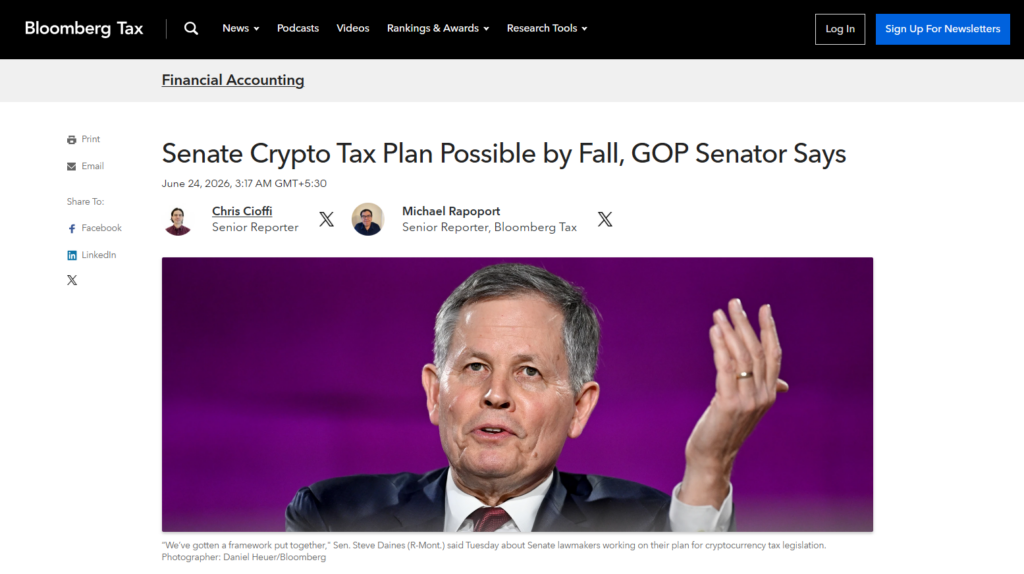
Source: Bloomberg Tax

Growing congressional interest in clearer tax rules for virtual assets prompted the Senate to develop the proposal. The Senate Finance Committee has previously discussed cryptocurrency tax legislation. Especially during hearings on staking rewards, mining, and other issues associated with the reporting of digital assets.

Additionally, several drafts of cryptocurrency tax legislation have been proposed in the House of Representatives, including by the House Ways and Means Committee. The legislation deals with such issues as staking, mining, decentralized finance operations, stablecoin transactions, and others.

CLARITY Act Still the Top Priority

While the Senate is moving forward with its tax proposal, the lawmakers are still discussing the Digital Asset Market CLARITY Act. This act aims at building an all-encompassing regulation for cryptocurrencies and defining regulatory authority for both federal authorities. The Senate Banking Committee passed this bill via a 15-9 bipartisan vote. Although the Senate is awaiting other provisions, the act is already under discussion.

Meanwhile, industry groups remain advocates for the bill, with over 200 cryptocurrency companies calling on the Senate leadership to put the bill up for a vote. They say that clear regulations will spur innovation and investments in the US digital assets market.

Regulatory Clarity Is Still at the Top of the Agenda

Both projects will be followed by market players because taxation and regulation are always crucial for the crypto business and investors. It is believed that the tax provision of the Senate and the CLARITY Act are complementary moves that aim at creating a more complete framework for digital assets. Despite the fact that neither of the projects has been finally approved yet, the activity of Congress demonstrates that the development of legislation for cryptocurrencies is gaining pace. It may be quite interesting for the next few months.

Highlighted Crypto News:

Ripple Secures Preliminary MiCA Approval in Luxembourg for Europe-Wide Expansion

TagsBlockchainBloombergClarity ACTCrypto Taxcrypto taxationSenatorU.SU.S Congress

Criptos en tendencia

Preguntas relacionadas

QWhat is the target release timeline for the US Senate's crypto tax bill, according to the article?

AThe US Senate is targeting a Fall 2026 release for its cryptocurrency tax bill.

QAccording to Senator Steve Daines, what stage has Congress reached regarding the crypto tax framework?

AAccording to Senator Steve Daines, Congress has developed a framework for the cryptocurrency tax legislation for deliberation and discussion.

QWhat is the main goal of the Digital Asset Market CLARITY Act mentioned in the article?

AThe main goal of the CLARITY Act is to build an all-encompassing regulation for cryptocurrencies and define regulatory authority for federal authorities.

QWhy are market players closely following both the Senate's tax proposal and the CLARITY Act?

AMarket players are closely following both projects because taxation and regulation are crucial for the crypto business and investors, and these moves aim to create a more complete framework for digital assets.

QHow did the industry show its support for the CLARITY Act, as per the article?

AOver 200 cryptocurrency companies called on the Senate leadership to put the CLARITY Act up for a vote, advocating that clear regulations will spur innovation and investments in the US digital assets market.

Lecturas Relacionadas

Is Ethereum Truly a "World Computer"?

Title: Is Ethereum Really a "World Computer"? Ethereum, envisioned as a "world computer" by its founder Vitalik Buterin, aims to be a decentralized platform for global applications. However, a recent analysis by Four Pillars raises questions about whether it is more accurately a "Western computer," based on the geographical distribution of its validators. Currently, the United States dominates with 38.19% of all validators, followed by Germany at 13.04%. Combined, these two countries account for over half of the network. In contrast, Asian representation is minimal, with Singapore holding only 3.15%. The concentration is partly due to affordable cloud hosting services like Hetzner and OVH in Europe and North America, as well as the prevalence of residential validators in the U.S., where individuals run nodes via home internet connections. When examining professionally operated validators, the distribution becomes more balanced. The U.S. share drops to 25.81%, while Asian countries like Singapore (7.28%), Hong Kong (6.44%), Japan (6.38%), and South Korea (4.59%) collectively approach the U.S. level. This shift reflects strategic deployments by institutions to meet regulatory requirements and reduce latency for local users. However, regions like South America, the Middle East, and Africa remain underrepresented. Ethereum's peer-to-peer network mechanisms, such as gossipsub, disadvantage areas with low node density, creating a feedback loop where delayed message propagation reduces validator performance and rewards. This imbalance challenges Ethereum's promises of censorship resistance and global accessibility. Despite these issues, opportunities exist for growth in underrepresented regions. As demand for localized staking infrastructure rises, early entrants in areas like the Middle East could establish dominant positions by offering compliant, low-latency solutions. The evolving validator landscape highlights both the structural challenges and the potential for Ethereum to move closer to its "world computer" ideal.

Foresight NewsHace 16 min(s)

Is Ethereum Truly a "World Computer"?

Foresight NewsHace 16 min(s)

WEEX TradFi Trading Competition Kicks Off, 50,000 USDT Prize Pool First-Come, First-Served, Open a Position and Get 5 U

WEEX Exchange Launches "TradFi Trading Competition" with a 50,000 USDT Prize Pool Amidst a crypto market downturn, WEEX Exchange highlights the growth of tokenized traditional finance (TradFi) assets as a key trend, allowing users to trade stocks, ETFs, and commodities using crypto. The platform has launched a "TradFi Trading Competition" from July 9th to 23rd, featuring a 50,000 USDT prize pool. The campaign offers three reward tiers: 1. **New User Bonus (25,000 USDT pool):** New users depositing ≥100 USDT, completing a specified spot trade, and one TradFi contract trade (margin ≥10 USDT) receive 200 USDT. 2. **Volume-Based Rewards (20,000 USDT pool):** All users can earn tiered bonuses for achieving TradFi contract trading volumes of 5,000 USDT (3 USDT), 20,000 USDT (10 USDT), and 100,000 USDT (50 USDT). Rewards are stackable. 3. **Participation Reward:** Any user opening a TradFi contract trade during the event receives 5 USDT instantly. The article promotes WEEX's TradFi features, which include trading tokenized shares of companies like NVIDIA and Tesla using USDT, 24/7 trading, fractional share investing starting from $5, and high leverage up to 100x for hedging. It positions these features as solutions to traditional investing barriers like high fees, strict trading hours, and high share prices. The summary concludes by encouraging users to join the competition and leverage WEEX's platform to access global TradFi markets.

marsbitHace 2 hora(s)

WEEX TradFi Trading Competition Kicks Off, 50,000 USDT Prize Pool First-Come, First-Served, Open a Position and Get 5 U

marsbitHace 2 hora(s)

Trading

Spot

Artículos destacados

Cómo comprar PUSH

¡Bienvenido a HTX.com! Hemos hecho que comprar Push Protocol (PUSH) sea simple y conveniente. Sigue nuestra guía paso a paso para iniciar tu viaje de criptos.Paso 1: crea tu cuenta HTXUtiliza tu correo electrónico o número de teléfono para registrarte y obtener una cuenta gratuita en HTX. Experimenta un proceso de registro sin complicaciones y desbloquea todas las funciones.Obtener mi cuentaPaso 2: ve a Comprar cripto y elige tu método de pagoTarjeta de crédito/débito: usa tu Visa o Mastercard para comprar Push Protocol (PUSH) al instante.Saldo: utiliza fondos del saldo de tu cuenta HTX para tradear sin problemas.Terceros: hemos agregado métodos de pago populares como Google Pay y Apple Pay para mejorar la comodidad.P2P: tradear directamente con otros usuarios en HTX.Over-the-Counter (OTC): ofrecemos servicios personalizados y tipos de cambio competitivos para los traders.Paso 3: guarda tu Push Protocol (PUSH)Después de comprar tu Push Protocol (PUSH), guárdalo en tu cuenta HTX. Alternativamente, puedes enviarlo a otro lugar mediante transferencia blockchain o utilizarlo para tradear otras criptomonedas.Paso 4: tradear Push Protocol (PUSH)Tradear fácilmente con Push Protocol (PUSH) en HTX's mercado spot. Simplemente accede a tu cuenta, selecciona tu par de trading, ejecuta tus trades y monitorea en tiempo real. Ofrecemos una experiencia fácil de usar tanto para principiantes como para traders experimentados.

233 Vistas totalesPublicado en 2024.12.13Actualizado en 2026.06.02

Cómo comprar PUSH

Discusiones

Bienvenido a la comunidad de HTX. Aquí puedes mantenerte informado sobre los últimos desarrollos de la plataforma y acceder a análisis profesionales del mercado. A continuación se presentan las opiniones de los usuarios sobre el precio de PUSH (PUSH).

活动图片