Deposits in RWA Tripled — Traditional Finance Chooses Blockchain

cryptonews.ruPublicado a 2026-08-24Actualizado a 2026-08-24

Resumen

The decentralized finance (DeFi) sector is undergoing a structural shift, with tokenized real-world assets (RWA) taking center stage. According to a joint report by CoinShares and Token Terminal, deposits in RWA lending and trading platforms tripled year-over-year, reaching $7.4 billion in Q2 2026. This explosive growth starkly contrasts with a 15% decline in overall DeFi deposits and a nearly 70% drop in DEX trading volumes over the same period. Analysts highlight this divergence as evidence of a fundamental shift: demand is driven not by speculation but by the genuine utility of blockchain for traditional finance. The primary drivers are tokenized U.S. Treasury bonds and multi-strategy funds, like BlackRock's BUIDL, which investors use as reliable collateral to secure stablecoin loans while earning yield. The Ethereum network hosts about 70% of all RWA collateral. Beyond government bonds, the tokenization of equities and commodity derivatives is advancing. The tokenized equity market is estimated at $2.2 billion, while perpetual futures on assets like oil and the S&P 500 have seen explosive growth on platforms like TradeXYZ. Standard Chartered projects the total tokenized asset market could reach $4 trillion by 2028. This growth signals that RWA has moved beyond crypto market cycles, offering tangible value, deep liquidity, and 24/7 global access, marking a new phase of institutional scaling for blockchain-based finance.

The decentralized finance (DeFi) sector is undergoing a structural transformation, with tokenized real-world assets (RWA) rapidly moving to the forefront.

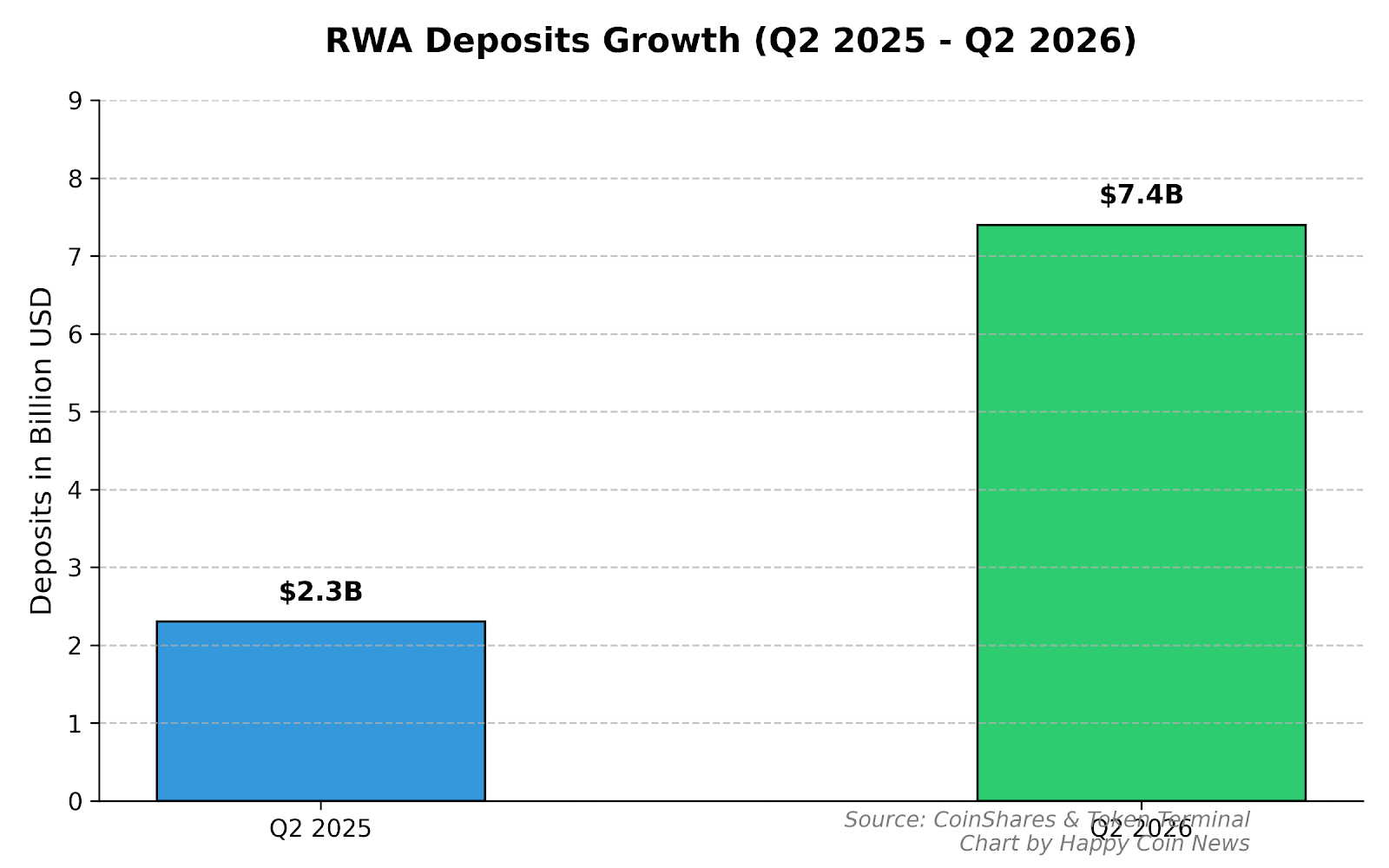
According to a report from analytics firm CoinShares and platform Token Terminal dated August 6, 2026, the volume of deposits in RWA on decentralized lending and trading platforms reached $7.4 billion in the second quarter of the current year. A year earlier, this figure was only $2.3 billion, indicating a more than threefold increase. Such a massive inflow of capital looks especially impressive against the backdrop of overall stagnation in classic cryptocurrency instruments.
Interest in traditional financial instruments on the blockchain is growing regardless of the market cycles of digital assets. At the same time, from the second quarter of 2025 through 2026, total deposits in DeFi decreased by approximately 15%, while the volume of spot trading in tokenized assets skyrocketed by 220%. For comparison, the aggregate trading volume on decentralized exchanges (DEX) fell by nearly 70% over the same period.

Experts at CoinShares emphasize that this gap confirms a fundamental shift: demand is being driven not by speculation, but by the real financial utility of blockchain as infrastructure for traditional capital.

The primary driver of this unprecedented growth is tokenized U.S. Treasury bonds and multi-strategy funds. Investors are actively using products such as BlackRock's BUIDL and Sky's sUSDS as reliable collateral. This allows them to attract liquidity in stablecoins while continuing to earn yield from the underlying asset, which ranges from 3.2% to 5.5% annually. Meanwhile, the Ethereum network remains the undisputed leader in liquidity concentration, accounting for about 70% of all RWA collateral. This is thanks to stablecoin pools and proven lending platforms such as Aave and Morpho.

In addition to government bonds, tokenized equities and commodity derivatives are seeing significant development. The market volume of tokenized stocks is currently estimated at approximately $2.2 billion. Although this figure may still seem small compared to the global stock market, the long-term trend is quite evident. Simultaneously, there is a boom in the perpetual futures sector based on RWA. For example, the decentralized platform TradeXYZ recorded a twentyfold increase in trading volume for contracts on oil, precious metals, and the S&P 500 index, offering investors round-the-clock access to price movements, which is impossible on traditional exchanges.

The prospects for further scaling of the tokenization segment look promising for the entire financial industry. According to forecasts by analysts at banking giant Standard Chartered, by the end of 2028, the total market capitalization of tokenized assets could reach $4 trillion. It is expected that this colossal volume of liquidity will be distributed between stablecoins and various classes of real-world assets integrated into global blockchain ecosystems.

The integration of traditional finance and cryptocurrency technology has moved from the experimental stage to the phase of active institutional scaling. The growth of the RWA sector proves that tokenization no longer depends on bullish market sentiments, as it offers tangible value, deep liquidity, and seamless access to global capital.

end-content

Preguntas relacionadas

QWhat key development in the DeFi sector is highlighted by the report from CoinShares and Token Terminal?

AThe report highlights the structural transformation of the DeFi sector, where tokenized real-world assets (RWA) are rapidly coming to the forefront.

QHow much did the volume of RWA deposits on decentralized lending and trading platforms grow from Q2 2025 to Q2 2026?

AThe volume of RWA deposits grew from $2.3 billion to $7.4 billion, representing a more than threefold increase.

QAccording to experts, what fundamental shift does the growth in RWA trading volumes versus the decline in DEX trading indicate?

AIt indicates a fundamental shift where demand is not driven by speculation, but by the real financial utility of blockchain as infrastructure for traditional capital.

QWhat are the two primary types of tokenized assets acting as the main driver of the unprecedented RWA growth mentioned in the article?

AThe two primary drivers are tokenized U.S. Treasury bonds and multi-strategy funds, such as BlackRock's BUIDL and Sky's sUSDS.

QWhat is the projected total market capitalization for tokenized assets by the end of 2028, according to Standard Chartered's forecast cited in the article?

AAccording to Standard Chartered's forecast, the total market capitalization of tokenized assets could reach $4 trillion by the end of 2028.

Lecturas Relacionadas

EIP-8363 Quantitative Review: Cutting Staking 'Subsidies' – What Does Ethereum Hope to Gain?

**EIP-8363 Quantitative Review: Reducing Staking "Subsidies" – What Does Ethereum Want in Return?** EIP-8363 proposes burning an increasing portion of validator rewards as the staking rate rises, reaching 100% burn when 50% of ETH is staked. This analysis models its impact on issuance, yield, and staking equilibrium, examines whether ETH's yield explains its price, quantifies the chain economy's reliance on this yield, and presents conclusions. Key findings: 1. **EIP-1559 Burns Are Ineffective:** Post-merge, burning (via base fees) has collapsed by 98% and now offsets only 2.4% of new ETH issuance, making issuance policy Ethereum's sole remaining supply lever. 2. **EIP-8363's Real Impact:** At the current ~42.2M ETH staked, the proposal would cut issuance by ~58.6% and staking APR by ~56.4%, removing ~633k ETH ($1.55B) in annual dilution (0.53% of market cap). It's not zero issuance; that would require 43% more ETH staked. 3. **Self-Limiting Mechanism:** The design has a built-in equilibrium. At reasonable required returns (e.g., 2%), the system stabilizes at ~26% staking rate and ~0.48% annual inflation. 4. **Yield vs. Price:** No detectable statistical relationship exists between changes in staking yield and ETH price returns over 43 months. The natural 37% yield decline since 2023 did not drive price action. 5. **Chain Economy Dependence:** While LSTs like wstETH form ~34% of collateral in major lending markets, their utility as collateral remains if yield is positive. The direct revenue hit to protocols like Lido is significant (~50% of fee income) but not systemic. Staking-focused ETFs represent only 0.19% of ETH supply. 6. **Core Conflict:** The debate masks a zero-sum redistribution: cutting ~$1.55B in annual issuance transfers value from concentrated staking intermediaries (LST/LRT protocols, leverage players) to the dispersed majority of non-staking ETH holders. 7. **Outlook:** The proposal is economically sound for ETH's scarcity but politically difficult due to concentrated opposition. It is unlikely to pass in its current form.

marsbitHace 14 min(s)

EIP-8363 Quantitative Review: Cutting Staking 'Subsidies' – What Does Ethereum Hope to Gain?

marsbitHace 14 min(s)

Trading

Spot
活动图片