U.S. Crypto Reserves Shrink by 26%: No 'Strategy' for Purchases, Only Shrinking 'Reserves'

比推Publicado a 2026-03-06Actualizado a 2026-03-06

Resumen

A year after former US President Donald Trump signed an executive order establishing a "Strategic Bitcoin Reserve" and a "US Digital Asset Reserve," the value of the US government's cryptocurrency holdings has fallen by 26%, from over $30 billion to approximately $22.39 billion. The reserves, which consist primarily of seized assets and are not involve new purchases, include about 328,272 Bitcoin (valued at roughly $22 billion), as well as Ethereum, USDC, wrapped Bitcoin, and BNB. The government has not increased its Bitcoin holdings since the order was issued and has no plans to use taxpayer funds for additional acquisitions. Officials emphasize that market volatility does not change the administration's commitment to US leadership in crypto, but critics warn that a lack of transparency and a clear framework could distort markets and erode public trust.

Author: Cointelegraph

Compiled by: AididiaoJP, Foresight News

Original title: U.S. Still Has No Plans to Advance Bitcoin Strategic Reserve


One year ago, U.S. President Trump signed an executive order to establish a U.S. Strategic Cryptocurrency Reserve. Now, a year later, the reserve's value has shrunk by billions of dollars.

Early in his administration, Trump established a special task force to study how the government could better implement and regulate cryptocurrencies, including plans for Bitcoin and cryptocurrency reserves.

Over the past year, the Trump administration has introduced multiple macroeconomic and policy adjustments. Among them, friendly regulatory policies from Washington have been beneficial for cryptocurrencies, but punitive tariffs and escalating geopolitical tensions have had negative impacts.

Currently, the number of tokens in the U.S. cryptocurrency reserve has remained largely unchanged since its establishment.

Trump's Crypto Reserve Largely Unchanged

On March 6, Trump established the "Strategic Bitcoin Reserve" and the "U.S. Digital Asset Reserve" via executive orders. The Bitcoin Reserve contains only Bitcoin, while the Digital Asset Reserve includes various altcoins. Before the order was issued, Trump had stated that the reserve would include XRP, Solana, and Cardano.
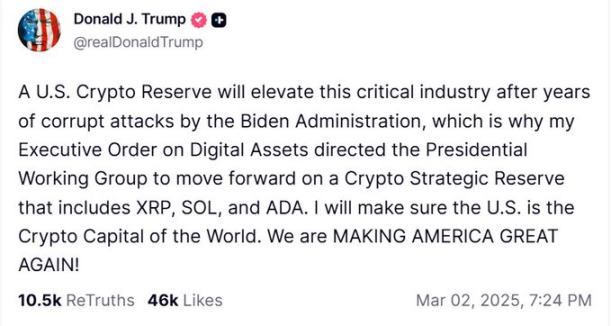
Source: Donald Trump

These two reserves "will not acquire additional assets by any means other than forfeiture proceedings."

This executive order essentially consolidated previously scattered seized assets from multiple federal regulatory and law enforcement agencies. The order stated that centralizing ownership, control, and management of these assets within the federal government would ensure proper oversight, accurate tracking, and a unified approach to managing the government's cryptocurrency holdings.

The government has not disclosed specific details of the Bitcoin Reserve and Digital Asset Reserve, but blockchain analytics company Arkham Research has identified multiple blockchain wallets associated with the U.S. government.

As of press time, the total value of cryptocurrencies held by the U.S. government is approximately $22.39 billion, with Bitcoin alone accounting for about $22 billion. Other major holdings include the stablecoin USDC, Ether, Wrapped Bitcoin (WBTC), and BNB.
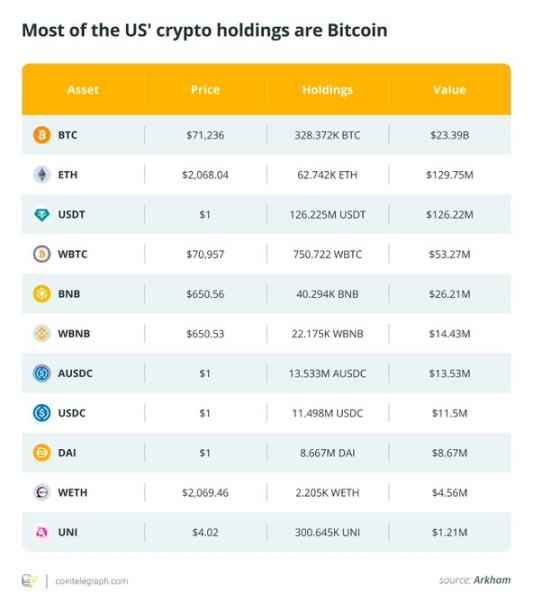
(Data collected on March 4)

It is currently unclear how much of these assets belong to the formal reserve, and whether and how these assets have been transferred. However, the dollar value of the reserve has significantly decreased. Arkham data shows that when Trump signed the executive order, the total value of crypto assets held by the U.S. was over $30 billion. As of press time, this figure has dropped to $22 billion, a decline of 26%.
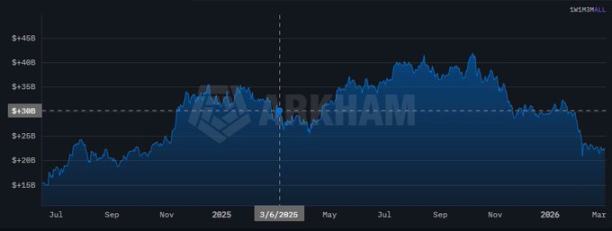
Significant decline in the value of the U.S. crypto asset portfolio since March 2025. Source: Arkham

The White House does not appear to be swayed by this. Deputy Press Secretary Kush Desai, commenting on the recent price drop, said: "In a free market, the government does not set prices. Market volatility does not change the Trump administration's determination to ensure U.S. dominance in cryptocurrency and other frontier technologies."

Bitcoin Holdings Unchanged, No Purchase Plans Yet

Despite hopes from staunch Bitcoin supporters that the U.S. government would start buying Bitcoin, the amount of Bitcoin held by the government has not changed. Since the executive order was signed, the U.S. government has held approximately 328,272 Bitcoin.
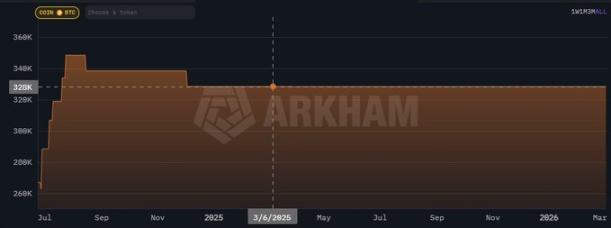
U.S. Bitcoin holdings have remained constant since the reserve's establishment. Source: Arkham

Ether is the second-largest crypto asset held by the U.S. government. Its quantity decreased after the executive order was signed, possibly due to exchanges or transfers. However, after April 2025, Ether holdings have remained largely stable.
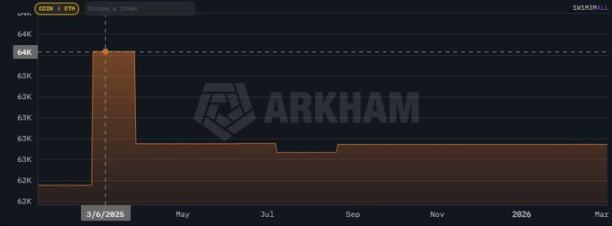
Changes in Ether holdings. Source: Arkham

Tether's USDT is the largest stablecoin held by the U.S. government. It saw a significant increase of over 200 million tokens in May 2025, before falling back to pre-March 2026 levels.
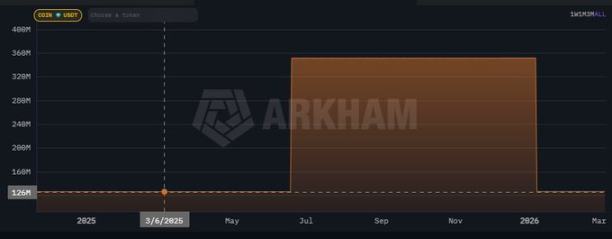
Changes in USDT holdings. Source: Arkham

These buying and selling patterns are not entirely clear. As mentioned, the government has not publicly disclosed specific transaction volumes.

The new crypto reserve strategy does not completely rule out the possibility of the government buying Bitcoin, but requires that any purchases must be made in a way that "does not impact the budget." Commissioner for AI and Crypto Affairs David Sacks said last year: "Cannot increase the deficit, cannot increase debt, cannot tax the American people."

"Not a single penny from taxpayers. But if the Treasury Secretaries can find a way to accumulate more Bitcoin without burdening taxpayers, they can do so."

A year on, it is unclear whether the government has developed such a strategy, or how it would be implemented.

Jason Yanowitz, co-founder of crypto company Blockworks, told the BBC last year that a crypto reserve containing a variety of different assets could negatively impact the market. "Without a clear framework, arbitrarily selecting assets can distort markets and lead to a loss of public trust," he said. "Ensuring transparency through independent audits and public reporting is crucial for fostering innovation and avoiding favoritism."

Following the success of software company-turned-Bitcoin investment vehicle Strategy, the idea of establishing Bitcoin reserves gained traction last year, both at the state and corporate levels. The narrative of Bitcoin as "digital gold" made holding the asset attractive for government budgets.

According to data from tracking website BitcoinTreasuries.net, 10 countries including the United States, China, Ukraine, El Salvador, the United Kingdom, and North Korea currently hold Bitcoin.

At the corporate level, analysts expect industry consolidation as the bear market continues. Wojciech Kasicki, Chief Strategy Officer of crypto infrastructure and treasury company BTCS, previously told Cointelegraph that companies with Bitcoin treasury values below net asset value might be acquired by operating businesses.

Bitcoin reserves remain a new concept and have not yet been tested through a full crypto winter.


Twitter:https://twitter.com/BitpushNewsCN

Bitpush TG Discussion Group:https://t.me/BitPushCommunity

Bitpush TG Subscription: https://t.me/bitpush

Original link:https://www.bitpush.news/articles/7617407

Preguntas relacionadas

QWhat was the total value of the US government's cryptocurrency holdings when the strategic reserve was established, and what is it now?

AWhen the strategic reserve was established, the US government's cryptocurrency holdings were valued at over $30 billion. As of the article's publication, that value has decreased to approximately $22.39 billion, a decline of 26%.

QAccording to the executive order, how can the US government acquire additional assets for its crypto reserves?

AAccording to the executive order, the US government can only acquire additional assets for its crypto reserves through forfeiture proceedings, not through purchases or any other means.

QWhat is the government's position on the recent price decline of its crypto assets, as stated by the deputy press secretary?

AThe deputy press secretary, Kush Desai, stated that in a free market, the government does not set prices, and market volatility does not change the Trump administration's determination to ensure US dominance in cryptocurrency and other frontier technologies.

QWhat was the condition set by Commissioner David Sacks for the government to potentially purchase more Bitcoin?

ACommissioner David Sacks stated that any purchase of Bitcoin must be done in a way that is 'budget-neutral,' meaning it cannot add to the deficit, increase debt, or tax the American people. Taxpayers should not spend a single penny.

QWhich other countries, besides the US, are listed as holding Bitcoin according to BitcoinTreasuries.net?

AAccording to BitcoinTreasuries.net, the countries that hold Bitcoin, besides the US, are China, Ukraine, El Salvador, the United Kingdom, and North Korea, among others, for a total of 10 nations.

Lecturas Relacionadas

MoneyGram: Why Did We Launch Our Own Stablecoin?

MoneyGram, a global leader in cross-border remittances for over 80 years, has launched its own stablecoin, MGUSD. The initiative aims to evolve from single-transaction services to becoming a more integral part of users' financial lives. By allowing customers to hold a stable US dollar balance within the MoneyGram app, MGUSD enables not only remittances but also everyday spending, currency exchange, cash access, and future financial services. Targeting the billions globally who face challenges like currency volatility or lack of bank accounts, MGUSD leverages Stellar blockchain technology with a self-custody wallet architecture. This gives users control over their assets while providing a secure, compliant experience through a trusted brand. The approach focuses on solving existing customer pain points within MoneyGram's established network, rather than competing for broad crypto market liquidity. A key advantage is MoneyGram's hybrid model, combining digital services with the world's largest physical network for crypto-to-cash conversions. The stablecoin also modernizes the company's internal infrastructure, streamlining treasury management and partner settlements, with annual forex volume via stablecoins already reaching $2 billion. The project was delivered in about a year, driven by a reorganization into agile, cross-functional teams that operate with startup-like speed while leveraging decades of institutional expertise. Partners include Stablecoin (issuance), Crossmint (wallet APIs), Fireblocks (enterprise treasury), m0 (smart contracts), and the Stellar network. MoneyGram emphasizes that enhancing direct consumer offerings strengthens its partner ecosystem. The future direction is clear: to provide users worldwide with stable value storage, better financial tools, and greater control over their funds through a trusted, existing network.

Foresight NewsHace 3 min(s)

MoneyGram: Why Did We Launch Our Own Stablecoin?

Foresight NewsHace 3 min(s)

BIP-110 Controversy Intensifies: Bitcoin May Face Its Most Divisive Hard Fork Battle in Years

Bitcoin is approaching a critical block height of 961,632, which could activate the controversial BIP-110 proposal. This proposal aims to restrict the amount of non-financial data, such as inscriptions and other large data payloads, within Bitcoin transactions. Supporters, including some node operators and Bitcoin purists, argue that BIP-110 is necessary to preserve Bitcoin's core function as a monetary settlement layer by reducing network congestion and node operational burdens caused by non-essential data. They frame it as a correction to keep the network true to its original purpose. However, critics, including prominent figures like Blockstream's Adam Back and developer Jameson Lopp, warn that the proposal's implementation mechanism is dangerously flawed. They highlight that its low 55% miner signaling threshold, coupled with a contentious enforcement mechanism allowing nodes to unilaterally reject non-compliant blocks, significantly increases the risk of a chain split. Opponents argue this sets a dangerous precedent for transaction censorship, undermines Bitcoin's protocol neutrality, and creates excessive uncertainty for developers and businesses, especially since the rule is proposed as a temporary one-year measure. Market analysts, such as those from Bitfinex, suggest a full-scale network split is unlikely due to a lack of broad economic consensus. Major mining pools remain neutral, and adoption of the new rules is minimal. They view the situation more as a governance stress test. The primary risk is operational disruption: if a minority chain persists, major exchanges and custodians may need to temporarily suspend Bitcoin deposits and withdrawals to manage security and liquidity, potentially unsettling newer institutional investors. While BIP-110 is not expected to succeed in overtaking the main chain, its approach has ignited a significant debate about Bitcoin's governance, core values, and resilience.

Foresight NewsHace 41 min(s)

BIP-110 Controversy Intensifies: Bitcoin May Face Its Most Divisive Hard Fork Battle in Years

Foresight NewsHace 41 min(s)

NEAR to Airdrop 330,000 Tokens, Betting on TVL Reaching $70 Million

On June 11th, NEAR Protocol launched the Near@3.33 Milestone Incentive Program, targeting users of its Confidential Intents privacy cross-chain execution feature. The program will distribute 333,333 milestone tokens when the Confidential Intents Total Value Locked (TVL) reaches $70 million. Users must have conducted Confidential transactions on near.com and maintain a Confidential balance above $100 in any asset to qualify, with a single wallet capped at 2% of the current airdrop pool. The milestone tokens will be locked upon receipt and cannot be sold or transferred. They can only be converted 1:1 to NEAR tokens once NEAR's Volume Weighted Average Price (VWAP) maintains $3.33 or higher for three consecutive trading days. As of the report, Confidential Intents TVL exceeds $20.69 million, needing roughly a 3x increase to trigger the airdrop. Confidential Intents, launched in February 2026, is NEAR's privacy execution layer designed to prevent MEV, front-running, and strategy leaks by building confidentiality directly into the execution environment. Its TVL has grown from zero to approximately $15 million in about three months. NEAR token price, which surged from around $1 in April to a peak of $3.08, currently trades near $2. The program aims to boost user activity for Confidential Intents, with future incentive rounds planned as community engagement increases.

Foresight NewsHace 2 hora(s)

NEAR to Airdrop 330,000 Tokens, Betting on TVL Reaching $70 Million

Foresight NewsHace 2 hora(s)

Crypto Market Makers Are Collectively Seeking Change as Money Becomes Harder to Earn

**Summary: Crypto Market Makers Adapt as Margins Shrink** Leading crypto market maker GSR exemplifies a broader industry shift, moving beyond traditional market-making to become a full-service "Web3 investment bank." Its recent strategic acquisitions—including an SEC-registered broker-dealer, rebranded as GSR Securities—and purchases of token advisory firms aim to create an integrated platform covering token design, fundraising, listing, liquidity provision, and asset management. This includes launching an ETF and investing in tokenization platforms like Libeara, backed by a strategic investment from Standard Chartered's SC Ventures. This transformation is not unique to GSR. Other major players like Keyrock, B2C2, Wintermute, and DWF Labs are also expanding geographically, pursuing regulatory licenses (especially under frameworks like MiCA in the EU), and diversifying into over-the-counter (OTC) trading, asset management, and real-world asset tokenization. The driving force behind this collective pivot is a rapidly changing market. Profits from traditional altcoin market-making are declining due to fewer viable projects, reduced client budgets, increased competition, and smarter, more demanding clients. Simultaneously, regulatory pressures are mounting, making compliance a baseline cost. Extreme market events further expose teams lacking robust risk controls. Consequently, the crypto market-making business model is evolving from one reliant on information asymmetry and volatility to a more institutionalized, regulated, and service-diverse industry. Survival now depends on building systemic capabilities beyond mere liquidity provision.

marsbitHace 2 hora(s)

Crypto Market Makers Are Collectively Seeking Change as Money Becomes Harder to Earn

marsbitHace 2 hora(s)

Trading

Spot
Futuros
活动图片





