Up Over 130% in a Month, Steadily Among Top Ethereum Blob Consumers—How Real is World Chain's Growth?

marsbitPublicado a 2026-06-22Actualizado a 2026-06-22

Resumen

World Chain, the Layer-2 blockchain developed by the Worldcoin project, has demonstrated significant recent growth despite a generally competitive and challenging L2 landscape. Its native token, WLD, surged over 130% in a month, driven by institutional holdings (notably from Eightco Holdings), increased trading activity from promotional campaigns, and a key upcoming reduction in daily token unlocks starting July 2026. Concurrently, World Chain's on-chain activity soared, with active addresses growing nearly 650% in 30 days and its Total Value Secured (TVS) surpassing $610 million, primarily from bridge inflows. However, its decentralized finance (DeFi) ecosystem remains nascent, with a total value locked (TVL) of only ~$40 million largely concentrated in a single protocol. A standout metric is World Chain's high data usage: it has become the second-largest consumer of Ethereum Blobs (data storage units), trailing only Base. This indicates substantial real-user transaction demand, likely fueled by Worldcoin's identity verification and reward distribution activities on its dedicated chain. While its current growth is fueled by token momentum and bridge capital, World Chain's long-term success depends on converting this activity into a sustainable, diverse on-chain economy.

Author: Nancy, PANews

Since Vitalik reframed the Layer2 roadmap this year, the survival competition in the L2 track has become increasingly brutal. Star L2s like Base, Arbitrum, and OP Mainnet continue to vie for market attention and liquidity, while numerous mid-to-long-tail and emerging L2s have become "ghost towns," with many projects even forced to make drastic cuts to survive.

Amid this growing L2 fragmentation, World Chain has carved out a relatively independent growth trajectory. Although its on-chain ecosystem applications remain sparse, real user activity drives high-frequency interaction demand. Concurrently, riding the AI wave, WLD has recently experienced a relatively independent upward trend.

Behind the 130%+ Monthly Surge: Why is WLD on an Independent Run?

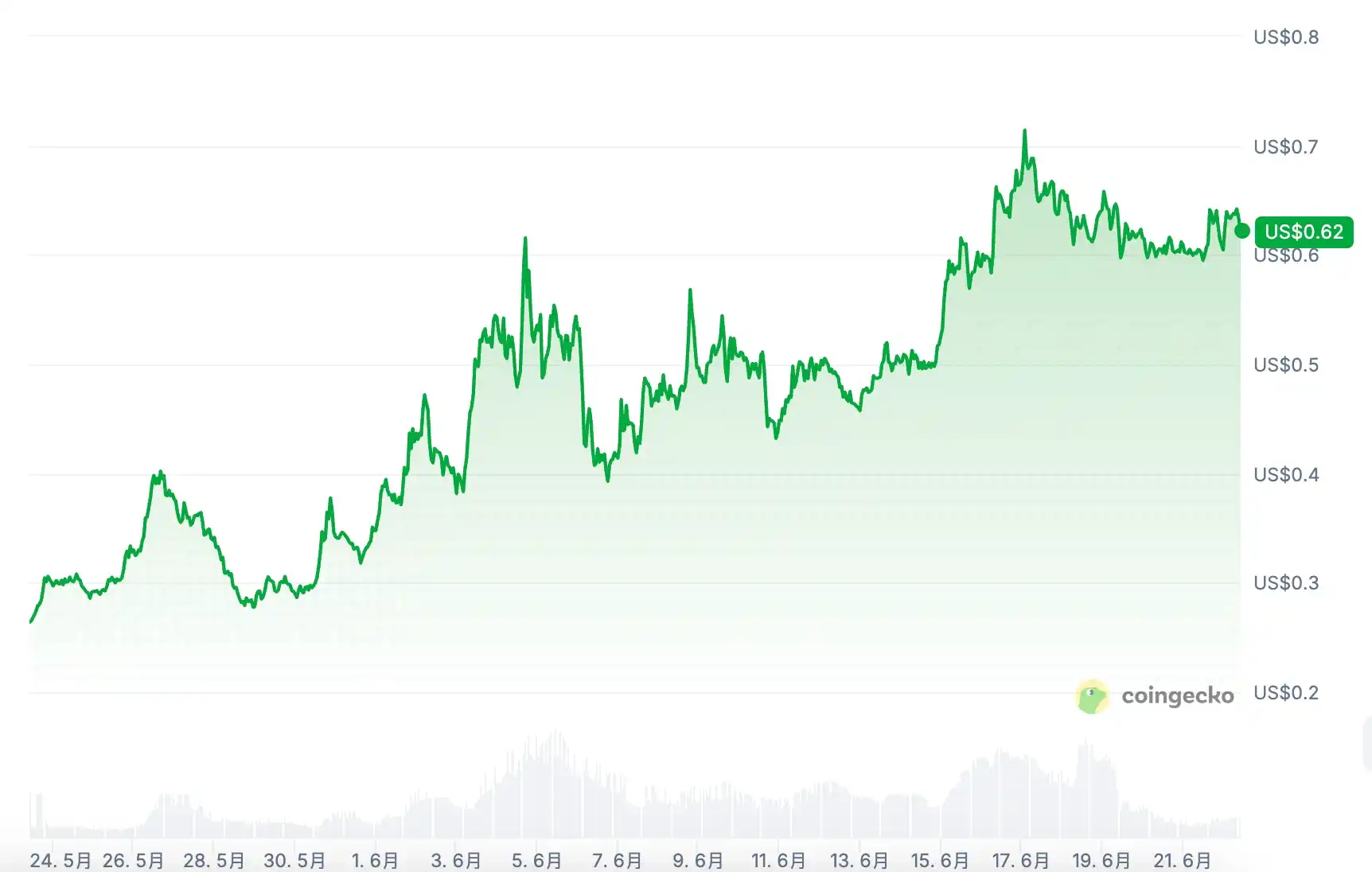
As the investment fervor in the AI sector continues to heat up, Worldcoin has become a target for market capital. CoinGecko data shows that WLD has surged 136.1% over the past 30 days, significantly outperforming most mainstream crypto assets.
This rally is primarily driven by a confluence of multiple expectations and capital inflows.

On one hand, substantial institutional holdings have boosted market confidence. Nasdaq-listed company Eightco Holdings publicly holds approximately 283 million WLD (about 8.4% of the circulating supply), incorporating it into its treasury asset allocation. Additionally, as the company holds indirect equity in OpenAI (an investment of around $90 million), it has amplified the market's imagination regarding the value of its token holdings.

On the other hand, incentive activities have stimulated WLD's trading activity. At the end of last month, Oku Trade integrated into the World App and launched a WLD trading competition, directly incentivizing user participation. Dune data shows that WLD's daily trading volume on DEXs once exceeded $11 million, compared to a long-term average of several hundred thousand dollars, representing a multiplier increase in volume.

A more critical driving factor comes from expectations of improvements in tokenomics. According to the latest adjustment plan, starting July 24, 2026, the daily WLD unlock volume will decrease from approximately 5.1 million to about 2.9 million tokens, a reduction of about 43%. Community unlocks will drop from 3.2 million to 1.6 million (50% decrease), while team and investor unlocks will decrease from 1.9 million to 1.3 million tokens per day (32% decrease). This adjustment is widely interpreted by the market as a significant alleviation of medium-to-long-term supply pressure, helping to dampen expectations of continuous sell-side pressure.

Furthermore, as expectations for the listing of AI giant OpenAI continue to heat up, the market fervor for the AI narrative has spilled over. As a crypto project co-founded by its figurehead Sam Altman, market attention on Worldcoin has intensified, further driving speculative capital inflows.

Soaring On-Chain Activity, Growth Dependent on Bridge Inflows

Alongside the rising token price, on-chain activity on World Chain is also surging.

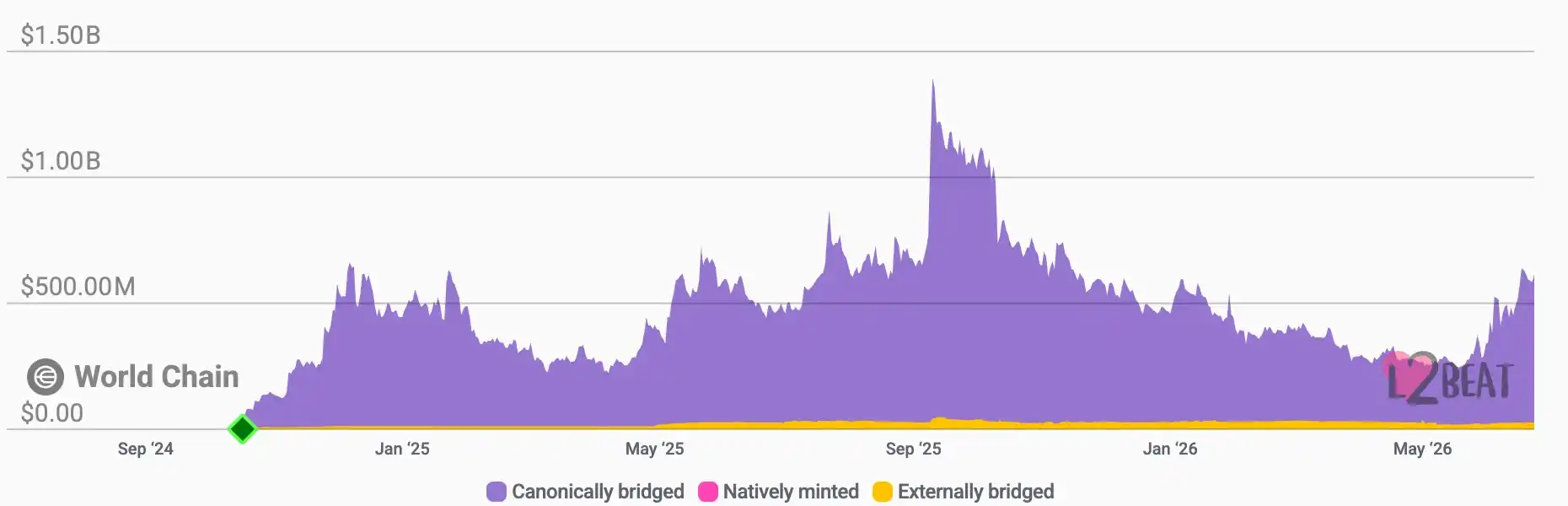
In terms of capital inflows, this growth phase is primarily fueled by bridged TVL. According to L2BEAT data, World Chain's Total Value Secured (TVS) now exceeds $610 million, representing an increase of about 122.6% over the past 30 days. Standard bridge asset inflows dominate this, amounting to approximately $557 million, a 118.4% month-on-month increase, constituting the main source of recent capital expansion.
Growing alongside the capital flow is its on-chain activity. GrowThePie data shows that over the past 30 days, World Chain's daily active addresses have skyrocketed by 649%. In comparison, Polygon, Base, Arbitrum One, Celo, and others saw limited growth during the same period, with some even experiencing negative growth.
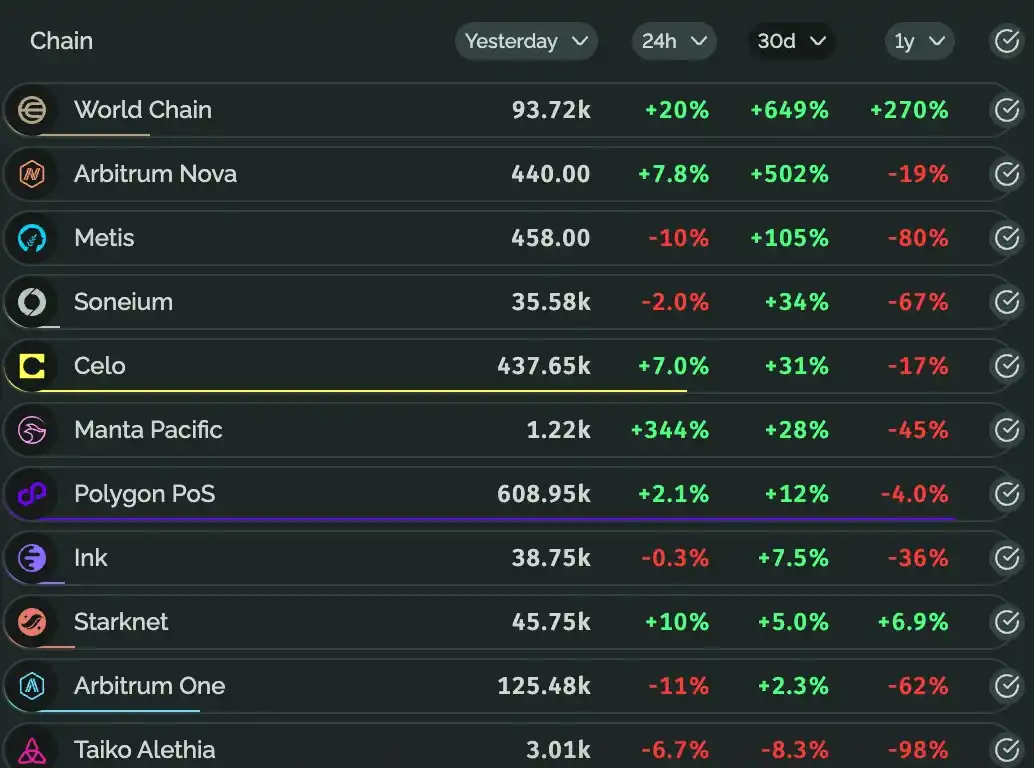
However, World Chain's on-chain ecosystem has not seen large-scale expansion. Compared to Base, which leverages Coinbase's traffic, or Arbitrum, which boasts a mature DeFi ecosystem, World Chain remains in the early stages of ecosystem development, lacking native protocols with network effects and high-frequency use cases.

DeFiLlama data shows that as of June 22, World Chain's TVL is only about $40.42 million, a scale incomparable to other leading L2s. Although it has nearly doubled over the past 30 days, the incremental liquidity is mainly concentrated in Morpho Blue-related vaults, with this protocol accounting for about 93% of World Chain's TVL.

In other words, a significant portion of the bridged capital remains in the form of idle assets, not effectively converted into DeFi lending, DEX trading, or complex application interactions. The depth of on-chain capital utilization and the efficiency of retention and conversion remain limited.

Second Only to Base, World Chain Becomes a Major Blob Consumer

Despite the lack of external applications, its unique positioning as Worldcoin's dedicated L2 and tens of millions of real user activities mean large-scale internal transactions are continuously driving up World Chain's Blob consumption, making it a high-frequency L2.

Blobs are primarily used by Layer 2 Rollups to publish transaction data to the mainnet at extremely low cost, achieving data availability. Since the Dencun upgrade in March 2024, the Ethereum mainnet has cumulatively submitted over 19.53 million Blobs. Among numerous Layer 2s, World Chain has grown into the second-largest Blob consumer, its strong performance even surpassing established L2s like Arbitrum.
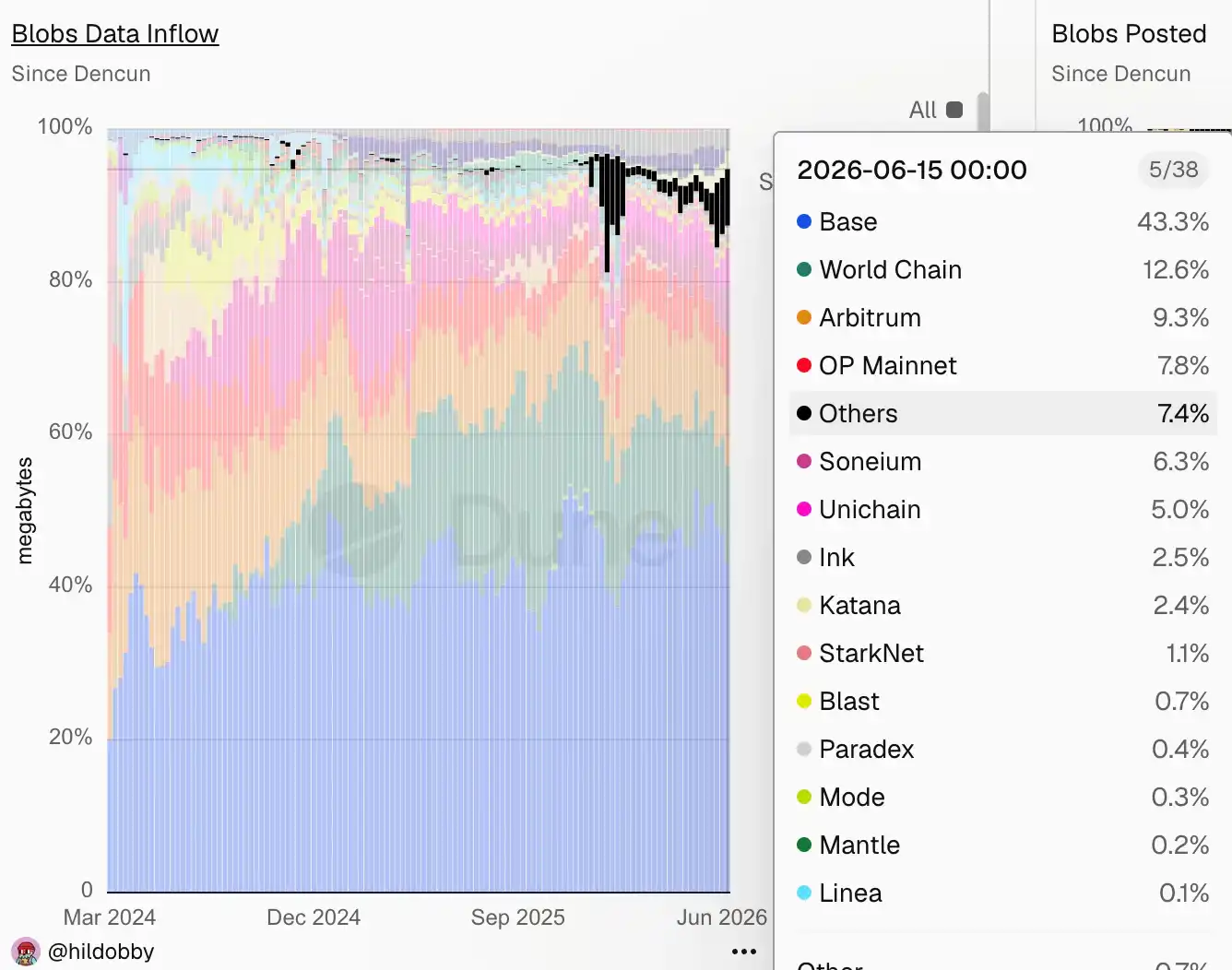
According to the latest Dune Analytics statistics, since its launch in June 2025, World Chain has cumulatively submitted over 2.63 million Blobs to Ethereum, firmly placing it among the top networks, second only to the leading Base. In the past 24 hours, it has averaged 106 Blob submissions per hour, equivalent to writing about 13.3MB of data to Ethereum per hour, with a Blob fill rate as high as 99%, leading most L2s in data packaging efficiency.

In terms of cost and operational efficiency, World Chain also demonstrates strong competitiveness. Over the past 3 days, its data availability (DA) fees amounted to about $304, with cumulative historical fees exceeding $2 million, proving more efficient compared to established L2s like Base (cumulative ~$6.45 million) and Arbitrum (cumulative ~$3.51 million). Simultaneously, it submits batches to Ethereum on average every 3 minutes and 45 seconds, with each submission transaction averaging 3 Blobs, indicating a high frequency of on-chain interactions.

Judging by the scale of data inflow, World Chain quickly ascended to the top tier shortly after launch and has maintained a leading position. As of June 15, its Blob data inflow accounted for 12.6% of the total network volume, second only to Base's 43.3%, solidifying its second-place standing. Mainstream L2s like Arbitrum One, Soneium, OP Mainnet, and Unichain all rank behind it.

While most L2s grapple with growth anxiety, World Chain's rise to the forefront of Blob consumption is not only due to the cost and throughput advantages afforded by its underlying OP Stack architecture, enabling it to handle on-chain activities more efficiently. More importantly, the migration of tens of millions of real World ID users to its dedicated chain, driven by scenarios like identity verification, subsidized Gas, and reward claims, generates sustained high-frequency transaction demand. This allows it to maintain vigorous data demand and Blob consumption even in the absence of a mature ecosystem.

Looking at a longer cycle, what truly determines the long-term development of an L2 is not short-term capital and trading hype. World Chain must effectively convert externally流入的资产 into on-chain liquidity and sustainable economic activities to evolve from a frequently used L2 into a mature network with a self-sustaining ecosystem.


Criptos en tendencia

Preguntas relacionadas

QWhat are the main factors driving WLD's significant price increase of over 130% in the past month?

AThe price surge is driven by multiple factors: institutional holdings (like Eightco Holdings holding ~284M WLD), incentive activities (e.g., Oku Trade integration boosting DEX volume), an expected improvement in tokenomics (a ~43% reduction in daily unlocks starting July 24, 2026), and heightened market interest in AI narratives linked to Sam Altman and OpenAI.

QHow has the on-chain activity of World Chain changed recently, and what is the primary source of its TVL growth?

AWorld Chain's on-chain activity has surged significantly, with active daily addresses increasing by 649% in the past 30 days. Its Total Value Secured (TVS) grew by about 122.6% to over $610 million, primarily driven by standard bridge inflows, which account for approximately $557 million of the TVL.

QWhat is the current state of World Chain's DeFi ecosystem compared to other major L2s?

AWorld Chain's DeFi ecosystem remains underdeveloped compared to L2s like Base or Arbitrum. Its total TVL is only about $40.42 million, with ~93% concentrated in Morpho Blue vaults. Most bridged assets are idle and have not been effectively converted into active DeFi usage such as lending or DEX trading.

QWhat is Blob consumption, and why is World Chain considered a major consumer on Ethereum?

ABlobs are used by Layer 2 Rollups to post transaction data to the Ethereum mainnet for data availability at low cost. World Chain is the second-largest Blob consumer on Ethereum, just after Base. Since its launch, it has submitted over 2.63 million Blobs, accounting for 12.6% of the network's total Blob data inflow, due to high-frequency transactions from millions of World ID users.

QWhat challenges does World Chain face for its long-term development despite its current high usage?

AThe key long-term challenge for World Chain is transforming externally bridged assets and high transaction frequency into a sustainable on-chain economy with deeper liquidity and diverse economic activities. It needs to move beyond being just a high-usage L2 driven by internal user actions (like identity verification and rewards) and build a robust, self-sustaining ecosystem with more native applications.

Lecturas Relacionadas

Blood Loss of $55 Million Selling 3,588 BTC, Strategy Becomes a Literal Scumbag

On July 6th, Strategy (formerly MicroStrategy) disclosed in an SEC filing that it sold 3,588 Bitcoin (BTC) between June 29th and July 5th for approximately $216 million, at an average price of ~$60,200. This marked the company's largest net sale since initiating its Bitcoin strategy in 2020 and its first institutionalized reduction of its core holding. The sale resulted in a realized loss of about $54.8 million, as the selling price was below its average cost basis of ~$75,476 per BTC. The proceeds were used to pay preferred stock dividends and replenish USD reserves. This move follows a new "Digital Credit Capital Framework" approved on June 29th, authorizing the sale of up to $1.25 billion in Bitcoin. The sale consumes roughly 17% of this authorized amount in its first week. Strategy's foundational narrative, built by founder Michael Saylor, was a commitment to "never sell" Bitcoin. The recent institutionalized selling framework and these substantial sales represent a significant shift from that original promise. While the amount sold is only 0.4% of Strategy's total holdings of 843,775 BTC, the action challenges the premium at which its stock (MSTR) trades relative to its Bitcoin holdings. Investors had priced in the "never sell" narrative. The company now faces a contradiction: it sells Bitcoin at a loss to pay dividends on the preferred stock it issued to fund Bitcoin purchases. Saylor has framed selling as a tool for future strategic purchases, but each sale erodes the credibility of the original commitment, potentially threatening the premium valuation of MSTR shares.

Foresight NewsHace 56 min(s)

Blood Loss of $55 Million Selling 3,588 BTC, Strategy Becomes a Literal Scumbag

Foresight NewsHace 56 min(s)

JP Morgan Tokenized Fund Surges 250% in TVL in One Month, Institutional Funds Are Treating Ethereum as the Default Underlying Layer

JPMorgan's tokenized money market fund, JLTXX, has seen its on-chain total value locked (TVL) surge approximately 250% in a month, reaching nearly $700 million from an initial $200 million since its launch seven weeks ago. The fund, which invests in short-term U.S. Treasuries and repos, operates exclusively on the public Ethereum mainnet, signaling growing institutional acceptance of Ethereum as a foundational layer for compliant financial products. A key driver of this growth is its inclusion as reserve assets for stablecoins like USDG, meeting requirements under U.S. stablecoin legislation. Simultaneously, despite a significant price decline—ETH has fallen over 50% from its 2025 high—institutional accumulation continues. BitMine Immersion Technologies, led by Tom Lee, purchased an additional $73 million worth of ETH last week, bringing its holdings to roughly 4.8% of Ethereum's circulating supply. The article highlights a divergence: while the tokenization of real-world assets and stablecoin reserves is driving long-term institutional adoption of Ethereum's infrastructure, short-term price action remains pressured by market sentiment and ETF outflows. This suggests that institutional on-chain activity, though a positive fundamental development, may not serve as a reliable signal for near-term price bottoms.

marsbitHace 1 hora(s)

JP Morgan Tokenized Fund Surges 250% in TVL in One Month, Institutional Funds Are Treating Ethereum as the Default Underlying Layer

marsbitHace 1 hora(s)

Dialogue with Yihui Capital, SoundAI Technology, Ling Universe, and Zhongbo Jili: Opportunities and Challenges in the AI Smart Hardware Track

On June 28, 2026, an event titled "New Opportunities in AI Hardware: The Battle for Interactive Entry Points Begins" was held in Beijing. It featured a report from ITJuzi and discussions with experts from SoundAI, Ling Universe, One Reed Capital, and Zhongbo Juli on the opportunities and challenges in China's AI hardware sector. Key report findings highlight the sector's intense activity: 327 out of 431 startups founded post-2023 have secured funding, with 179 investments in H1 2026 alone. The landscape is dominated by embodied intelligent robots, while wearable tech like smart rings and AI glasses shows rapid growth. Geographically, Shenzhen leads, leveraging its superior hardware supply chain, followed by Beijing and Shanghai. The overarching trend is for companies to focus on micro-innovations within specific scenarios rather than reinventing foundational technology. Industry leaders shared several critical insights: 1. **Balancing Innovation & Market Readiness**: Entrepreneurs face the "hammer looking for a nail" dilemma. Success requires balancing technical capability with user acceptance, cost control, and incremental design improvements rather than chasing disruptive innovation. 2. **Competitive Landscape**: The future interactive entry point may not be a single super-device but a mix of universal terminals and specialized, scenario-specific hardware. While large companies have ecosystem advantages, startups can win by deeply targeting vertical markets and specific user groups. 3. **Core Challenges & Business Models**: Key hurdles include deep understanding of AI models and navigating non-transparent hardware supply chains. Viable business models may involve selling hardware at cost and generating revenue through software subscriptions, but this requires tight control over both hardware BOM and model inference costs. 4. **The Road to Commercialization**: The ultimate test is market validation—achieving sales growth and sustainable cash flow. Companies must find the right application scenario, use edge computing effectively, and close the loop from technology to commercial success. 5. **The Future of Interaction**: Proactive, context-aware interaction is the next frontier, though it's currently limited by issues like model hallucinations and environmental perception. The near-term focus should be on identifying target users and creating a coherent experience in specific domains, such as health wearables. In summary, to succeed in the competitive AI hardware arena, companies must strategically choose their niche, build a team with the right geographical advantages (e.g., leveraging Shenzhen's supply chain), and most importantly, execute a flawless commercialization strategy that translates technology into market-accepted products and sustainable business growth.

marsbitHace 1 hora(s)

Dialogue with Yihui Capital, SoundAI Technology, Ling Universe, and Zhongbo Jili: Opportunities and Challenges in the AI Smart Hardware Track

marsbitHace 1 hora(s)

Trading

Spot

Artículos destacados

Qué es ETH 2.0

ETH 2.0: Una Nueva Era para Ethereum Introducción ETH 2.0, conocido ampliamente como Ethereum 2.0, marca una actualización monumental para la blockchain de Ethereum. Esta transición no es solo una mejora superficial; busca mejorar fundamentalmente la escalabilidad, seguridad y sostenibilidad de la red. Con un cambio del mecanismo de consenso intensivo en energía Prueba de Trabajo (PoW) a una Prueba de Participación (PoS) más eficiente, ETH 2.0 promete un enfoque transformador para el ecosistema blockchain. ¿Qué es ETH 2.0? ETH 2.0 es un conjunto de actualizaciones interconectadas y distintivas centradas en optimizar las capacidades y el rendimiento de Ethereum. La reestructuración está diseñada para abordar desafíos críticos que el mecanismo actual de Ethereum ha enfrentado, particularmente en lo que respecta a la velocidad de transacción y la congestión de la red. Objetivos de ETH 2.0 Los objetivos principales de ETH 2.0 giran en torno a mejorar tres aspectos clave: Escalabilidad: Con el objetivo de aumentar significativamente el número de transacciones que la red puede manejar por segundo, ETH 2.0 busca superar la limitación actual de aproximadamente 15 transacciones por segundo, potencialmente alcanzando miles. Seguridad: Las medidas de seguridad mejoradas son fundamentales para ETH 2.0, particularmente a través de una mejor resistencia contra ciberataques y la preservación del ethos descentralizado de Ethereum. Sostenibilidad: El nuevo mecanismo PoS está diseñado no solo para mejorar la eficiencia, sino también para reducir drásticamente el consumo de energía, alineando el marco operativo de Ethereum con consideraciones ambientales. ¿Quién es el Creador de ETH 2.0? La creación de ETH 2.0 se puede atribuir a la Fundación Ethereum. Esta organización sin fines de lucro, que desempeña un papel crucial en el apoyo al desarrollo de Ethereum, es liderada por el notable cofundador Vitalik Buterin. Su visión de un Ethereum más escalable y sostenible ha sido la fuerza motriz detrás de esta actualización, involucrando contribuciones de una comunidad global de desarrolladores y entusiastas dedicados a mejorar el protocolo. ¿Quiénes son los Inversores de ETH 2.0? Si bien los detalles sobre los inversores de ETH 2.0 no se han hecho públicos, se sabe que la Fundación Ethereum recibe apoyo de varias organizaciones e individuos en el ámbito de blockchain y tecnología. Estos socios incluyen firmas de capital de riesgo, compañías tecnológicas y organizaciones filantrópicas que comparten un interés mutuo en apoyar el desarrollo de tecnologías descentralizadas e infraestructura blockchain. ¿Cómo Funciona ETH 2.0? ETH 2.0 se distingue por introducir una serie de características clave que lo diferencian de su predecesor. Prueba de Participación (PoS) La transición a un mecanismo de consenso PoS es uno de los cambios más destacados de ETH 2.0. A diferencia de PoW, que se basa en la minería intensiva en energía para la verificación de transacciones, PoS permite a los usuarios validar transacciones y crear nuevos bloques de acuerdo con la cantidad de ETH que apuestan en la red. Esto conduce a una mayor eficiencia energética, reduciendo el consumo en aproximadamente un 99.95%, convirtiendo a Ethereum 2.0 en una alternativa considerablemente más verde. Cadenas Shard Las cadenas shard son otra innovación crítica de ETH 2.0. Estas cadenas más pequeñas operan en paralelo con la cadena principal de Ethereum, lo que permite que múltiples transacciones sean procesadas simultáneamente. Este enfoque mejora la capacidad general de la red, abordando las preocupaciones de escalabilidad que han afectado a Ethereum. Cadena Beacon En el núcleo de ETH 2.0 se encuentra la Cadena Beacon, que coordina la red y gestiona el protocolo PoS. Funciona como un organizador de cierta manera: supervisa a los validadores, asegura que los shards permanezcan conectados a la red y monitorea la salud general del ecosistema blockchain. Cronología de ETH 2.0 El viaje de ETH 2.0 ha estado marcado por varios hitos clave que trazan la evolución de esta importante actualización: Diciembre 2020: El lanzamiento de la Cadena Beacon marcó la introducción de PoS, preparándose para la migración hacia ETH 2.0. Septiembre 2022: La finalización de “La Fusión” representa un momento crucial en el que la red Ethereum se trasladó exitosamente de un marco PoW a uno PoS, anunciando una nueva era para Ethereum. 2023: El lanzamiento esperado de cadenas shard tiene como objetivo mejorar aún más la escalabilidad de la red Ethereum, consolidando a ETH 2.0 como una plataforma robusta para aplicaciones y servicios descentralizados. Características Clave y Beneficios Escalabilidad Mejorada Una de las ventajas más significativas de ETH 2.0 es su escalabilidad mejorada. La combinación de PoS y cadenas shard permite que la red expanda su capacidad, permitiendo acomodar un volumen mucho mayor de transacciones en comparación con el sistema heredado. Eficiencia Energética La implementación de PoS representa un gran paso hacia la eficiencia energética en la tecnología blockchain. Al reducir drásticamente el consumo de energía, ETH 2.0 no solo disminuye los costos operativos, sino que también se alinea más estrechamente con los objetivos de sostenibilidad global. Seguridad Mejorada Los mecanismos actualizados de ETH 2.0 contribuyen a mejorar la seguridad en toda la red. El despliegue de PoS, junto con las medidas de control innovadoras establecidas a través de cadenas shard y la Cadena Beacon, asegura un mayor grado de protección contra posibles amenazas. Costos Más Bajos para los Usuarios A medida que la escalabilidad mejora, los efectos sobre los costos de transacción también serán evidentes. Se espera que una mayor capacidad y una menor congestión se traduzcan en tarifas más bajas para los usuarios, haciendo que Ethereum sea más accesible para transacciones cotidianas. Conclusión ETH 2.0 marca una evolución significativa en el ecosistema blockchain de Ethereum. A medida que aborda problemas fundamentales como la escalabilidad, el consumo de energía, la eficiencia en las transacciones y la seguridad general, la importancia de esta actualización no puede ser subestimada. La transición a la Prueba de Participación, la introducción de cadenas shard y el trabajo fundamental de la Cadena Beacon son indicativos de un futuro donde Ethereum puede satisfacer las crecientes demandas del mercado descentralizado. En una industria impulsada por la innovación y el progreso, ETH 2.0 se erige como un testimonio de las capacidades de la tecnología blockchain para allanar el camino hacia una economía digital más sostenible y eficiente.

183 Vistas totalesPublicado en 2024.04.04Actualizado en 2024.12.03

Qué es ETH 2.0

Qué es ETH 3.0

ETH3.0 y $eth 3.0: Un Examen Profundo del Futuro de Ethereum Introducción En el paisaje en rápida evolución de las criptomonedas y la tecnología blockchain, ETH3.0, a menudo denotado como $eth 3.0, ha surgido como un tema de considerable interés y especulación. El término abarca dos conceptos principales que merecen aclaración: Ethereum 3.0: Esto representa una posible actualización futura destinada a aumentar las capacidades de la blockchain existente de Ethereum, enfocándose particularmente en mejorar la escalabilidad y el rendimiento. ETH3.0 Meme Token: Este proyecto de criptomoneda distinto busca aprovechar la blockchain de Ethereum para crear un ecosistema centrado en memes, promoviendo la participación dentro de la comunidad de criptomonedas. Comprender estos aspectos de ETH3.0 es esencial no solo para los entusiastas de las criptomonedas, sino también para aquellos que observan tendencias tecnológicas más amplias en el espacio digital. ¿Qué es ETH3.0? Ethereum 3.0 Ethereum 3.0 se presenta como una actualización propuesta para la red de Ethereum ya establecida, que ha sido la columna vertebral de muchas aplicaciones descentralizadas (dApps) y contratos inteligentes desde su inicio. Las mejoras previstas se concentran principalmente en la escalabilidad, integrando tecnologías avanzadas como sharding y pruebas de conocimiento cero (zk-proofs). Estas innovaciones tecnológicas tienen como objetivo facilitar un número sin precedentes de transacciones por segundo (TPS), potencialmente alcanzando millones, abordando así una de las limitaciones más significativas que enfrenta la tecnología blockchain actual. La mejora no es meramente técnica, sino también estratégica; está destinada a preparar la red de Ethereum para su adopción generalizada y utilidad en un futuro marcado por una mayor demanda de soluciones descentralizadas. ETH3.0 Meme Token En contraste con Ethereum 3.0, el ETH3.0 Meme Token se aventura en un ámbito más ligero y juguetón al combinar la cultura de memes de internet con la dinámica de las criptomonedas. Este proyecto permite a los usuarios comprar, vender e intercambiar memes en la blockchain de Ethereum, proporcionando una plataforma que fomenta la participación comunitaria a través de la creatividad y los intereses compartidos. El ETH3.0 Meme Token tiene como objetivo demostrar cómo la tecnología blockchain puede intersectarse con la cultura digital, creando casos de uso que son tanto entretenidos como financieramente viables. ¿Quién es el Creador de ETH3.0? Ethereum 3.0 La iniciativa hacia Ethereum 3.0 es impulsada principalmente por un consorcio de desarrolladores e investigadores dentro de la comunidad de Ethereum, incluyendo notablemente a Justin Drake. Conocido por sus ideas y contribuciones a la evolución de Ethereum, Drake ha sido una figura prominente en las discusiones sobre la transición de Ethereum a una nueva capa de consenso, denominada “Beam Chain.” Este enfoque colaborativo para el desarrollo significa que Ethereum 3.0 no es el producto de un creador singular, sino más bien una manifestación de ingenio colectivo centrado en avanzar la tecnología blockchain. ETH3.0 Meme Token Los detalles sobre el creador del ETH3.0 Meme Token son actualmente inidentificables. La naturaleza de los tokens de memes a menudo conduce a una estructura más descentralizada y dirigida por la comunidad, lo que podría explicar la falta de atribución específica. Esto se alinea con la ética de la comunidad cripto más amplia, donde la innovación a menudo surge de esfuerzos colaborativos en lugar de individuales. ¿Quiénes son los Inversores de ETH3.0? Ethereum 3.0 El apoyo a Ethereum 3.0 proviene principalmente de la Fundación Ethereum junto con una entusiasta comunidad de desarrolladores e inversores. Esta asociación fundamental proporciona un grado significativo de legitimidad y mejora la perspectiva de una implementación exitosa, ya que aprovecha la confianza y credibilidad construidas a lo largo de años de operaciones en la red. En el clima cambiando rápidamente de las criptomonedas, el apoyo de la comunidad juega un papel crucial en impulsar el desarrollo y la adopción, posicionando a Ethereum 3.0 como un contendiente serio para futuros avances en blockchain. ETH3.0 Meme Token Si bien las fuentes actualmente disponibles no proporcionan información explícita sobre las fundaciones o organizaciones de inversión que respaldan el ETH3.0 Meme Token, es indicativo del modelo de financiamiento típico para tokens de memes, que a menudo depende del apoyo de base y la participación comunitaria. Los inversores en tales proyectos suelen consistir en individuos motivados por el potencial de innovación impulsada por la comunidad y el espíritu de cooperación que se encuentra dentro de la comunidad cripto. ¿Cómo Funciona ETH3.0? Ethereum 3.0 Las características distintivas de Ethereum 3.0 radican en su implementación propuesta de sharding y tecnología zk-proof. Sharding es un método de particionamiento de la blockchain en piezas más pequeñas y manejables o “shards,” que pueden procesar transacciones de manera concurrente en lugar de secuencial. Esta descentralización del procesamiento ayuda a prevenir la congestión y asegura que la red permanezca receptiva incluso bajo una carga pesada. La tecnología de prueba de conocimiento cero (zk-proof) contribuye con otra capa de sofisticación al permitir la validación de transacciones sin revelar los datos subyacentes involucrados. Este aspecto no solo mejora la privacidad, sino que también aumenta la eficiencia general de la red. También se habla de incorporar una Máquina Virtual de Ethereum de conocimiento cero (zkEVM) en esta actualización, amplificando aún más las capacidades y utilidad de la red. ETH3.0 Meme Token El ETH3.0 Meme Token se distingue al capitalizar la popularidad de la cultura de memes. Establece un mercado para que los usuarios participen en el comercio de memes, no solo por entretenimiento sino también por el posible beneficio económico. Al integrar características como staking, provisión de liquidez y mecanismos de gobernanza, el proyecto fomenta un entorno que incentiva la interacción y participación de la comunidad. Al ofrecer una mezcla única de entretenimiento y oportunidad económica, el ETH3.0 Meme Token tiene como objetivo atraer a una audiencia diversa, que abarca desde entusiastas de las criptomonedas hasta conocedores casuales de memes. Línea de Tiempo de ETH3.0 Ethereum 3.0 11 de noviembre de 2024: Justin Drake insinúa la próxima actualización de ETH 3.0, centrada en mejoras de escalabilidad. Este anuncio significa el comienzo de las discusiones formales sobre la futura arquitectura de Ethereum. 12 de noviembre de 2024: Se espera que la propuesta anticipada para Ethereum 3.0 se desvele en Devcon en Bangkok, preparando el escenario para una mayor retroalimentación de la comunidad y posibles próximos pasos en el desarrollo. ETH3.0 Meme Token 21 de marzo de 2024: El ETH3.0 Meme Token se lista oficialmente en CoinMarketCap, marcando su incursión en el dominio público de las criptomonedas y mejorando la visibilidad de su ecosistema basado en memes. Puntos Clave En conclusión, Ethereum 3.0 representa una evolución significativa dentro de la red de Ethereum, enfocándose en superar las limitaciones en términos de escalabilidad y rendimiento a través de tecnologías avanzadas. Sus actualizaciones propuestas reflejan un enfoque proactivo hacia las demandas y la usabilidad futura. Por otro lado, el ETH3.0 Meme Token encapsula la esencia de la cultura impulsada por la comunidad en el espacio de las criptomonedas, aprovechando la cultura de memes para crear plataformas atractivas que fomentan la creatividad y participación del usuario. Comprender los distintos propósitos y funcionalidades de ETH3.0 y $eth 3.0 es fundamental para cualquiera interesado en los desarrollos en curso dentro del espacio cripto. Con ambas iniciativas abriendo caminos únicos, subrayan colectivamente la naturaleza dinámica y multifacética de la innovación en blockchain.

207 Vistas totalesPublicado en 2024.04.04Actualizado en 2024.12.03

Qué es ETH 3.0

Cómo comprar ETH

¡Bienvenido a HTX.com! Hemos hecho que comprar Ethereum (ETH) sea simple y conveniente. Sigue nuestra guía paso a paso para iniciar tu viaje de criptos.Paso 1: crea tu cuenta HTXUtiliza tu correo electrónico o número de teléfono para registrarte y obtener una cuenta gratuita en HTX. Experimenta un proceso de registro sin complicaciones y desbloquea todas las funciones.Obtener mi cuentaPaso 2: ve a Comprar cripto y elige tu método de pagoTarjeta de crédito/débito: usa tu Visa o Mastercard para comprar Ethereum (ETH) al instante.Saldo: utiliza fondos del saldo de tu cuenta HTX para tradear sin problemas.Terceros: hemos agregado métodos de pago populares como Google Pay y Apple Pay para mejorar la comodidad.P2P: tradear directamente con otros usuarios en HTX.Over-the-Counter (OTC): ofrecemos servicios personalizados y tipos de cambio competitivos para los traders.Paso 3: guarda tu Ethereum (ETH)Después de comprar tu Ethereum (ETH), guárdalo en tu cuenta HTX. Alternativamente, puedes enviarlo a otro lugar mediante transferencia blockchain o utilizarlo para tradear otras criptomonedas.Paso 4: tradear Ethereum (ETH)Tradear fácilmente con Ethereum (ETH) en HTX's mercado spot. Simplemente accede a tu cuenta, selecciona tu par de trading, ejecuta tus trades y monitorea en tiempo real. Ofrecemos una experiencia fácil de usar tanto para principiantes como para traders experimentados.

4.2k Vistas totalesPublicado en 2024.12.10Actualizado en 2026.06.02

Cómo comprar ETH

Discusiones

Bienvenido a la comunidad de HTX. Aquí puedes mantenerte informado sobre los últimos desarrollos de la plataforma y acceder a análisis profesionales del mercado. A continuación se presentan las opiniones de los usuarios sobre el precio de ETH (ETH).

活动图片