Unlocking 20%, $125 Million in Pressure, Can PUMP Hold Up?

Odaily星球日报Publicado a 2026-07-13Actualizado a 2026-07-13

Resumen

"Pump.fun Faces Crucial Test with $125M Token Unlock Despite a cooldown in the meme coin market, Pump.fun remains one of Web3's top revenue-generating protocols, earning $28.4 million in the past 30 days. The platform has accumulated approximately $1.05 billion in total revenue from over 12 million tokens created. The protocol now faces its biggest challenge: the first unlock of team and investor tokens. A total of 82.5 billion PUMP tokens (8.25% of total supply, 20.23% of previous circulating supply), valued at around $125 million, have been unlocked. This potential selling pressure is significant compared to the token's 24-hour trading volume of only $28 million. While Pump.fun uses a portion of its revenue to buy back and burn PUMP tokens, creating buy-side pressure, this support has weakened. The buyback rate was reduced from 100% to 50% of net fees in April 2024. In June 2024, monthly buybacks totaled just $9.2 million, an over 80% drop from its peak. At this rate, selling just 7% of the newly unlocked tokens would offset a full month of buybacks. Furthermore, this unlock is only the first batch; team and investors still hold another 247.5 billion locked PUMP tokens, with 240 billion community tokens awaiting a release schedule. Despite these headwinds, PUMP is argued to be a relatively scarce asset in the current market. With a $610 million market cap against $28.4 million in monthly revenue, its valuation is lower than competitors like Hyperliquid. The investment ...

Original | Odaily Planet Daily (@OdailyChina)

Author | Asher (@Asher_0210)

Even though the Meme market has cooled down significantly from its peak, Pump.fun remains one of the most profitable protocols in Web3. According to DefiLlama data, over the past 30 days, Pump.fun protocol revenue reached $28.4 million, higher than Polymarket ($22.12 million monthly revenue), and only lower than Hyperliquid ($43.93 million monthly revenue).
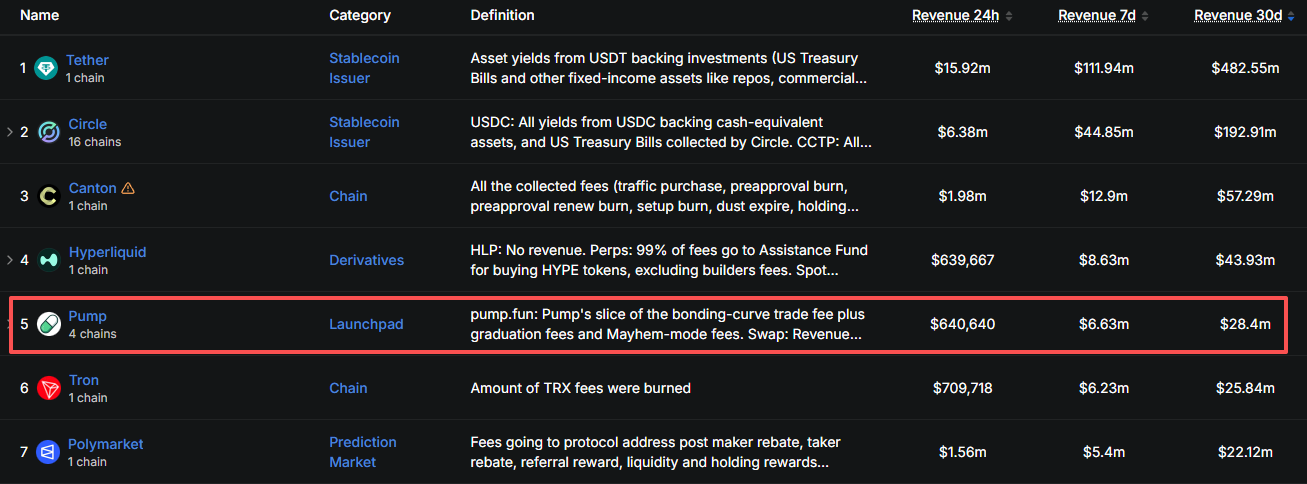
Web3 Protocol Monthly Revenue Rankings

Someone issues a token, it takes a cut; someone trades, it takes a cut; a Meme coin from birth to death, it can extract fees from every buy and sell. Since its launch over two years ago, Pump.fun has issued over 12 million tokens, with cumulative platform revenue reaching approximately $1.05 billion, once becoming the first application on Solana to surpass $1 billion in revenue.

Pump.fun uses a portion of its revenue to repurchase and burn PUMP, converting the money the platform earns into buy-side pressure for the token. But at 10 PM last night, this value cycle faced its biggest test yet. PUMP saw its first unlock of team and investor tokens, totaling 82.5 billion tokens, accounting for 8.25% of the total supply, equivalent to 20.23% of the circulating supply before the unlock, valued at approximately $125 million.

In comparison, PUMP's trading volume in the past 24 hours was only $28 million. So, will this potential sell pressure of $125 million cause PUMP's price to plummet? How much can the platform's repurchase buy-side absorb? Is PUMP still worth buying?

Just Burned 129 Billion PUMP in April, Why Can't It Stop the Unlock Pressure?

On April 29 this year, Pump.fun executed a one-time burn of 129 billion PUMP, accounting for 12.9% of the max supply, the largest burn in PUMP's history.

In terms of quantity, the 129 billion burned is even more than the 82.5 billion unlocked this time. However, they cannot directly offset each other. Most of the burned PUMP had already been repurchased by the platform and stored in specific wallets; they were not freely circulating on the market in the first place. The concentrated burn merely removed these tokens permanently and did not create an extra 129 billion token buy-side on that day in April.

This unlock is the complete opposite. Starting last night, 82.5 billion previously non-tradable team and investor holdings gained the possibility to enter the market. April reduced the total theoretical supply, July increased the potentially sellable holdings.

Furthermore, the 82.5 billion is just the first batch. The team and investors collectively hold 330 billion PUMP; this unlock represents only a quarter of that, with 247.5 billion still locked. It's worth noting that there are also 240 billion community tokens without a clear release schedule.
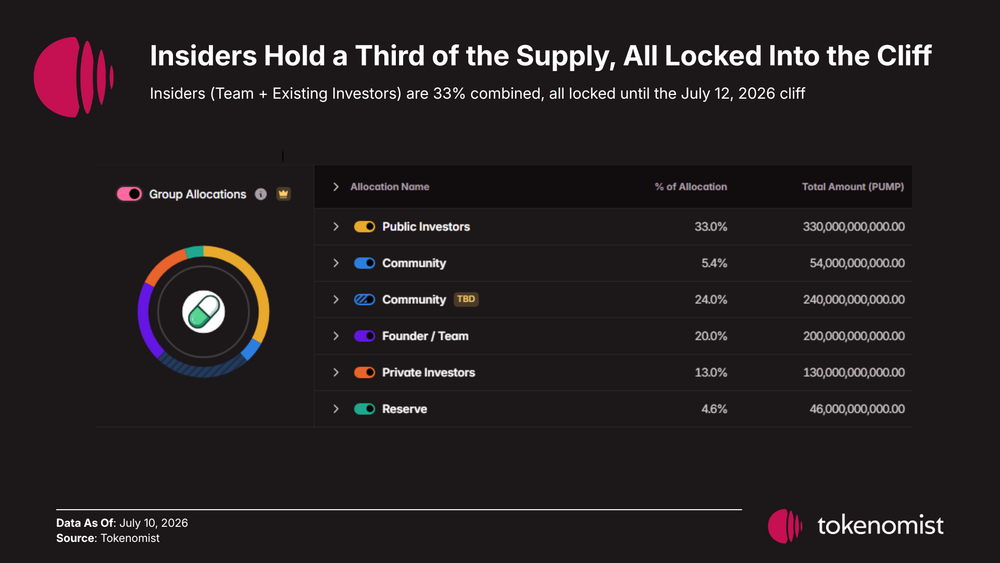
PUMP Token Distribution Chart

The two parts combined total 487.5 billion, equivalent to 1.2 times the circulating supply before the unlock. The market not only needs to digest the immediate 82.5 billion but also faces long-term uncertainty from the subsequent supply.

Unlock Gates Open, While Repurchases Are Ebbing

In the past, the most stable buy-side pressure for Pump.fun came from the platform's token repurchases.

After the repurchase program launched in July 2025, Pump.fun once used 100% of net protocol fees to buy PUMP. In September of last year, the monthly repurchase amount surged to $55.3 million, even higher than the $42.8 million protocol revenue for that month.

However, this April, Pump.fun announced it would reduce the repurchase ratio from 100% to 50%, reserving the other half for the company for hiring, marketing, and acquisitions. In June this year, the monthly repurchase amount for PUMP dropped to just $9.2 million, shrinking over 80% from its peak.
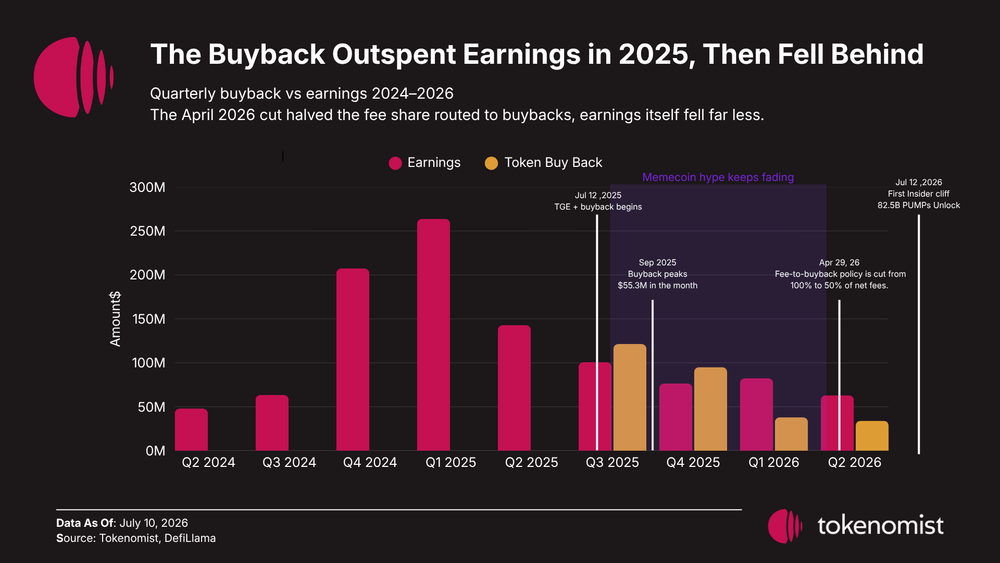
PUMP Revenue vs. Token Repurchase Comparison Chart

Looking at a six-month period, the difference is even more pronounced. In the second half of 2025, Pump.fun invested about $217 million in repurchasing PUMP; in the first half of 2026, it invested only $72.2 million, a 67% decrease, while protocol revenue during the same period decreased by only 18%.

Pump.fun is still highly profitable, but the funds actually flowing into PUMP have significantly diminished. Based on June's repurchase scale of $9.2 million, selling just about 7% of this unlocked batch would be enough to offset one month of the platform's repurchases.

Picking the Best of a Bunch, PUMP Remains a Scarce Asset in a Bear Market

Sell pressure is evident, but looking across the entire market, there aren't many platforms that can consistently generate high revenue.

Hyperliquid, with higher revenue than Pump.fun, had protocol revenue of approximately $43.93 million in the past 30 days. However, HYPE's current market cap is nearly $15 billion, over 20 times that of PUMP. Polymarket had revenue of about $22.12 million in the past 30 days and has not yet issued a token. The company's previously rumored financing valuation was already $15 billion. Even if it issues a token in the future, the valuation will likely not be cheap.

In comparison, Pump.fun's revenue over the past 30 days reached $28.4 million, while PUMP's market cap is only about $610 million. It faces unlock pressure, and repurchases are shrinking, but at least the platform's revenue is real, its business model is stable, and the token has already fallen to a relatively low valuation.

More importantly, Pump.fun doesn't rely on any single hit Meme coin. As long as the market continues to issue and trade tokens, the platform can continuously collect fees. Betting on PUMP is essentially not betting on the next big Meme, but betting that whether in a bear or bull market, the Meme market will continue to repeatedly generate hype, and that Pump.fun can continue to guard this traffic gateway.

Choosing assets for accumulation in a bear market is not about finding projects with no issues; it's about prioritizing protocols that still have users, are still profitable, and still have the ability to repurchase from a pile of risks. From this perspective, PUMP is not perfect, but it remains one of the few high-revenue platform tokens whose valuation hasn't yet been pushed to astronomical levels.

The 82.5 billion token unlock tests short-term absorption capacity, but Pump.fun's revenue determines how far PUMP can go. As long as this Meme machine continues to make money, PUMP may not necessarily follow the "unlock means rug pull" script. The current situation might instead be a good time for long-term accumulation.


Preguntas relacionadas

QAccording to the article, what is the main challenge PUMP token faces, and what specific event is causing it?

AThe main challenge PUMP token faces is significant potential selling pressure. This is caused by the first unlock of team and investor tokens, totaling 82.5 billion PUMP (8.25% of total supply, ~20.23% of pre-unlock circulating supply), valued at approximately $125 million.

QWhat are the two key factors that have reduced the previous support system (buy pressure) for the PUMP token price?

AThe two key factors are: 1) The platform's token buyback ratio was reduced from 100% to 50% of net protocol fees in April 2026. 2) Consequently, the monthly buyback amount has significantly decreased, falling to $9.2 million in June 2026 from a high of $55.3 million in September 2025.

QDespite the unlock pressure, why does the article suggest PUMP might still be a scarce or attractive asset in the current market?

AThe article suggests PUMP might still be attractive because Pump.fun is a highly profitable protocol with real, stable revenue ($28.4M in the past 30 days). Compared to other high-revenue protocols like Hyperliquid (HYPE market cap ~$15B) and Polymarket ($15B valuation), PUMP's market cap is relatively low at ~$610M, offering a lower valuation for a proven revenue-generating business.

QWhat is the fundamental investment thesis for holding PUMP, according to the article's conclusion?

AThe fundamental thesis is not betting on a single meme coin, but on the continuous activity of the meme coin market itself. Investing in PUMP is a bet that meme coin creation and trading will persist across market cycles and that Pump.fun will maintain its position as the leading platform for this activity, thereby ensuring sustained protocol revenue.

QHow much total supply of PUMP remains locked for the team, investors, and community after the initial unlock, and what is its significance?

AAfter the initial 82.5 billion token unlock, a total of 487.5 billion PUMP remains locked. This includes 247.5 billion for team/investors and 240 billion for the community. This amount is equivalent to 1.2 times the pre-unlock circulating supply, representing a long-term overhang and uncertainty for the market to digest.

Lecturas Relacionadas

Major Reshuffle in Foreign Trade Cities! Shenzhen Surpasses Shanghai, Suzhou Surpasses Beijing

A major reshuffle has occurred in China's foreign trade city rankings for the first seven months of 2026. Shenzhen has consolidated its position as the top city, significantly widening its lead over Shanghai. Notably, Shenzhen's import value surpassed Shanghai's for the first time historically. Suzhou overtook Beijing to become the third-ranked city, while Wuxi entered the top ten, replacing Qingdao which dropped out. Xi'an emerged as the biggest dark horse, with its foreign trade soaring by 100.4%. Nationally, import growth (22%) significantly outpaced export growth (14%), becoming the primary driver of overall trade expansion. This surge in imports, particularly of intermediate goods, signals a recovery in domestic demand and strengthens the foundation for future exports. Key cities leading the charge are those with strong foundations in semiconductors and AI hardware. Xi'an's explosive growth is powered by major memory chip manufacturers like Samsung and Micron. Suzhou's rise is driven by electronics and AI computing hardware exports. Shenzhen, Hefei, and Wuxi also benefited from their robust integrated circuit and electronics manufacturing industries. The overall trend shows manufacturing and export-oriented cities advancing rapidly in the rankings. However, 19 of the top 30 cities grew slower than the national average, indicating an uneven recovery.

marsbitHace 14 min(s)

Major Reshuffle in Foreign Trade Cities! Shenzhen Surpasses Shanghai, Suzhou Surpasses Beijing

marsbitHace 14 min(s)

Marvell: Can't Compare to NVIDIA, Can't Meet Expectations, Overvaluation Gets Squeezed First?

Marvell Technology (MRVL.O) reported its Q2 FY2027 earnings (ending July 2026) after market close on August 27. Key points include: The company raised its full-year revenue outlook for FY2027 to $12 billion (from $11.5B) and for FY2028 to $18 billion (from $16.5B). However, these upward revisions were only slightly above market expectations and significantly trailed NVIDIA's recent explosive guidance. The Data Center segment, accounting for 79% of revenue, grew 19% quarter-over-quarter to $2.17 billion, primarily driven by connectivity products. For FY2028, management forecasts over 60% growth for this segment, again below NVIDIA's >70% outlook. A major disappointment for investors was the lack of an upward revision to the Custom ASIC business guidance, despite Marvell's recent partnership agreement with Google. The market had anticipated potential gains from Google's TPU orders, but the maintained guidance for "over 100% growth" in FY2028 (with no specific target for FY2027) led to concerns that the Google deal may be a less favorable "framework agreement" where Marvell holds a weaker negotiating position. Adjusted gross margin was flat at 58.3%. Q3 revenue guidance is $3.15 billion, slightly above consensus. Overall, the report was largely in line with expectations, but the subsequent stock decline is attributed to growth forecasts that failed to meet heightened market expectations (particularly versus NVIDIA) and lingering uncertainty around the tangible benefits of the Google ASIC partnership. High valuation faces near-term pressure, but expectations for >50% growth in the coming years and long-term ASIC opportunity may provide support.

marsbitHace 54 min(s)

Marvell: Can't Compare to NVIDIA, Can't Meet Expectations, Overvaluation Gets Squeezed First?

marsbitHace 54 min(s)

US Stock Market Trend (August 31st): Kashkari's Hawkish Remarks Weigh on Chip Stocks, US-Iran Weekend Strikes Boost Oil Prices

U.S. stock markets ended lower on Friday following hawkish remarks from Federal Reserve Chair Wash at the Jackson Hole symposium, which sharply increased the probability of a September rate hike from 35% to nearly 60%. Major indexes fell: the S&P 500 dropped 0.25%, the Nasdaq declined 0.52%, and the Dow was essentially flat. This shift in interest rate expectations pressured rate-sensitive assets, leading to significant declines in chip stocks. The Philadelphia Semiconductor Index fell 3.47%, with Nvidia dropping 4.57%, erasing about half its post-earnings gains. Geopolitical tensions also escalated over the weekend as the U.S. and Iran exchanged military strikes, raising concerns over the security of oil transit through the Strait of Hormuz. This pushed oil prices up over 2% in early Asian trading on Monday, reintroducing a geopolitical risk premium. In other energy news, former President Trump announced a landmark 25-year oil deal with Venezuela, aiming to significantly increase the country's oil production. However, this long-term supply boost was overshadowed in the short term by the Middle East conflict and the dominant market focus on interest rates. The core market narrative for the coming week revolves around the interplay between re-priced hawkish rate expectations and escalating geopolitical risks. Key areas to watch include the trajectory of Treasury yields, the evolution of U.S.-Iran tensions and its impact on oil prices, and whether the sell-off in high-valuation tech and semiconductor stocks stabilizes or continues under the pressure of higher rates.

marsbitHace 1 hora(s)

US Stock Market Trend (August 31st): Kashkari's Hawkish Remarks Weigh on Chip Stocks, US-Iran Weekend Strikes Boost Oil Prices

marsbitHace 1 hora(s)

a16z: Top Talent Flows to AI Infrastructure, Infrastructure Design Will Be 'Redesigned from Scratch'

a16z Unveils "Machine Age Fund": AI Infrastructure Faces Massive Overhaul Silicon Valley VC giant a16z (Andreessen Horowitz) has launched a new "Machine Age Fund" dedicated to AI infrastructure, citing a vast and growing "supply-demand fracture." Key takeaways: * **Unlimited Demand vs. Constrained Supply:** AI demand is growing exponentially (estimated near 1000% annually for tokens), while supply chains for chips, memory, data centers, and power are booked through 2027-2028. GPU prices are rising against historical trends. * **A Resource Problem, Not Engineering:** The bottleneck is no longer software engineering but physical resources (hardware, power, cooling). Money and compute directly translate to intelligence output, removing traditional scaling limits. * **Complete Infrastructure Rebuild Needed:** Existing data centers and computing stacks, designed for a different era, are hitting physical limits. Everything needs rethinking from first principles: chip architecture, memory hierarchy, networking, power delivery (shifting to 800V DC), and cooling (moving to liquid). * **Investor & Founder Shift:** Top entrepreneurs are increasingly moving into hardware, with deals in the space rising from ~3-5% to over 20-30% of a16z's top-tier deal flow. Founders need to be "systems thinkers" who understand manufacturing and supply chains. * **Massive Economic Scale:** Training a frontier model now costs $3-5B. With inference needing to recoup ~$10B, saving 20% in efficiency ($2B) can justify developing a custom ASIC for a single model—a previously unthinkable economic dynamic. * **Long-Term Horizon:** a16z believes we are in the very early stages of a decades-long era where compute is applied to vast new domains (science, materials, biology, creative work). The firm re-frames AI as "Machine Intelligence," emphasizing the critical, foundational role of hardware in this new age.

marsbitHace 1 hora(s)

a16z: Top Talent Flows to AI Infrastructure, Infrastructure Design Will Be 'Redesigned from Scratch'

marsbitHace 1 hora(s)

Trading

Spot
活动图片