Marvell Technology (MRVL.O) released its Q2 fiscal year 2027 earnings (ending July 2026) in the pre-market hours (US Eastern Time) on August 28:
1. Full-Year Outlook: Raised fiscal 2027 revenue outlook to $12 billion (previous quarter guidance was $11.5 billion), representing year-over-year growth of 45%. Raised fiscal 2028 revenue outlook to $18 billion (previous quarter guidance was $16.5 billion), representing year-over-year growth of 50%, with Data Center business growth exceeding 60%+ (NVIDIA's growth outlook for next year is 70%+), and Custom ASIC revenue growth more than doubling (maintained).
Compared to short-term performance, the market is most focused on the company's future growth potential. Management directly provided revenue outlooks for the next two fiscal years during the post-earnings call.
In fact, before the earnings release, mainstream institutions had expected revenue for $Marvell Technology (MRVL.US)$ fiscal 2027/2028 to be $11.8 billion and $17.0-17.5 billion, respectively. The company's raised outlook this time is only slightly better than market expectations. Compared to NVIDIA's significantly exceeded expectations outlook previously, Marvell's outlook is clearly "much less impressive."
Influenced by the recent agreement with Google, the market began to have expectations for the company's custom ASIC business (including potentially capturing Google TPU orders, etc.). However, the company did not raise its guidance for the custom ASIC business in this outlook (did not mention the ASIC outlook for this fiscal year, maintained the expectation of doubling for fiscal 2028), which may lead the market to think this signed agreement is more like a framework agreement where the company is "actively giving money" to Google.
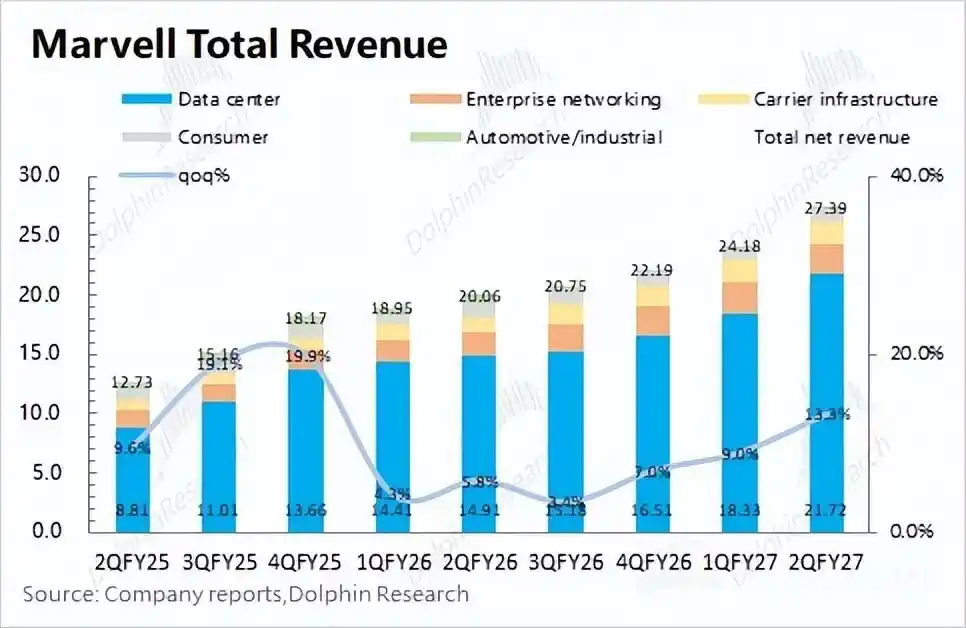
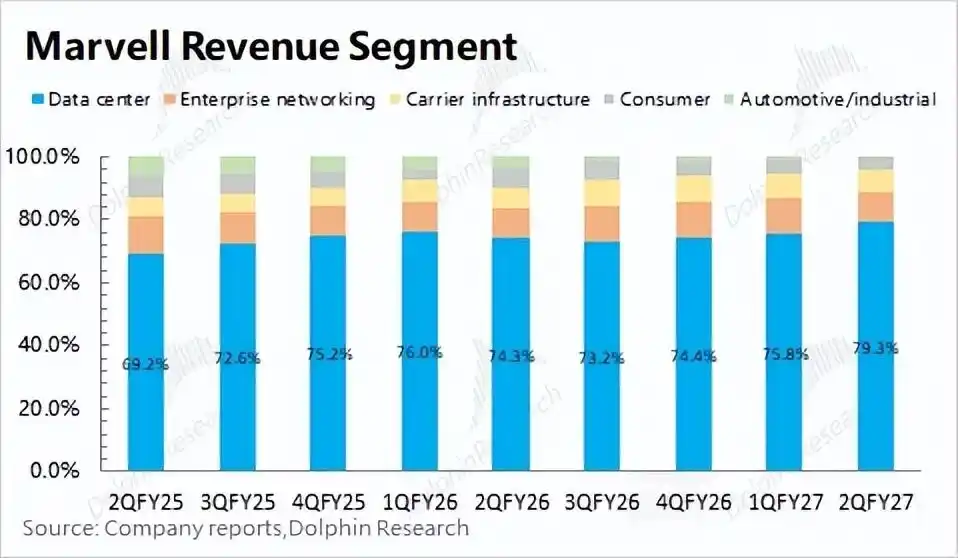
2. Data Center Business: Revenue for the quarter was $2.17 billion, a sequential increase of 19%, mainly driven by growth in connectivity products. Data Center business accounted for 79% of revenue this quarter.
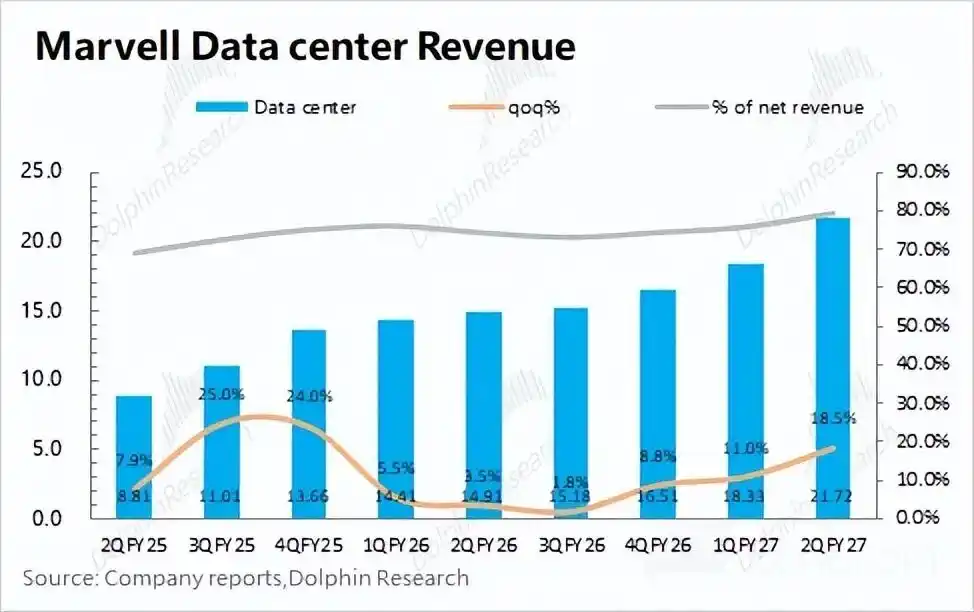
Within the Data Center business, the company's connectivity products are the main driver, which is consensus. However, at present, compared to connectivity products, the market is actually more concerned about the performance of the custom ASIC business, especially given the recent cooperation agreement signed with Google.
Currently, the company's custom ASIC business mainly involves providing Amazon with Trainium series chips. However, under the competitive influence from Alchip, the company's custom ASIC business performance has not been very good (significantly weaker than the growth performance of Amazon's capital expenditure).
After Google signed the cooperation agreement with the company, the stock price surged over 10%+ at the time, mainly also placing expectations on custom ASIC (capturing Broadcom's TPU orders).
However, management did not raise ASIC guidance in the subsequent communication, did not mention growth targets for this fiscal year (last quarter gave 20%+), and maintained the outlook of "more than doubling" growth for the next fiscal year. Then, can Google bring incremental custom ASIC/TPU orders to the company? The market will add another "question mark"?
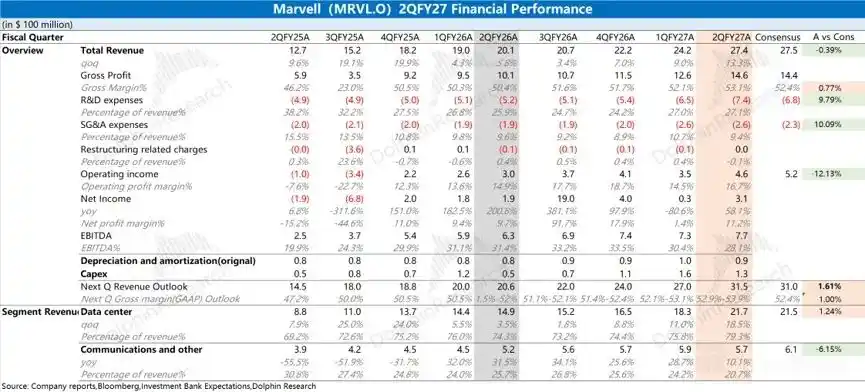
3. Operational Metrics: Quarterly revenue was $2.74 billion, a sequential increase of 13%, close to market expectations ($2.75 billion). The $300 million sequential increase this quarter all came from the growth in the Data Center business.
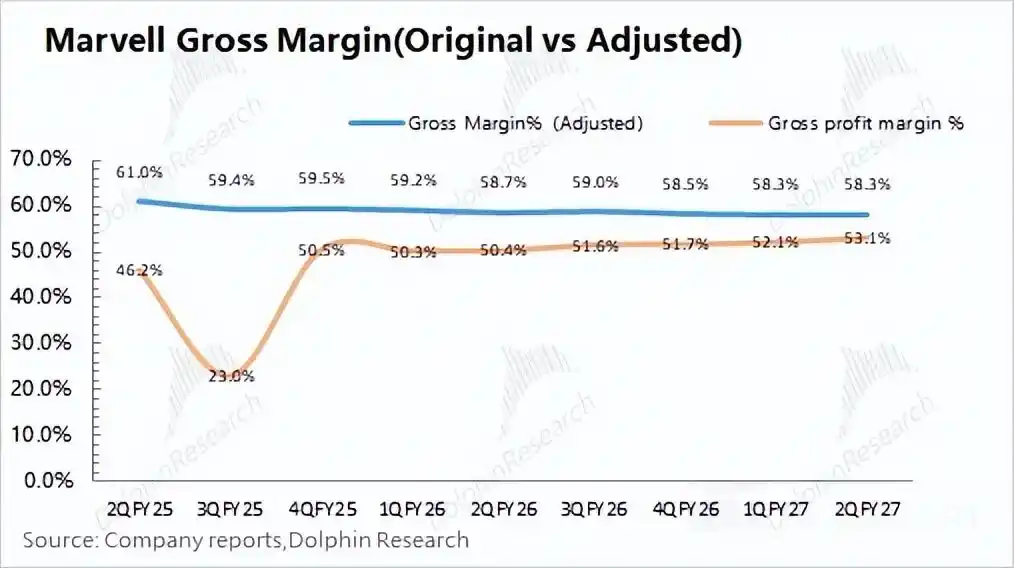
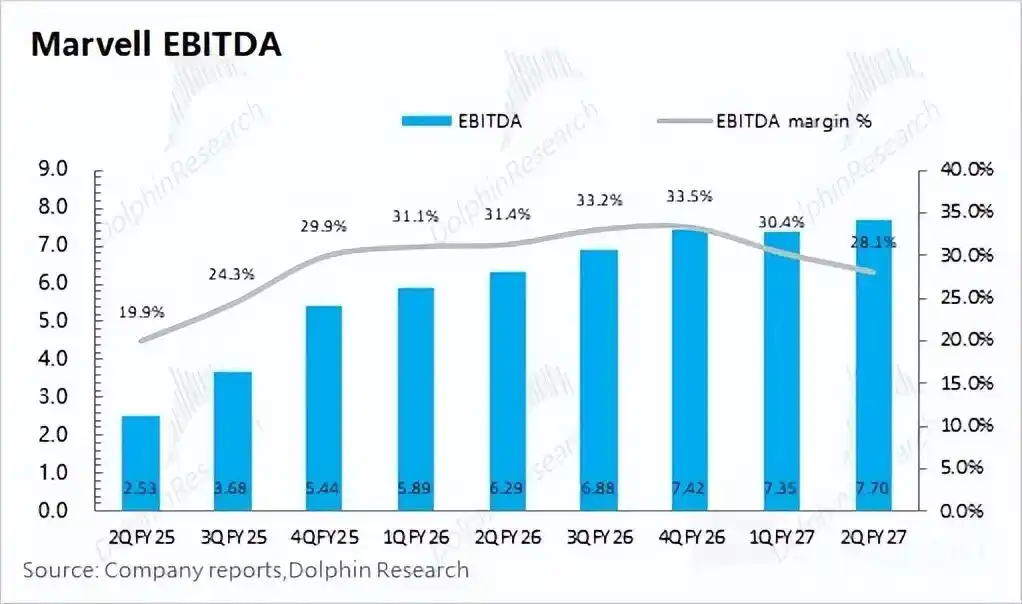
Gross margin for the quarter was 53.1%, up 1 percentage point sequentially. Since the company's gross margin is affected by factors such as acquisition-related amortization, the reported gross margin does not directly reflect operational performance.
After excluding this impact, Dolphin Research references the adjusted gross margin. The company's adjusted gross margin for the quarter was 58.3%, flat sequentially. If lower-margin businesses like custom ASIC accelerate growth in the future, gross margin will still face downward pressure.
4. Next Quarter Guidance: Revenue of $3.15 billion, slightly better than market expectations ($3.1 billion). Combined with the full-year guidance, the company's Q4 revenue is estimated to be around $3.7 billion. The sequential growth for both quarters is around 15-20%, mainly driven by demand growth in interconnect products; GAAP gross margin 52.9%-53.9%. Since the company provided annual guidance for fiscal 2027/2028, the importance of quarterly guidance is relatively diminished.
Dolphin Research's Overall View: "Paying to" Form Alliance, Outlook "Not Good Enough"
The company's earnings report this time was basically in line with expectations, with growth on the revenue side all coming from the Data Center business (interconnect products). After excluding amortization and other impacts, the company's adjusted gross margin was 58.3%, flat sequentially.
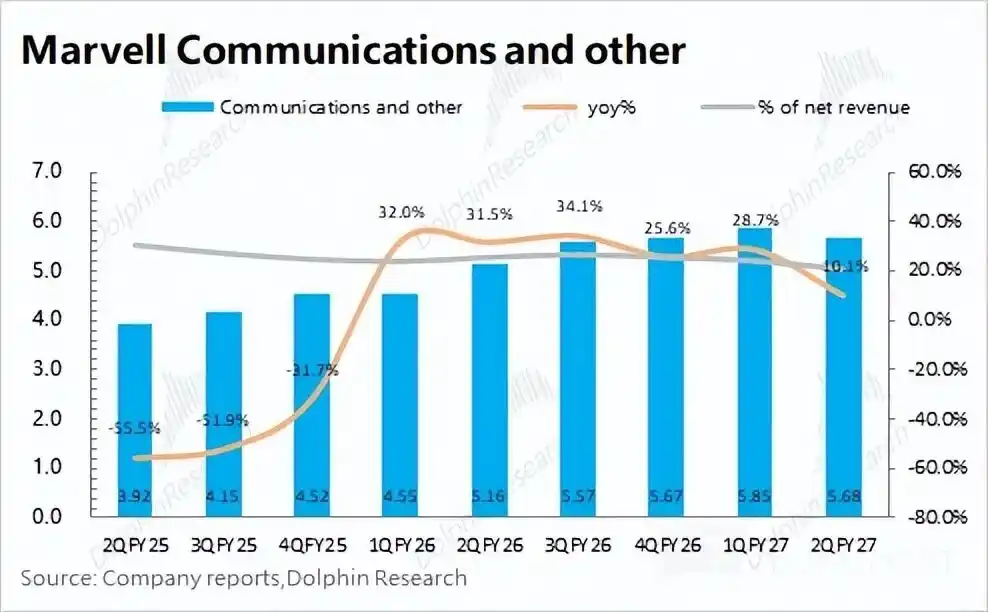
The company changed its business reporting segments starting this fiscal year, adjusting from the original 5 segments to 2 (Data Center, Communications and Other). The Data Center business was the main growth driver this quarter, with a sequential increase of 19%, primarily driven by demand for connectivity products.
Since the company provided full-year guidance, the importance of next quarter's guidance is significantly reduced. It can be inferred that the company's revenue for the next two quarters will reach approximately $3.15 billion and $3.7 billion, respectively, with quarterly sequential growth around 15-20%.
More importantly, the company directly provided a two-year revenue outlook in the subsequent communication. The company expects revenue for fiscal 2027/2028 to be $12 billion and $18 billion, respectively (previous quarter guidance was $11.5 billion and $16.5 billion). In fact, mainstream institutional expectations before the earnings had already been around $11.8 billion and $17.0-17.5 billion. Compared to NVIDIA's "explosive" guidance previously, Marvell's outlook is clearly less impressive.
Dolphin Research believes the after-hours plunge in Marvell's stock price is mainly due to two reasons:
1. After announcing the cooperation with Google, the company did not raise its custom ASIC outlook this time, making it seem more like a framework agreement where they are "actively giving money";
2. The company's Data Center business growth outlook for fiscal 2028 is 60%+, while NVIDIA, with its much larger scale, previously gave a growth guidance of 70%+ for next year. It seems the explosiveness of the connectivity business is also not strong enough.
Beyond the financial data, Marvell has several key areas of focus:
1) ASIC Field
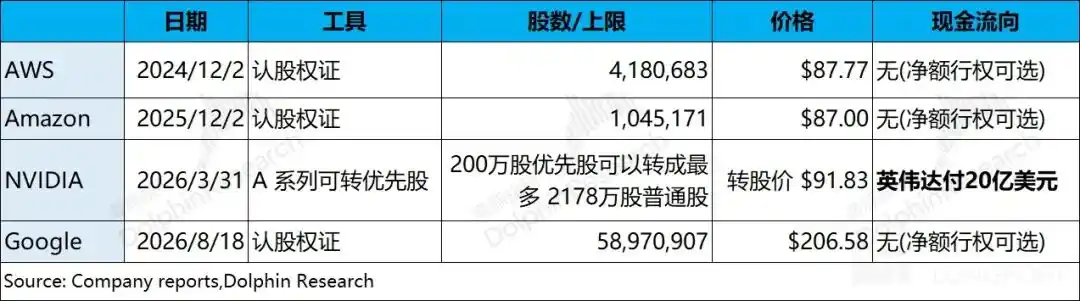
Marvell Technology recently announced a cooperation agreement with Google: The company plans to grant Google warrants for a total of 58.97 million shares. The warrant issuance date is August 18, 2026, with an exercise price set at $206.58 per share.
Specifically, it can be divided into two parts: 1. Direct grant of 1.36 million shares, vesting in 340k share increments at 3/6/9/12 months respectively; 2. Performance-based unlocking of 57.61 million shares (divided into 240 tranches). Starting from August 1, 2026, each $500 million of Qualified Revenue achieved unlocks one tranche (approximately 240k shares).
Qualified Revenue is defined as revenue from custom ASIC chips for Google, including AI inference accelerators, storage controllers, network interface controllers, memory interface controllers, and near-memory computing.
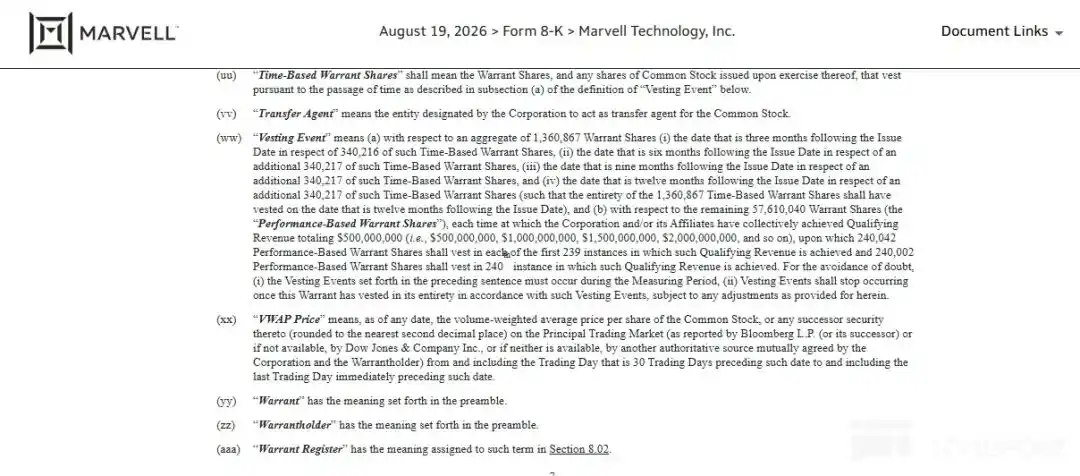
Clearly, Marvell is in a relatively weaker position. The purpose is also clear: mainly to compete for Google's custom ASIC orders, and to "show goodwill" by granting Google a portion of warrants upfront. The overall approach actually references the previous cooperation model between the company and Amazon.
2) Networking and Connectivity Capabilities
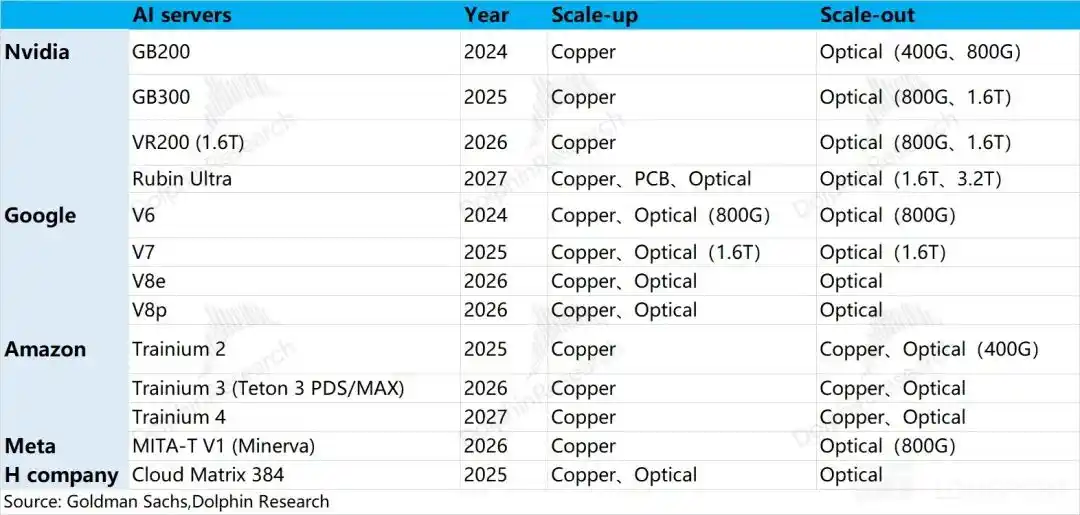
Through acquisitions like XConn (PCIe/CXL switches), Celestial AI (photonics interconnect), Polariton (electro-optic modulators), the company has gained comprehensive capabilities across the three major AI networking layers: Scale-Out, Scale-Up, and Scale-Across. This allows it to provide customers with a full suite of high-speed interconnect hardware from within the rack to across data centers.

In current Scale-Out optical interconnect scenarios, traditional pluggable optical modules remain the absolute mainstream. Major players like NVIDIA, Google, etc., mostly adopt pluggable optical module solutions. Marvell's PAM4 DSP holds a relatively leading position in the pluggable optical module market. Management previously mentioned, "The 1.6T solution has begun volume production and will ramp up rapidly in fiscal 2027." This will be a major growth driver for the company's interconnect products.
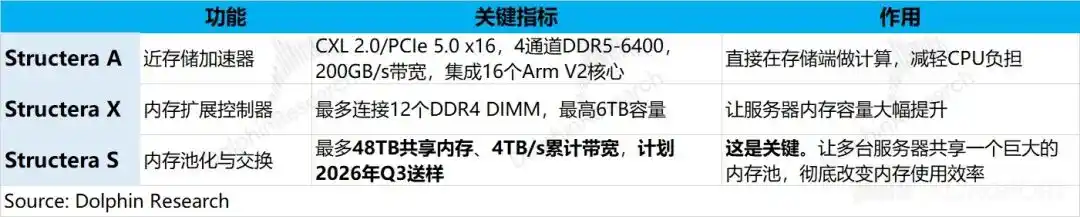
3) CXL Memory Expansion/Pooling (Structera): As the market enters the AI inference phase, massive KV Cache is required. HBM is too expensive, DRAM capacity is insufficient, so NAND/Storage-Class Memory can be used for expansion.
Marvell's layout in the CXL memory expansion and pooling field mainly includes: Structera A, Structera X, and Structera S, serving as near-storage accelerators, memory expansion controllers, and memory pooling and switching functions, respectively.
Compared to NVIDIA and Broadcom, Marvell Technology's valuation is relatively high, primarily incorporating market expectations for the company to capture share in ASIC AI chips and high growth in the connectivity field. However, the Data Center growth rate for fiscal 2028 given by the company this time is only 60%+, even lower than the 70%+ given by NVIDIA, which naturally fails to satisfy the market.
On the other hand, part of the recent stock price increase was driven by the cooperation agreement signed with Google. Looking at the agreements Marvell signed with Google and Amazon, the company is clearly in a "disadvantaged" position in negotiations currently. However, the company did not raise its ASIC guidance this time, which may lead the market to view this agreement more as a framework agreement where the company is "actively giving gifts."
Overall, the company's earnings performance this time was basically in line with expectations. The "after-hours plunge" was mainly due to market dissatisfaction with the company's full-year outlook. Since the market primarily focuses on the company's future growth potential, recent events like open-source models and Anthropic ARR growth slowdown will amplify the volatility of the company's stock price.
The AI chip market has relatively few players, and Marvell is one of the rare "US-based" ASIC companies that has established cooperation with multiple major customers. Broadcom, through its cooperation with Google on TPU, once reached an overall market capitalization of $2 trillion, while Marvell's market cap is only $200 billion. If Marvell can capture 10-20% of TPU share, it could directly bring tens of billions of dollars in annual incremental revenue (currently, the company's custom ASIC annual revenue is only around $2 billion). This is also the main reason for the market's high expectations for the company.
Regarding not raising ASIC guidance this time, management later added that this would be elaborated upon during the Analyst Day on October 6, with scenario-based guidance provided. Pay attention to the specific guidance then.
Although the company's full-year outlook is not great, the fact that the company has successfully "given gifts" to both Amazon and Google means the market will still expect opportunities to capture some orders later.
It's just that under the current high valuation, there will be short-term pressure for a pullback. However, with the support of "over 50% growth for the next two years + growth potential," it will still provide some support for the company's relatively high valuation.
Dolphin Research on Marvell Technology (MRVL.O) Earnings and Specific Data:
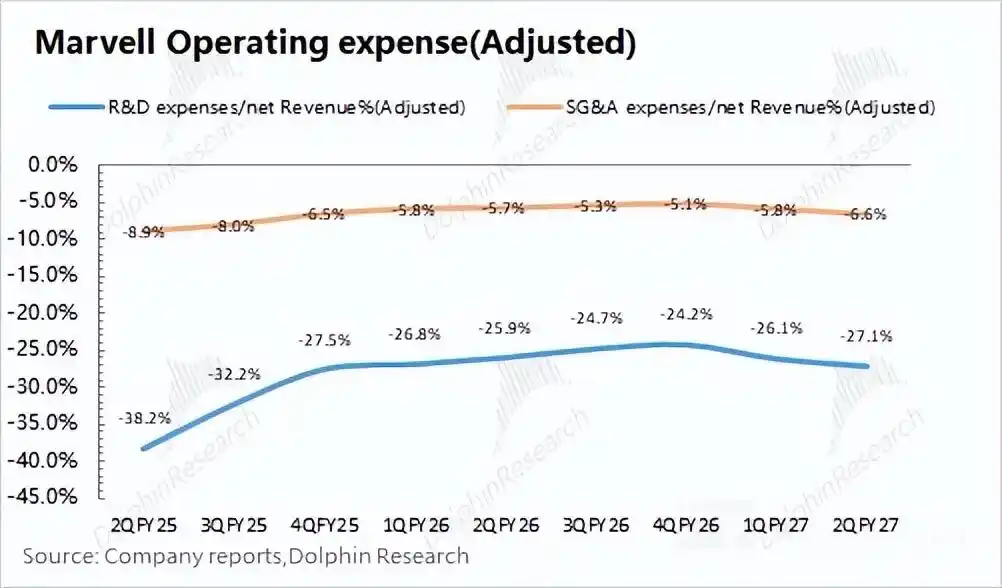
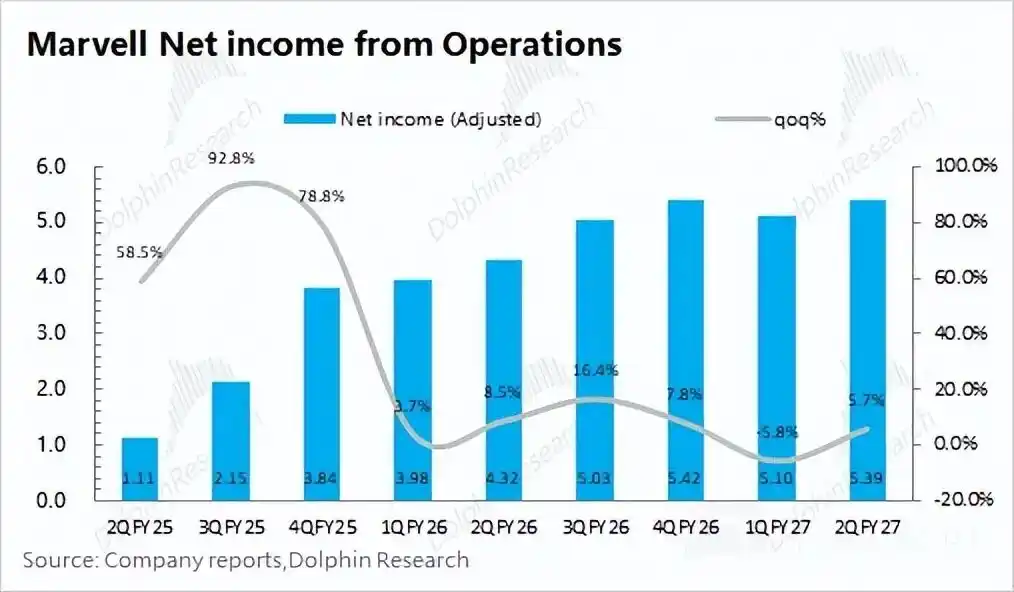
Note: Adjusted operational data includes SBC but mainly adjusts for depreciation/amortization impacts, providing a more intuitive reflection of the company's operational status.
This article is from the WeChat public account "Dolphin Investment Research" (ID: haituntouyan), author: Dolphin Research.