Uniswap v4 Hook Analysis: Architecture Design, Common Vulnerabilities, and Protection Practices

marsbitPublicado a 2026-06-22Actualizado a 2026-06-22

Resumen

Uniswap v4's Hook mechanism is a major innovation, enabling custom logic injection into liquidity pool lifecycle events like swaps and liquidity provisioning. This transforms the AMM into programmable infrastructure, shifting the security model from protocol-level to pool-level, as each pool's safety now depends on its bound Hook contract. The core architecture revolves around the singleton PoolManager contract, which manages all pools via a flash accounting system. State changes are tracked in transient storage and must be settled by the end of a transaction. Hook contracts are permanently bound to pools via a PoolKey, with their permissions encoded directly into their address via specific low-order bits. This design introduces unique security considerations and challenges for future upgrades. Key vulnerabilities and best practices identified include: - **Access Control Gaps:** Early versions of the BaseHook abstract contract only protect `unlockCallback()`, leaving other lifecycle functions (`beforeSwap`, `afterSwap`, etc.) exposed unless explicitly secured by developers. - **Unrestricted Pool Binding:** The `initialize()` function does not validate if a Hook "consents" to a new pool. Hooks must implement their own whitelisting in `beforeInitialize` to prevent unauthorized pool creation. - **Async/Custom Curve Hooks:** These high-risk Hooks can completely replace Uniswap's swap logic. Their security depends entirely on their own implementation, as they operate outside the...

Since the mainnet launch of Uniswap v4, the Hook mechanism has become one of the most-discussed innovations in DeFi. The memecoin launchpad Flaunch on Base leverages Hooks to achieve fixed presale pricing and automatic listing and liquidation mechanisms; the liquidity protocol Bunni v2 uses Hooks to build programmable liquidity and restaking models; tokens like SATO, uPEG (Unipeg), and Slonks, which revolve around Hook-based gameplay, have also seen tens-of-times price surges in short periods this year.

On the flip side of the Hook ecosystem's prosperity, attacks targeting Hook implementation flaws have also increased significantly. This article will start with the Hook mechanism in Uniswap v4, gradually analyze its core call stack, and help project teams understand potential vulnerabilities.

Uniswap v4 Hook Security

1. Introduction

The most significant architectural change in Uniswap v4 compared to v3 is the introduction of the Hook mechanism: it allows developers to attach custom contracts to lifecycle events of liquidity pools, injecting arbitrary logic at nodes such as swap, add/remove liquidity, and initialization.

Key changes in v4 are as follows:

- Singleton Pattern: All pool states are centrally managed by a single PoolManager contract, no longer deploying separate contracts for each pool.

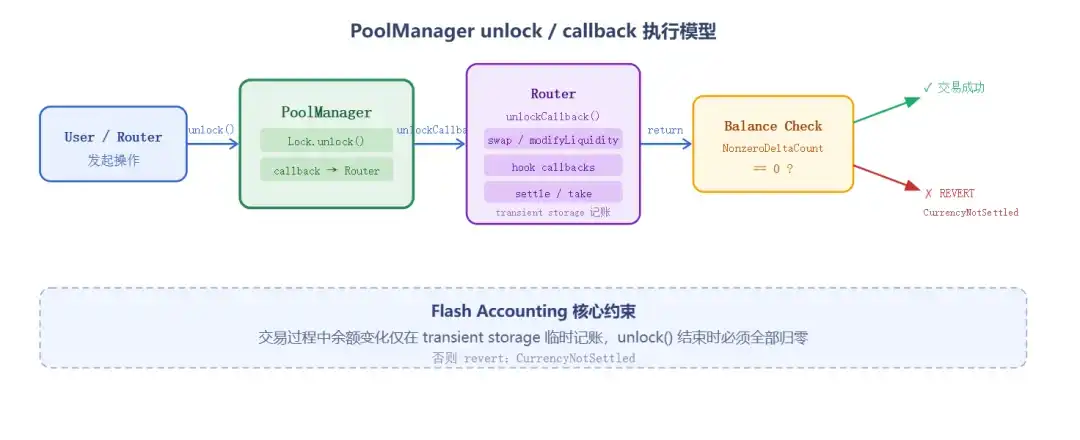
- Flash Accounting: Intermediate balance changes during a transaction are recorded only in transient storage, with final settlement occurring only at the end of the transaction.

- Hook Mechanism: Each pool can be bound to a Hook contract. The PoolManager will call back to this contract at key nodes (beforeInitialize, beforeSwap, afterAddLiquidity, etc.).

- Hook Immutability: Once a pool is initialized, the bound Hook address is permanently fixed (The Hook address bound to a pool cannot be changed, but whether the Hook contract itself is upgradeable depends on its implementation).
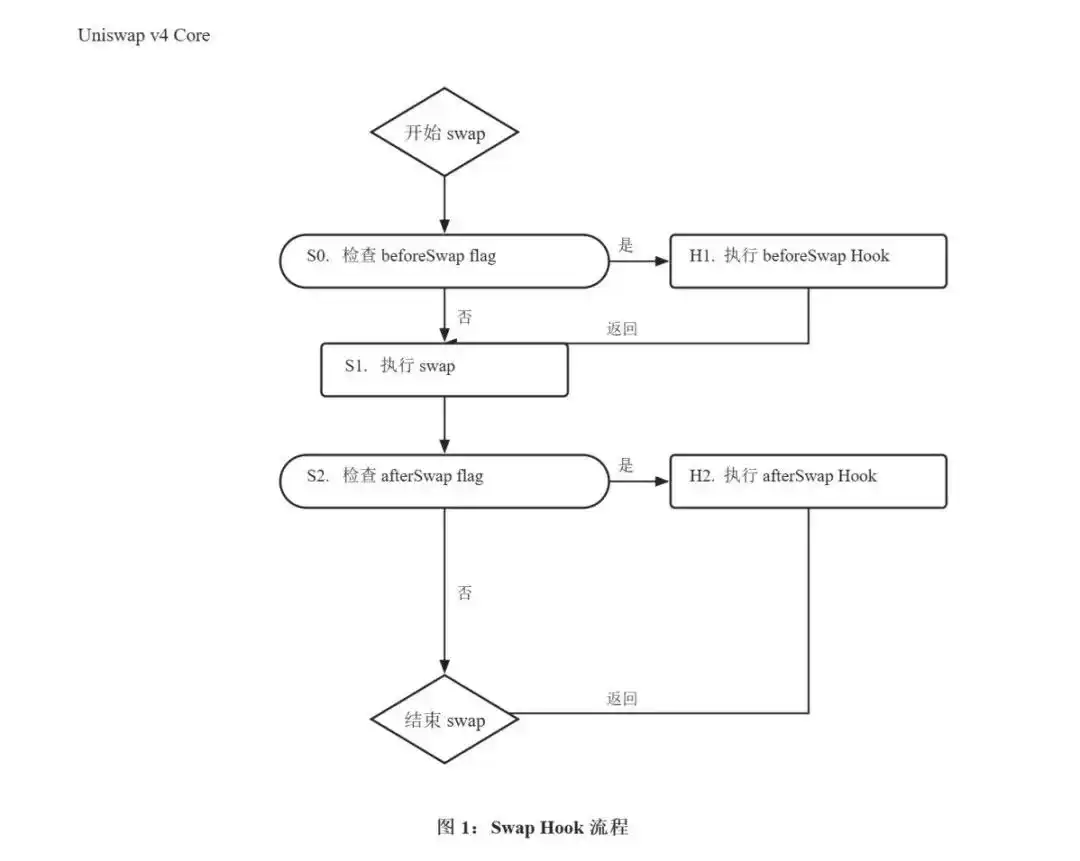
In the v3 era, developers only needed to trust the Uniswap protocol itself; in the v4 era, the security of each pool depends on the Hook it's bound to. Hooks expand AMM from a fixed financial primitive to a programmable financial infrastructure, but the security model has also fragmented from "protocol-level" to "pool-level."

2. Hook Architecture

2.1 PoolManager and the unlock/callback Model

The core contract of v4 is the singleton PoolManager. Any operation that changes a pool's state (swap, add/remove liquidity) must first call PoolManager.unlock() to obtain one-time callback permission, then perform the specific action within unlockCallback(). At the end of the entire process, the PoolManager will verify whether the ledger balances:
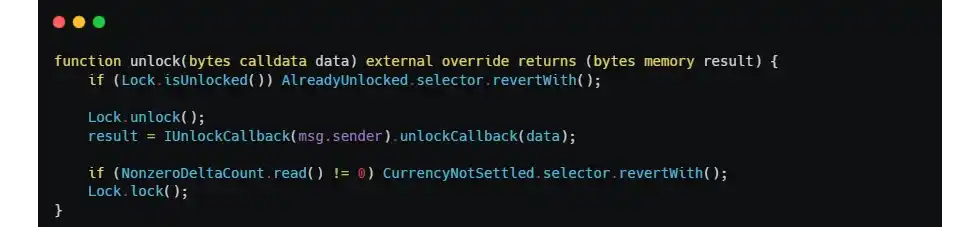
If NonzeroDeltaCount != 0, it directly reverts. This is the core constraint of v4's flash accounting. Any Hook can temporarily unbalance the accounts during execution but must settle itself before the transaction ends; otherwise, the entire transaction rolls back.

Each pool is uniquely identified by a PoolKey structure, which includes a hooks field:

PoolId is calculated as keccak256(PoolKey), so different hook addresses will result in different pools. This also means the PoolManager does not verify whether a Hook address has been used for other pools; the same Hook contract can be bound to multiple pools simultaneously.
2.2 Hook Permission Bits Encoded in the Address

A counterintuitive design in v4 is: Hook permissions are not determined by a variable inside the contract but by the deployment address of the Hook contract.

The PoolManager checks the lower 14 bits of the Hook address to determine if the Hook needs to be called at a certain lifecycle point:

For example, BEFORE_SWAP_FLAG = 1 << 7. If bit 7 of the Hook address is 1, the PoolManager will call the Hook's beforeSwap() before a swap; otherwise, even if the Hook contract implements beforeSwap(), it will never be called by the PoolManager.

This means the Hook must be deployed via CREATE2 + salt to calculate an address where the lower bits exactly match the target permissions. Uniswap officially provides the HookMiner tool for this purpose:
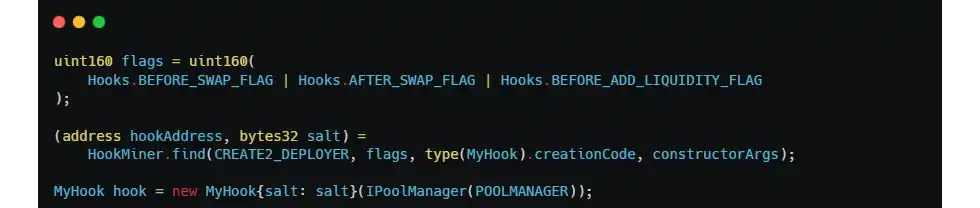
Mismatches between permission bits and function implementation can lead to two types of issues:

(1) A hook function is implemented, but the address does not encode the corresponding permission bit—The PoolManager will never call that function, rendering the logic useless.

(2) The address encodes a permission bit, but the hook does not implement the corresponding function—The PoolManager may revert during the callback (causing DoS) or fail on return value verification, preventing the related operation from executing.

This is also a natural obstacle to Hook upgrades: If a Hook is upgradable via a proxy, the deployment address remains unchanged during upgrades, so post-upgrade, only existing hook function implementations can be modified, not new hook types added. To reserve future extensibility, all possible permission bits must be pre-mined during initial deployment.

2.3 BaseHook and a Commonly Overlooked Access Control Trap

The BaseHook abstract contract provided by earlier versions of the Uniswap v4 periphery allows developers to inherit it for custom Hook implementation. One important role of BaseHook is to provide the onlyPoolManager modifier for the unlockCallback() function:

However—here lies a design trap that is very easy to overlook—early versions of BaseHook only added onlyPoolManager to unlockCallback, providing no protection for other hook callback functions (beforeSwap, afterSwap, beforeAddLiquidity, etc.). Access control for these functions must be explicitly added by the Hook developer.

3. Hook Lifecycle Code Walkthrough

Using an exact-input swap as an example, the following analyzes the complete call stack from when a user initiates a transaction to settlement.

3.1 Pool Initialization and Hook Binding

Anyone can call PoolManager.initialize() to create a new pool:
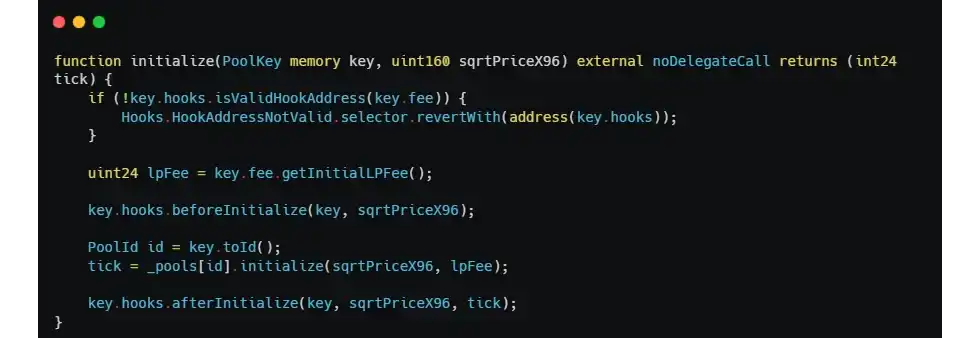
isValidHookAddress only checks the compatibility of the address permission bits with the fee field. It does not verify whether the Hook is already used in other pools, nor does it check if the Hook "wants" to accept this PoolKey. If the Hook design does not include whitelisting or single-pool binding logic in beforeInitialize, anyone can construct a new pool using the same Hook but with an arbitrary token pair, triggering all subsequent callbacks of the Hook.

3.2 beforeSwap and BeforeSwapDelta

The swap process entry is PoolManager.swap(). Before executing the core swap logic, it calls Hooks.beforeSwap():
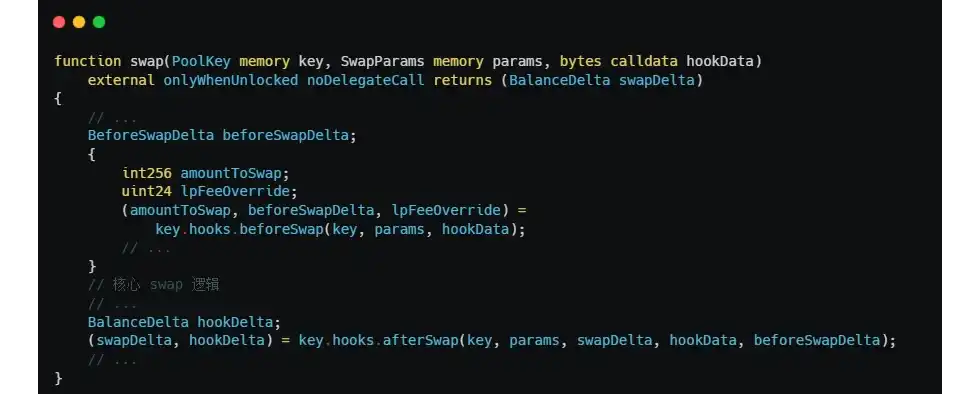
The return value of beforeSwap is a triple (bytes4, BeforeSwapDelta, uint24):

- bytes4: Must equal IHooks.beforeSwap.selector, otherwise PoolManager directly reverts.

- BeforeSwapDelta: The delta adjustments for the specified token and unspecified token that the Hook makes for this swap.

- uint24: Dynamic LP fee override value (only effective when the pool has dynamic fees enabled).

BeforeSwapDelta is an alias for int256, with the high 128 bits being the delta for the specified token (the token the user specified the amount for) and the low 128 bits being the delta for the unspecified token:
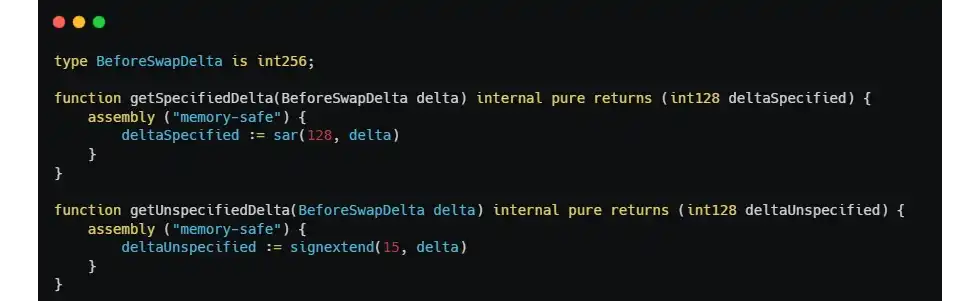
Note that the semantic of BeforeSwapDelta is: the Hook should return a positive value for collecting fees and a negative value for refunding tokens. Developers can easily get the sign wrong. Simultaneously, the correspondence between specified and unspecified depends on params.zeroForOne and the sign of amountSpecified. Slight carelessness in writing can lead to token misplacement.

The PoolManager directly adds the specifiedDelta returned by beforeSwap to the amountToSwap:

This line implies a crucial semantic: the Hook can intercept the swap amount. When hookDeltaSpecified equals -params.amountSpecified, amountToSwap directly becomes zero, meaning the Hook completely takes over this swap—this is the so-called Async Hook or Custom Curve Hook.

Async Hooks are the highest-risk design pattern in v4: they essentially replace Uniswap's swap logic with the Hook's own logic. If the Hook has vulnerabilities or is malicious itself, user funds are no longer constrained by Uniswap's native pricing logic but rely primarily on the correctness of the Hook's own implementation.

3.3 Delta Settlement and NonzeroDeltaCount

The deltas returned by beforeSwap and afterSwap do not immediately trigger transfers but are recorded in the PoolManager's internal ledger:
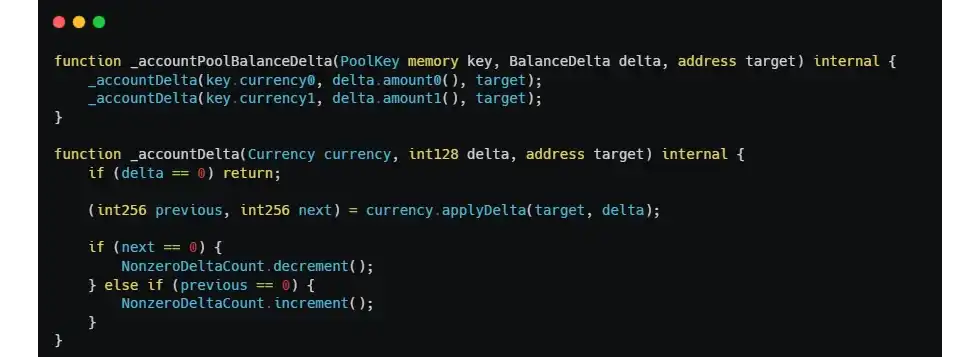
Whenever the cumulative delta for a token changes from zero to non-zero, NonzeroDeltaCount increments; when it returns to zero, it decrements. As mentioned in 2.1, if NonzeroDeltaCount != 0 at the end of unlock(), the entire transaction reverts.

The Hook balances its delta through two actions: settle() (transferring to the PoolManager) and take() (taking from the PoolManager):

The security semantics brought by this mechanism are clear: everyone must eventually balance the accounts. However, it only guarantees "account conservation," not "account correctness." If the Hook returns a maliciously constructed delta in beforeSwap, the PoolManager will faithfully account for this delta. As long as it's eventually settled and balanced, the transaction succeeds—even if this means the Hook can, by forging business states, cause the system to incorrectly believe an attacker has certain asset rights, which the PoolManager cannot recognize as an error at the business level.

A previous security incident involving Cork Protocol was due to a vulnerability in its Hook, and it had been audited by four firms before the attack. In retrospect, we found:

- Three of the four audits did not include the CorkHook contract in their scope.

- The only firm that audited CorkHook identified some code issues and submitted improvement suggestions but did not fully cover access control problems.

- Another auditor explicitly suggested in their report: "an interesting follow-up engagement would be to prove the invariants for the CorkHook functions that are being invoked by different components verified within the scope of this engagement." This suggestion appears highly pertinent in hindsight.

This exposes a new blind spot in audits in the v4 Hook era: the explosion in protocol complexity makes scope definition itself a security decision. The interaction chain between Hooks and other protocol contracts is very long. Auditing the Hook contract alone is insufficient to discover cross-contract combinatorial issues; conversely, auditing peripheral contracts while excluding the Hook from scope misses the largest attack surface in the v4 era.

4. Reflections

Looking at the protocol mechanisms alongside the Cork attack post-mortem, several core points of the v4 Hook security model can be summarized:

(1) If Hook callback functions rely on the calling context provided by PoolManager, they should explicitly restrict calls to only PoolManager. BaseHook does not do this for developers. This is the design trap in v4 that most easily conflicts with general contract auditing experience.

(2) The binding relationship between a Hook and a pool is not restricted by PoolManager. Developers must implement pool whitelisting or single-pool binding in beforeInitialize themselves.

(3) The permission bits of the Hook address must strictly match the function implementation. The calculated address should pre-include all permission bits that might be needed in the future.

(4) Async / Custom Curve Hooks are essentially completely custom swap implementations. They have no Uniswap protocol-level protection and must be audited to the standard of "fully autonomous financial contracts."

(5) "Conservation" in delta accounting does not equal "correctness." NonzeroDeltaCount == 0 only guarantees the final ledger is balanced, not that the ledger's content hasn't been maliciously manipulated.

(6) Token type confusion across markets is a new type of attack surface in the v4 era. When a protocol allows users to create markets, semantic validation of tokens is mandatory and cannot rely solely on interface checks.

Each Hook is an independent trust domain, and the security of each pool is determined by the Hook it's bound to. Therefore, the complexity of Hook security audits is no longer "auditing one piece of code" but "auditing a complete sub-protocol"—this change signifies a methodological upgrade for both project teams and auditors.

View Original Text

Criptos en tendencia

Preguntas relacionadas

QWhat is the core architectural change introduced in Uniswap v4, and what key security implication does it create?

AThe core architectural change introduced in Uniswap v4 is the Hook mechanism. This allows developers to attach custom logic to key pool lifecycle events like swaps and liquidity changes. The key security implication is a shift from a 'protocol-level' security model in v3, where users trusted the Uniswap protocol itself, to a 'pool-level' security model in v4. The security of each liquidity pool becomes dependent on the security of the specific Hook contract it is bound to.

QHow does Uniswap v4's flash accounting model enforce security, and what is its main constraint?

AUniswap v4's flash accounting model records intermediate balance changes in transient storage during a transaction and only performs final settlement at the transaction's end. It enforces security by requiring the account ledger to be balanced before the transaction concludes. The main constraint is that the `NonzeroDeltaCount` must be zero at the end of a transaction (specifically after `PoolManager.unlock()`); if it is not zero, the entire transaction reverts.

QWhat determines which callback functions (e.g., `beforeSwap`) on a Hook contract are actually invoked by the PoolManager?

AThe invocation of a Hook's callback functions is determined by the last 14 bits (the permission bits) of the Hook contract's deployment address. The PoolManager checks these bits against predefined flags (e.g., `BEFORE_SWAP_FLAG`). If the corresponding bit for a function is set to 1 in the address, the PoolManager will call that function. This permission is fixed at deployment via CREATE2 and cannot be changed later through an upgrade.

QWhat is a significant security oversight in the early version of the BaseHook abstract contract provided by Uniswap v4 periphery?

AA significant security oversight in the early version of the BaseHook abstract contract was that it only protected the `unlockCallback()` function with an `onlyPoolManager` modifier. It did not apply any access control to other critical hook callback functions like `beforeSwap`, `afterSwap`, `beforeAddLiquidity`, etc. This meant developers had to manually and explicitly add access control checks to these functions to prevent unauthorized calls, creating a major security trap if overlooked.

QWhat is an 'Async Hook' or 'Custom Curve Hook' in Uniswap v4, and why is it considered high-risk?

AAn 'Async Hook' or 'Custom Curve Hook' in Uniswap v4 is a Hook design pattern where the Hook's `beforeSwap` function returns a `hookDeltaSpecified` value that cancels out the user's requested swap amount (e.g., `-params.amountSpecified`). This effectively sets the `amountToSwap` to zero, allowing the Hook's own custom logic to completely take over and execute the swap. It is considered high-risk because it replaces Uniswap's native, battle-tested AMM pricing and swap logic. The security of user funds then depends entirely on the correctness and security of the custom Hook implementation, which may have vulnerabilities or be malicious.

Lecturas Relacionadas

During the World Cup, USDT becomes the preferred chip for illegal gambling? Beware of three typical scams

During the 2026 FIFA World Cup, USDT has become the preferred payment method for illegal online gambling due to its price stability, anonymity, and fast cross-border transfers. This article analyzes how USDT facilitates this activity and outlines three major scams targeting users. **Why USDT is the "Chip of Choice"**: It solves bettors' anxiety over crypto volatility, enables instant cross-border transfers without traditional banking, and shows significant abnormal transaction spikes during major events. **The Fund Flow**: Gambling platforms use a complex laundering chain involving multi-layer address hopping, cross-chain transfers (e.g., Polygon to Tron), mixers like Tornado Cash, and final cash-out via exchanges. **Three Typical Scams**: 1. **"USDT Betting Evades Regulation"**: Fake platforms promising anonymous, high-odds betting but manipulating outcomes. 2. **Fake Sportsbooks**: High-quality replica sites that allow small initial withdrawals to build trust before freezing accounts with larger funds. 3. **"Insider Tips / Guaranteed Wins"**: Schemes selling fabricated "AI predictions" or "fixed match" models to exploit information anxiety. **Identifying Suspicious Addresses**: Key chain-based indicators include a "fast-in, fast-out" transaction pattern, clustered addresses with consistent behavior, uniform Gas fee patterns, and frequent cross-chain jumps. **User Protection Advice**: * Avoid any project promoting "USDT betting," "Web3 predictions," or "anonymous high returns." * Be skeptical of promises like "guaranteed wins" or "insider models." * Do not trust platforms just because they allow small withdrawals—this is a common trust-building tactic. * If scammed, preserve all evidence: transaction hashes, wallet addresses, chat logs, and platform URLs. **Conclusion**: USDT provides unprecedented liquidity for illicit activities. The most effective protection for users is complete non-participation in any form of online crypto gambling.

marsbitHace 14 min(s)

During the World Cup, USDT becomes the preferred chip for illegal gambling? Beware of three typical scams

marsbitHace 14 min(s)

Zoomex X Space Recap With Djibril Cissé and the World Cup Trading Panel

Zoomex hosted a World Cup-themed X Space with Champions League winner Djibril Cissé and four crypto traders, discussing pressure management, analysis, and philosophy, and launching a charity pledge. Cissé emphasized embracing pressure in critical moments, drawing from his experience taking a penalty in a Champions League final. The traders agreed that managing stress comes from systematic preparation and clear risk parameters before executing a trade. The conversation explored parallels between football and trading. Cissé highlighted pace as his key weapon, but stressed that output (goals) matters more than tools. The traders debated timing versus speed of execution, concluding that timing is paramount and relative to one's timeframe. Discussing resilience, Cissé shared his mindset after major injuries: focusing on recovery and finding the positive. Similarly, traders emphasized learning from losses rather than avoiding them. Cissé declined to speculate on alternate histories, like France's 2006 World Cup run without his injury, stating one must work only with reality—a principle directly applicable to trading. In a lighter segment, traders mapped cryptocurrencies to national teams (e.g., Bitcoin to Brazil/France). The core lesson was that high performers, in both fields, thrive on uncertainty by relying on tested systems and focusing solely on actionable information. The session was part of Zoomex's World Cup Impact Pledge, which includes charity donations tied to guest predictions.

TheNewsCryptoHace 21 min(s)

Zoomex X Space Recap With Djibril Cissé and the World Cup Trading Panel

TheNewsCryptoHace 21 min(s)

Fed Turns Hawkish, Wall Street Capitulates, Citi Stands as 'Last Holdout': Insists on Resuming Rate Cuts in October

Amid a surprisingly hawkish shift from the Fed and most of Wall Street capitulating on rate cut expectations, Citigroup stands as a notable outlier, holding firm to its forecast for monetary easing to restart this October. Following the June FOMC meeting, where the "dovish bias" was removed and the dot plot shifted dramatically, markets priced in nearly 37bps of tightening for 2026. Major banks like Deutsche Bank and Goldman Sachs revised their calls, predicting rate hikes as soon as September. Citigroup, however, maintains a baseline scenario for a 25bps rate cut in October, followed by two more cuts in December and January 2027. Its counter-consensus view rests on three key arguments: 1) Plunging oil prices are eliminating a major inflation upside risk. 2) Rising initial jobless claims are mirroring seasonal weakening patterns seen in 2024-2025, signaling a labor market cool-down. 3) The strong core PCE is an "outlier," heavily influenced by AI-related prices and equity market gains rather than broad consumer price pressures, with other inflation metrics showing more moderation. While Wall Street largely "surrenders" to the hawkish Fed narrative, with Deutsche Bank forecasting two hikes and Goldman Sachs warning of potential back-to-back moves, Citigroup remains the "last holdout," betting that disinflationary forces will pave the way for cuts before year-end.

marsbitHace 23 min(s)

Fed Turns Hawkish, Wall Street Capitulates, Citi Stands as 'Last Holdout': Insists on Resuming Rate Cuts in October

marsbitHace 23 min(s)

Open Systems Will Ultimately Prevail: Why Ethereum Is the Next Linux?

The article "Open Systems Will Ultimately Prevail: Why Ethereum Is the Next Linux?" argues that Ethereum, like Linux before it, will triumph over closed, proprietary systems in finance due to its open, permissionless, and credibly neutral nature. It draws a historical parallel: just as the open internet defeated corporate private networks and Linux outcompeted proprietary Unix systems, open financial infrastructure like Ethereum will surpass private blockchains. The core advantage lies in the "bazaar" development model (as described in Eric Raymond's "The Cathedral and the Bazaar"), where decentralized, permissionless innovation by a global community of developers outpaces the controlled "cathedral" approach of centralized entities. This model fosters rapid innovation, as seen with Ethereum standards like ERC-20 and applications like Uniswap, which were built without needing permission. Ethereum's key, irreplicable strength is its credible neutrality: transparent, equally applicable, immutable rules that allow anyone to participate. This ensures sovereign independence, meaning no single entity (company, government) can control or change its core rules—a critical feature for global financial infrastructure. In contrast, private blockchains and consortium chains (like SWIFT or various bank-led projects) suffer from platform risk, central control, and an inability to attract broad developer ecosystems, leading to frequent failures. The article notes that major institutions (e.g., BlackRock, JPMorgan, Coinbase, Robinhood) are already building on Ethereum or its Layer 2 networks, recognizing its security, developer ecosystem, and network effects. While critics argue finance requires accountable, controlled systems, the response is that compliance (KYC, regulations) can be built at the application layer on top of a neutral settlement layer like Ethereum, just as secure commerce was built on the open internet via HTTPS. Ultimately, the thesis is that attempting to build walled-garden, proprietary financial networks is a flawed strategy that stifles innovation. The winning approach is to build applications on top of open, credibly neutral infrastructure like Ethereum, which is poised to become the foundational settlement layer for global finance.

Foresight NewsHace 34 min(s)

Open Systems Will Ultimately Prevail: Why Ethereum Is the Next Linux?

Foresight NewsHace 34 min(s)

Trading

Spot
Futuros

Artículos destacados

Cómo comprar ONE

¡Bienvenido a HTX.com! Hemos hecho que comprar Harmony (ONE) sea simple y conveniente. Sigue nuestra guía paso a paso para iniciar tu viaje de criptos.Paso 1: crea tu cuenta HTXUtiliza tu correo electrónico o número de teléfono para registrarte y obtener una cuenta gratuita en HTX. Experimenta un proceso de registro sin complicaciones y desbloquea todas las funciones.Obtener mi cuentaPaso 2: ve a Comprar cripto y elige tu método de pagoTarjeta de crédito/débito: usa tu Visa o Mastercard para comprar Harmony (ONE) al instante.Saldo: utiliza fondos del saldo de tu cuenta HTX para tradear sin problemas.Terceros: hemos agregado métodos de pago populares como Google Pay y Apple Pay para mejorar la comodidad.P2P: tradear directamente con otros usuarios en HTX.Over-the-Counter (OTC): ofrecemos servicios personalizados y tipos de cambio competitivos para los traders.Paso 3: guarda tu Harmony (ONE)Después de comprar tu Harmony (ONE), guárdalo en tu cuenta HTX. Alternativamente, puedes enviarlo a otro lugar mediante transferencia blockchain o utilizarlo para tradear otras criptomonedas.Paso 4: tradear Harmony (ONE)Tradear fácilmente con Harmony (ONE) en HTX's mercado spot. Simplemente accede a tu cuenta, selecciona tu par de trading, ejecuta tus trades y monitorea en tiempo real. Ofrecemos una experiencia fácil de usar tanto para principiantes como para traders experimentados.

302 Vistas totalesPublicado en 2024.12.12Actualizado en 2026.06.02

Cómo comprar ONE

Discusiones

Bienvenido a la comunidad de HTX. Aquí puedes mantenerte informado sobre los últimos desarrollos de la plataforma y acceder a análisis profesionales del mercado. A continuación se presentan las opiniones de los usuarios sobre el precio de ONE (ONE).

活动图片