Uniswap Innocent, Tornado Developer Jailed: Two Verdicts from the Same Judge

比推Publicado a 2026-03-03Actualizado a 2026-03-03

Resumen

In a landmark ruling, a New York federal court dismissed a class-action lawsuit against Uniswap and its founder, Hayden Adams, holding that open-source developers are not liable for fraudulent tokens traded on their decentralized protocols. The judge, Katherine Polk Failla, compared the case to holding a car manufacturer responsible for crimes committed using its vehicles. This decision is seen as a significant victory for DeFi developers. However, the same judge previously presided over the case against Tornado Cash developer Roman Storm, who was convicted for operating an unlicensed money-transmitting business. The contrasting outcomes highlight a key distinction in regulatory attitude: decentralization is tolerated, but privacy tools that enable large-scale money laundering—especially for state actors like North Korean hackers—are not. The article argues that while Uniswap isn’t legally obligated to screen for scam tokens, there is an expectation for major platforms to take proactive measures to protect users. The piece concludes that operating within existing legal frameworks—such as implementing sanctions screening—may be essential for decentralized protocols to survive.

Author: Eric, Foresight News

Original Title: The Same Judge, Different Outcomes for Uniswap and Tornado


At 3 a.m. Beijing time on March 3, the class action lawsuit demanding that Uniswap and its founder Hayden Adams be held responsible for scam tokens on Uniswap was dismissed by the U.S. District Court for the Southern District of New York. Brian Nistler, General Counsel of the Uniswap Foundation, called it a "landmark ruling for DeFi."
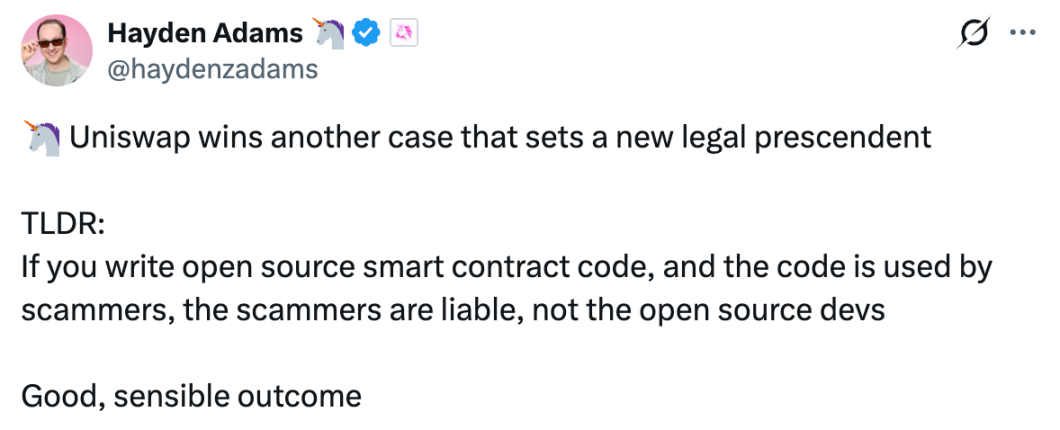
Hayden Adams also tweeted, "If you write open-source smart contract code and that code is used by scammers, the scammers are responsible, not the open-source developers. This is a reasonable and just outcome."

For Web3 developers, this is undoubtedly good news. But little known is that the judge who made this "just ruling" is the same person who, during the tenure of the former SEC chairman, found the developers of the mixer Tornado Cash guilty.

The Final Verdict

Nearly four years have passed since the class action lawsuit against Uniswap was filed and today's final resolution.

In April 2022, Uniswap users, represented by Nessa Risley, filed a class action lawsuit in court, accusing defendants Paradigm, a16z, Uniswap, and its founder Hayden Adams of violating federal securities laws by issuing and selling unregistered securities, including UNI, in the form of tokens on Uniswap. Additionally, the defendants failed to register Uniswap as an exchange or broker-dealer under applicable securities laws and did not provide investors with registration statements for the securities they issued and sold.

This lawsuit was initiated by the law firms Kim&Serritella and Barton, representing users who traded EtherumMax, Bezoge, MatrixSamurai, Alphawolf Finance, RocketBunny, and BoomBaby.io tokens on Uniswap between April 5, 2021, and April 4, 2022.

The phrase "unregistered securities" had extraordinary destructive power in the crypto industry at the time, but this lawsuit unexpectedly and quickly tilted in Uniswap's favor.

Presiding Judge Katherine Polk Failla, while agreeing that the so-called "scam tokens" were indeed securities, ruled that Uniswap did not need to be held responsible. Failla argued that Uniswap's decentralized nature meant the protocol had no control over which tokens were listed on the platform or who could interact with it. "The case is more like holding the developer of an autonomous vehicle responsible for traffic violations or bank robberies committed by third parties using the car."

Based on this, Failla dismissed the federal securities law charges in August 2023. The plaintiffs then appealed, and the Second Circuit Court of Appeals affirmed the dismissal of the federal part in 2025 but remanded the state law part for retrial.

Subsequently, the plaintiffs amended the complaint and sued again. This time, the losing investors accused Uniswap and other defendants of aiding and abetting fraud, making false statements, profiting from transactions involving scam tokens, and violating fraud laws in multiple states.

After another review by the same judge, Failla, the amended claims were dismissed again, with no further amendments allowed, bringing the case to a complete end.

The judge's reasoning this time was largely the same as before: Uniswap was unaware of the scam tokens, and even if it were aware, it did not provide substantial assistance. It also did not meet the definition of fraudulent behavior under any state law. Regarding unjust enrichment, Uniswap did not gain direct benefits, and the speculative indirect benefits from such scam activities expanding the user base were too tenuous.
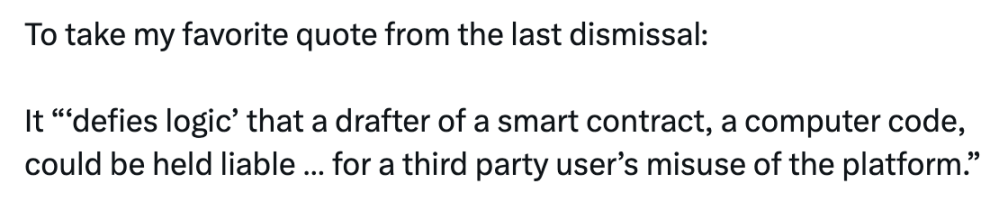
Brian Nistler stated in a tweet, quoting a line from the previous ruling, that it "defies logic" to hold the drafter of a smart contract responsible for the abusive actions of third-party users on the platform.

Tornado Cash's Different Outcome

Facing the same judge, Roman Storm of Tornado Cash met a different fate.

Tornado Cash was first added to the sanctions list by the U.S. Treasury Department's Office of Foreign Assets Control (OFAC) on August 8, 2022, accused of helping criminals, including North Korean hackers, launder over $7 billion. Two days after being added to the sanctions list, Dutch police arrested Alexey Pertsev, one of Tornado Cash's core developers.

On May 14, 2024, a Dutch court found Alexey Pertsev guilty of money laundering and sentenced him to 64 months in prison. The court ruled that Pertsev was aware that the platform he developed and operated was used for crime but did nothing to stop it, subjectively acquiescing to Tornado Cash being used as a money laundering tool. Alexey Pertsev is still appealing, but there have been no recent updates.

Seven months before Alexey Pertsev was found guilty, the U.S. Department of Justice sued two other developers, Roman Storm and Roman Semenov, in the Southern District of New York. Roman Storm was previously arrested in Washington State, while Roman Semenov remains at large.

Roman Storm in court

Although an appeal later determined that OFAC's sanctions against Tornado Cash were an overreach and invalid, Roman Storm still found himself in the defendant's seat last July. After a trial presided over by Judge Katherine Polk Failla, the jury found Roman Storm guilty of "conspiracy to operate an unlicensed money transmitting business," though sentencing has not yet been formally announced.
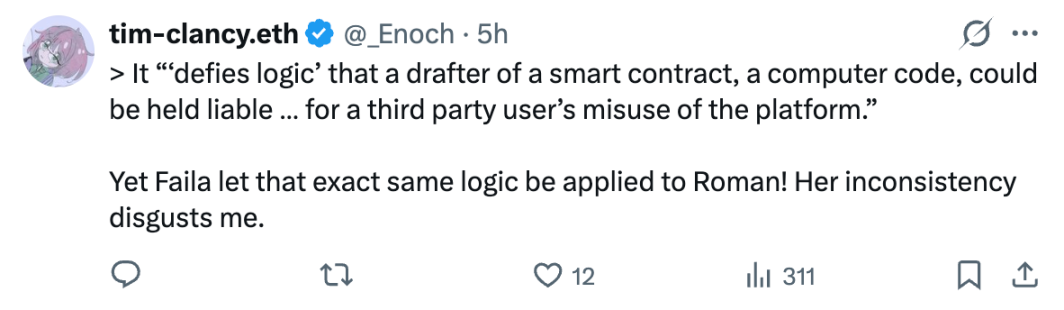
Under Brian Nistler's tweet celebrating Uniswap's victory, a comment by Sigil developer tim-clancy.eth criticizing Failla's contradictory rulings (the verdict against Roman Storm was actually made by a jury) received the most likes among all comments.

Decentralization Is Fine, but Privacy Is Not

I am not a professional lawyer, but setting aside political factors and from a simple emotional perspective, I can roughly understand why Uniswap and Tornado Cash had different outcomes.

The core reason is that Tornado Cash's developers should have been well aware that mixers would inevitably be used for money laundering. This clearly reveals regulators' stance: decentralization is acceptable, but it must be traceable. Tether faced similar challenges, which is why it later began cooperating with money laundering investigations and added freezing capabilities.

Perhaps Roman Storm, behind bars, would feel unjust upon learning of today's ruling. But he should realize that even in a crypto-friendly U.S. under Trump's administration, platforms aiding North Korean state-level hackers in money laundering cannot be tolerated. The power of crypto today is still insufficient to challenge national authority.

Web3 practitioners decry the injustice faced by Tornado Cash's developers while cheering Uniswap's victory. In our eyes, the two protocols are not fundamentally different; in fact, Tornado Cash even excels in privacy protection. Uniswap's addition of front-end blocking for sanctioned addresses in 2022 sparked some debate. Now, it seems that permissionless operation within the existing legal framework may be the only way for decentralized protocols to survive.

But that said, did Uniswap really have no responsibility at all in these scam incidents?

Strictly logically speaking, as the judge's analogy suggests, you cannot hold Mercedes responsible for a bank's losses just because a robber used their car to rob a bank. However, from a business perspective, we tend to believe that giants should provide protection within their capabilities. Current security tools can already identify a large number of potential scam projects in advance. For these established projects that have reaped the benefits of Web3's development, simple screening is not troublesome.

Doing their part to protect investors is not a mandatory obligation, but it is a responsibility that ordinary investors hope Uniswap and others will actively shoulder.


Twitter:https://twitter.com/BitpushNewsCN

Bitpush TG Discussion Group:https://t.me/BitPushCommunity

Bitpush TG Subscription: https://t.me/bitpush

Original link:https://www.bitpush.news/articles/7616264

Preguntas relacionadas

QWhat was the outcome of the class action lawsuit against Uniswap and its founder Hayden Adams?

AThe class action lawsuit against Uniswap and Hayden Adams was dismissed by the court. The judge ruled that Uniswap, as a decentralized protocol, was not responsible for scam tokens on its platform, comparing it to holding the developer of an autonomous car liable for traffic violations or crimes committed by users.

QWho was the judge presiding over both the Uniswap and Tornado Cash cases, and what were the different outcomes?

AJudge Katherine Polk Failla presided over both cases. She dismissed the lawsuit against Uniswap, ruling the protocol was not liable for third-party misuse. However, in the Tornado Cash case, developer Roman Storm was convicted by a jury for conspiracy to operate an unlicensed money transmitting business.

QWhy did the judge rule that Uniswap was not liable for the scam tokens on its platform?

AThe judge ruled that Uniswap's decentralized nature meant it had no control over which tokens were listed or who interacted with the protocol. She stated that holding the smart contract developers responsible for third-party misuse was 'illogical' and compared it to blaming autonomous car developers for crimes committed using their vehicles.

QWhat was the core reason suggested in the article for the different legal outcomes for Uniswap and Tornado Cash?

AThe article suggests the core reason is that Tornado Cash's developers were aware their mixer would be used for money laundering, particularly by entities like North Korean hackers. The author states that while decentralization is acceptable to regulators, privacy tools that enable untraceable transactions, especially for sanctioned entities, are not tolerated.

QWhat does the article suggest is the 'only way to survive' for decentralized protocols under the current legal framework?

AThe article suggests that 'permissionlessness within the existing legal framework' is the only way for decentralized protocols to survive. This is exemplified by Uniswap's 2022 decision to add front-end blocking of sanctioned addresses, a move that balances decentralization with regulatory compliance.

Lecturas Relacionadas

A Clod of Chinese Soil Chokes Two Japanese Giants

"Chinese Soil Chokes Japanese Giants" The production of a key electronic specialty gas, tungsten hexafluoride (WF6), vital for manufacturing AI chips, was halted by two leading Japanese producers—Kanto Denka and Central Glass. Their shutdown was not due to a technological failure but a sudden, critical shortage of a raw material they had long taken for granted: ultra-high-purity (6N-grade) tungsten powder, which is almost entirely sourced from China. Following a quiet Chinese export announcement in January 2026, tungsten powder shipments to Japan dropped to zero for months. Despite frantic efforts, Japanese companies found no viable alternative; imported powder was three times more expensive and lacked the required purity. Their existing stockpiles were exhausted by mid-2026. WF6 is essential for depositing tungsten into the microscopic contact holes of High Bandwidth Memory (HBM) chips, which are crucial for advanced processors like those from Nvidia. While Japanese firms had mastered producing ultra-pure WF6 gas, their entire supply chain relied on China's 6N tungsten powder—a dependency now revealed as a fatal vulnerability. China's dominance in this "soil" results from decades of painstaking R&D by companies like Xiamen Tungsten and China Tungsten & Hightech. They overcame immense technical hurdles, such as separating chemically similar molybdenum from tungsten, to achieve mass production of the world's purest tungsten powder. With their primary suppliers gone, Kanto Denka and Central Glass announced a permanent halt to WF6 production starting July 1, 2026. This immediately created a supply crisis for major semiconductor manufacturers like Samsung and SK Hynix, forcing them to urgently seek and certify new Chinese suppliers for WF6 itself. The reversal marks a dramatic shift: China has moved from exporting low-value raw materials to controlling the high-purity foundation of a critical global tech supply chain, upending a long-established industrial hierarchy.

marsbitHace 24 min(s)

A Clod of Chinese Soil Chokes Two Japanese Giants

marsbitHace 24 min(s)

Without Tencent, What's Left for Suiyuan?

The article centers on the crucial question posed in the title: what is Seyond Technology really worth if its dominant customer, Tencent, were to stop purchasing its AI chips? As the last of China's "Four AI Chip Dragons" to secure approval for a public listing, Seyond's IPO filing reveals a profound and controversial dependency. In 2025, 74.9% to over 80% of its revenue came from Tencent. The piece argues that this extreme customer concentration is not merely a vulnerability but a strategic outcome of China's AI industry evolution. It contrasts Seyond's path with its peers (Moore Thread, Biren Technology, and MetaX), noting that while others raced to market with ambitious stories, Seyond focused first on securing and delivering for a major client. Its explosive revenue growth—with Q1 2026 up 1474.85% year-on-year—is driven by concentrated orders from Tencent, which itself faces massive, escalating AI compute demands for products like its Yuanbao and Hunyuan models. The relationship is framed as a deliberate, symbiotic cultivation of a supply chain. As both a major shareholder (20.26%) and primary client, Tencent is actively fostering Seyond to build a controllable, stable alternative to NVIDIA, similar to how global tech giants historically nurtured key suppliers. The high switching costs—involving software stacks and deployed systems—create a deep "ecological moat" for Seyond within Tencent's ecosystem. The analysis positions the AI chip landscape in three tiers: NVIDIA as the global leader, Huawei's Ascend as the state-backed player, and commercial firms like Seyond competing for market orders. Seyond is increasingly seen as "Tencent's compute foundation," with its product roadmap closely aligned with the tech giant's needs. The conclusion is that the industry's metric for success is shifting from fundraising and technical specs to real orders, delivery capability, and ecosystem binding. Seyond's value, therefore, lies not just in its chips but in holding a massive, multi-year procurement order from China's largest internet company—a tangible asset arguably more telling than any technical whitepaper in the current climate. The core insight is that for domestic chips, the ultimate challenge isn't just catching up technologically with NVIDIA, but earning the trust, scenarios, and recurring orders from a major anchor client.

marsbitHace 1 hora(s)

Without Tencent, What's Left for Suiyuan?

marsbitHace 1 hora(s)

War Trade Unwinding | TradeXYZ Weekend Observations

Weekend markets saw a clear return of risk appetite. Major indices rose broadly, with significant gains in tech and precious metals, while energy sectors fell sharply on the "end of war" narrative. On June 14, oil prices initially rose on reports Iran had not yet finalized a memorandum of understanding. Later, YNET reported Trump might immediately lift the maritime blockade on Iran and the Strait of Hormuz. At 21:30, Trump confirmed on Truth Terminal that a deal with Iran was done, authorizing an immediate end to the US blockade and toll-free opening of the Strait. Iran's deputy foreign minister simultaneously announced an immediate and permanent halt to military actions on multiple fronts. Oil prices had already fallen to weekend boundaries, pre-pricing the news. The S&P 500 subsequently touched 7530. Markets will likely remain in a waiting period until the formal peace deal signing on June 19. At the moment of the deal announcement, gold jumped from ~4,221 to a high of 4,337, and silver from ~67.85 to 70.83, before stabilizing at higher levels. Individual stocks and ETFs like NBIS, RKLB, and LITE performed strongly. NBIS, added to the Nasdaq index, saw a target price increase due to strong AI cloud growth. RKLB, also added to the index, benefited from positive SpaceX valuation sentiment. LITE received a $1,130 target from JPMorgan. SPCX rose quickly after Musk tweeted SpaceX could potentially reach ~$1 trillion in revenue by 2030. In summary, the market shock from the multi-month war is beginning to dissipate. Israel's actions remain the key variable before the June 19 signing. Upcoming events like Fed Chair Warsh's debut and BoJ rate hike expectations will also significantly impact markets this week.

marsbitHace 2 hora(s)

War Trade Unwinding | TradeXYZ Weekend Observations

marsbitHace 2 hora(s)

Trading

Spot
Futuros
活动图片