Unable to Retain with a $100 Million Annual Salary, Yu Jiahui Departs Meta to Start His Own Venture

marsbitPublicado a 2026-08-14Actualizado a 2026-08-14

Resumen

Despite a reported compensation package rumored to be worth up to $100 million over four years, AI researcher Jiahui Yu has announced his departure from Meta after just over a year to start his own company. Yu joined Meta in June 2025 as a founding member and multimodal lead of the TBD Lab within Meta's Superintelligence Labs (MSL). During his tenure, he was instrumental in developing and launching key products like the Muse Spark foundational model and its subsequent versions, Muse Image, Muse Video, and Voice Mode. In his departure statement, Yu expressed gratitude for his time at Meta but cited being drawn to an "important yet underexplored problem for humanity's future" as his reason for leaving. While details of his new venture remain undisclosed, his exit adds to a notable trend of high-profile AI researchers departing Meta, with one platform listing nearly 930 former Meta researchers. The move raises questions about the long-term effectiveness of Meta's high-cost talent acquisition strategy in the competitive AI landscape.

$100 million couldn't keep him!

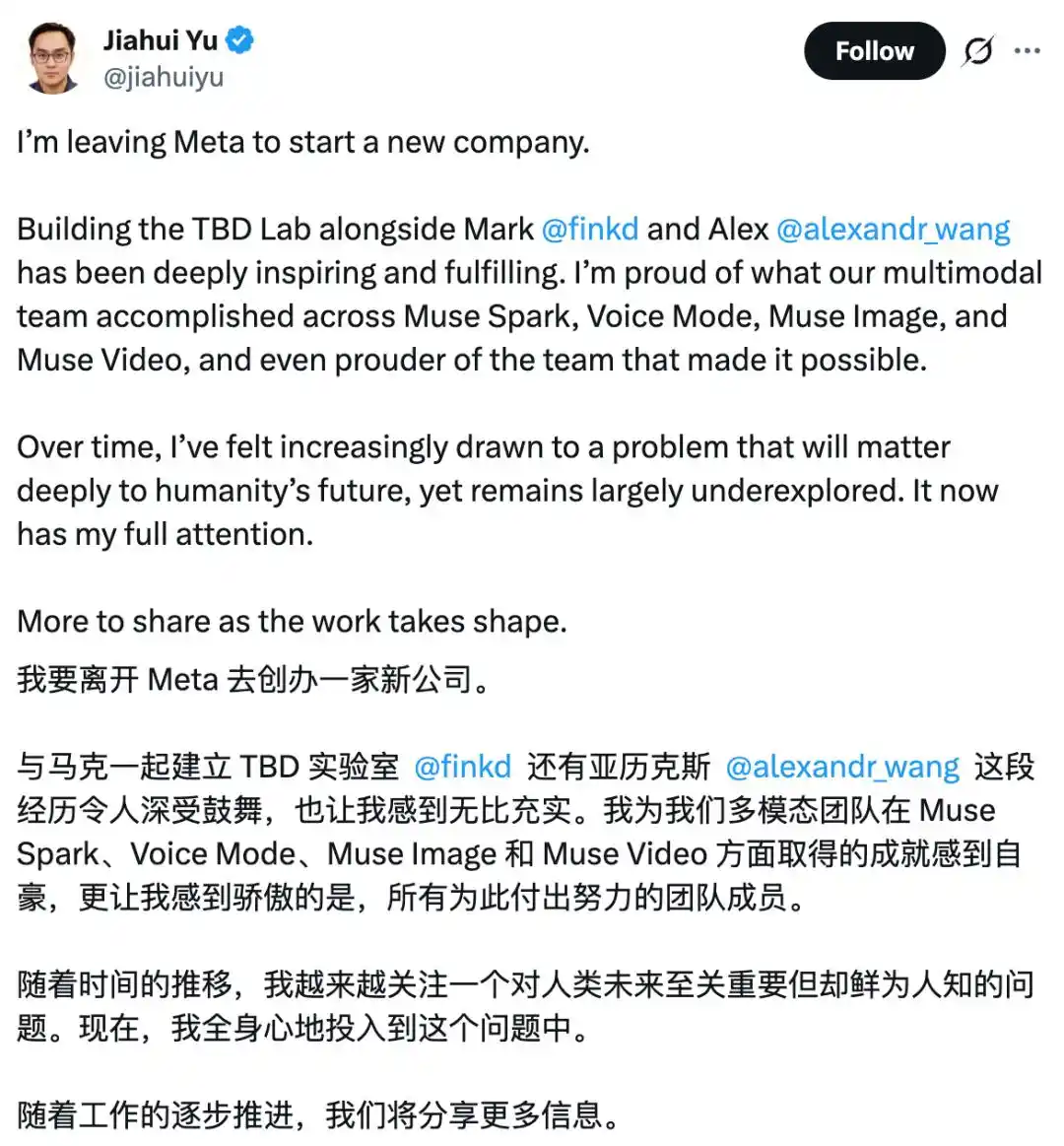
Just now, Yu Jiahui officially announced his departure from Meta to start a business.

From joining at the end of June 2025 to announcing his departure on August 14, 2026, it's exactly one year and a little over one month.
His personal website has also been updated with his resume.
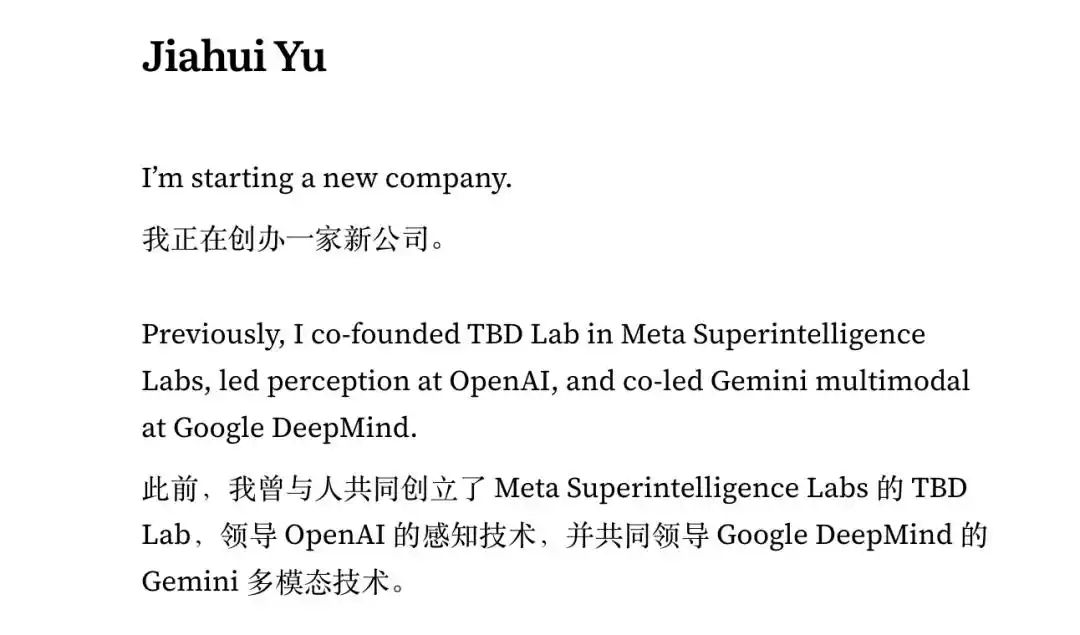
Just a few days before his departure, Meta had just launched Muse Spark 1.2.

Over the past few months, Yu Jiahui's multimodal team had also successively delivered Muse Spark, Voice Mode, Muse Image, and Muse Video.

In his announcement, Yu Jiahui stated that the experience of building TBD Lab together with Zuckerberg and Meta's Chief AI Officer Alexander Wang was "extremely inspiring and fulfilling."

He specifically highlighted several achievements made by the team over the past year and mentioned that he has been increasingly drawn to a question that is "crucial for humanity's future but remains insufficiently explored."

Now, this question will receive his undivided attention.

As for the name of the new company, its specific research focus, and who the partners are, he didn't say a word:

More to share as the work takes shape.

More information will be shared as things gradually take shape.

Just Finished Delivering the Muse Suite, and the Person Is Gone

This past year, Yu Jiahui certainly didn't slack off.

At the end of June 2025, it was exposed that Yu Jiahui, along with researchers like Zhao Shengjia, Bi Shuchao, and Ren Hongyu from OpenAI, had collectively joined Meta's newly formed superintelligence team.

Zuckerberg personally stepped in to recruit him, with rumors of a "$100 million annual salary" setting a new record in the AI talent market.

Within a few days, Zuckerberg officially announced the establishment of the Meta Superintelligence Labs, or MSL.

The lab was led by Alexander Wang. For this, Meta invested $14.3 billion in Scale AI and aggressively poached talent from companies like OpenAI, Google DeepMind, and Apple.

TBD Lab was one of the core model research teams under MSL, responsible for developing Meta's next-generation frontier models. Yu Jiahui was a founding member and the head of the multimodal direction.

In April this year, this team delivered its first major report card: Muse Spark.
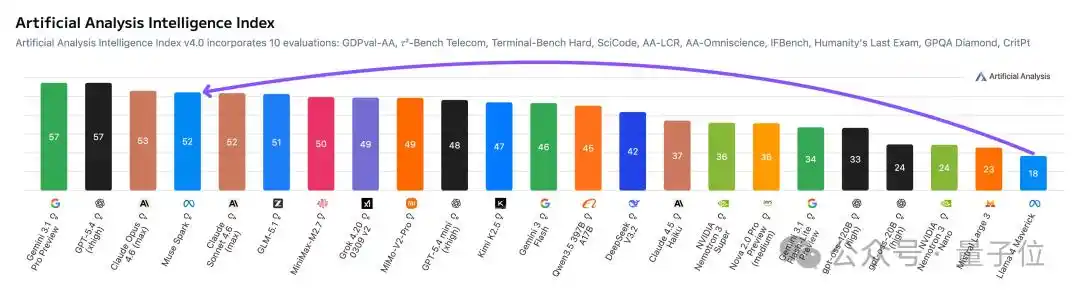
This was the first foundation model released after MSL's establishment, also marking the official shift of Meta's frontier models from the Llama series to the Muse series.

Subsequently, Yu Jiahui's team continued to release Voice Mode, Muse Image, and Muse Video, covering speech, image, and video generation.

The recent update, Muse Spark 1.2, further pushed the focus towards programming, long-horizon Agent tasks, and multimodal capabilities.
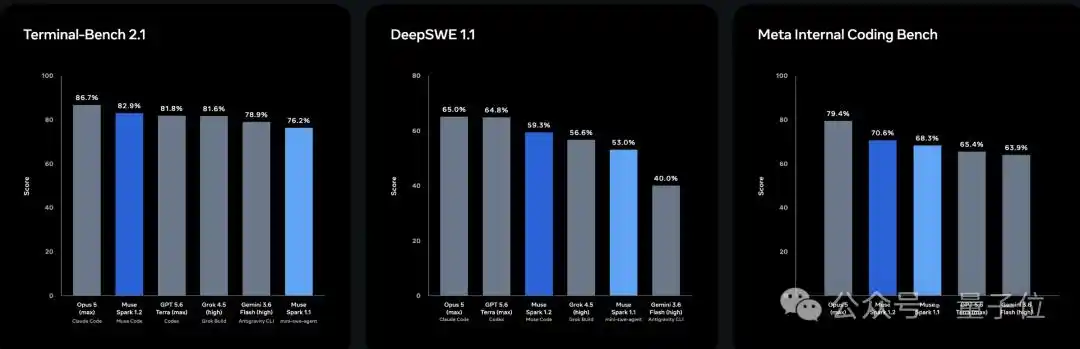
During his year at Meta, Yu Jiahui essentially built a team from scratch, re-architected the technology stack, and served up the Muse suite dish by dish.

Meta researcher Zhiqing Sun revealed that Yu Jiahui was also one of the people who recruited him into Meta.

He recalled having a meal with Yu Jiahui at a Daeho restaurant in San Francisco, where Yu persuaded him to join TBD Lab. Later, they worked together on multimodal capabilities and Computer Use.

A year later, it was the turn of someone Yu Jiahui himself recruited to see him off.

Oh Zuck, oh Zuck... was this $100 million annual salary ultimately all for naught?

Rumored $100 Million: Why Did Zuck Specifically Fight for Him?

Exactly how much money Yu Jiahui received still lacks an authoritative answer.

But in last year's Silicon Valley talent war, he was undoubtedly one of the most talked-about names.

At that time, Altman had publicly stated that Meta offered some OpenAI employees $100 million in signing bonuses and even higher annual compensation.

Subsequently, WIRED reported that Meta's offers to a few top AI talents could reach up to $300 million over four years, with total first-year compensation potentially exceeding $100 million.
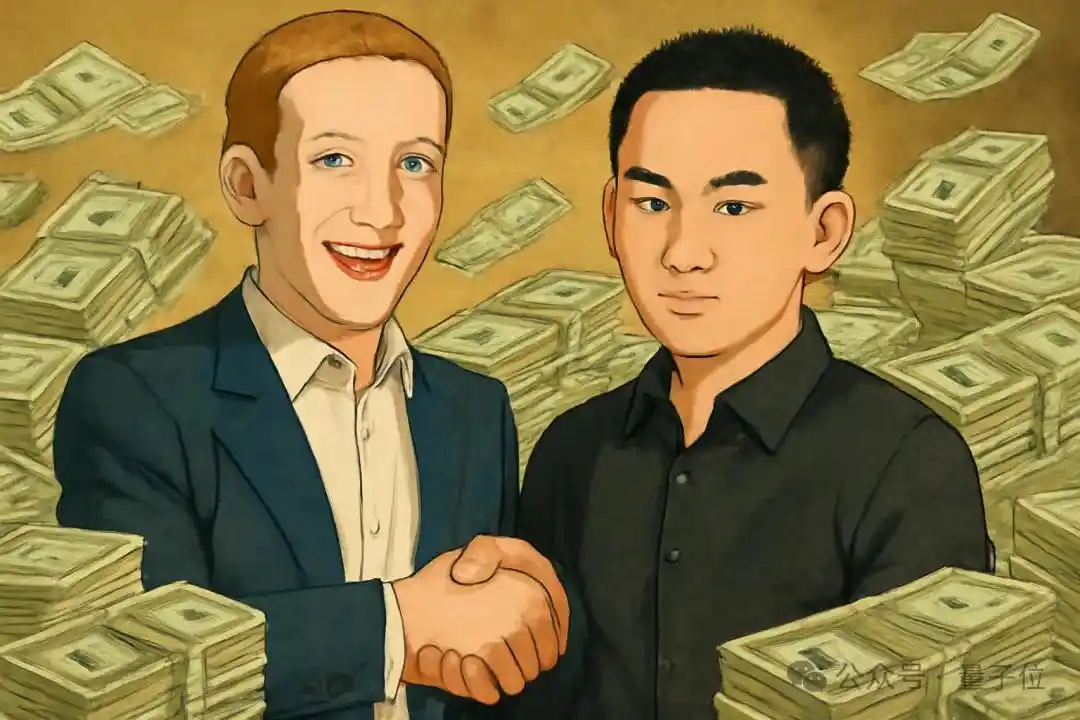
However, Meta CTO Andrew Bosworth later clarified that the widely circulated $100 million figure was not for everyone, nor was it a signing bonus paid upon joining. It likely referred to a total compensation package including stock, bonuses, tenure, and performance conditions.

So, whether Yu Jiahui personally received the "$100 million annual salary" remains unknown to us.

(Shrugs)

Even so, Yu Jiahui was still placed within the story of the "hundred-million-dollar man."

His resume also seems to have hit nearly every hot keyword in the large model field over the past few years.

Yu Jiahui completed his undergraduate studies at the School of the Gifted Young, University of Science and Technology of China, before pursuing his Ph.D. at UIUC under the supervision of computer vision scholar Thomas S. Huang.

During his Ph.D., he contributed to the development of DeepFill. Simply put, it allowed AI to erase unwanted objects from photos and automatically fill in the background.

Later, after joining Google Brain, he progressed from computer vision to multimodal large models, participating in and co-leading the Gemini multimodal direction.

After moving to OpenAI at the end of 2023, he led the Perception team, contributing to GPT-4o, GPT-4.1, and a series of o-series models.
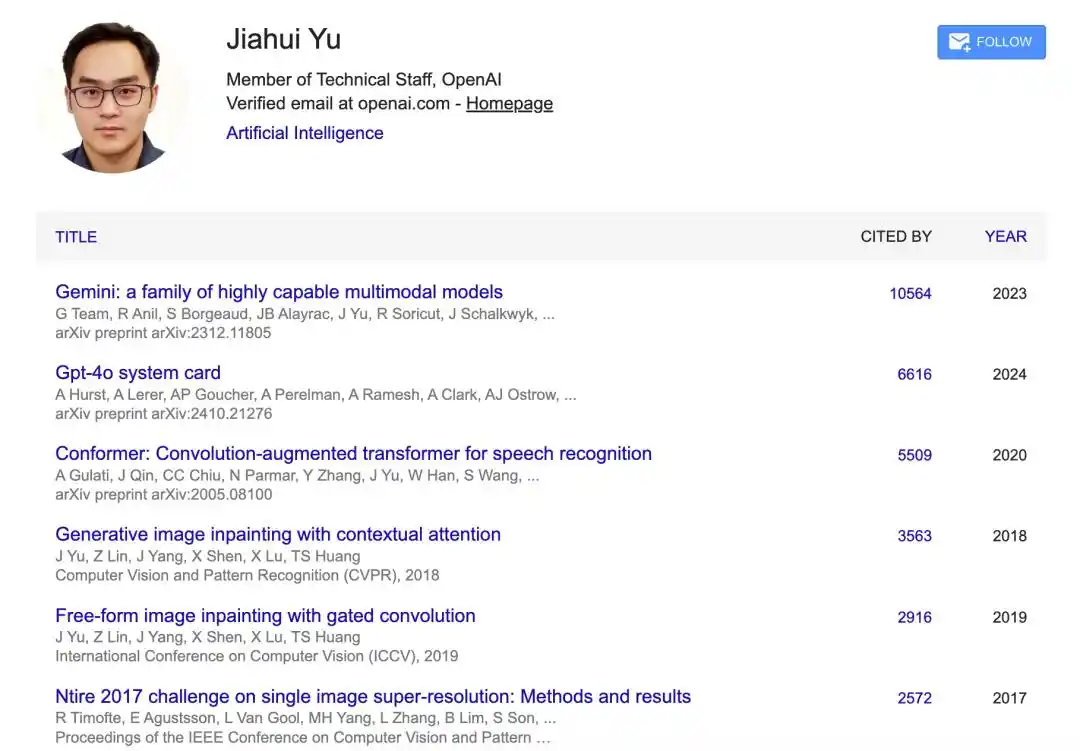
Meta was precisely in need of someone like him at that time.

With Llama 4's performance falling short of expectations, Meta urgently needed a team to rebuild its frontier model capabilities.

Compared to researchers who only made breakthroughs in a single paper, Yu Jiahui had experience in low-level vision research, had participated in large model development at both Google and OpenAI, and possessed the experience of pushing multimodal capabilities into real products.

A year ago, people might have debated:

Was Yu Jiahui really worth the rumored nine-figure compensation package?

But now, the question has become:

What exactly does someone, whom even this level of compensation, computing power, and product opportunities cannot retain, want to do by leaving?

Indeed, for researchers who have reached Yu Jiahui's level, the conditions offered by big tech companies may be nearing the ceiling for employment.

Moving further up, the remaining path seems to be becoming a founder themselves~

Meta, Just How Many People Have You Lost?!

With Yu Jiahui's departure, netizens casually started checking Meta's household register.

One look, and the numbers were startling:

929.

The research paper platform alphaXiv pulled out a list of departed Meta researchers, claiming that before Yu Jiahui, over 200 well-known researchers had already left Meta.
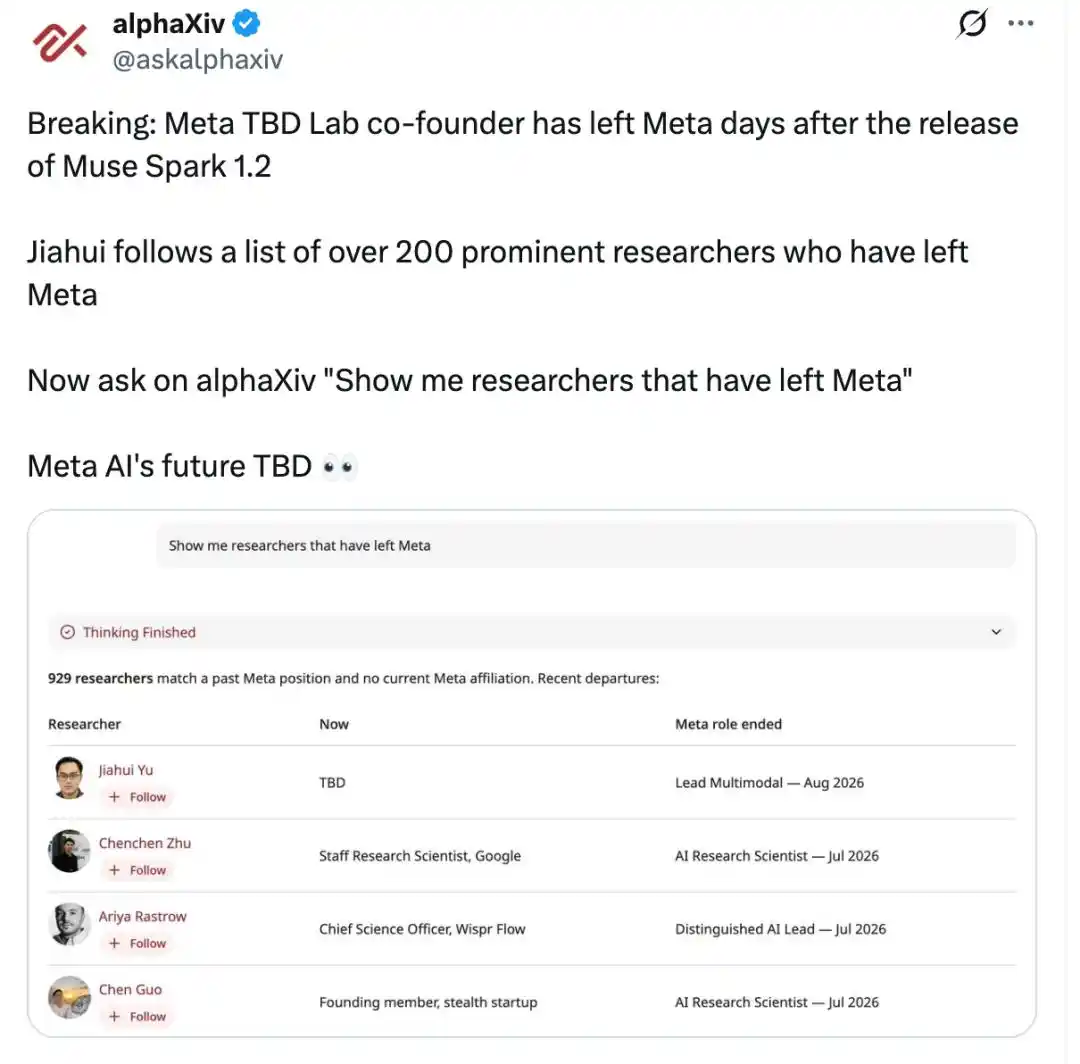
Its search page shows that a total of 929 researchers meet the criteria of "previously worked at Meta, currently not at Meta."

At the top of the list is Yu Jiahui.

Following closely are researchers who recently joined Google, became chief scientists at startups, or joined stealth startup projects.

alphaXiv didn't miss the chance to use the ready-made TBD pun, directly stating:

The future of Meta AI is also TBD (To Be Determined).

Whoa, at first glance, this Meta lab looks more like an AI talent transit hub...

Last year, when Meta was waving checks to poach talent, Altman stated:

The missionaries will ultimately defeat the mercenaries.

Now, even Yu Jiahui, whom Meta poached with heavy money, has left.

Is Zuck's talent acquisition strategy, which was mocked as employing "mercenaries," ultimately successful?

The answer is similarly TBD.

Reference Links:

[1]https://x.com/jiahuiyu/status/2087936732939616299?s=20

[2]https://x.com/askalphaxiv/status/2087973800952623416?s=20

This article is from the WeChat public account "QbitAI," author: Ting Yu

Preguntas relacionadas

QWho is the main subject of the article and what major career move did they announce?

AThe main subject is Jiahui Yu. He announced his departure from Meta to start his own company.

QWhat is the name of the core model research team Jiahui Yu was a part of at Meta, and what was its purpose?

AHe was a founding member of the TBD Lab, which was part of Meta Superintelligence Labs (MSL). Its purpose was to develop Meta's next-generation frontier models, with Yu leading the multimodal direction.

QAccording to the article, what significant product series did Jiahui Yu's team release at Meta, and what was the first major model called?

AHis team released the 'Muse' product series, which included Muse Spark, Voice Mode, Muse Image, and Muse Video. The first major foundational model was Muse Spark.

QWhat was the rumored compensation package offered to Jiahui Yu to join Meta, and how was it clarified by a Meta executive?

AIt was rumored to be a '1亿美元年薪' (a $100 million annual salary). Meta CTO Andrew Bosworth clarified that such figures were not a signing bonus for everyone but a total compensation package potentially including stock, bonuses, tenure, and performance conditions.

QWhat does the article suggest is a broader trend at Meta regarding AI researchers, based on data from alphaXiv?

AThe article suggests a significant trend of researchers leaving Meta. According to alphaXiv, over 200 known researchers had left before Jiahui Yu, with a total of 929 researchers meeting the criteria of having previously worked at Meta but no longer being there.

Lecturas Relacionadas

Stripe’s 16-Year Chronicle: From 7 Lines of Code to a $100 Billion Valuation

Stripe's 16-year journey began with a simple promise: "7 lines of code to accept payments." Founded by Patrick and John Collison, the company started by hiding the complexity of bank integrations and merchant accounts behind a clean API, initially targeting developers at startups. This early focus on user experience and technical simplicity fueled rapid adoption. A key early milestone was establishing vital bank partnerships, a challenge overcome by hiring Billy Alvarado, who brought crucial institutional relationship skills. From this foundation, Stripe systematically expanded its product boundaries. It launched Connect for platform payments, Atlas for company formation, Radar for fraud prevention, and Billing for subscriptions. This transformed Stripe from a payment processor into a broader financial infrastructure suite for internet businesses. The COVID-19 pandemic accelerated growth but also led to over-hiring. A 14% layoff in 2022 marked a period of organizational correction. Subsequently, Stripe shifted its growth strategy towards strategic acquisitions to enter new domains quickly. It acquired Bridge (stablecoin infrastructure), Privy (wallet infrastructure), Metronome (usage-based billing), and agreed to buy OpenRouter (AI model routing). These moves signal Stripe's ambition to build a "programmable money system" for the emerging AI and agent-based economy, managing not just currency flows but also the measurement and pricing of computational resources like AI tokens. Internally, Stripe leverages AI agents (like "Minions") to boost engineering productivity. Despite scaling to nearly 8,000 employees and processing $1.9 trillion in payment volume annually, the company remains private. A recent employee tender offer valued it at $159 billion. The core question for Stripe's future is whether it can successfully integrate its expanding product matrix—spanning payments, crypto, and AI infrastructure—into a cohesive platform, positioning itself as the foundational economic layer for autonomous software agents.

marsbitHace 26 min(s)

Stripe’s 16-Year Chronicle: From 7 Lines of Code to a $100 Billion Valuation

marsbitHace 26 min(s)

Treasury Secretary's Move to Suppress Treasury Yields Ignites 'Currency Debasement Trade'! Gold Hits Three-Month High, Bitcoin Surges Over 25% in a Single Week

US Treasury Secretary Besant's efforts to lower long-term Treasury yields by announcing expanded buybacks had only a brief market impact. However, this move fueled a "currency devaluation trade," weakening the US dollar while boosting both gold (to a three-month high) and Bitcoin (up over 25% for the week). Analysts attribute this reaction to deepening market concerns over the massive US fiscal deficit and structural pressures keeping long-term rates elevated, including fierce competition for capital from global government borrowing and massive AI sector financing. Despite the Treasury's actions, fundamental forces like growth, inflation, and capital demand are seen as limiting its ability to sustainably suppress yields. Bitcoin's strong positive correlation with gold has reinforced its narrative as a hedge against devaluation. While equity markets have shown resilience, some strategists warn that Treasury yields nearing 5% increase pressure on the dollar and high-leverage assets. Figures like Ray Dalio have advised reducing bond exposure in favor of gold and some Bitcoin, citing US debt risks. Market opinions are divided on the sustainability of the devaluation trade, with some noting the lack of a near-term catalyst for its next leg higher. The underlying tension between the Treasury's desire for lower borrowing costs and the Federal Reserve's focus on inflation and reducing market intervention remains a key theme. Upcoming events like Nvidia's earnings and the Jackson Hole symposium will test whether AI profits can continue supporting stocks and if the Fed aligns more with Washington's preference for easier financial conditions.

华尔街日报Hace 2 hora(s)

Treasury Secretary's Move to Suppress Treasury Yields Ignites 'Currency Debasement Trade'! Gold Hits Three-Month High, Bitcoin Surges Over 25% in a Single Week

华尔街日报Hace 2 hora(s)

Alexander Shokhin: Business Needs an Interest Rate Below 10% and the Dollar at 90-95 Rubles

Alexander Shokhin, head of the Russian Union of Industrialists and Entrepreneurs (RSPP), has advocated for potentially using "non-market" tools to keep the ruble within a target exchange rate corridor. This, he argues on August 21, would help avoid excessive volatility, though he called the topic a separate discussion. Shokhin had previously raised the idea of a currency corridor in late May, noting the ruble's current exchange rate is not fully market-driven due to a limited currency segment and reduced foreign currency demand. He stated that many business community colleagues propose fixing a corridor, even through non-market methods, to ensure predictability. The business community's key targets, as outlined by Shokhin in late December 2025, are a Central Bank key rate of 12%, inflation of 4–5%, and a US dollar exchange rate of 90–95 rubles by the end of 2026. A turning point for investment, he said, would be lowering the rate to 12% with 6% inflation, though truly comfortable business conditions would require a rate below 10%. He stressed the critical importance of currency predictability for corporate investment decisions. From a data analysis perspective, the idea of a ruble corridor is not new. A similar mechanism was used in Russia from 1995 to 1998, where the central bank held the dollar within fixed boundaries through regular interventions. This regime lasted three years before ending abruptly during the 1998 default, illustrating the fragility of rigid targets under external shocks. The macro-economic link is clear: stricter corridors require more reserves to defend against currency pressure. The key unresolved technical aspect is the specific sources and volume of such interventions given the current market's limited liquidity. Whether this discussion remains theoretical or leads to concrete corridor parameters will be seen in the coming months.

cryptonews.ruHace 4 hora(s)

Alexander Shokhin: Business Needs an Interest Rate Below 10% and the Dollar at 90-95 Rubles

cryptonews.ruHace 4 hora(s)

Trading

Spot
活动图片