Twitter Tags Lead Directly to Market Quotes, Is Trading Far Behind?

marsbitPublicado a 2026-01-12Actualizado a 2026-01-12

Resumen

X is advancing its "Everything App" vision with the upcoming launch of Smart Cashtags, a feature that allows users to tag specific financial assets and view real-time prices directly within posts. This enhancement addresses issues like ambiguous ticker symbols in crypto by enabling precise asset identification via smart contract addresses. It aggregates discussions and may integrate one-click buy/sell functionality, potentially compressing the traditional financial decision-making process into a seamless social-to-trading experience. This move aligns with Elon Musk’s ambition to transform X into an all-in-one platform encompassing social, media, payment, and trading services. The feature could also support AI agents in processing asset information more accurately. However, challenges include ensuring reliable data sources, mitigating market manipulation risks (e.g., pump-and-dump schemes), and navigating complex global financial regulations. The announcement by X product lead Nikita Bier—who has a background in crypto, including an advisory role at Solana—hints at potential ecosystem biases, as evidenced in demo visuals featuring tokens like BONK and a speculative Base token. Ultimately, Smart Cashtags may accelerate the convergence of social media and financial trading, positioning X as a central hub for global capital flow and decision-making.

When asset tags represent a real-time money interface, X takes another step closer to its "Everything App" dream.

On January 11, 2016, X Product Lead Nikita Bier announced the launch of the Smart Cashtags feature next month. At first glance, this seems like a minor improvement allowing users to precisely tag assets and view real-time prices. But when placed within X's grand financial ecosystem strategy, this is undoubtedly a key move in building the "Everything App".

What is Smart Cashtags?

According to the content and screenshots released by Nikita Bier, the upcoming Smart Cashtags brings several fundamental changes:
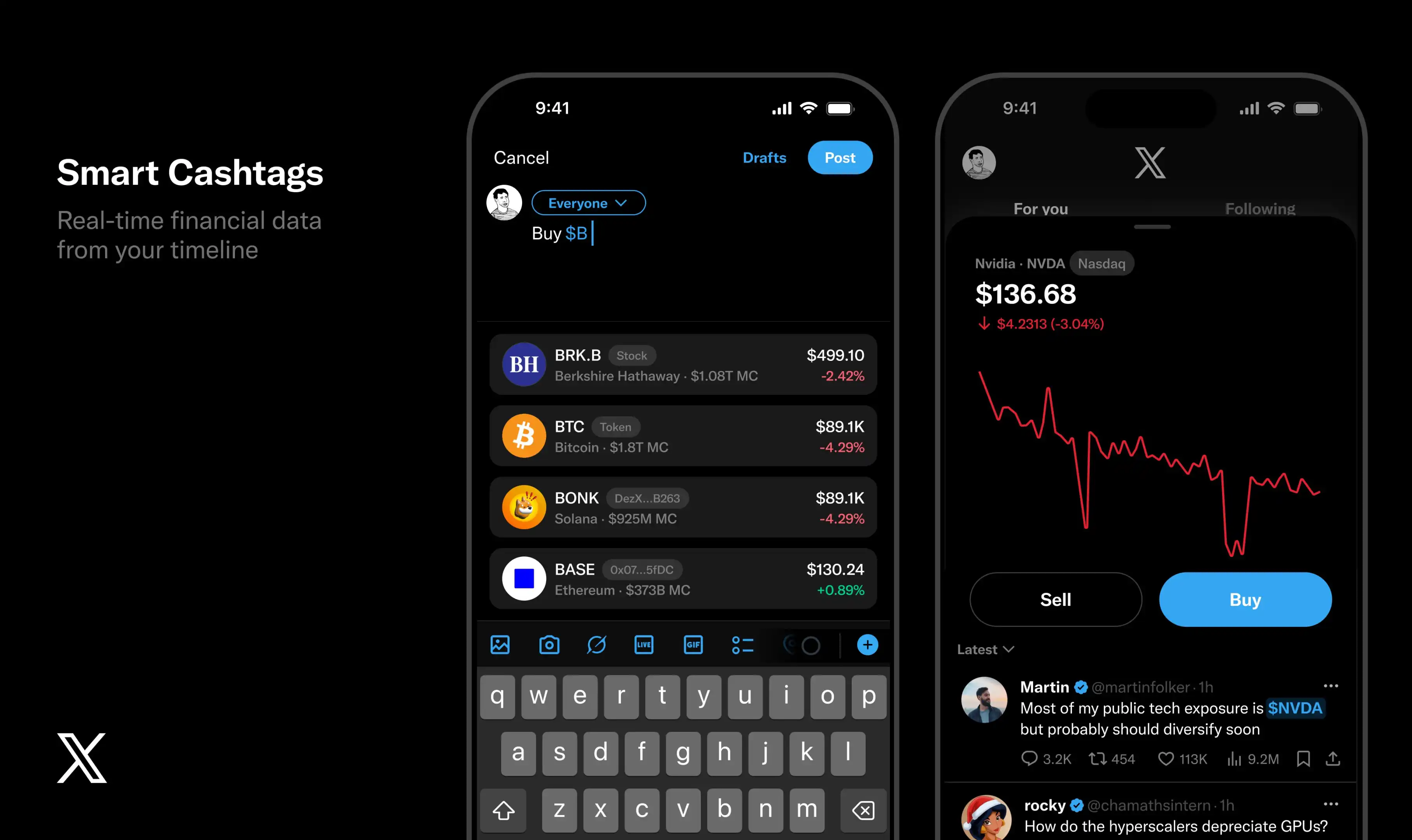
1. Precise Asset Anchoring: Posters can assign a tag to a specific asset or smart contract address. This means that when multiple assets or tokens with the same name exist, especially a common pain point in the crypto market with rampant同名代币 (Ticker), clicking the tag will directly point to the unique target asset.

2. One-Click Real-Time Price Viewing: Cashtags in the timeline can be clicked directly to instantly display real-time prices.

3. Aggregated Discussion: Aggregates all tweets mentioning that asset, forming a complete discussion view.

4. Trading Closed-Loop: The screenshot shown by Nikita Bier displayed one-click buy or sell buttons after opening the NVDA tag. Although it's not yet clear if this feature will cover crypto assets, it sends a strong signal: X is experimenting with embedding trading functions directly into the information feed.

In response to a question about "Does this mean we will be able to use self-custody wallets or even CEX widgets to trade on X in the future?", Nikita Bier replied with an Emoji "".

When the information flow and price flow merge into one, X is no longer just a chat box, but a financial trading terminal in its infancy. The traditional financial decision path is: see news → switch apps to search → check quotes → find analysis → decide to trade. Smart Cashtags compresses this to: see news / discussion → click tag (check quotes / view sentiment)→ one-click trade.

The Larger Game: From Social Media to "Everything App"

Musk has repeatedly stated his desire to build X into an Everything App encompassing social, media, payment, and trading. On January 11, 2026, he emphasized again that X is the set of all things.

It's worth emphasizing that in June 2025, former X CEO Linda Yaccarino, before stepping down, stated that users would "soon" be able to invest or trade on X, and that X was also exploring the launch of an X credit or debit card. X had previously stated it would launch a digital wallet and peer-to-peer payment service X Money, with Visa as its first partner.

On the other hand, what's active on X in the future might not just be people, but also AI agents. Smart Cashtags can help these AI agents more accurately identify and process asset information.

What are the Potential Challenges?

Of course, this feature is not without challenges. First is the credibility of the data source. For cryptocurrencies, where does the real-time price come from? Centralized exchanges, decentralized oracles, or multi-source aggregation?

Secondly, Smart Cashtags and the ensuing trading functions could also exacerbate market manipulation risks. If a KOL tweets promoting a small-cap coin, and fans can just "click to buy", FOMO sentiment can be amplified instantly, potentially making Pump and Dump easier than ever. How X limits malicious tags will be a huge challenge.

Last but not least, there's the minefield of regulatory compliance. When X starts providing real-time financial data, pushing related assets through algorithms (could this be considered asset recommendation?), and trading functions, could it be classified as an "exchange" or "investment advisor" by regulators? Regulatory attitudes vary greatly across different jurisdictions, and X needs to balance innovation and compliance globally.

Key Figure: Nikita Bier's Crypto Background

Nikita Bier is not just X's product lead; he previously founded the social apps tbh app and Gas, which were acquired by Meta and Discord respectively. He is also an investment partner at Lightspeed and began serving as a Solana advisor in March 2025.

In Nikita Bier's Smart Cashtags announcement screenshot today, the dropdown list after typing "$B" included BTC" and the Solana ecosystem's BONK token. Some community users believe that BONK, as a leading Solana Meme, being placed in such a prominent position is clearly not a coincidence, reflecting Nikita Bier's preference and push for the Solana ecosystem.

Another point is that the screenshot also showed a Base token, displaying a market cap of $373 billion and a single token price of $130, which was interpreted by some community users as an abstract prophecy of an upcoming Base token issuance. Previously, in mid-September at the BaseCamp 2025 conference in Stowe, Vermont, Base network lead Jesse Pollak stated that Base was exploring the possibility of issuing a network token to accelerate Base's decentralization process.

Summary

The boundary between social media and financial terminals is completely dissolving. The launch of Smart Cashtags will mark the official arrival of the era of "social-driven trading".

For ordinary users, this means more transparent information and faster tools; but for regulators and traditional financial institutions, this may mean a "new battlefield" that is harder to control, more volatile, and entirely driven by community sentiment.

Nikita Bier stated bluntly, "X is the best platform for financial information—what users read here influences the allocation of trillions of dollars."

Whoever controls the financial information flow controls the entry point for capital movement. When X completes the closed loop of "information + payment + trading", it will become one of the operating systems of the global financial market. At that time, decisions on the allocation of hundreds of billions of dollars will not only be based on information on X, but will happen directly on X.


Preguntas relacionadas

QWhat is the core function of the newly announced Smart Cashtags feature on X?

ASmart Cashtags allows users to precisely tag specific financial assets or smart contract addresses, view real-time prices directly within the timeline, aggregate discussions about the asset, and potentially execute buy/sell orders through an integrated interface.

QHow does Smart Cashtags contribute to X's broader strategic vision?

AIt is a key step in X's plan to become an 'Everything App' by integrating social interaction, media, payment services, and financial trading into a single platform, effectively merging information flow with capital flow.

QWhat are some potential challenges associated with Smart Cashtags?

AChallenges include ensuring reliable data sources (especially for crypto assets), mitigating market manipulation risks like pump-and-dump schemes facilitated by quick trading access, and navigating complex regulatory compliance across different jurisdictions.

QWho is Nikita Bier and why is his role significant for this feature?

ANikita Bier is X's Product Lead, a former founder of social apps acquired by Meta and Discord, a Lightspeed investment partner, and a Solana advisor. His crypto background and product expertise signal X's serious intent to integrate financial and blockchain elements.

QWhat does the integration of trading functionality via Smart Cashtags imply for the future of financial interactions?

AIt signifies the arrival of 'social-driven trading,' where users can seamlessly transition from seeing news/discussions to executing trades without leaving the platform, potentially making X a global financial operating system that influences trillion-dollar capital allocation decisions.

Lecturas Relacionadas

Must-Watch Events Next Week|CLARITY Act Could Face Senate Vote; SpaceX, Circle to Report Earnings (8.3-8.9)

**Summary: Key Events and Developments to Watch (August 3-9)** The upcoming week is marked by significant financial disclosures, key legislative deadlines, and notable product updates. **Major Financial Events:** Several companies are scheduled to release their Q2 2026 earnings. American Bitcoin (ABTC) will report on August 3, followed by SpaceX and Hut 8 Mining Corp. on August 4, and Circle on August 5. Notably, a significant portion of SpaceX shares (up to 12% of total shares) will be unlocked on August 6 following their earnings release. **Key Legislative Deadline:** The U.S. Senate faces an August 7 deadline to secure 60 votes for the CLARITY Act, a bipartisan bill aiming to establish a federal regulatory framework for cryptocurrencies. The Senate may hold a full vote on the bill during the week. **Economic Data:** The U.S. July Non-Farm Payrolls report will be released on August 7, providing crucial labor market data. **Technology & Product Updates:** * **Shutdowns:** DeFi portfolio tracker Zapper and wallet app Ctrl Wallet will cease operations on August 3. * **Upgrades:** LayerZero will deprecate its v1 relayers on August 3. XRP Ledger's new version 3.3.0, featuring five new functions, is expected next week. * **AI:** Elon Musk announced that the advanced Grok 4.6 AI model is set for release around August 7. * **Bitcoin:** The BIP-110 forced signaling for a potential Bitcoin network change is scheduled to begin around August 8. **Other Notable Events:** Chinese robotics firm Unitree Tech has set its preliminary price inquiry for its IPO for August 5. South Korean exchange Upbit will delist AQT and AERGO tokens on August 3.

marsbitHace 1 hora(s)

Must-Watch Events Next Week|CLARITY Act Could Face Senate Vote; SpaceX, Circle to Report Earnings (8.3-8.9)

marsbitHace 1 hora(s)

Stocks Are Plummeting More Sharply Than Cryptocurrencies. Where Has the Money Gone?

Stock Markets Plunge Deeper Than Cryptocurrencies: Where Did the Money Go? In late July, Seoul's Kospi index triggered circuit breakers for two consecutive days, plummeting over 40% from its June high. The collapse was led by heavyweight stocks like SK Hynix, whose record profits still disappointed investors, and devastating leveraged ETFs, with one major product losing over 83% of its value. This signaled a global, forced deleveraging targeting the most crowded trades. Interestingly, while stocks exhibited extreme volatility akin to crypto markets, Bitcoin rose nearly 15% in July after a prior steep drop. Analysis shows the money fleeing equities did not flow into Bitcoin. Instead, Bitcoin had already absorbed its sell-off in May-June, when U.S. spot Bitcoin ETFs saw historic outflows. The true safe-haven beneficiary was gold, whose price rose over 20% year-on-year, highlighting a decoupling between Bitcoin and gold as "digital gold." The sell-off was a targeted unwinding of leveraged positions in tech and semiconductors, accelerated by broker-dealer risk management and shifts in the AI narrative, including new competition from Chinese memory chipmakers. The retreat path was clear: from high-valuation tech stocks to cash and U.S. Treasuries, then to gold. For Bitcoin to attract sustained institutional inflows, conditions like eased global liquidity pressure, a "soft-landing" Fed rate cut, and U.S. regulatory clarity via legislation like the stalled CLARITY Act are needed. Currently, Bitcoin is not a safe haven but an already-cleared asset. Its low correlation with tech stocks, however, makes it a potential diversification play for institutional portfolios once the storm passes. The money isn't here yet, but the positioning is underway.

marsbitHace 1 hora(s)

Stocks Are Plummeting More Sharply Than Cryptocurrencies. Where Has the Money Gone?

marsbitHace 1 hora(s)

In Conversation with Ray Dalio: We Are Currently in an AI Bubble, with 1% of My Portfolio in Bitcoin

Ray Dalio, founder of Bridgewater Associates, warns in an interview that the current AI boom shows classic bubble characteristics, which could lead to significant economic downturns as seen in past cycles like 1929 or 2000. He explains that speculative enthusiasm, fueled by debt and overvaluation, often precedes a crash when rising rates or taxation force asset sales, causing widespread losses and recession. Dalio also outlines his "Big Cycle" theory, describing an approximate 80-year pattern where widening wealth gaps, massive government deficits, and shifting geopolitical power (like China's rise) create internal conflict and global instability. He emphasizes that we are in a late-cycle, transitional phase where traditional powers like the US and UK face decline. For personal wealth protection, Dalio advises diversification beyond cash into assets like stocks, bonds, real estate, and particularly gold, which he prefers over Bitcoin. While he holds about 1% of his portfolio in Bitcoin as a non-printable hard asset, he views gold as more secure from technological or governmental threats. Regarding AI's impact, Dalio believes it will disproportionately benefit capital owners, worsening inequality by replacing both physical and cognitive labor. He suggests that human intuition and emotional intelligence, combined with AI, will be key for future workers. On taxation, Dalio argues that wealth taxes are impractical and risk triggering asset sell-offs, reducing productive investment. He points to the UK as a cautionary example of debt, low productivity, and political strife. Geopolitically, Dalio foresees a more regionalized world, with the US showing weakness in prolonged conflicts like with Iran, akin to past imperial declines. The ideal outcome, he suggests, is coexisting powerful blocs (e.g., Americas, China-Asia Pacific) without major war.

marsbitHace 5 hora(s)

In Conversation with Ray Dalio: We Are Currently in an AI Bubble, with 1% of My Portfolio in Bitcoin

marsbitHace 5 hora(s)

Trading

Spot
活动图片




