Trump's Bank Arrives: 49% Goes to Middle East Royalty, 38% Belongs to President's Family

marsbitPublicado a 2026-08-28Actualizado a 2026-08-28

Resumen

The U.S. Office of the Comptroller of the Currency (OCC) has granted preliminary conditional approval to World Liberty Financial to establish a national trust bank for its USD1 stablecoin. Major ownership of the bank's holding company reveals Sheikh Tahnoon bin Zayed al Nahyan, a senior UAE official and national security advisor, holds 49% through an investment vehicle, while entities linked to the Trump family hold 38%. This mirrors a prior $500 million investment by the sheikh into World Liberty, which reportedly channeled $263 million to Trump-linked entities. The bank would allow World Liberty to directly custody USD1's dollar reserves (currently $4 billion) and keep all interest income, estimated at $150 million annually, rather than sharing it with a third-party custodian. This move was enabled by the 2025 "Genius Act," signed by the president, which permits approved stablecoin issuers to self-custody reserves. The approval process, overseen by a Trump-appointed OCC head, has drawn scrutiny due to the unprecedented foreign and presidential family stakes in a federally chartered bank poised to manage significant U.S. Treasury investments.

Earlier this month, the U.S. Office of the Comptroller of the Currency (OCC) granted World Liberty Financial preliminary conditional approval to establish a federally chartered national trust bank to issue, redeem, and custody USD1, the dollar-backed stablecoin it launched last year.

The Wall Street Journal disclosed the ownership structure behind this bank on Thursday.
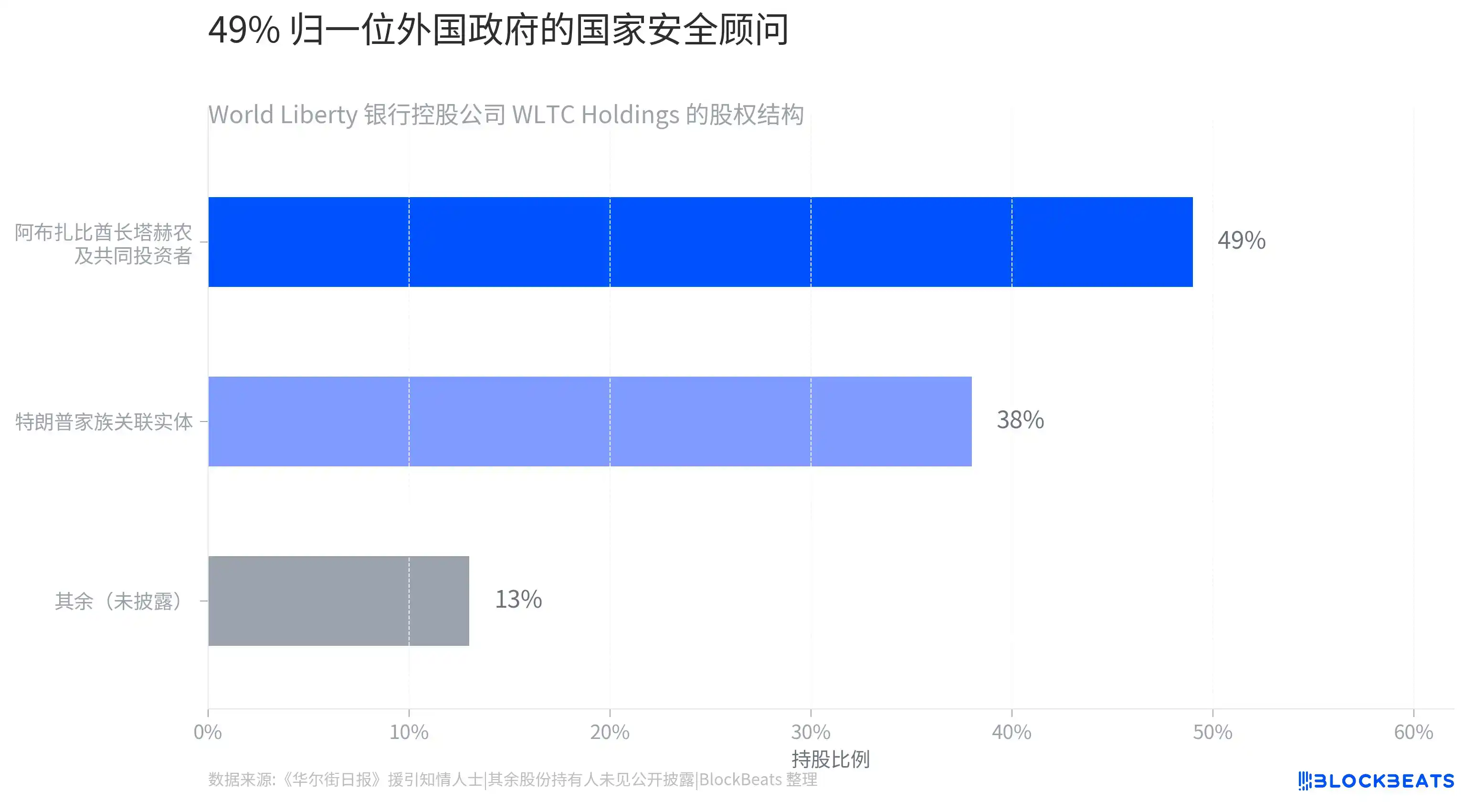
The largest shareholder is Sheikh Tahnoon bin Zayed al Nahyan, a member of the Abu Dhabi royal family, and his co-investors. Through an entity called StringZ Holding RSC, they hold 49% of the bank's holding company, WLTC Holdings.

Entities linked to the Trump family hold 38%.

Who is Tahnoon? He is the National Security Advisor of the United Arab Emirates and a brother of the country's President. He oversees a financial empire exceeding $1.3 trillion, with funds coming from both his personal wealth and state coffers. In Western media reports, he is sometimes referred to as the "Spy Sheikh."

This Isn't His First Appearance on This Chain

In January 2025, four days before Trump's inauguration, Tahnoon and co-investors invested $500 million into World Liberty Financial through an entity called Aryam Investment 1, acquiring a 49% stake in the company. That deal was not disclosed at the time and was only exposed by The Wall Street Journal this January.

According to the President's latest financial disclosure, $263 million of that money flowed to Trump family entities.

Democratic lawmakers and legal experts criticized it directly at the time: a senior foreign government official holding significant ownership in a company belonging to a U.S. President-elect was unprecedented.

Now, the same 49% appears in an institution about to receive a U.S. federal bank charter. The shareholder structure of the bank holding company is the same as that of World Liberty itself, except Tahnoon's side uses a different entity to hold the shares.

What Exactly Will This Bank Do?

It is not a traditional bank; a trust charter generally does not allow taking deposits or making loans. What it can do is: hold assets for clients nationwide and facilitate faster payment settlements.

Specifically for World Liberty, this charter allows it to issue USD1 directly and custody the dollar assets backing the stablecoin itself. These two tasks are currently handled by partner BitGo, an independent trust bank that holds USD1's reserves and keeps a portion of the interest.

This is the core of the business.

USD1 currently has a market capitalization of $4 billion. World Liberty states that the dollars backing it are invested in U.S. Treasury bonds and other cash equivalents, generating an estimated $150 million in interest annually.

Previously, this interest had to be shared with BitGo. With its own bank, it won't.

And the logic is self-reinforcing: the more USD1 in circulation, the larger the reserves, the greater the interest income. Therefore, World Liberty says the mission of this trust bank is to drive the "mainstream adoption" of USD1 while offering new services to customers, such as charging fees to custody their cryptocurrency.

After the OCC approval, World Liberty CEO Zach Witkoff said the company's ambition is "to build the most trusted and widely used digital dollar in the world." He is the son of Steve Witkoff, the U.S. Middle East envoy.

The Legal Gateway for This Charter Was Signed by the President Himself

World Liberty only began the process of setting up the bank after July 2025, the month the President signed the Genius Act.

This law did one key thing: it allowed approved stablecoin companies to directly hold the reserve assets backing their tokens.

Before this, World Liberty had to rely on a third party like BitGo. After this, it can do it itself, as long as it obtains a federal charter. It applied in January of this year and received preliminary conditional approval on August 14.

The Genius Act also stipulates that U.S.-issued dollar-pegged stablecoins must be backed by specific assets, including U.S. Treasury securities maturing in 93 days or less. Treasury Secretary Besant previously cited a prediction that stablecoins could grow into a market approaching $4 trillion and has written that "this could lower the government's borrowing costs."

In other words, the stablecoin track has clear fiscal significance for this administration; it creates new buyers for U.S. Treasury debt. And one of the companies running furthest ahead on this track belongs to the President's family.

The Same Regulator, Several Other Decisions This Summer

The OCC has approved a series of national bank charters for crypto companies in recent months, with Ripple and Circle both receiving preliminary approvals. The current Comptroller, Jonathan Gould, was appointed by Trump last year.

But there were also rejections.

In early August, the OCC rejected Dutch fintech company Bunq's application for a national bank charter, citing significant regulatory and compliance concerns. In mid-August, Zerohash, which provides crypto infrastructure for Morgan Stanley's E*Trade, had its trust bank application returned, citing material deficiencies; it subsequently resubmitted with a narrower business scope, with a public comment period ending September 17.

Regarding World Liberty's application, the OCC's letter stated: "This preliminary conditional approval is based on a comprehensive evaluation of all information available to the OCC, including statements and commitments made in the application and by representatives of the bank." Final approval is contingent on meeting a series of "pre-opening requirements" and passing a final examination.

A World Liberty spokesperson said OCC career staff reviewed the application "for compliance with statutory, regulatory, and policy requirements and factors governing bank approvals." The company did not comment on the shareholder structure behind its bank.

An OCC official said application reviews are handled by career staff and that the agency "consulted with multiple experienced career government ethics officials" to ensure the process "complies with all government ethics standards and policies."

There's Another Sum of Money

Tahnoon's $500 million is not the only controversial funding entering this company.

Earlier this month, The New York Times reported that a businessman named Guren "Bobby" Zhou invested a total of $100 million into World Liberty through a new company called Aqua 1, becoming one of the largest buyers of the company's tokens.

Two years ago, he was a failed hardwood flooring retailer in the UK, under investigation for money laundering there, and presided over the collapse of a small crypto startup.

Under World Liberty's policy, up to $75 million of that money was allocated to a company controlled by the President and his three sons, while also benefiting the Witkoff family.

On July 19, the day of the World Cup final, Zhou and Zach Witkoff sat together in a luxury box at the stadium in New Jersey.

What Remains to Be Seen

The bank has not yet opened. It must first meet the conditions set by the OCC and pass a final examination.

What is already certain is: if it opens, an institution 49% owned by a senior foreign government official and 38% owned by the President's family will hold the full reserves of a dollar stablecoin, invest them into U.S. Treasury bonds, and take all the interest.

Criptos en tendencia

Preguntas relacionadas

QWhat is the primary function of the federal trust bank charter granted to World Liberty Financial, and what key business advantage does it provide?

AThe primary function is to allow World Liberty Financial to directly issue, redeem, and custody its USD1 stablecoin. The key business advantage is that it allows the company to hold the reserve assets backing the stablecoin itself, eliminating the need to share the interest income from those reserves with a third-party custodian like BitGo.

QWho are the major owners of the bank holding company (WLTC Holdings) behind World Liberty Financial, and what percentage does each control?

ASheikh Tahnoon bin Zayed al Nahyan of Abu Dhabi and his co-investors, through StringZ Holding RSC, own 49% of WLTC Holdings. Entities linked to the Trump family own 38%.

QHow did the 'Genius Act,' signed by President Trump, create a legal pathway for World Liberty Financial to establish its own trust bank?

AThe Genius Act, signed in July 2025, allowed approved stablecoin companies to directly hold the reserve assets backing their tokens. This removed the legal requirement for a third-party custodian, enabling World Liberty to seek its own federal trust bank charter to perform this function in-house.

QWhat controversy surrounded the initial $500 million investment in World Liberty Financial by Sheikh Tahnoon bin Zayed al Nahyan in January 2025?

AThe controversy centered on the unprecedented nature of a senior foreign government official holding significant ownership in a company controlled by an incoming U.S. President (then President-elect Trump). Critics argued it created a major conflict of interest, with $263 million of that investment flowing to Trump-family entities.

QWhat is one additional source of controversial funding mentioned in the article that flowed into World Liberty Financial, and who benefited from it?

ABusinessman Guren 'Bobby' Zhou invested $100 million through Aqua 1. Up to $75 million of that was allocated to a company controlled by the then President and his three sons, and also benefited the Witkoff family (the CEO's family).

Lecturas Relacionadas

Chinese Venture Capital Is Shifting from 'Selecting People' to 'Selecting Cities'

Chinese Venture Capital: Shifting from "Picking Founders" to "Picking Cities" The article discusses a significant shift in China's venture capital (VC) landscape. Historically, VC investments heavily focused on the individual founder's vision, track record, and capability, as seen in early internet-era successes like Wang Xing (Meituan), Li Bin (Nio), and Li Xiang (Li Auto). The belief was that betting on exceptional people was the key to success. However, the rise of hard tech startups—in fields like semiconductors, robotics, AI, and biotech—has changed this calculus. These industries depend heavily on deep, localized ecosystems: specialized talent pools, established supply chains, manufacturing bases, and application scenarios. A city's industrial "resume" now significantly impacts a startup's chances. Examples include Shenzhen's dominance in robotics, Beijing's concentration of AI firms, Suzhou's biotech cluster, and Hefei's successful bet on semiconductor giant ChangXin. This shift is further driven by changes in funding sources. Government-guided funds and state-owned capital now dominate VC limited partners (LPs). These "patient capital" investors prioritize local economic development, job creation, and industrial chain growth alongside financial returns. Their early bets signal viability to other investors. Ultimately, the VC logic remains about managing risk and increasing the odds of success. In the hard tech era, a supportive city ecosystem provides crucial resources—talent, suppliers, R&D, and policy stability—that a single founder cannot easily assemble. The investment due diligence process has thus expanded from evaluating just the founder to also evaluating the founder's city. Consequently, capital is concentrating in a few regions with strong, focused industrial foundations, challenging other cities to build compelling, credible ecosystems to attract investment.

marsbitHace 7 min(s)

Chinese Venture Capital Is Shifting from 'Selecting People' to 'Selecting Cities'

marsbitHace 7 min(s)

BitGo Buys NYDIG's Trading Unit as Institutions Consolidate Crypto Services

On August 27, 2026, BitGo, a major regulated crypto custodian, announced the acquisition of NYDIG's institutional trading division. This move expands BitGo's service offerings to include derivatives, structured products, and lending services, allowing it to provide institutions with a more comprehensive, single-provider solution for custody, trading, and settlement. The deal adds approximately 30 NYDIG employees and their trading network to BitGo. The acquisition reflects a broader institutional trend towards consolidating digital asset services with fewer, regulated partners. A Fireblocks report from April 2026 indicated strong institutional budget allocation for such infrastructure, with 53% of surveyed firms spending at least $1 million. BitGo, which went public in January 2026, reported significant revenue and client growth alongside platform assets of $65.2 billion. Its regulatory standing, including a federal trust license, is a key factor for risk-conscious institutions. The deal also provides BitGo access to the crypto lending market, despite a recent quarterly decline reported by Galaxy Research, and aligns with growing activity on regulated derivatives venues like CME Group. However, this integration of multiple services attracts closer regulatory scrutiny. The Bank for International Settlements has warned that such crypto conglomerates could concentrate financial risks. For NYDIG, the sale marks a strategic shift to focus on its vertically integrated bitcoin mining and high-performance computing data center business.

cryptonews.ruHace 13 min(s)

BitGo Buys NYDIG's Trading Unit as Institutions Consolidate Crypto Services

cryptonews.ruHace 13 min(s)

Trading

Spot

Artículos destacados

Qué es $BANK

Banco AI: Un Paso Revolucionario en el Futuro de la Banca Introducción En una era marcada por avances rápidos en tecnología, Banco AI se sitúa en la intersección de la inteligencia artificial (IA) y los servicios bancarios. Este proyecto innovador busca redefinir el panorama financiero, mejorando la eficiencia operativa, las medidas de seguridad y las experiencias del cliente a través del poder de la IA. Al embarcarnos en esta exploración de Banco AI, profundizaremos en lo que implica el proyecto, sus dinámicas operativas, su contexto histórico y hitos significativos. ¿Qué es Banco AI? En su esencia, Banco AI representa una iniciativa transformadora destinada a integrar la inteligencia artificial en varias operaciones bancarias. Este proyecto aprovecha las capacidades de la IA para automatizar procesos, mejorar los protocolos de gestión de riesgos y mejorar la interacción con los clientes a través de servicios personalizados. Los objetivos principales de Banco AI incluyen: Automatización de Funciones Bancarias: Al aprovechar las tecnologías de IA, Banco AI tiene como objetivo automatizar tareas rutinarias, reduciendo la carga sobre los recursos humanos y mejorando la eficiencia. Mejora en la Gestión de Riesgos: El proyecto utiliza algoritmos de IA para predecir e identificar riesgos, fortaleciendo así las medidas de seguridad contra fraudes y otras amenazas. Personalización de Servicios Bancarios: Banco AI se centra en ofrecer productos y servicios financieros a medida al analizar datos y comportamientos de los clientes. Mejoramiento de la Experiencia del Cliente: La implementación de soluciones impulsadas por IA, como chatbots y asistentes virtuales, tiene como objetivo proporcionar a los usuarios interacciones más humanas, revolucionando la forma en que los clientes se relacionan con los bancos. Con estos objetivos, Banco AI se posiciona como un jugador crucial para hacer que la banca sea más eficiente, segura y centrada en el usuario. ¿Quién es el Creador de Banco AI? Los detalles sobre el creador de Banco AI siguen siendo desconocidos. Como tal, no se ha identificado a ninguna persona u organización específica en la información disponible. El anonimato que rodea el inicio del proyecto plantea preguntas, pero no resta valor a su ambiciosa visión y objetivos. ¿Quiénes Son los Inversores de Banco AI? Al igual que con el creador del proyecto, no se ha divulgado información específica sobre los inversores u organizaciones que apoyan a Banco AI. Sin esta información, es un desafío delinear el respaldo financiero y el apoyo institucional que podrían estar impulsando el proyecto hacia adelante. No obstante, la importancia de contar con una sólida base de inversión es fundamental para sostener el desarrollo en un campo tan innovador. ¿Cómo Funciona Banco AI? Banco AI opera en múltiples frentes innovadores, centrándose en factores únicos que lo diferencian de los marcos bancarios tradicionales. A continuación, se presentan las características operativas clave: Automatización: Al aplicar algoritmos de aprendizaje automático, Banco AI automatiza varios procesos manuales dentro de los bancos. Esto resulta en la reducción de costos operativos y permite que los trabajadores humanos redirijan sus esfuerzos hacia actividades más estratégicas. Gestión Avanzada de Riesgos: La integración de la IA en las prácticas de gestión de riesgos equipa a los bancos con herramientas para predecir con precisión amenazas potenciales como el fraude, garantizando que la información y los activos de los clientes permanezcan seguros. Recomendaciones Financieras Personalizadas: A través del aprendizaje continuo a partir de las interacciones con los clientes, los sistemas de IA desarrollan una comprensión matizada de las necesidades del usuario, lo que les permite ofrecer consejos adaptados sobre decisiones financieras. Interacciones Mejoradas con los Clientes: Al utilizar chatbots y asistentes virtuales impulsados por IA, Banco AI permite una experiencia más atractiva para el cliente, permitiendo a los usuarios resolver sus consultas rápidamente, reduciendo así los tiempos de espera y mejorando los niveles de satisfacción. En conjunto, estas características operativas posicionan a Banco AI como un pionero en el sector bancario, estableciendo nuevos parámetros para la entrega de servicios y la excelencia operativa. Línea de Tiempo de Banco AI Entender la trayectoria de Banco AI requiere mirar su contexto histórico. A continuación, se presenta una línea de tiempo que destaca hitos y desarrollos importantes: Inicios de 2010: La conceptualización de la integración de la IA en los servicios bancarios comenzó a ganar atención a medida que las instituciones bancarias reconocieron los posibles beneficios. 2018: Se produjo un aumento notable en la implementación de tecnologías de IA cuando los bancos comenzaron a utilizar herramientas de IA como chatbots para el servicio al cliente básico y sistemas de gestión de riesgos para mejorar la seguridad. 2023: La sofisticación de la IA continuó avanzando, con la introducción de IA generativa para tareas más complejas como el procesamiento de documentos y análisis de inversiones en tiempo real. Este año marcó un salto significativo en las capacidades que la tecnología de IA otorgó a los bancos. 2024-Estatus Actual: A partir de este año, Banco AI se encuentra en una trayectoria ascendente, con investigaciones y desarrollos en curso que pronto mejorarán las capacidades en las operaciones bancarias. La continua exploración de las aplicaciones de IA sugiere emocionantes desarrollos aún por venir. Puntos Clave Sobre Banco AI Integración de la IA en la Banca: Banco AI se centra en adoptar inteligencia artificial para optimizar los procesos bancarios y mejorar la experiencia del usuario. Enfoque en Automatización y Gestión de Riesgos: El proyecto enfatiza fuertemente estas áreas, con el objetivo de desplazar la carga de tareas rutinarias mientras mejora los marcos de seguridad a través de análisis predictivos. Soluciones Bancarias Personalizadas: Al aprovechar los datos de los clientes, Banco AI permite servicios bancarios adaptados a las necesidades individuales de los usuarios. Compromiso con el Desarrollo: Banco AI se mantiene comprometido con esfuerzos de investigación y desarrollo continuos, asegurando su adaptabilidad y relevancia continua a medida que la tecnología sigue evolucionando. Conclusión En resumen, Banco AI ejemplifica un paso crucial hacia adelante en la industria bancaria, aprovechando la inteligencia artificial para redefinir los paradigmas operativos, mejorar la seguridad y promover la satisfacción del cliente. A pesar de las lagunas en la información sobre el creador y los inversores, los objetivos claros y los mecanismos funcionales de Banco AI proporcionan una sólida base para su evolución continua. A medida que la tecnología de IA sigue avanzando y fusionándose con el sector bancario, Banco AI está bien posicionado para impactar significativamente el futuro de los servicios financieros, mejorando la forma en que entendemos e interactuamos con la banca.

322 Vistas totalesPublicado en 2024.04.06Actualizado en 2024.12.03

Qué es $BANK

Cómo comprar BANK

¡Bienvenido a HTX.com! Hemos hecho que comprar Lorenzo Protocol (BANK) sea simple y conveniente. Sigue nuestra guía paso a paso para iniciar tu viaje de criptos.Paso 1: crea tu cuenta HTXUtiliza tu correo electrónico o número de teléfono para registrarte y obtener una cuenta gratuita en HTX. Experimenta un proceso de registro sin complicaciones y desbloquea todas las funciones.Obtener mi cuentaPaso 2: ve a Comprar cripto y elige tu método de pagoTarjeta de crédito/débito: usa tu Visa o Mastercard para comprar Lorenzo Protocol (BANK) al instante.Saldo: utiliza fondos del saldo de tu cuenta HTX para tradear sin problemas.Terceros: hemos agregado métodos de pago populares como Google Pay y Apple Pay para mejorar la comodidad.P2P: tradear directamente con otros usuarios en HTX.Over-the-Counter (OTC): ofrecemos servicios personalizados y tipos de cambio competitivos para los traders.Paso 3: guarda tu Lorenzo Protocol (BANK)Después de comprar tu Lorenzo Protocol (BANK), guárdalo en tu cuenta HTX. Alternativamente, puedes enviarlo a otro lugar mediante transferencia blockchain o utilizarlo para tradear otras criptomonedas.Paso 4: tradear Lorenzo Protocol (BANK)Tradear fácilmente con Lorenzo Protocol (BANK) en HTX's mercado spot. Simplemente accede a tu cuenta, selecciona tu par de trading, ejecuta tus trades y monitorea en tiempo real. Ofrecemos una experiencia fácil de usar tanto para principiantes como para traders experimentados.

1.0k Vistas totalesPublicado en 2025.05.09Actualizado en 2026.06.02

Cómo comprar BANK

Discusiones

Bienvenido a la comunidad de HTX. Aquí puedes mantenerte informado sobre los últimos desarrollos de la plataforma y acceder a análisis profesionales del mercado. A continuación se presentan las opiniones de los usuarios sobre el precio de BANK (BANK).

活动图片