Trump Tweets After Hours, Pushing On-Chain Perpetual Contracts into the Mainstream

marsbitPublicado a 2026-03-24Actualizado a 2026-03-24

Resumen

Trump, who calls himself the "Crypto President," is also driving the adoption of perpetual futures contracts. He frequently makes market-moving statements outside traditional trading hours, coinciding with the rise of 24/7 trading infrastructure. Over a single weekend, Hyperliquid’s S&P 500 proxy product experienced three major price swings triggered by Trump’s tweets—first rising on positive remarks, then falling after a threat against Iran, and surging again following claims of diplomatic progress (later denied by Iran). This highlights a structural shift toward perpetual contracts and round-the-clock markets. Perpetual DEX trading volume reached $739 billion in January 2026, accounting for 10.2% of all crypto perpetual trading—up from just 2.0% two years prior. While it remains uncertain whether perps will dominate traditional finance, growth is undeniable. Recent developments, like Katana’s acquisition of IDEX and the launch of Katana Perps, signal increasing momentum. Regulatory clarity and macro risks are accelerating the move toward 24/7 trading, where price discovery happens continuously.

Author: FintechFrank

Compiled by: Deep Tide TechFlow

Deep Tide Guide: This article captures an ongoing structural shift: Trump's habit of making market-moving statements after the market closes, which coincides with the rise of 24/7 trading infrastructure. The S&P 500 proxy product on Hyperliquid experienced three significant fluctuations triggered by Trump's tweets over the same weekend. This is not a coincidence but a preview of a new normal.

Full Text Below:

Trump calls himself the "Crypto President," but in many ways, he is also the "Perpetual Contracts President."

It is well-known that Trump doesn't sleep, and he doesn't hesitate to make statements that can shake the market outside of traditional trading hours. This is a peculiar yet fitting backdrop: the market is evolving toward 24/7 trading, and we happen to have a president who can best be described as "spontaneous and sometimes chaotic."

This dynamic was fully demonstrated over the weekend.

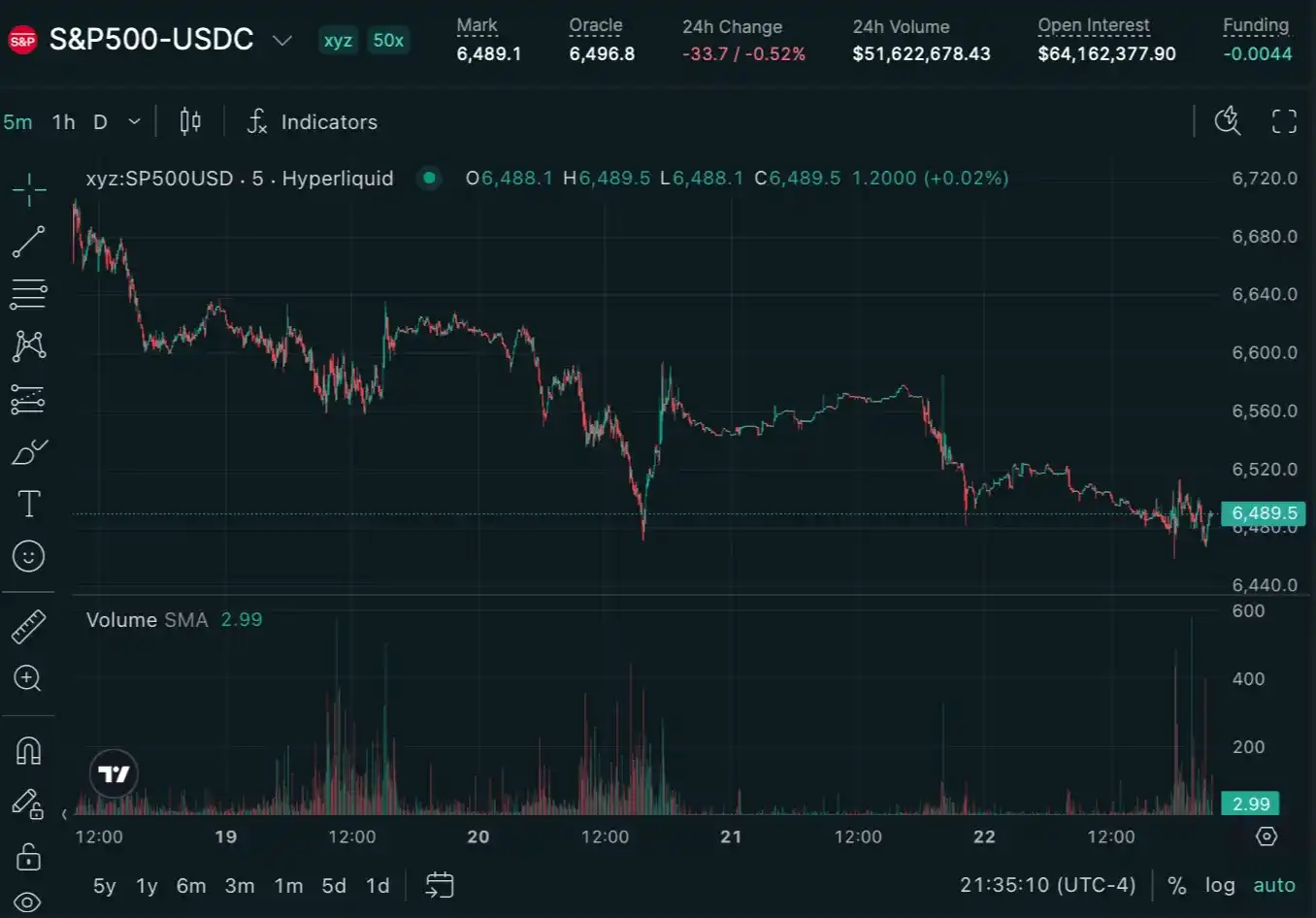
Just days after S&P Global announced it would authorize trading of the S&P 500 on Hyperliquid, Trump stated on Friday afternoon after the market closed that the U.S. is "very close to achieving our goals." The S&P 500 proxy product on Hyperliquid immediately rose.

Then, on Saturday at 7:44 PM Eastern Time, Trump escalated his threats, warning that he would strike Iran's power facilities if the Strait of Hormuz was not reopened. The reaction was instantaneous: the S&P 500 on Hyperliquid immediately fell.

But it didn't end there. On Monday morning, Trump claimed that the U.S. and Iran had held talks on a "comprehensive and thorough resolution of hostilities." S&P 500 futures surged by over 3.5%. Iran later denied Trump's statement.

Trump's presidency may not be driving the arrival of 24/7 markets, but it has made it impossible to ignore the issue.
It remains unclear which perpetual contract product will dominate or whether perpetual contracts will become the primary structure for 24/7 markets. Futures have historically been far less familiar to U.S. retail investors than options, and whether traditional brokerages can successfully promote these products to their customer base remains an open question. I am skeptical. What works in crypto markets may not seamlessly translate to traditional finance users.

Nevertheless, growth is undeniable.

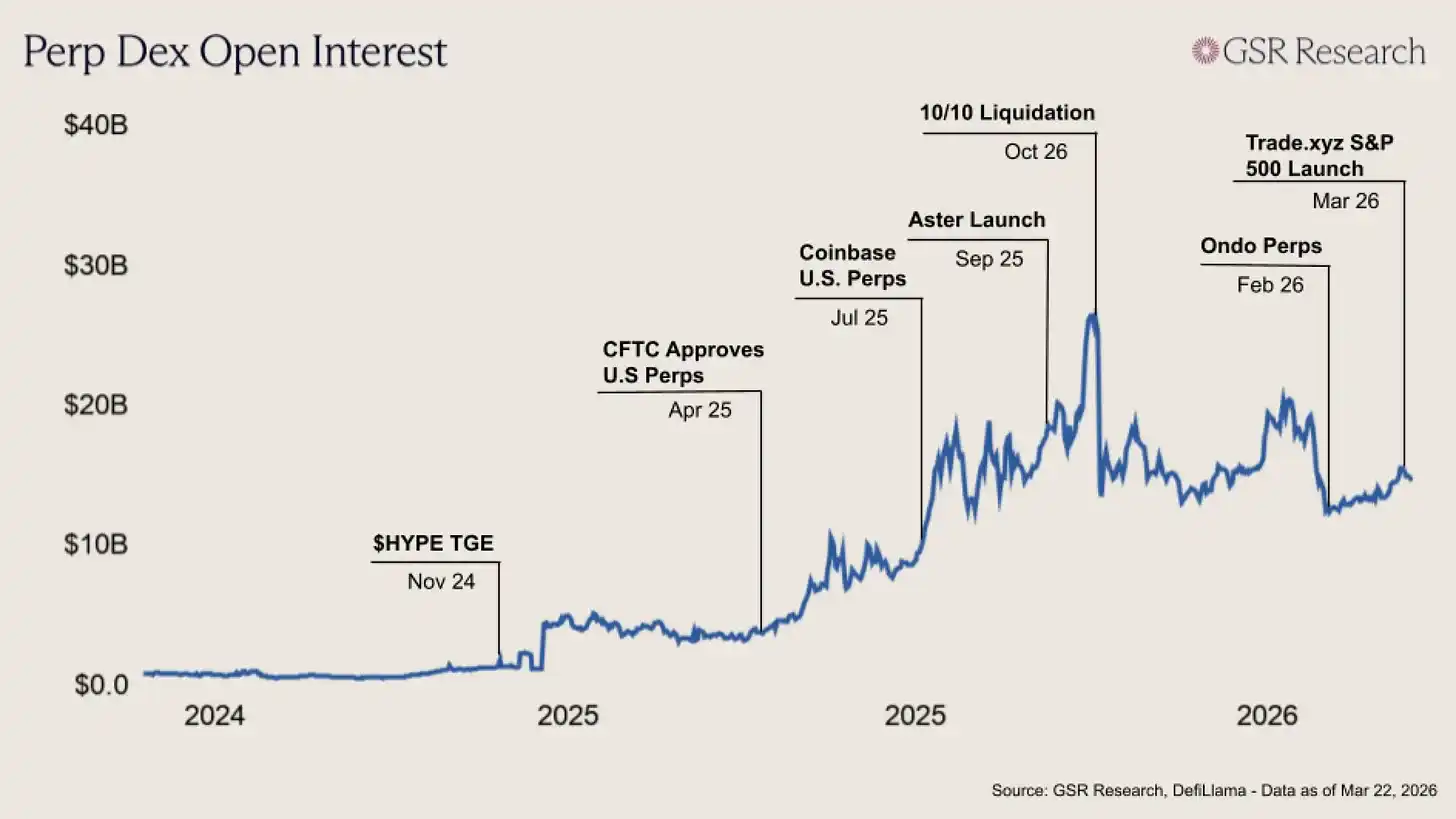
The open interest on perpetual contract DEX platforms has surged significantly. In January 2026, the trading volume of perpetual contract DEXs reached $739 billion, accounting for 10.2% of the total crypto perpetual contract trading volume on decentralized platforms—compared to just 2.0% two years ago.

As Carlos Guzman and Slater Santer of GSR Research show in the chart, news flow in both centralized and decentralized perpetual contract markets has accelerated since the HYPE TGE:
This morning, there was further momentum within the GSR ecosystem:

Katana acquired the early decentralized exchange IDEX and launched Katana Perps, a platform designed to unify spot and derivatives trading on-chain. This is the first major move by CEO Matthew Fisher since taking office, reflecting a pursuit of controlling more of the trading stack and capturing greater economic value.

This move also highlights a broader shift: the environment for perpetual contracts is becoming increasingly favorable. Here’s how Katana put it:

"This move coincides with U.S. regulators sending clear signals allowing crypto perpetual contracts, marking a potential inflection point for on-chain derivatives. At the same time, trading activity continues to migrate toward 24/7 markets, with price discovery increasingly happening in real-time rather than during fixed trading hours. As global markets adapt to new realities, macro risks no longer wait for trading hours, reinforcing the importance of a continuous 24/7 trading environment."


Preguntas relacionadas

QWhat is the main argument of the article regarding Trump and the financial markets?

AThe article argues that former President Trump, through his habit of making market-moving statements after traditional trading hours, is inadvertently accelerating the adoption and mainstream relevance of 24/7 on-chain perpetual contracts, making him a 'Perpetuals President'.

QWhich platform's S&P 500 proxy product is highlighted as reacting to Trump's tweets?

AThe S&P 500 proxy product on the Hyperliquid platform is highlighted, as it experienced significant price movements in response to a series of Trump's tweets over a single weekend.

QWhat significant change in market share for perpetual DEXs does the article mention?

AThe article states that perpetual DEX trading reached $739 billion in January 2026, accounting for 10.2% of all crypto perpetual trading volume, a significant increase from just 2.0% two years prior.

QWhat recent corporate acquisition and product launch is cited as evidence of growing momentum in the on-chain derivatives space?

AKatana acquired the early decentralized exchange IDEX and launched 'Katana Perps', a platform aiming to unify spot and derivatives trading on-chain.

QAccording to the article, what broader shift in trading is being reinforced by global macro events?

AThe article states that trading activity is shifting towards 24/7 markets, with price discovery happening increasingly in real-time, a trend reinforced by the fact that global macro risks no longer wait for traditional market hours.

Lecturas Relacionadas

In Jinjiang, Fujian, a Storage Super Unicorn Lies Quiet

In Fujian's Jinjiang, a city known for sportswear, lies a quiet semiconductor giant: Fujian Jinhua Integrated Circuit Co. (JHICC). Once a promising domestic DRAM manufacturer alongside Yangtze Memory and ChangXin Memory Technologies (CXMT), its journey was derailed in 2018 when the U.S. placed it on an Entity List and filed criminal charges for alleged trade secret theft. This halted production for years. A turning point came in February 2024 when a U.S. federal court found JHICC not guilty. However, it had lost crucial time. While CXMT soared to become a top-valued A-share company in 2024, JHICC, with an estimated valuation of 80 billion RMB, was just restarting. Its current output is primarily customized DDR4 chips, not the advanced DDR5/HBM demanded for AI, but it still benefits from the broader memory chip upcycle. JHICC's story is tied to Chen Zhengkun, a veteran engineer who left Micron to lead the venture. Founded in 2016 with state-backed funding, JHICC partnered with Taiwan's UMC to develop DRAM technology. Rapid progress was cut short by the U.S. actions, which Micron initiated, partly due to its heavy reliance on the Chinese market. Post-sanctions, Chen's team worked to rebuild the production line with reduced reliance on U.S. technology. According to its records, JHICC achieved small-scale production and revenue growth under immense pressure. It now focuses on the stable "niche" DRAM market (e.g., TVs, routers) with a monthly capacity of ~40,000 wafers, aiming for 60,000 by 2026. It holds over 1,000 patents but remains on the Entity List. For Jinjiang, investing in JHICC was a bold industrial leap. The local government provided unwavering financial and logistical support during the crisis, helping the company survive. JHICC has become the anchor for a growing local semiconductor cluster. Though its scale lags behind domestic peers, JHICC's persistence symbolizes a hard-won foothold in a global market long dominated by Samsung, SK Hynix, and Micron. Having missed one boom, it seeks a place in the new AI-driven memory supercycle.

marsbitHace 6 min(s)

In Jinjiang, Fujian, a Storage Super Unicorn Lies Quiet

marsbitHace 6 min(s)

Must-Watch Events Next Week|CLARITY Act Could Face Senate Vote; SpaceX, Circle to Report Earnings (8.3-8.9)

**Summary: Key Events and Developments to Watch (August 3-9)** The upcoming week is marked by significant financial disclosures, key legislative deadlines, and notable product updates. **Major Financial Events:** Several companies are scheduled to release their Q2 2026 earnings. American Bitcoin (ABTC) will report on August 3, followed by SpaceX and Hut 8 Mining Corp. on August 4, and Circle on August 5. Notably, a significant portion of SpaceX shares (up to 12% of total shares) will be unlocked on August 6 following their earnings release. **Key Legislative Deadline:** The U.S. Senate faces an August 7 deadline to secure 60 votes for the CLARITY Act, a bipartisan bill aiming to establish a federal regulatory framework for cryptocurrencies. The Senate may hold a full vote on the bill during the week. **Economic Data:** The U.S. July Non-Farm Payrolls report will be released on August 7, providing crucial labor market data. **Technology & Product Updates:** * **Shutdowns:** DeFi portfolio tracker Zapper and wallet app Ctrl Wallet will cease operations on August 3. * **Upgrades:** LayerZero will deprecate its v1 relayers on August 3. XRP Ledger's new version 3.3.0, featuring five new functions, is expected next week. * **AI:** Elon Musk announced that the advanced Grok 4.6 AI model is set for release around August 7. * **Bitcoin:** The BIP-110 forced signaling for a potential Bitcoin network change is scheduled to begin around August 8. **Other Notable Events:** Chinese robotics firm Unitree Tech has set its preliminary price inquiry for its IPO for August 5. South Korean exchange Upbit will delist AQT and AERGO tokens on August 3.

marsbitHace 2 hora(s)

Must-Watch Events Next Week|CLARITY Act Could Face Senate Vote; SpaceX, Circle to Report Earnings (8.3-8.9)

marsbitHace 2 hora(s)

Trading

Spot
活动图片




