Trump to begin interviews with Fed chair finalists this week: FT

cointelegraphPublished on 2025-12-10Last updated on 2025-12-10

Abstract

President Trump is set to interview finalists for the next Federal Reserve chair this week, with a decision expected in January. Treasury Secretary Scott Bessent has presented a shortlist of four candidates, including former Fed governor Kevin Warsh and National Economic Council director Kevin Hassett, who is considered the frontrunner. Other potential candidates include Fed governors Christopher Waller and Michelle Bowman, and BlackRock’s Rick Rieder. Trump has hinted he already has a preferred candidate in mind. Prediction markets currently give Hassett around a 73% chance of being selected. The appointment is expected to influence crypto markets, and Hassett has stated he would maintain an apolitical approach if chosen.

The race for the new US Federal Reserve chair is nearing the finish line, with US President Donald Trump reportedly set to begin interviewing finalists for the top job this week.

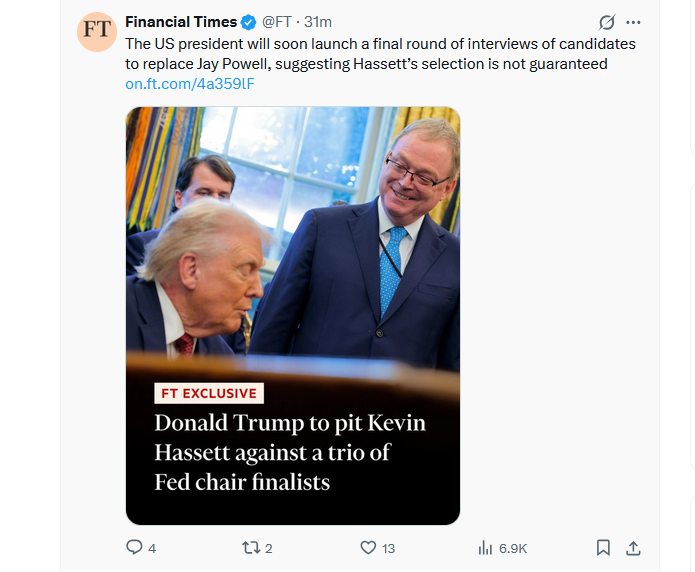
According to a report from the Financial Times (FT) on Tuesday, Treasury Secretary Scott Bessent has presented a list of four names to the White House.

One of these is former Fed governor Kevin Warsh, whom Bessent is scheduled to meet with on Wednesday. Another is National Economic Council director Kevin Hassett, who is seen as the frontrunner for the role.

Another two names would be picked from a list of other finalists, which includes Fed governors Christopher Waller and Michelle Bowman, and BlackRock chief investment officer Rick Rieder.
Source: Financial Times

Trump and Bessent are expected to hold at least one interview next week, as a decision looks likely to be announced in January.

However, Trump has revealed he already has his eye on one particular candidate.

“We’re going to be looking at a couple different people, but I have a pretty good idea of who I want,” Trump said to journalists on Air Force One on Tuesday.

Kevin Hassett is a frontrunner for Fed chair role

The upcoming round of interviews suggests that Hassett may not be the clear lock in for the role as previously thought, though he is seen as the favorite.

Earlier this month, prediction market odds on Kalshi and Polymarket shot up for Hassett significantly following comments from Trump at the White House on Dec. 2.

While welcoming guests, Trump labeled Hassett as “potential Fed chair” leading many to assume the president had let a major hint slip.

Related: Trump’s national security strategy is silent on crypto, blockchain

With Hassett’s odds spiking to 85% after Trump’s comments last week, they have since declined to around 73% for Hassett, while Warsh’s odds sit at 13% on Kalshi at the time of writing, which has floated around this range over December.
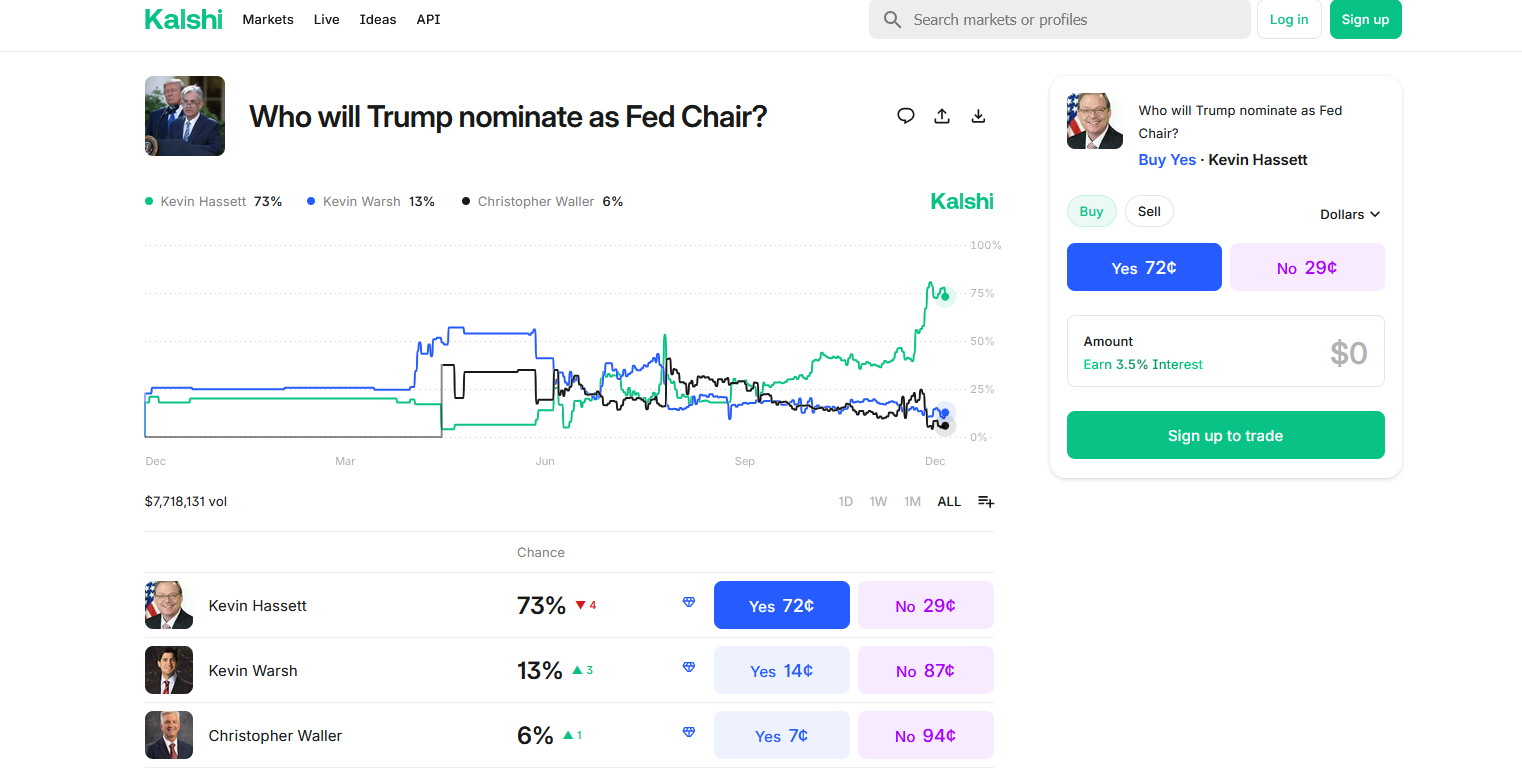
Odds for next Fed chair. Source: Kalshi

Regardless of who ends up taking over as chair, the move is bound to impact crypto markets under the new leadership.

If elected, Hassett has asserted that he will be apolitical in terms of running the Fed, despite his close ties to Trump. Speaking with The Wall Street Journal this week, Hassett said that “You just do the right thing” when asked if he would blindly follow orders from Trump.

“Suppose that inflation has gotten from, say, 2.5% to 4%. You can’t cut,” Hassett said, adding that he would rely on his own “judgment, which I think the president trusts.”

Magazine: The one thing these 6 global crypto hubs all have in common...

Related Reads

Grasp Four Keywords to Enter the Main Theme of Crypto in 2025 Early

The article "4 Major Keywords: The Four Seasons of Crypto in 2025" reviews the key developments in the cryptocurrency industry throughout 2025, a year marked by significant regulatory shifts, market volatility, and growing mainstream adoption. The year began with the "Trump Effect," as the new U.S. President took office, driving Bitcoin toward $100,000 and sparking a memecoin frenzy with TRUMP token, which reached an $80 billion market cap. Regulatory progress included the appointment of a crypto-friendly SEC chair and the proposal of a national Bitcoin reserve using seized assets. Summer saw market turbulence due to Trump's global tariff policies, causing sharp declines in both crypto and stock markets. Ethereum rebounded strongly, fueled by the rise of DAT treasury companies—public firms holding ETH and other cryptocurrencies—though many later faced significant losses. Stablecoins and PayFi gained prominence, especially after Circle’s successful public listing. Autumn brought breakthroughs in stock tokenization, with platforms like xStocks enabling on-chain trading of tokenized equities. Traditional players like Nasdaq also entered the space. Meanwhile, on-chain Perp DEXs like Aster and stablecoin projects like Plasma and WLFI attracted attention, though their tokens later declined sharply. Winter was defined by the "10·11 Great Crash," triggered by Trump’s tariff threats, resulting in over $300–400 billion in liquidations. Despite the crash, prediction markets like Polymarket and Kalshi thrived, both reaching valuations exceeding $10 billion. The year, crypto continued its path toward mainstream integration, heavily influenced by U.S. policy and traditional finance. The industry’s evolution emphasized both opportunities and risks, requiring adaptability from participants navigating this dynamic landscape.

比推Hace 9 min(s)

Grasp Four Keywords to Enter the Main Theme of Crypto in 2025 Early

比推Hace 9 min(s)

x402 V2 Released: What Are the Core Highlights?

The x402 protocol, initially developed by Coinbase, has now released its V2 upgrade. The core idea remains leveraging the HTTP 402 status code to embed payment logic directly into web requests. Since its launch, x402 has processed over 100 million payments across various use cases, such as API calls and AI agents purchasing compute resources. V2 introduces several major improvements. It supports wallet-based identity (e.g., Sign-In-With-X via CAIP-122) and reusable sessions, allowing users and autonomous agents to avoid repeated on-chain payments after initial authentication, significantly reducing latency and cost for high-frequency interactions. A unified payment interface now supports multiple chains (including Base and Solana) by default and integrates traditional payment rails like ACH and credit cards through Facilitators. Dynamic payTo routing enables complex pricing models and multi-tenant setups. The architecture is now modular and plugin-based, making it easier for developers to extend support for new chains or payment methods without altering core SDK code. Configuration is simplified, with automatic optimization based on developer preferences. A new discovery mechanism allows services to publish structured metadata, which Facilitators can automatically index, ensuring pricing and endpoint information stays current without manual updates. For end-users, V2 enables seamless, near-invisible payments with a "micro-subscription" feel. Developers benefit from reduced integration effort, dynamic pricing capabilities, and more flexible business logic. AI agents can autonomously transact using endowed wallets, making independent economic decisions. Overall, x402 V2 evolves from a pay-per-use tool into a versatile economic layer for the internet, though widespread adoption, modular risks, and regulatory challenges remain.

marsbitHace 21 min(s)

x402 V2 Released: What Are the Core Highlights?

marsbitHace 21 min(s)

Trading

Spot
Futures
活动图片