Trump Family-Linked Crypto Company Faces More Scrutiny Over Auditor Controversy

bitcoinistPublicado a 2025-12-30Actualizado a 2025-12-30

Resumen

Trump-linked crypto treasury company Alt5 Sigma faces intensified scrutiny and potential Nasdaq delisting after appointing an auditor with an expired license and regulatory violations. The firm, which rebranded to hold Donald Trump’s WLFI token, failed to file quarterly reports and has seen high-level departures, including Eric Trump. Its newly hired auditor, Victor Mokuolu CPA, had its license expired in Texas and previously failed a peer review. Alt5 Sigma has since replaced the auditor amid ongoing compliance issues and risks violating audit committee requirements.

Recent reports claim that the internal turmoil of a crypto treasury company backed by the Trump family has deepened as the firm risks being delisted from Nasdaq and has appointed an audit company facing regulatory scrutiny.

Crypto Treasury Company’s Turmoil Intensifies

On Monday, Nasdaq-listed crypto treasury company Alt5 Sigma is facing renewed scrutiny after appointing a new audit company with an expired and inactive license earlier this month, the Financial Times initially reported.

The Las Vegas-based company rebranded from a biotech company to a Digital Asset Treasury Company (DAT) earlier this year, seeking to become the first publicly traded firm to accumulate WLFI, the token of US President Donald Trump’s crypto ventures, World Liberty Financial.

As the report noted, the company’s financial position has turned murky over the past few months due to its failure to file quarterly results on schedule. Now, its recent switch of auditors has deepened its current position as the newly appointed firm, Victor Mokuolu CPA PLLC, was allegedly fined by accounting regulators and failed an inspection under the standard peer review process.

According to the Financial Times, filings in the state of Texas show that the company’s licence expired in August. Meanwhile, the board’s records show that its license has not been renewed by December 26. Therefore, state regulations prohibit the firm from doing any audit work until the licence is renewed.

The audit company has reportedly been working for over two years to address its deficiencies, which previously resulted in a failing grade under the accounting profession’s peer review process in 2023.

This year’s failure to renew its license follows the Texas State Board of Public Accountancy and another US regulator’s actions against the firm for “repeatedly failing to file regulatory paperwork on time.”

In a statement to the news media outlet, Alt5 Sigma affirmed that the auditor is “undergoing a peer review per Texas State Board of Accountancy regulations and will be completed by the end of January 2026, at which point the auditor expects the firm’s licence to be active.”

The Trump-backed crypto treasury firm emphasized that “No reviews or audits of Alt5’s financial statements will be issued by our auditor until the firm’s licence is active.”

In an update, the Financial Times added that Alt5 Sigma fired the audit firm on Christmas Day following its inquiries about the issue. A regulatory filing made on Monday reportedly shows that the company has hired LJ Soldinger Associates as its new accounting firm.

Alt5 Sigma Risks Nasdaq Delisting

The controversial December 8 appointment comes amid a period of turmoil for the company, the report noted, as it already risks being delisted from Nasdaq, where it trades under the ticker “ALTS.”

The company failed to submit its quarterly results for the period ending in late September, blaming the delay on the “timeliness and responsiveness” of its previous auditor, who seemingly quit last month. This has opened the door to a potential delisting from the stock exchange.

In August, World Liberty Financial unveiled its partnership with Alt5 Sigma and became an investor in the technology firm, which sought to raise $1.5 billion for its crypto treasury strategy based on WLFI.

As a result, multiple World Liberty Financial co-founders joined Alt5 Sigma’s board. Notably, Zach Witkoff, son of President Trump’s Special Envoy Steve Witkoff, was appointed as chairman of the crypto treasury firm.

Similarly, Eric Trump joined the company’s board as a director, while Zak Folkman became a board observer. Nonetheless, Trump stepped down from his position in September, just weeks after being appointed, as revealed in a Securities and Exchange Commission (SEC) filing

Jonathan Hugh, Alt5’s Chief Financial Officer (CFO), left the company after just three months, while chief executive Peter Tassiopoulos resigned in October. Meanwhile, board member David Danziger parted ways with the firm in November.

This also puts the company “in violation of a requirement to have an audit committee of a certain size and with accounting experience,” the report concluded.
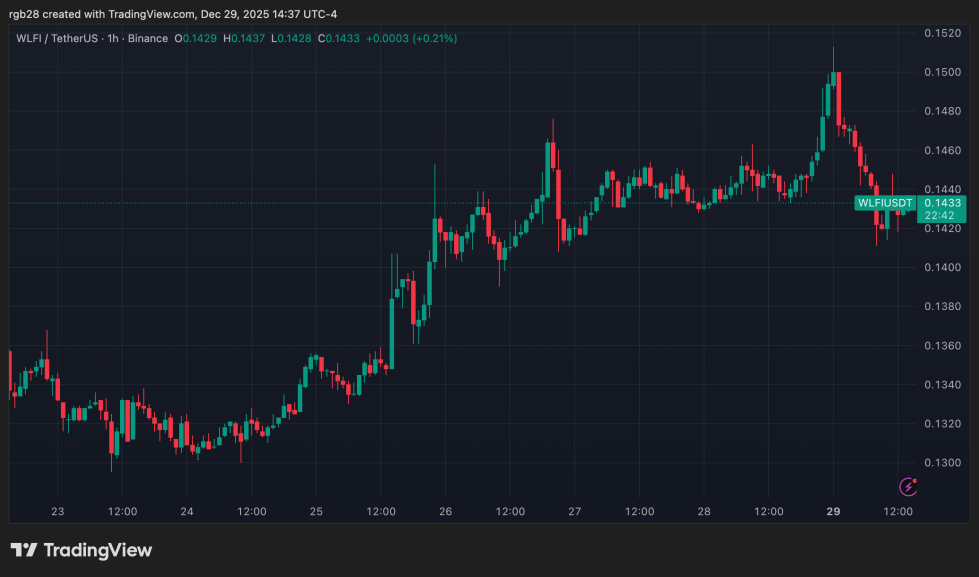
WLFI trades at $0.14 in the one-week chart. Source: WLFIUSDT on TradingView


Preguntas relacionadas

QWhat is the name of the crypto treasury company backed by the Trump family that is facing scrutiny?

AThe company is called Alt5 Sigma.

QWhy is Alt5 Sigma at risk of being delisted from Nasdaq?

AThe company failed to submit its quarterly results for the period ending in late September, which opens the door to a potential delisting.

QWhich audit firm did Alt5 Sigma initially appoint in December, and what was the main issue with it?

AThe company initially appointed Victor Mokuolu CPA PLLC, whose license had expired and was inactive, and the firm had been fined by regulators and failed a peer review.

QWhich member of the Trump family briefly served on Alt5 Sigma's board of directors?

AEric Trump joined the company's board as a director but stepped down from his position in September, just weeks after being appointed.

QWhat is the primary cryptocurrency token that Alt5 Sigma's treasury strategy is based on?

AThe strategy is based on WLFI, the token of former US President Donald Trump's crypto ventures, World Liberty Financial.

Lecturas Relacionadas

NVIDIA Begins Adding Soap to the Bubble

NVIDIA is taking on a dual role: not just as a leading chip supplier, but as a massive capital allocator across the entire AI supply chain. In 2026, the company has committed over $40 billion in investments within five months, targeting everything from optical fiber manufacturing and data center operations to foundational AI model development. This investment spree, described as a systematic "sprinkler" approach, primarily funds companies that are major buyers of NVIDIA's own GPUs. Critics, including analysts from Goldman Sachs, label this a "circular revenue" loop—comparable to a supplier financing a customer to buy more of its products. A prominent example is NVIDIA's investment in OpenAI, which is expected to generate around $13 billion in revenue for NVIDIA, much of which may be reinvested back into OpenAI. While CEO Jensen Huang dismisses the "circular financing" critique as "absurd," arguing the investments are confidence votes in long-term generational shifts, some analysts express discomfort. They note that while investments in critical supply chain components like optics are strategically sound, funding new cloud providers like CoreWeave feels like "pre-paying for your own GPUs." The strategy carries significant risks. If the AI investment cycle turns, the market may question how much demand is genuine versus artificially sustained by NVIDIA's own balance sheet. Despite posting record-breaking earnings—$215.9 billion in annual revenue and $120 billion in net profit for FY2026—NVIDIA's stock fell after its report, signaling that "beating expectations" may no longer be enough to assure investors about the duration of the AI spending boom. The article concludes that while a bubble isn't necessarily a fraud, NVIDIA's actions resemble adding soap to a bubble—making it appear more robust and durable. This creates a complex scenario requiring extreme冷静 from investors to distinguish between real structural growth and financial engineering.

marsbitHace 13 min(s)

NVIDIA Begins Adding Soap to the Bubble

marsbitHace 13 min(s)

Short Positions Have Been Squeezed Out: Will the Next Leg of the U.S. Stock AI Rally Continue in Seoul?

"Short Squeeze Exhausted: Will the Next Leg of the AI Rally Continue in Seoul?" A Nomura report suggests the US AI stock rally, which saw the S&P 500 rise ~16.6% in 28 days largely driven by 10 key stocks, may be pausing. The fuel from short covering, CTA fund positioning, and volatility-control strategies is nearing its limit. For the rally to continue, new momentum from retail and sentiment-driven FOMO (Fear Of Missing Out) is needed. South Korea's market provided a potential answer on the very day the report was published. The KOSPI index surged 4.32%, triggering a buy-side circuit breaker, led by massive gains in chip giants SK Hynix (+11.98%) and Samsung. This surge is characterized by retail "hynix FOMO" and overseas funds precisely buying into AI themes via chip-focused ETFs, shifting from broad Korean market ETFs. The Korean rally is a high-beta extension of the US AI capital expenditure story, as major cloud providers plan massive infrastructure spending, directly benefiting memory chip leaders. However, this linkage also implies vulnerability. The sustainability of this next leg depends on whether US tech stocks correct, the trajectory of US inflation (with upcoming CPI data key), and geopolitical tensions around the Strait of Hormuz. Seoul has emerged as the new epicenter of the AI trade, but its fate remains tied to these broader macro and market dynamics.

marsbitHace 18 min(s)

Short Positions Have Been Squeezed Out: Will the Next Leg of the U.S. Stock AI Rally Continue in Seoul?

marsbitHace 18 min(s)

Borrowing Money from a Hundred Years Later, Building Incomprehensible AI

Tech giants like Alphabet, Amazon, Meta, and Microsoft are undergoing a radical financial transformation due to AI. Their traditional "light-asset, high-free-cash-flow" model is being dismantled by staggering capital expenditures on AI infrastructure—data centers, GPUs, and power. Combined 2026 guidance exceeds $700 billion, a 4.5x increase from 2022, causing free cash flow to plummet (e.g., Amazon's fell 95%). To fund this, they are borrowing unprecedented sums through long-dated, multi-currency bonds (e.g., Alphabet's 100-year bond). The world's most conservative capital—pensions, insurers—is now funding Silicon Valley's most speculative bet. This shift makes these companies resemble heavy-asset industrials (railroads, utilities) rather than software firms, threatening their premium valuations. Historically, such infrastructure booms (railroads, fiber optics) followed a pattern: genuine technology, overbuilding fueled by competitive frenzy, aggressive debt financing, and a crash triggered by financial conditions—not technology failure. The infrastructure remained, but many original builders and financiers did not survive. The core gamble is a "time arbitrage": using cheap debt today to build scale and lock in customers before AI capabilities commoditize. They are betting that AI revenue will materialize before debt comes due. Their positions vary: Amazon is under immediate cash pressure; Meta's path to monetization is unclear; Alphabet has a robust core business buffer; Microsoft has the shortest path from infrastructure to revenue. The contract is set: the most risk-averse global capital has lent its time to Silicon Valley, awaiting a future that is promised but uncertain.

marsbitHace 1 hora(s)

Borrowing Money from a Hundred Years Later, Building Incomprehensible AI

marsbitHace 1 hora(s)

Trading

Spot
Futuros
活动图片




