Trump Administration Backs Kalshi and Polymarket as Nevada Moves to Enforce Ban

bitcoinistPublicado a 2026-02-19Actualizado a 2026-02-19

Resumen

A legal battle over prediction markets is intensifying in the U.S. as federal regulators, backed by the Trump administration, support operators Kalshi and Polymarket, while Nevada moves to enforce a ban. The dispute centers on whether prediction markets are financial products under federal oversight or a form of gambling subject to state regulation. Nevada’s Gaming Control Board filed a lawsuit to block Kalshi from offering sports-related event contracts, arguing they constitute unlicensed gambling. Kalshi contends its contracts are financial derivatives regulated by the CFTC, which has filed a brief supporting federal jurisdiction. The outcome could define the regulatory boundary between financial markets and gambling nationwide.

A growing legal clash over prediction markets in the United States is intensifying after federal regulators aligned with the Trump administration stepped in to support industry operators Kalshi and Polymarket, even as Nevada moves forward with enforcement action to shut down parts of their businesses.

The dispute raises a broader question facing courts and regulators: whether prediction markets are financial products governed by federal law or a form of online gambling subject to state control.

The latest developments came after the U.S. Court of Appeals for the Ninth Circuit rejected Kalshi’s request to pause enforcement actions by Nevada regulators. Within hours of the decision, the Nevada Gaming Control Board filed a civil lawsuit seeking to block the platform from offering sports-related event contracts to state residents.
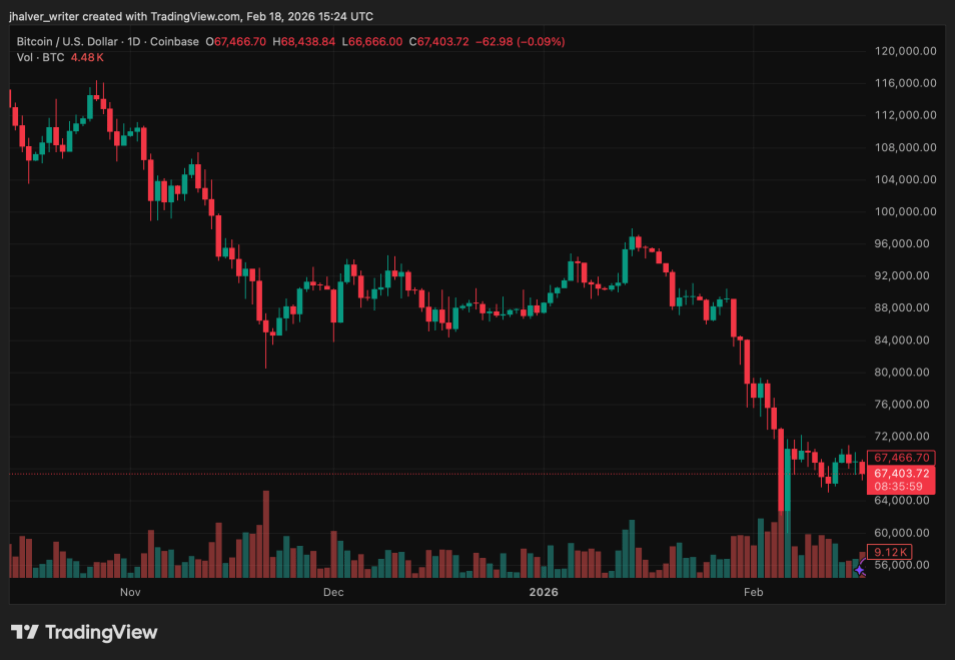
BTC's price trends to the downside on the daily chart. Source: BTCUSD on Tradingview 

Nevada Pushes Gambling Enforcement

Nevada regulators argue that Kalshi’s event contracts, which allow users to trade on outcomes such as sports results, function similarly to traditional sports betting and therefore require a state gaming license.

Officials say the company is offering unlicensed wagering that violates Nevada’s gaming laws and undermines the state’s tightly regulated betting market.

The lawsuit seeks an injunction that could force Kalshi to halt its local operations while litigation continues. The state has taken similar action against other platforms, reflecting a wider effort by multiple jurisdictions to limit prediction markets they view as gambling products.

Kalshi disputes that characterization, maintaining that its contracts are financial derivatives, not bets. The company operates as a federally regulated exchange and has moved to have the case transferred to federal court, arguing that state laws are preempted by federal oversight.

Federal Regulators Enter the Fight

At the center of the dispute is the Commodity Futures Trading Commission (CFTC), which, under Chairman Michael Selig, has taken a more active stance in defending prediction markets. The agency filed an amicus brief supporting federal jurisdiction, arguing that states cannot reclassify federally regulated derivatives trading as illegal gambling.

The Trump administration’s backing of Kalshi and Polymarket shows a broader policy shift toward treating prediction markets as part of the financial system rather than the gambling industry. Federal officials argue that allowing individual states to impose bans could create fragmented regulation and undermine national derivatives markets.

Prediction platforms allow participants to buy contracts priced between one and 99 cents based on the probability of real-world events occurring. While markets cover politics, economics, and weather outcomes, sports-related contracts account for the majority of trading volume.

What Comes Next for Prediction Markets

The legal battle is unfolding across several courts and could ultimately determine who regulates prediction markets nationwide. States, including Massachusetts, Tennessee, and others, have issued lawsuits or cease-and-desist orders, while operators continue to argue for federal protection.

Nevada’s enforcement action increases immediate pressure on Kalshi, though appeals, including a potential emergency request to the U.S. Supreme Court, remain possible.

The outcome could reshape how Americans participate in event-based trading and define the boundary between financial speculation and online gambling for years to come.

Cover image from ChatGPT, BTCUSD chart from Tradingview

Preguntas relacionadas

QWhat is the core legal dispute surrounding prediction markets like Kalshi and Polymarket in the United States?

AThe core legal dispute is whether prediction markets are financial products governed by federal law (specifically, as derivatives regulated by the CFTC) or a form of online gambling subject to state control and licensing.

QWhich federal agency has intervened to support Kalshi and Polymarket, and what is its argument?

AThe Commodity Futures Trading Commission (CFTC), under Chairman Michael Selig, has intervened. It filed an amicus brief arguing that states cannot reclassify federally regulated derivatives trading as illegal gambling, as this would undermine national derivatives markets and create fragmented regulation.

QWhat specific action did Nevada regulators take against Kalshi, and what is their justification?

ANevada regulators filed a civil lawsuit seeking an injunction to block Kalshi from offering sports-related event contracts to state residents. They argue these contracts function like traditional sports betting and therefore require a state gaming license, making their current operation unlicensed wagering that violates state law.

QHow does Kalshi define its own event contracts, and what action has it taken in response to Nevada's lawsuit?

AKalshi defines its event contracts as financial derivatives, not bets. In response to Nevada's lawsuit, the company has moved to have the case transferred to federal court, arguing that state laws are preempted by federal oversight.

QWhat broader policy shift does the Trump administration's backing of these prediction markets represent?

AIt represents a policy shift toward treating prediction markets as part of the financial system rather than the gambling industry, aiming to prevent fragmented state-level regulation that could undermine the national derivatives market.

Lecturas Relacionadas

a16z Partner: Being in the Flow of Capital Is the True Moat

A16z Partner: Standing in the Cash Flow is the True Moat Historically, many of the strongest companies built their moats by positioning themselves within "cash flows"—facilitating value creation and transfer in a network and taking a cut. The more value flows, the larger they grow. Crypto is the first modern technology natively built for this. With open ledgers, programmable settlement, and stablecoins enabling internet-speed global value transfer, it allows startups to inherit network effects from day one. Well-designed tokens align users, developers, and the protocol towards network growth, distributing value to contributors. This model isn't new (e.g., railroads, Visa, Google, AWS) but Crypto democratizes it. It lets entrepreneurs target areas with high inefficiency and profit extraction—like traditional finance's payments, custody, FX, and settlement—to compress costs, increase speed, and redistribute value by standing in the new flow. The opportunity extends beyond finance to emerging markets like GPU/compute, AI training data, energy, and space, where new, programmable infrastructure can be built without legacy constraints. Key questions for founders: Are you already in the cash flow? Does your revenue scale 10x with network activity? Where is profit extraction highest relative to value created in your market? The strategy is clear: compress the old cost structure, position yourself in the new value stream, and let the network compound.

marsbitHace 19 min(s)

a16z Partner: Being in the Flow of Capital Is the True Moat

marsbitHace 19 min(s)

Capturing 15 Top-Tier Zero-Day Vulnerabilities: A Consensus Protocol Debug Agent Framework Built by 0G Lab in Collaboration with Teams from NUS, PKU, and BUPT

"Agents Capture 15 Critical Zero-Day Bugs: 0G Lab's Multi-Agent Framework Automates Debugging in Consensus Protocols" Distributed consensus protocols are notoriously difficult to debug due to complex, intertwined states. A novel framework, Agora, developed by 0G Labs with researchers from NUS, Peking University, and Beijing University of Posts and Telecommunications, tackles this by fusing deep domain expertise with a collaborative multi-agent LLM architecture. Agora moves beyond the limitations of single LLMs and traditional testing like fuzzing. It employs three specialized agents: an Orchestrator for global state, a Strategy agent for generating attack scenarios using distributed systems knowledge, and a TestGen agent that creates executable tests. A core innovation is its efficient "Succinct Memory & Communication" mechanism and a dynamic test harness. This allows the system to translate abstract hypotheses into concrete tests across languages like Go and Rust, run them, capture failures, and refine the approach in a closed loop—all with minimal token overhead. In rigorous evaluations on production-level protocols including Raft, EPaxos, and components from etcd and Sui, Agora discovered 15 previously unknown deep logic bugs (e.g., execution divergence, liveness violations). In stark contrast, powerful standalone LLMs like GPT-5.2 and Claude 4.5 found zero such bugs. Agora achieved this with a high precision of 73.9% and at an average cost of only about $40 per bug found. The framework demonstrates high generalizability. Its decoupled design allows the "Multi-Agent + Hypothesis-Driven Testing" paradigm to be applied to other complex domains like database concurrency control, OS kernels, and Web3 smart contract auditing. By enabling efficient, automated detection of deep logic flaws, Agora points the way for AI-powered security in critical infrastructure, aligning with the growing trends of agentic systems and automated quality control.

marsbitHace 22 min(s)

Capturing 15 Top-Tier Zero-Day Vulnerabilities: A Consensus Protocol Debug Agent Framework Built by 0G Lab in Collaboration with Teams from NUS, PKU, and BUPT

marsbitHace 22 min(s)

a16z crypto Partner: Cash Flow Is the True Moat

Title: a16z Crypto Partner: Capital Flow is the True Moat In business history, enduringly successful enterprises often share a core logic: capturing value by facilitating its creation and transfer within an ecosystem, taking a share of the proceeds. The scale of value flowing through the ecosystem directly correlates with the company's growth. Cryptography is the first modern technology natively suited to this commercial logic. Startups that don't leverage this framework in product design and business model construction miss significant opportunities. Stablecoins enable internet-speed, 24/7 global settlement of value with end-to-end programmability. With open underlying channels for capital flow and transparent unit economics, every circulating dollar globally represents potential flow in this arena. Blockchain is inherently a network business model. All transactions are recorded on a shared ledger, and each new participant strengthens this foundational system for future developers. More users and applications increase the network's value for all. Crypto entrepreneurs start with built-in network effects, unlike traditional businesses that spend years building them on legacy infrastructure. Network tokens amplify this advantage. A well-designed token system aligns users, developers, service providers, and validators around a common goal—network growth—while distributing rewards based on contribution. All proceeds flow back to ecosystem participants, creating a virtuous cycle of value circulation. This is not a new logic; the crypto industry simply makes it easier for startups to implement and scale. Historic giants like railroads, Standard Oil, AT&T, and modern leaders like Google and AWS succeeded by positioning themselves at critical junctures of value flow. In finance, Visa processed $15.7 trillion in payments (net revenue: $35.9B), and top market makers like Jane Street thrive by being in the path of order flow, benefiting from volume. Combining capital flow with network effects creates one of business's most robust models. As Jeff Bezos noted, "Your margin is my opportunity." This is acutely true in traditional finance, where sectors like payments, custody, and settlements extract significant fees (e.g., 2-3% for card networks, 6-9% for cross-border transfers). These profits represent opportunities for disruption by reducing costs and increasing efficiency, as proven by Stripe and Square in payments. Crypto founders can build the next-generation infrastructure: programmable, instant, global, and inherently embedded in capital flow paths. Opportunities extend beyond finance to markets like compute/GPU trading, AI training data, energy, robotics, and critical minerals—areas poised for massive global value movement that existing channels cannot handle. These are blue oceans for new, programmable infrastructure centered on capital flow, free from entrenched platforms and intermediaries. Founders should ask: Is your business at the heart of a value flow? Does your revenue scale 10x with ecosystem transaction growth? Where are the highest margins relative to value created in your target market? The answers point to the opportunity: cut existing costs, enter new value flow arenas, and grow through network effects.

Foresight NewsHace 23 min(s)

a16z crypto Partner: Cash Flow Is the True Moat

Foresight NewsHace 23 min(s)

Unveiling the 'White-haired Stock God' Serenity: A Spiritual Remedy for Anxious Retail Investors

The article details the rise of Serenity, dubbed the "White-Haired Stock God," whose social media posts have recently caused significant volatility in China's A-share market. Previously gaining fame in international retail investor communities, Serenity is known for his "Chokepoint Investment" strategy targeting small monopolies in the AI supply chain, reportedly achieving returns over 3612% this year. His influence stems from his background as a former AI research scientist, detailed analysis, and a massive following on X, where his subscriber count has surpassed Elon Musk's. In early June, Serenity's Chinese-language posts mentioning A-shares like LeaderDrive (Lide Xiebo), Easun, and Innolight triggered immediate 20% surges in their stock prices. He later clarified that some recommendations were crowdsourced from followers and claimed he did not hold positions in these stocks, stating his actions were "just for fun" to offer a foreign perspective on Chinese markets. This activity drew scrutiny from Chinese financial media, which warned of potential "pump-and-dump" schemes and legal risks. While anonymous, clues suggest Serenity is likely a Chinese-speaking individual living in Japan. He maintains his anonymity due to past harassment but enjoys substantial monthly income from his paid subscriptions. The article posits that Serenity embodies the market's current appetite for a charismatic, successful figure during the AI bull run, serving as an "outward projection" of bullish sentiment. It concludes by noting the cyclical nature of such market icons, warning that the same crowds that elevate them often seek scapegoats when trends reverse.

Odaily星球日报Hace 28 min(s)

Unveiling the 'White-haired Stock God' Serenity: A Spiritual Remedy for Anxious Retail Investors

Odaily星球日报Hace 28 min(s)

Unveiling the 'White-Haired Stock God' Serenity: The Mental Elixir for Anxious Retail Investors

The anonymous stock influencer known as "White-Haired Stock God" Serenity has ignited a frenzy in the A-share market. From June 5-9, Serenity's posts on platform X mentioning A-shares like LeaderDrive, Easun, and Innolight triggered sharp price surges, with some stocks hitting 20% daily limits. Serenity, who claims a 3612% personal return this year, gained fame internationally using a "chokepoint investment" strategy focused on small, monopolistic AI supply chain companies. With over 810k X followers, his influence rivals top analysts. His recent foray into Chinese stocks, which he claims is "for fun" to offer a "foreign perspective," has drawn scrutiny. While Serenity denies holding positions in these A-shares and states his posts are not recommendations, his actions have caused significant market volatility. He monetizes through a $1/month subscription, earning an estimated $54k monthly. Facing accusations of market manipulation, he maintains he promotes "information democracy." Community analysis suggests Serenity is likely an English-speaking Chinese national living in Japan, based on his posting patterns and shared personal details. He maintains anonymity due to past harassment. Ultimately, Serenity is seen by many as a manifestation of the current AI bull market's euphoria—a mysterious, seemingly successful figure who fulfills the market's desire for a "stock god," though such personas often face intense scrutiny when market sentiment shifts.

marsbitHace 29 min(s)

Unveiling the 'White-Haired Stock God' Serenity: The Mental Elixir for Anxious Retail Investors

marsbitHace 29 min(s)

Trading

Spot
Futuros

Artículos destacados

Cómo comprar BAN

¡Bienvenido a HTX.com! Hemos hecho que comprar Comedian (BAN) sea simple y conveniente. Sigue nuestra guía paso a paso para iniciar tu viaje de criptos.Paso 1: crea tu cuenta HTXUtiliza tu correo electrónico o número de teléfono para registrarte y obtener una cuenta gratuita en HTX. Experimenta un proceso de registro sin complicaciones y desbloquea todas las funciones.Obtener mi cuentaPaso 2: ve a Comprar cripto y elige tu método de pagoTarjeta de crédito/débito: usa tu Visa o Mastercard para comprar Comedian (BAN) al instante.Saldo: utiliza fondos del saldo de tu cuenta HTX para tradear sin problemas.Terceros: hemos agregado métodos de pago populares como Google Pay y Apple Pay para mejorar la comodidad.P2P: tradear directamente con otros usuarios en HTX.Over-the-Counter (OTC): ofrecemos servicios personalizados y tipos de cambio competitivos para los traders.Paso 3: guarda tu Comedian (BAN)Después de comprar tu Comedian (BAN), guárdalo en tu cuenta HTX. Alternativamente, puedes enviarlo a otro lugar mediante transferencia blockchain o utilizarlo para tradear otras criptomonedas.Paso 4: tradear Comedian (BAN)Tradear fácilmente con Comedian (BAN) en HTX's mercado spot. Simplemente accede a tu cuenta, selecciona tu par de trading, ejecuta tus trades y monitorea en tiempo real. Ofrecemos una experiencia fácil de usar tanto para principiantes como para traders experimentados.

567 Vistas totalesPublicado en 2024.12.11Actualizado en 2026.06.02

Cómo comprar BAN

Discusiones

Bienvenido a la comunidad de HTX. Aquí puedes mantenerte informado sobre los últimos desarrollos de la plataforma y acceder a análisis profesionales del mercado. A continuación se presentan las opiniones de los usuarios sobre el precio de BAN (BAN).

活动图片













