TRON Integration Pushes Kolo Further Into Real-World Stablecoin Payments – Details

bitcoinistPublicado a 2026-02-05Actualizado a 2026-02-05

Resumen

Kolo's integration with the TRON network enables direct TRC-20 USDT transfers to Kolo cards, allowing near-real-time settlement after on-chain confirmation. This move aims to reduce reliance on traditional exchanges and banking systems, streamlining the use of on-chain liquidity for everyday payments. Amid broader crypto volatility, TRON is defending the $0.30 price level, with its technical structure remaining intact despite market weakness. TRX continues to trade within a key consolidation range, supported by rising long-term moving averages and declining selling pressure. Kolo has processed over $250 million in transactions, with 30% occurring on the TRON network, highlighting TRON’s growing role in real-world payments. Lower transaction costs and faster confirmations make TRON suitable for frequent, smaller transactions. The network has also surpassed Ethereum in USDT circulating supply, reflecting its increasing adoption in practical, real-world stablecoin usage.

Trusted Editorial content, reviewed by leading industry experts and seasoned editors. Ad Disclosure

TRON is attempting to defend the $0.30 level as broader crypto markets remain under sustained selling pressure and risk appetite stays fragile. Price action across major assets has been dominated by deleveraging and reduced spot participation, leaving altcoins particularly exposed to downside volatility. Within this context, TRON’s ability to hold key technical levels is being closely watched, not only as a price signal but also as a reflection of ongoing network activity and real-world usage.

Against this uncertain market backdrop, Kolo announced its integration with the TRON network, enabling direct TRC-20 USDT transfers to Kolo cards with near-real-time settlement following on-chain confirmation. The integration allows funds to move from the TRON network to payment cards without relying on traditional exchange withdrawals or banking rails, reducing settlement delays that have historically limited practical usage of on-chain liquidity.

Rather than signaling speculative expansion, this development highlights an operational use case at a time when markets are contracting. With stablecoin flows increasingly concentrated on the TRC-20 USDT standard, the integration underscores how existing blockchain infrastructure is being used to support everyday transactions even during market stress.

TRON’s Growing Role in Stablecoin Payments

Recent data around Kolo provides useful context for understanding TRON’s role in today’s stablecoin market. Kolo has processed more than $250 million in total transaction volume to date, with roughly 30% of that activity executed directly on the TRON network. This concentration is notable given the broad range of chains available for stablecoin transfers and points to sustained usage rather than short-term experimentation.

The platform has also recorded a high number of individual deposits, reinforcing the idea that TRC-20 USDT is increasingly used as a settlement rail for everyday payments and routine transfers, rather than solely for trading or arbitrage.

Lower transaction costs and faster confirmation times make the TRON network particularly suited for smaller, frequent payments, which tend to dominate real-world spending behavior. Kolo’s design emphasizes speed and operational simplicity, allowing users to open an account, complete verification, and begin spending within minutes, while remaining fully compliant with global KYC and AML requirements.

At the network level, this activity aligns with a broader structural shift. TRON has now surpassed Ethereum in USDT circulating supply, reflecting where stablecoins are actually being held and moved at scale.
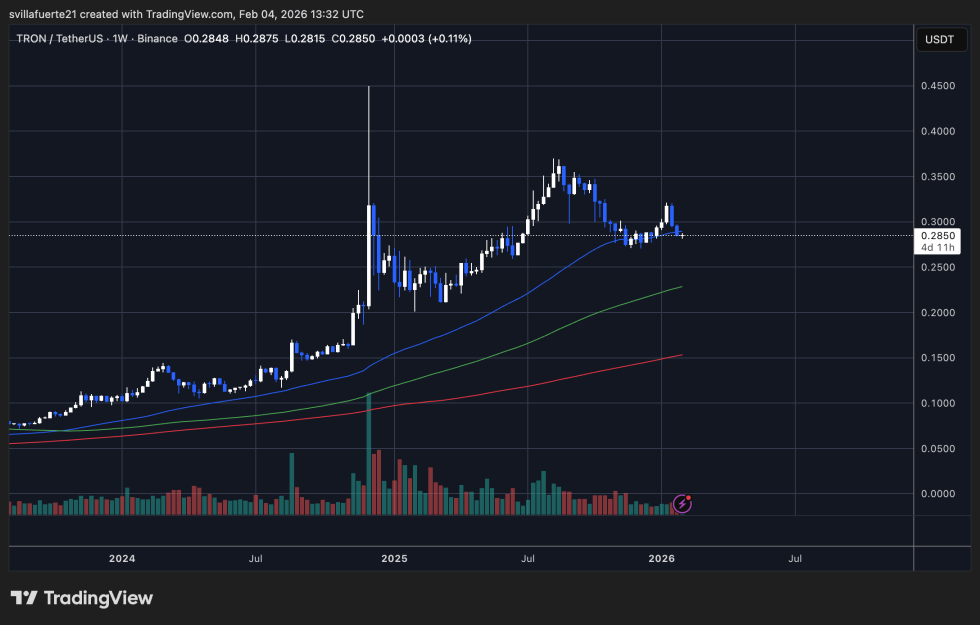

TRX Price Holds Key Structure Amid Market Weakness

TRON (TRX) continues to trade near the $0.28–$0.30 zone, a level that has become structurally important on the weekly chart. After a strong advance throughout 2024, price entered a consolidation phase following the sharp spike and rejection above the $0.35 area. Since then, TRX has been moving sideways, suggesting the market is digesting prior gains rather than entering a clear distribution phase.

TRX testing critical demand level | Source: TRXUSDT chart on TradingView

From a trend perspective, the broader structure remains constructive. Price is still holding above the rising 100-week moving average (blue), which has acted as dynamic support during pullbacks. The 200-week moving average (green) continues to slope higher well below the current price, reinforcing that the long-term trend remains intact despite recent volatility. The 50-week moving average (red) also continues to rise, indicating that long-term momentum has not yet broken.

Volume behavior supports this interpretation. The largest volume spike occurred during the impulsive rally, while recent weeks show declining activity, consistent with consolidation rather than aggressive selling. This suggests sellers are not pressing the market with urgency.

However, the inability to decisively reclaim and hold above $0.30 highlights near-term caution. A sustained break below the $0.27–$0.28 range would weaken the structure and expose deeper support near the 100-week average. Conversely, a clean weekly close above $0.30 would signal renewed strength and open the door for a retest of prior highs.

Featured image from ChatGPT, chart from TradingView.com 

Editorial Process for bitcoinist is centered on delivering thoroughly researched, accurate, and unbiased content. We uphold strict sourcing standards, and each page undergoes diligent review by our team of top technology experts and seasoned editors. This process ensures the integrity, relevance, and value of our content for our readers.

Sebastian Villafuerte

Follow

Sebastian's journey into the world of crypto began four years ago, driven by a fascination with the potential of blockchain technology to revolutionize financial systems. His initial exploration focused on understanding the intricacies of various crypto projects, particularly those focused on building innovative financial solutions. Through countless hours of research and learning, Sebastian developed a deep understanding of the underlying technologies, market dynamics, and potential applications of cryptocurrencies. As his knowledge grew, Sebastian felt compelled to share his insights with others. He began actively contributing to online discussions on platforms like X and LinkedIn, focusing on fintech and crypto-related content. His goal was to expose valuable trends and insights to a wider audience, fostering a deeper understanding of the rapidly evolving crypto landscape. Sebastian's contributions quickly gained recognition, and he became a trusted voice in the online crypto community. To further enhance his expertise, Sebastian pursued a UC Berkeley Fintech: Frameworks, Applications, and Strategies certification. This rigorous program equipped him with valuable skills and knowledge regarding Financial Technology, bridging the gap between traditional finance (TradFi) and decentralized finance (DeFi). The certification deepened his understanding of the broader financial landscape and its intersection with blockchain technology. Sebastian's passion for finance and writing is evident in his work. He enjoys delving into financial research, analyzing market trends, and exploring the latest developments in the crypto space. In his spare time, Sebastian can often be found immersed in charts, studying 10-K forms, or engaging in thought-provoking discussions about the future of finance. Sebastian's journey as a crypto analyst and investor has been marked by a relentless pursuit of knowledge and a dedication to sharing his insights. His ability to navigate the complex world of crypto, combined with his passion for financial research and communication, makes him a valuable asset to the industry. As the crypto landscape continues to evolve, Sebastian remains at the forefront, providing valuable insights and contributing to the growth of this revolutionary technology.

Full Profile

Related Posts

Les altcoins dans le rouge : l’altseason n’aura plus jamais lieu sur le marché crypto ?

Claude IA évoque une phase haussière sur les cryptomonnaies : trois jetons à surveiller en février 2026

Famous Analyst Says Altcoin Holders Will Be Disappointed, Bitcoin Rotation Not Coming?

Cardano’s Big Rally In Sight? ADA’s Interest Sees Subtle Shift As Smart Money Accumulates

From Boom To Goodbye: NFT Marketplace Nifty Gateway To End Operations

ONDO’s Silent Accumulation: Whales Absorb The 1.94B Unlock While Price Bleeds

Preguntas relacionadas

QWhat is the significance of Kolo's integration with the TRON network?

AThe integration enables direct TRC-20 USDT transfers to Kolo cards with near-real-time settlement, allowing funds to move from the TRON network to payment cards without relying on traditional exchange withdrawals or banking rails. This reduces settlement delays and supports practical usage of on-chain liquidity for everyday transactions.

QWhat percentage of Kolo's total transaction volume is executed on the TRON network?

AApproximately 30% of Kolo's total transaction volume, which is over $250 million, is executed directly on the TRON network.

QWhy is the TRON network particularly suited for real-world payments according to the article?

AThe TRON network is suited for real-world payments due to its lower transaction costs and faster confirmation times, which are ideal for smaller, frequent payments that dominate real-world spending behavior.

QWhat key technical level is TRON (TRX) attempting to defend amidst market weakness?

ATRON (TRX) is attempting to defend the $0.30 level, which is a structurally important zone on the weekly chart. A break below the $0.27–$0.28 range would weaken its market structure.

QHow does the article characterize the current trend and momentum for TRX based on its moving averages?

AThe broader structure remains constructive as TRX is holding above the rising 100-week moving average, and the 200-week moving average continues to slope higher, indicating the long-term trend is intact. The 50-week moving average is also rising, showing that long-term momentum has not broken.

Lecturas Relacionadas

Korean Youth, Making a 'Last Stand' in an Epic Bull Market

South Korea is experiencing an unprecedented stock market boom in the first half of 2026, with the KOSPI index doubling in six months, driven primarily by tech giants Samsung Electronics and SK Hynix. This "epic bull run," tied to the semiconductor cycle, has sparked a nationwide frenzy for stock trading. The country, with a population of just over 50 million, now has over 105 million securities accounts. The article, from the perspective of a Chinese national living in Seoul, explores how this speculative fever reflects deeper societal anxieties among Korean youth. Facing stagnant wages, high costs of living, housing pressures, and rigid social stratification, many young people see the volatile market as a "last chance" to alter their predetermined life trajectories and escape financial precarity. Stories include a young office worker investing her meager savings, a couple delaying marriage due to financial pressures, and a seasoned trader navigating exclusive social circles where market information is currency. However, the boom also exposes and exacerbates existing inequalities. While some achieve windfalls, others face devastating losses, with borrowing to invest reaching record highs. The narrative contrasts the illusion of equal opportunity with the harsh reality that the ability to absorb risk is unevenly distributed. Ultimately, the market frenzy is portrayed not as a solution, but as a symptom of a generation's struggle against a system offering limited upward mobility, where daily life is a precarious balance of bills, debts, and societal expectations.

marsbitHace 16 min(s)

Korean Youth, Making a 'Last Stand' in an Epic Bull Market

marsbitHace 16 min(s)

Young South Koreans, Making a 'Last-Ditch Effort' in an Epic Bull Market

This article explores how an unprecedented stock market boom in South Korea during the first half of 2026, driven by the semiconductor industry, is transforming the lives of ordinary people, particularly the youth. The KOSPI index doubled in six months, fueled by giants Samsung and SK Hynix, leading to a frenzy of retail investing. With over 105 million stock accounts in a population of just over 50 million, a sense of "FOMO" (fear of missing out) is pervasive. Through the perspective of Li Yuning, a Chinese woman living in Seoul, the piece follows several young Koreans who see the market as a last chance to escape stifling economic pressures, high housing costs, and narrow social mobility. Individuals like Minji, a low-paid office worker, and Junho, saving for marriage, invest their limited savings, while experienced traders like Suhu navigate exclusive social circles. The narrative reveals that this speculative fever stems less from greed and more from deep-seated anxiety about being left behind in a society with growing wealth inequality and rigid class structures. However, the boom also exposes stark social divides. It exacerbates wealth gaps, as those with family support or existing capital fare better. The pressure to succeed is immense, with stories of devastating losses leading to personal tragedy. Ultimately, the article suggests the牛市 acts as a pressure valve and a temporary illusion of opportunity in a system where traditional paths to advancement seem increasingly closed, leaving young people to gamble on the market as a final, desperate bid for a better future.

链捕手Hace 22 min(s)

Young South Koreans, Making a 'Last-Ditch Effort' in an Epic Bull Market

链捕手Hace 22 min(s)

Doubao Charges More than GPT, While DeepSeek Slashes Prices Dramatically: Who Will Win?

The article discusses the divergent pricing strategies of two major Chinese AI companies. In May, Doubao (by ByteDance) began testing fees, with its professional tier priced higher than ChatGPT Plus. Meanwhile, DeepSeek permanently cut prices for its V4-Pro API to a quarter of the original, setting new global lows. Doubao, with high user traffic from ByteDance apps like TikTok, leads in monthly active users but faces massive compute costs from its free model. Its move to a freemium model targets heavy users, aiming to balance scale and monetization amid substantial investments. DeepSeek's price cut is attributed to architectural innovations that slash inference costs, adaptation to domestic hardware reducing dependency, and engineering optimizations. It focuses on the enterprise (B2B) market, aiming to become a leading model base. Both companies are currently unprofitable. The article contrasts their approaches with Anthropic, which is profitable by primarily serving enterprises with high-value use cases like coding and agents. It argues that sustainable AI business models require integrating AI into real workflows to deliver tangible ROI, rather than just offering chat services. DeepSeek's recent $7 billion funding round, including investments from Tencent, is noted to bolster its B2B position. The ultimate winner will be the player that successfully transforms AI into measurable returns, whether through consumer productivity ecosystems or enterprise platforms.

marsbitHace 31 min(s)

Doubao Charges More than GPT, While DeepSeek Slashes Prices Dramatically: Who Will Win?

marsbitHace 31 min(s)

Promised Year of Crypto IPOs? Only One Went Public in Six Months, Down 70%

The much-anticipated wave of crypto IPOs in 2026 has failed to materialize, with market conditions worsening dramatically. While SpaceX prepares for the largest IPO in history, raising $75 billion at a $1.75 trillion valuation, the crypto sector faces a frozen pipeline. The sole crypto IPO success this year, BitGo, serves as a cautionary tale. After launching on the NYSE in January at $18, its stock has plummeted approximately 70%. Other major contenders have stalled or delayed. Kraken, which secretly filed in late 2025, has put its plans on ice, seeing its valuation drop 33% to $13.3 billion. Consensys has postponed its filing until autumn at the earliest, and Bitpanda is poised to miss its self-imposed H1 deadline for a Frankfurt listing. This widespread retreat is driven by a severe liquidity crunch. Bitcoin has fallen below $60,000, with capital being diverted to AI stocks and the massive SpaceX offering. The poor performance of earlier crypto listings like Gemini and the stagnant price of Coinbase further dampen investor appetite. A key underlying pressure is the impending US midterm elections in November, which could alter the currently favorable regulatory landscape. Companies had hoped to go public during this window of policy certainty, but challenging market dynamics have overridden those plans. The transparency that comes with being a public company is now seen as a potential liability rather than a benefit in a down market. The industry's fate now hinges on a few critical watchpoints: whether Kraken restarts its process in H2, if Consensys files in the fall, and if SpaceX's debut can revitalize market liquidity. Otherwise, the promised "crypto IPO year" will likely be pushed beyond the election.

marsbitHace 45 min(s)

Promised Year of Crypto IPOs? Only One Went Public in Six Months, Down 70%

marsbitHace 45 min(s)

Trading

Spot
Futuros

Artículos destacados

Cómo comprar TRX

¡Bienvenido a HTX.com! Hemos hecho que comprar TRON (TRX) sea simple y conveniente. Sigue nuestra guía paso a paso para iniciar tu viaje de criptos.Paso 1: crea tu cuenta HTXUtiliza tu correo electrónico o número de teléfono para registrarte y obtener una cuenta gratuita en HTX. Experimenta un proceso de registro sin complicaciones y desbloquea todas las funciones.Obtener mi cuentaPaso 2: ve a Comprar cripto y elige tu método de pagoTarjeta de crédito/débito: usa tu Visa o Mastercard para comprar TRON (TRX) al instante.Saldo: utiliza fondos del saldo de tu cuenta HTX para tradear sin problemas.Terceros: hemos agregado métodos de pago populares como Google Pay y Apple Pay para mejorar la comodidad.P2P: tradear directamente con otros usuarios en HTX.Over-the-Counter (OTC): ofrecemos servicios personalizados y tipos de cambio competitivos para los traders.Paso 3: guarda tu TRON (TRX)Después de comprar tu TRON (TRX), guárdalo en tu cuenta HTX. Alternativamente, puedes enviarlo a otro lugar mediante transferencia blockchain o utilizarlo para tradear otras criptomonedas.Paso 4: tradear TRON (TRX)Tradear fácilmente con TRON (TRX) en HTX's mercado spot. Simplemente accede a tu cuenta, selecciona tu par de trading, ejecuta tus trades y monitorea en tiempo real. Ofrecemos una experiencia fácil de usar tanto para principiantes como para traders experimentados.

1.8k Vistas totalesPublicado en 2024.12.10Actualizado en 2026.06.02

Cómo comprar TRX

Discusiones

Bienvenido a la comunidad de HTX. Aquí puedes mantenerte informado sobre los últimos desarrollos de la plataforma y acceder a análisis profesionales del mercado. A continuación se presentan las opiniones de los usuarios sobre el precio de TRX (TRX).

活动图片













