Tornado Cash Suffers Another Governance Attack: A Fake Proposal Targets $23 Million Community Treasury

Foresight NewsPublicado a 2026-06-26Actualizado a 2026-06-26

Resumen

On June 25, 2026, a deceptive governance proposal (#67) appeared in the Tornado Cash DAO, masquerading as an upgrade to implement fee adjustments and token burns. Security researchers, including Sergey Shemyakov and Pascal Caversaccio, quickly identified it as malicious. The proposal's unverified code contained a hidden function designed to stealthily replace the protocol's legitimate governance address (0x5efda50f22d34F262c29268506C5Fa42cB56A1Ce) with an attacker-controlled address (0x5efda50f22d34f272c7077689d6abc42f15e285f). If passed, this would have granted the attacker control over the DAO's treasury, containing approximately $23 million in TORN tokens, and the ability to drain all relayers. The attacker's wallet (0xd4eca8c9242b9f9faa3cf19a78defc21dc97a925) was funded via the privacy protocol Railgun four days prior, obscuring the source. The community response was swift, with the proposal receiving 27,163 TORN votes against (100%) and 0 for, far below the 100,000 TORN quorum required for validity. It is set to expire on June 30. This incident marks the second major governance attack on Tornado Cash, following a May 2023 exploit that stole $2.17 million. It highlights persistent vulnerabilities in DAO structures where power derives from token ownership. The article advises users to follow security researchers, vote against unverified proposals, and delegate voting power. For developers, implementing timelocks—a delay between proposal approval and execution—is presente...


Author: angelilu, Foresight News


At 6:18 AM on June 25, 2026, a governance proposal numbered 67 appeared on the voting page of the Tornado Cash DAO.
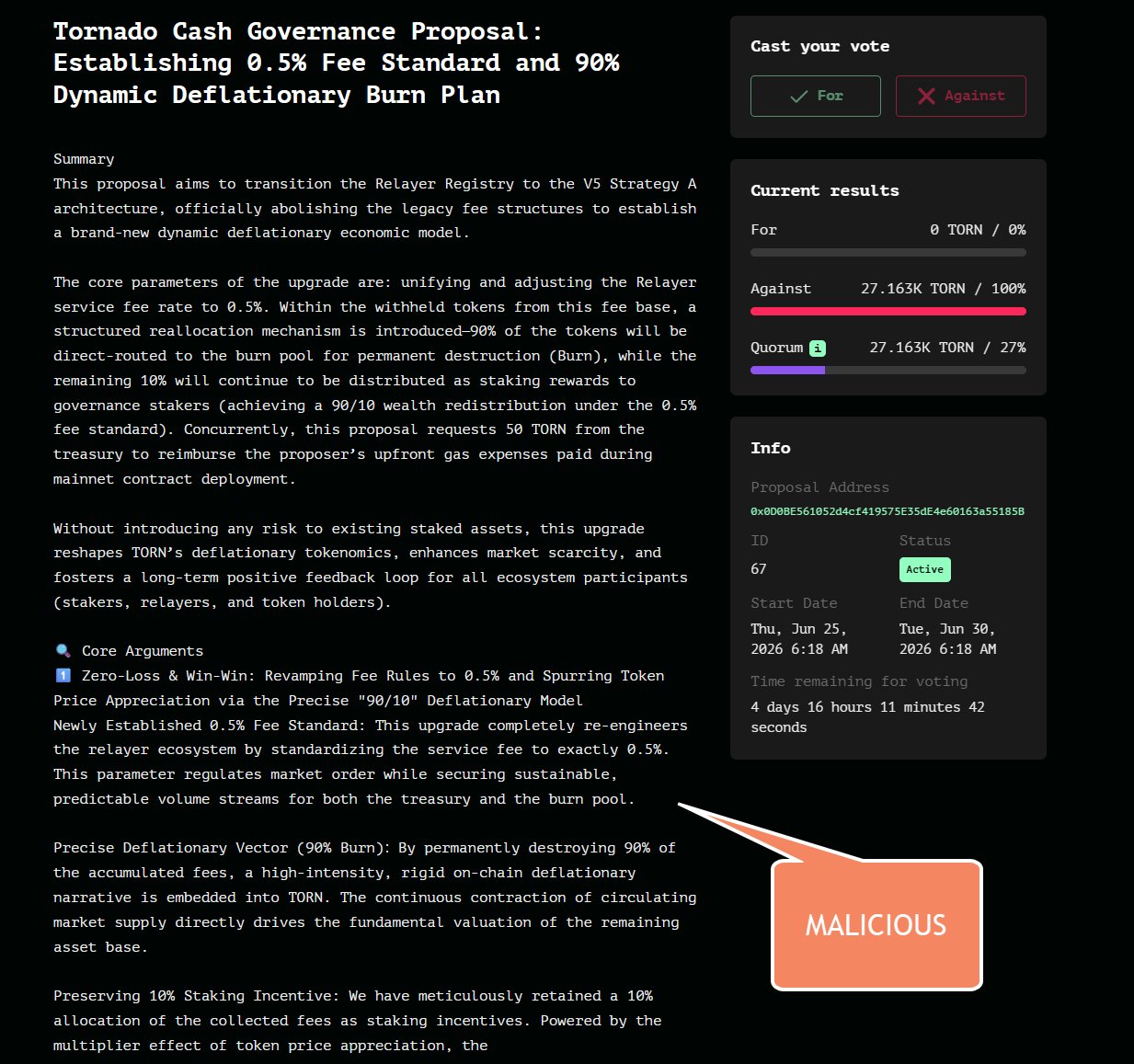


The title was written formally: "Establishing a 0.5% Fee Standard and 90% Dynamic Deflationary Burn Scheme." The main text was lengthy and elaborate, claiming to upgrade the relayer registry to the "V5 Strategy A" architecture, permanently burning 90% of the protocol fees, distributing 10% to stakers, and including a set of economic model projections for a "positive wealth cycle."


The proposer also requested 50 TORN tokens from the treasury to compensate for the Gas fees prepaid when deploying the contract—this detail made the entire proposal appear to be written by a responsible, out-of-pocket community contributor.


However, the contract code for this proposal was not verified at all. That is, the execution logic (Calldata) of the proposal was not source code verified on a block explorer (like Etherscan). Without verification, the community saw only machine code and could not directly review it. Historical normal proposals for Tornado Cash always included this step; this proposal skipped it.


L2BEAT researcher Sergey Shemyakov was the first to notice this. About 8 hours after the proposal went live, he tagged security researcher Pascal Caversaccio, saying: "The logic of this proposal is abnormally complex, please help with an independent review."


Security Alliance researcher Pascal Caversaccio quickly delivered a conclusion.


The Proposal's True Purpose: Stealthily Changing the Protocol's Admin Address


Caversaccio used a decompilation tool to revert the proposal contract's bytecode and determined the proposal was malicious.


The code contained a function named "governance," with only one function: to return an address, telling the protocol "who the admin is." The address hardcoded within this function was the attacker's own wallet.
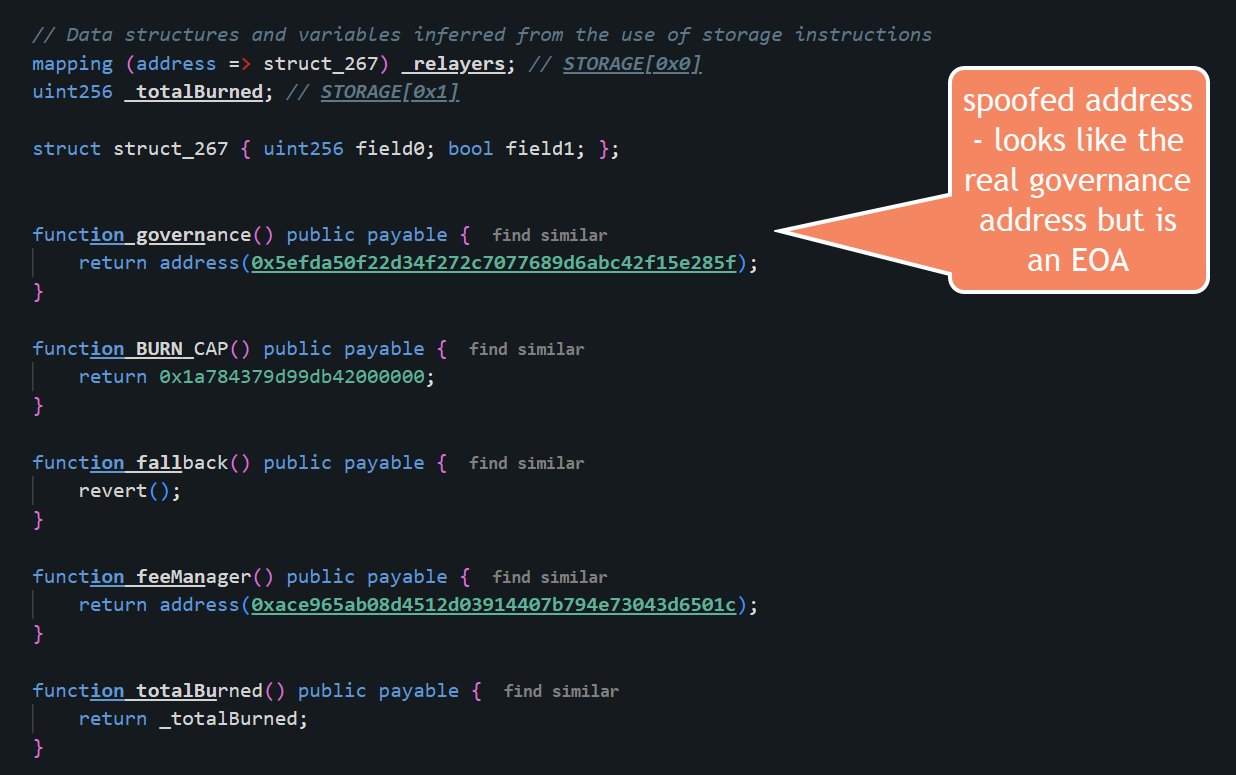


In Tornado Cash's architecture, various parts of the protocol call this function to confirm the highest authority. Once the proposal passed and executed, the address originally pointing to the community governance contract would be silently replaced with this attacker address.


The real governance address is 0x5efda50f22d34F262c29268506C5Fa42cB56A1Ce;

The forged attacker address is 0x5efda50f22d34f272c7077689d6abc42f15e285f.


The first 15 characters of the two addresses are identical, with differences starting only from the 16th character. It's very difficult for the average person to spot the difference by eye.


If this proposal passed, the consequence would be: the protocol's recognized "highest admin" address would be silently switched to the attacker's address. At that point, the attacker could use this identity to withdraw approximately $23 million worth of TORN tokens currently locked in the governance contract—this money is staked by community members for voting participation. Additionally, the attacker could forcibly zero out the balances of all relayers (service providers that forward transactions for users) within the protocol, paralyzing the entire system.


Who is the Attacker? Where Did the Money Come From?


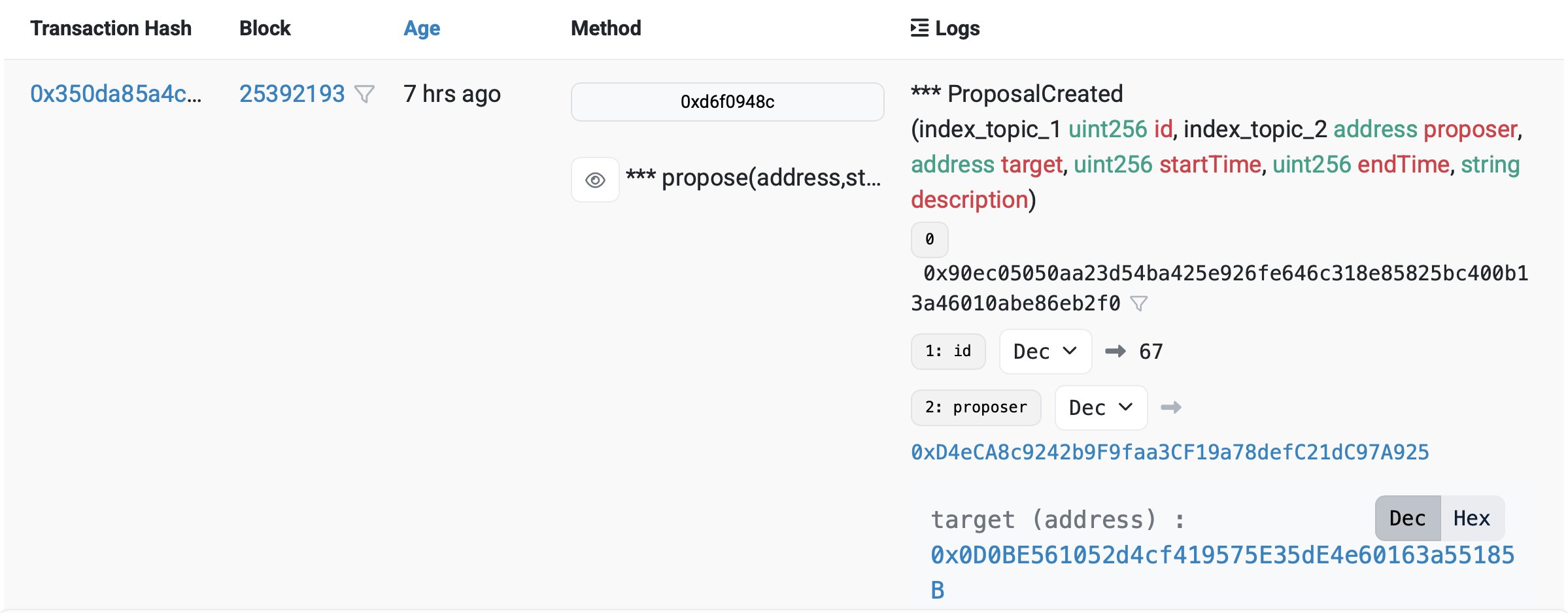
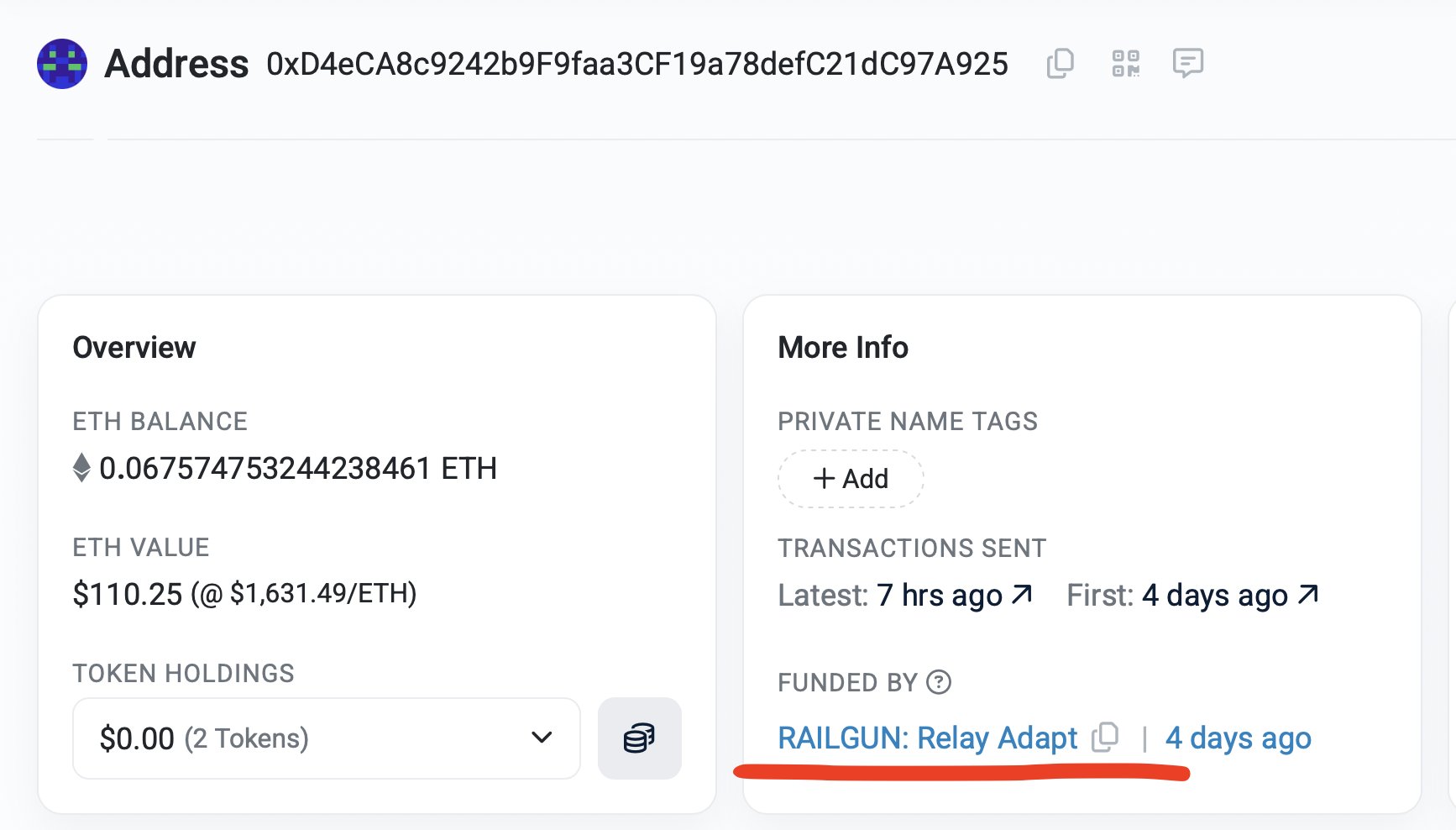
The wallet address of the proposal creator is 0xd4eca8c9242b9f9faa3cf19a78defc21dc97a925.


Caversaccio traced the funding source of this address and found it had received a transfer just 4 days before the proposal submission. The sender was Railgun—another on-chain privacy mixing protocol and a direct competitor of Tornado Cash. Using Railgun for the transfer means the fund source is obfuscated, untraceable to real identity.


Current Voting Status After Community Discovery


As of now, the voting results for this proposal are: 0 votes in favor, 27,163 TORN against, accounting for 100%. Voting closes on June 30.


Tornado Cash's governance rules require at least 100,000 TORN participating in the vote to reach quorum; currently, only 27% has been reached. Unless a large-scale abnormal wave of votes in favor appears within the next 4 days, pushing the quorum up and flipping the result. Otherwise, the proposal will expire and the result of being rejected is non-execution. However, the greater impact of this incident is the warning it provides.


This is already the second time Tornado Cash has faced this type of attack. In May 2023, an attacker gained governance control with 1.2 million votes through a proposal containing a hidden self-destruct function, while the entire DAO's legitimate votes at the time were only 70,000. In that attack, the attacker withdrew approximately $2.17 million worth of TORN, using Tornado Cash itself to launder the money, then submitted a "restore governance" proposal, netting about $900,000 before making a clean exit. Since then, no one has fundamentally repaired this governance structure.


DAO Governance Attacks: How Can Ordinary Users Defend Themselves?


Governance attacks are now a regular risk in Web3, not specific to any one protocol. In April 2022, Beanstalk was attacked by a perpetrator who borrowed $1 billion in temporary voting power via a flash loan, passed a proposal, transferred $182 million, and repaid the loan all within a single transaction, taking less than a minute. In February of the same year, Build Finance DAO was taken over by an attacker using counterfeit governance tokens, emptying its $11 million treasury.


The forms of attack are evolving: from flash loan vote snatching, to hidden self-destruct functions, to this time's address character substitution. But the underlying logic remains the same—a DAO's power comes from tokens, and tokens can be borrowed, forged, and obfuscated. Any governance mechanism that can be controlled by code can be attacked.


For ordinary users holding governance tokens, there are several practical paths. First, pay attention to real-time alerts from security researchers; this attack was first flagged by an L2BEAT researcher. Second, proposals pointing to unverified contracts should most likely be voted against directly. Third, if you hold a protocol's governance tokens but don't plan to actively participate, delegating your voting power to active community members is safer than letting the tokens lie dormant in your wallet. Silent tokens only make it harder to reach quorum.


For protocol developers, a more fundamental line of defense is introducing a timelock at the governance layer—proposals, once passed, do not execute immediately but have a 48 to 72-hour window, giving the community and security researchers a chance to review and trigger an emergency pause. Protocols like Compound and Aave have long made this mechanism standard; Tornado Cash still does not have it, which is also part of its extreme choice regarding compliance and censorship resistance.


Preguntas relacionadas

QWhat was the main deceptive tactic used in the fake Tornado Cash proposal to try and gain control of the protocol?

AThe fake proposal contained hidden code that, if executed, would have changed the protocol's 'governance' function to return the attacker's wallet address. This would have stealthily replaced the legitimate admin address, granting the attacker control over the DAO treasury and other protocol functions.

QWho first raised the alarm about the suspicious Proposal #67, and what was the key red flag they identified?

AL2BEAT researcher Sergey Shemyakov first raised the alarm about the suspicious proposal. The key red flag he identified was that the proposal's contract code was not verified on a block explorer like Etherscan, meaning its execution logic was hidden as unreadable bytecode, unlike normal proposals.

QWhat were the potential consequences if the malicious Tornado Cash proposal had passed?

AIf passed, the attacker would have gained control of the protocol's governance. They could have drained the approximately $23 million worth of TORN tokens from the community treasury and forced the balances of all protocol relayers to zero, effectively paralyzing the entire Tornado Cash service.

QHow does this 2026 attack on Tornado Cash relate to a previous incident involving the same protocol?

AThis was the second major governance attack on Tornado Cash. In May 2023, an attacker used a proposal with a hidden self-destruct function to gain voting control, drain roughly $2.17 million from the treasury, and profit by approximately $900,000. The article notes that the fundamental governance structure was not fixed after that first attack.

QAccording to the article, what is a fundamental defensive measure that protocols like Tornado Cash lack, which could help prevent such governance attacks?

AThe article states that Tornado Cash lacks a timelock mechanism in its governance layer. A timelock would impose a 48 to 72-hour delay between a proposal passing and its execution, giving the community and security researchers a window to review the code and trigger an emergency shutdown if necessary, a feature already standard in protocols like Compound and Aave.

Lecturas Relacionadas

Who's Paying for the $64 Billion Paper Feast?

"The Illusion of Wealth: Who Bears the Burden of the $64 Billion Paper Bonanza?" Bitcoin recently broke below the critical $60,000 support level, triggering significant selling by major holders. While the price drop itself is concerning, a deeper issue lies with publicly traded companies that have bet their entire balance sheets on Bitcoin, creating a precarious financial link between their stock prices and crypto valuations. Leading the pack is Strategy (formerly MicroStrategy), holding 847,000 BTC at an average cost of ~$75,600, now facing over 20% unrealized losses. Its stock trades at a deep discount to its Bitcoin holdings. Other companies like Japan's Metaplanet (nearly 40% unrealized loss) and Solmate (which fully pivoted to Solana and saw its stock collapse 98%) illustrate the risks of this model without underlying business operations. A key misconception is that these firms face immediate, forced liquidation. Their debt structures provide a buffer. However, the core "financial flywheel" is stalling. Strategy's CEO has even hinted at potentially selling Bitcoin to cover obligations—a reversal of his long-standing "never sell" doctrine. New accounting rules (ASU 2023-08) exacerbate the problem, requiring quarterly mark-to-market adjustments. Bull markets create paper profits, attracting capital. In bear markets, they generate massive paper losses, potentially triggering index exclusions and forced selling by passive funds. The true crisis point is not the current price, but a looming debt reckoning. If Bitcoin fails to recover above key cost bases within 12-24 months, convertible note redemption windows opening in Fall 2027 could force companies to sell massive Bitcoin holdings for cash, potentially triggering a severe liquidity crisis. The model hasn't eliminated risk; it has merely transformed instant, price-triggered liquidation into a slow-burning, time-triggered debt crisis.

marsbitHace 12 min(s)

Who's Paying for the $64 Billion Paper Feast?

marsbitHace 12 min(s)

Base Halts for Two Hours: A Single Invalid Block Reveals the Centralized Reality of L2s

Base, an Ethereum Layer-2 Rollup, experienced a two-hour network outage starting around 00:03 UTC on June 26. The halt was caused by a consensus issue that led to an invalid block being sequenced, which prevented the generation of new blocks after block 47806542. The team identified the problem, restored block sequencing by 01:51 UTC, and confirmed full recovery of ecosystem infrastructure synchronization shortly after. This incident highlights the operational reality for many L2s: while they leverage Ethereum for security and data availability, their day-to-day usability heavily depends on their sequencer and internal systems. Base employs a high-availability sequencer system with one active leader, but this setup did not prevent the outage when a consensus-level problem arose. This follows a previous 33-minute outage in August 2025 related to a faulty sequencer handover process. The downtime occurred near the scheduled activation window for the "Beryl" network upgrade, which has since been postponed. Beryl introduces the native B20 token standard, among other improvements. The incident has sparked renewed discussion about Base potentially launching its own network token in the future, shifting the conversation from mere speculation to questions about how a token might relate to sequencer decentralization, governance, and accountability in such failure scenarios.

Foresight NewsHace 32 min(s)

Base Halts for Two Hours: A Single Invalid Block Reveals the Centralized Reality of L2s

Foresight NewsHace 32 min(s)

STRC Must Re-Anchor for a BTC Bull Market to Happen

Title: STRC's Depegging Threatens MicroStrategy's Bitcoin-Buying Machine, and Thus the BTC Bull Run Summary: The sustained depegging of MicroStrategy's priority share STRC (trading ~25% below its $100 target) is severely disrupting the company's core business model and poses a major risk to Bitcoin (BTC) price support. STRC was MicroStrategy's most efficient and low-cost funding tool, designed to allow continuous capital raises near its $100 par value to fuel relentless BTC accumulation. Its depegging has effectively blocked this primary funding channel. The situation creates a severe cash flow crisis. STRC and other priority shares now obligate MicroStrategy to pay approximately $1.7 billion in annual cash dividends, while the company's cash reserves are only about $1.4 billion — insufficient to cover one year of payments. To raise cash, MicroStrategy is increasingly resorting to issuing common stock (MSTR) through ATM offerings. However, recent raises show most proceeds (around 90% in one week) are now used to bolster cash reserves rather than buy Bitcoin. This dilutes the key metric of Bitcoin per MSTR share, eroding the fundamental value proposition for equity investors. The company faces grim alternatives: issuing high-cost debt or selling its massive Bitcoin holdings. The latter, though hinted at, would likely trigger significant negative market reactions. Conclusion: As BTC's largest corporate holder and a major marginal buyer, MicroStrategy's funding woes mean reduced, and potentially reversing, institutional buy-side pressure. The company has shifted from being a guaranteed source of BTC demand to a significant overhang on the market. The article argues that without STRC re-anchoring to restore its funding engine, a sustained BTC bull market is in jeopardy.

marsbitHace 52 min(s)

STRC Must Re-Anchor for a BTC Bull Market to Happen

marsbitHace 52 min(s)

No Bull Market for BTC Without STRC Re-pegging

Summary: The sustained de-pegging of MicroStrategy's (MSTR) Strategy Preferred Shares (STRC) poses a severe threat to Bitcoin (BTC) and could prevent a bull market. STRC, designed to trade near a $100 target, has plunged to around $75, effectively shutting down MicroStrategy's cheapest and most efficient funding channel. This channel was critical for its "raise funds, buy BTC" business model. More critically, MicroStrategy now faces a massive cash outflow from these preferred shares. With approximately $10.49 billion of STRC outstanding at an 11.5% dividend yield, the annual cash obligation exceeds $1.2 billion. Combined with other preferred shares, the total annual payout nears $1.7 billion, depleting its current ~$1.4 billion cash reserve within a year. To address this, MicroStrategy is increasingly relying on common stock (MSTR) offerings via its ATM program. However, recent sales show most raised capital is now used to bolster cash reserves rather than buy more Bitcoin. This dilutes the key metric of BTC per share for common stockholders, eroding the foundation of its premium valuation. If STRC cannot re-peg, this costly dilution may continue. Worse, if cash pressure intensifies, selling Bitcoin becomes a real risk. As the largest corporate BTC holder (~847,363 BTC), any significant sales could crash the market. Thus, MicroStrategy is transforming from BTC's most reliable institutional buyer into a major potential seller, casting a significant shadow over Bitcoin's price prospects.

Odaily星球日报Hace 53 min(s)

No Bull Market for BTC Without STRC Re-pegging

Odaily星球日报Hace 53 min(s)

Trading

Spot
Futuros
活动图片