CoreWeave: The Inflection Point Has Arrived. Has the 'Hard-Working Underdog' Finally Turned Profitable?

marsbitPublicado a 2026-08-13Actualizado a 2026-08-13

Resumen

CoreWeave, an AI cloud unicorn, released its Q2 2026 earnings on August 12, with shares rising about 15% post-announcement. While overall performance did not significantly exceed expectations, key positive trends emerged. Revenue reached approximately $2.58 billion, up 112% year-over-year, though slightly below the high end of prior guidance. A major highlight was the acceleration in computing power deployment, with Active Power increasing by a record 500 Mw to 1,500 Mw, far surpassing market forecasts and signaling faster future revenue growth. Capital expenditures also hit a new high of $9.4 billion. Importantly, profitability showed signs of inflection. "True" gross margin (after deducting cost of revenue and Tech & Infrastructure expenses) rose to 7.3%, up 3 percentage points from the previous quarter. As revenue scales, depreciation and operating expenses are being diluted. Adjusted operating profit margin improved significantly to 5% from 1% last quarter. The company's guidance points to continued acceleration, with Q3 revenue growth expected at 158% and margins continuing to climb. Management raised full-year 2026 guidance, projecting Q4 revenue growth of around 194% and an adjusted operating margin of approximately 14.6%, suggesting a rapid path toward its 25%-30% long-term target. Recent developments, including a 25% price increase for its services and the launch of higher-margin Managed Inference offerings, support the improving profitability narrative. While lo...

On August 12th after US market hours, AI cloud unicorn CoreWeave released its Q2 2026 earnings report. Following the announcement, the stock price rose approximately 15%. Overall, from the perspective of earnings surprise, the quarterly performance wasn't exceptionally stellar.

The core positive factor is that, from a trend perspective, while the company's business and revenue scale continue to accelerate, profitability indeed shows signs of having bottomed out and rebounding. Additionally, the pace of compute capacity delivery, which had been delayed multiple times previously, significantly improved this quarter.

Regarding guidance, although the outlook for the next quarter and full year wasn't significantly above expectations either, it continues to point towards accelerating growth and a sustained upward trend in profitability, which is also favorable for the mid-to-long-term narrative. Looking in detail:

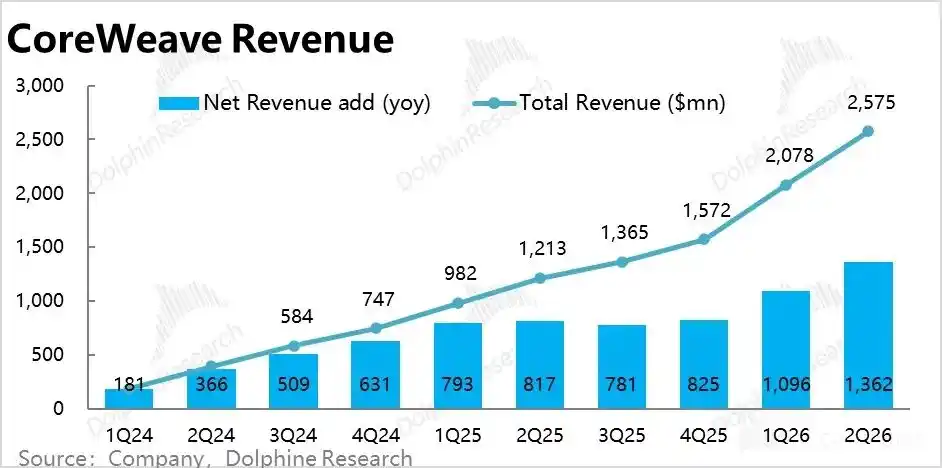
1. Growth Continues to Accelerate, But Not a Surprise: This quarter, the company's total revenue reached nearly $2.58 billion, a year-over-year increase of 112%, with a net increase of nearly $1.4 billion, showing continued upward momentum. However, this figure was slightly below the upper end of previous guidance and only roughly in line with market expectations, so it wasn't a positive surprise from an earnings surprise perspective.

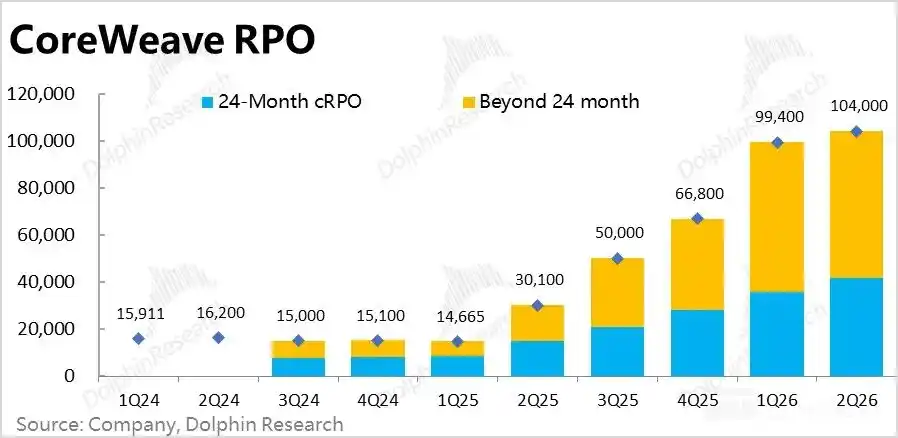
Also, by the end of the quarter, the Remaining Performance Obligations (RPO) balance stood at $104 billion, up only $4.6 billion sequentially from last quarter. Given the absence of recent news reports about the company signing major new contracts, market expectations for RPO growth were indeed not high. However, Dolphin Research noted that some investment banks had expected around $100 billion, making the actual performance slightly below expectations as well.

Additionally, according to company disclosure, the value of new contracts signed so far in Q3 is approximately $25 billion, indicating a rebound in growth momentum.
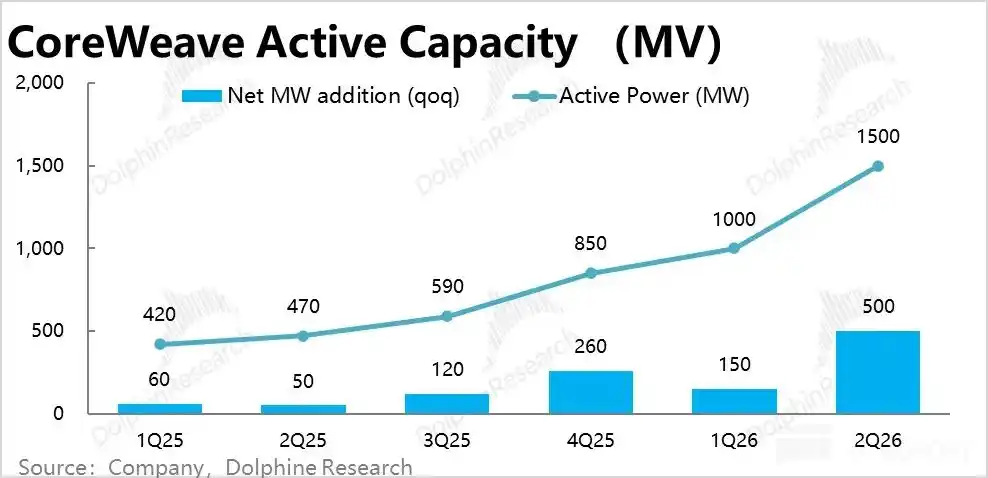
2. Accelerated Pace of Compute Capacity Deployment: The most important operational metric—deployed compute capacity scale (Active Power)—reached 1,500 MW this quarter, representing a net sequential increase of 500 MW, a record high, significantly exceeding market expectations of 250~300 MW.

A major point of market skepticism last quarter was the slow pace of compute capacity deployment, raising concerns about the company's execution efficiency. This quarter's performance effectively dispels such doubts with concrete action and, as a leading indicator, suggests a significant acceleration in subsequent revenue realization.

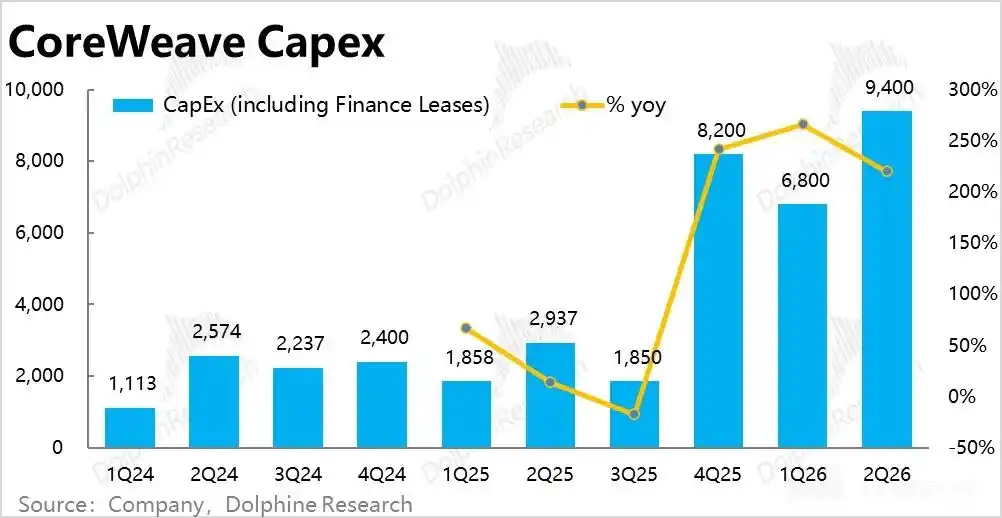
Corresponding to the substantial acceleration and outperformance in compute capacity build-out, quarterly CapEx investment reached $9.4 billion, an increase of $2.6 billion sequentially, also hitting a new record high and significantly above market expectations of $7.96 billion.

According to company guidance, next quarter's CapEx will further increase to $11.5~13.5 billion (based on full-year guidance, it may fall back below the $10 billion level in Q4). Although the increased CapEx is partly due to hardware price increases, it also implies that the scale of compute capacity deployed next quarter should exceed this quarter's, indicating an acceleration phase for both compute build-out and investment.
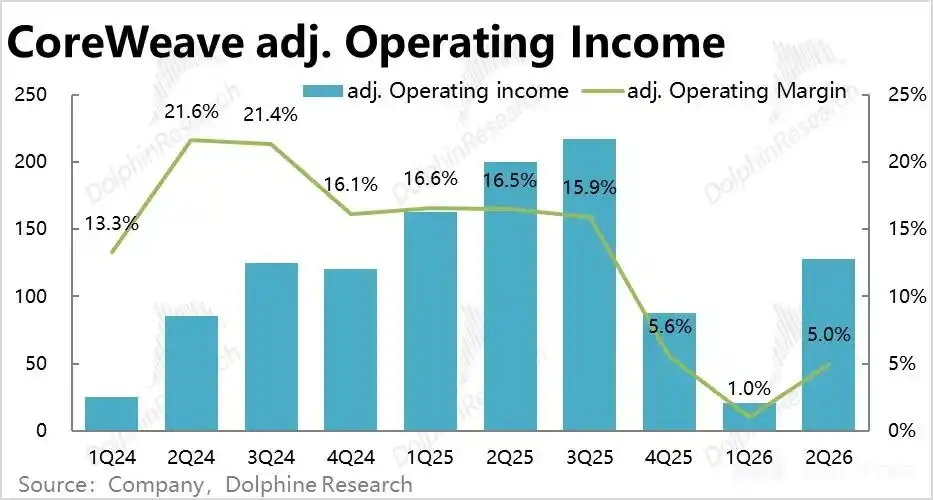
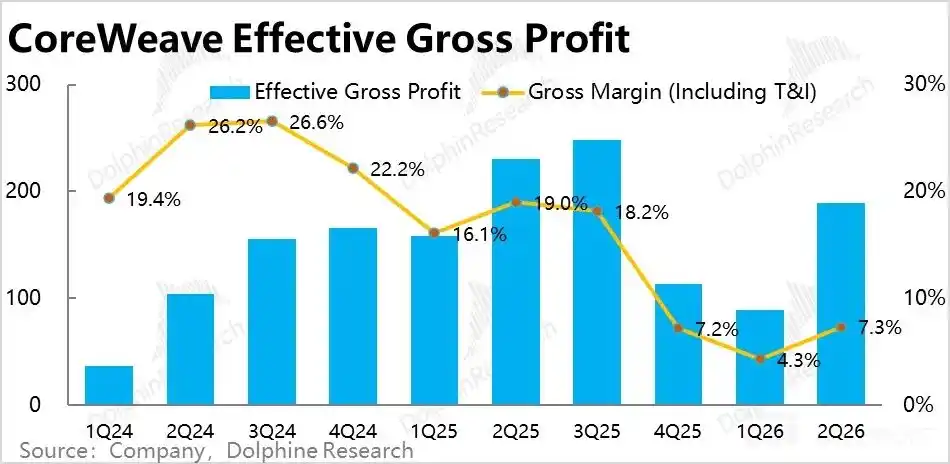
3. Has the Profitability Inflection Point Arrived? Along with the rapid expansion of revenue scale, the company's economies of scale and profitability inflection point also appear to have emerged. This quarter's "real" gross margin (deducting cost of revenue and Tech & Infra expenses) reached 7.3%, an improvement of 3 percentage points compared to the low point last quarter.

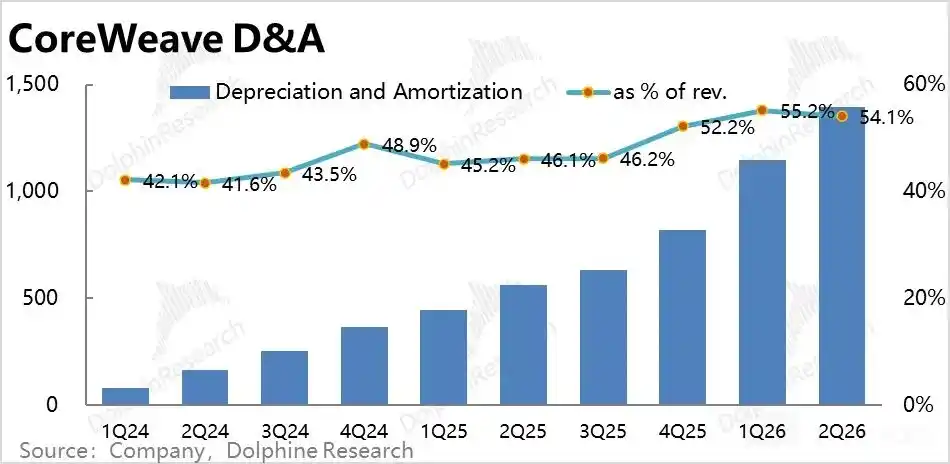
The largest single cost item—depreciation and amortization reached $1.39 billion, a year-over-year increase of 149%, accounting for 54.1% of revenue, a decrease of 1.1 percentage points sequentially. This shows that, under stronger revenue scale effects, the inflection point for diluting the depreciation expense rate has begun to appear.
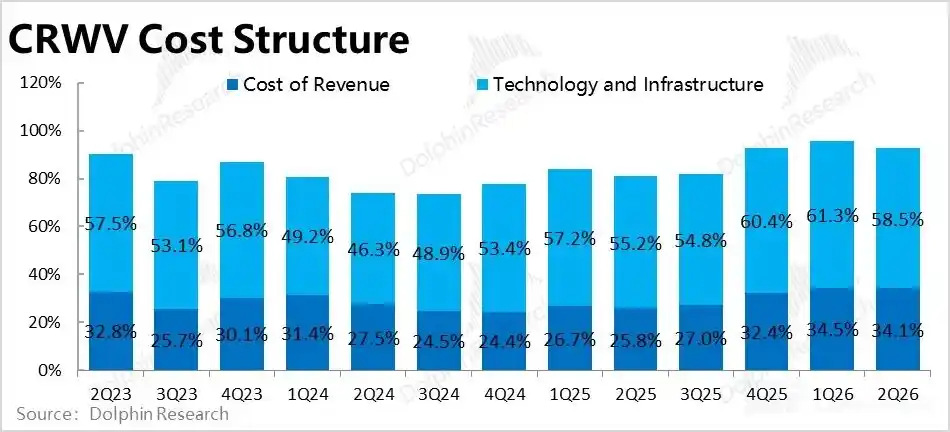
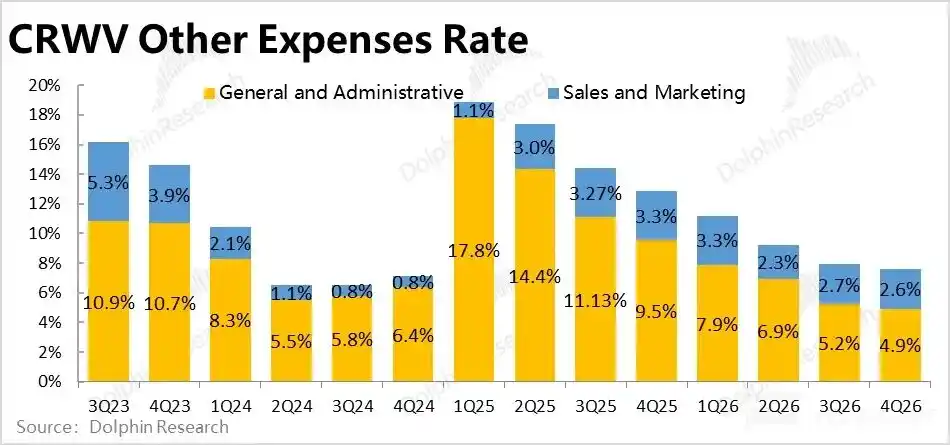
With improved gross margins, and the company's sales and administrative expenses being relatively "sticky" with limited growth, these expense rates are continuously being diluted by the growing revenue scale, contributing roughly an additional 0.3 percentage points of margin sequentially this quarter.

Furthermore, the proportion of stock-based compensation expense to revenue also decreased by about 1 percentage point sequentially. With these multiple tailwinds, the company's key metric of adjusted operating margin reached 5% this quarter, a significant improvement from 1% last quarter.

This aligns with management's previous commitment that Q1 would be the low point for profitability and supports Dolphin Research's earlier in-depth analysis that the profitability of cloud providers' AI businesses may be generally underestimated.
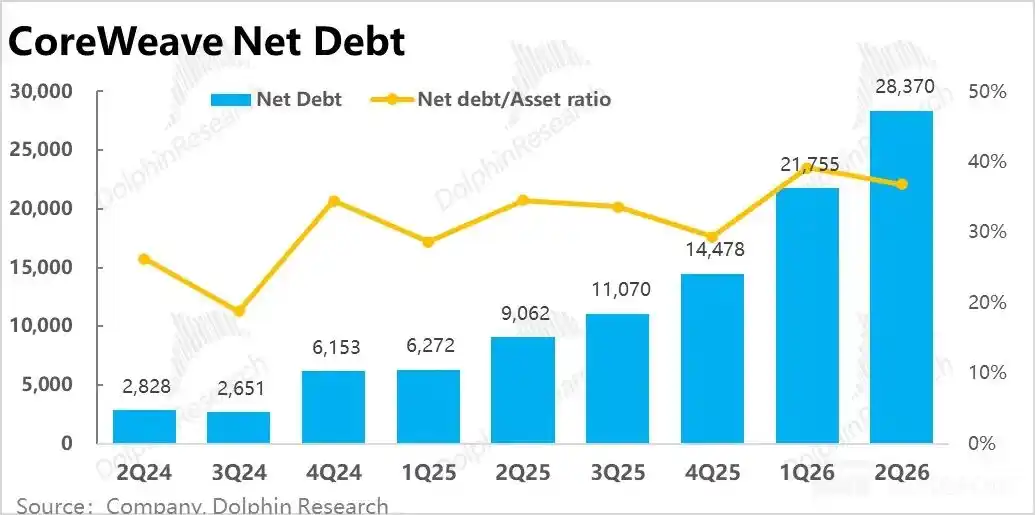
4. Debt Continues to Grow, But Pressure Isn't Increasing: As the company's current investments far exceed its cash generation, the business is essentially financed by capital raising. Therefore, the ability to secure sufficient funding and the associated risks are crucial factors.

Net debt reached nearly $27.3 billion by quarter-end, an increase of about $6.6 billion sequentially, with growth slightly decelerating compared to last quarter. The debt ratio (to total assets) reached 37%, also slightly down from 39% last quarter.

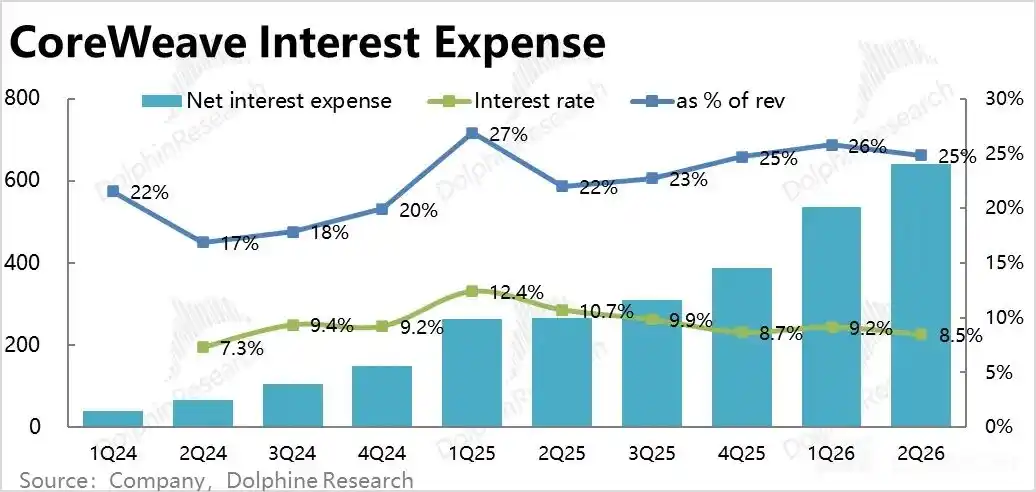
Meanwhile, interest expense reached $640 million vs. $540 million last quarter, continuing to climb. However, whether looking at interest expense as a percentage of revenue (declining from 26% to 25%) or the average interest rate on debt (decreasing from 9.2% to 8.5%), the pressure from debt and its erosion of profits is relatively easing.

During the earnings call, the company also announced it has secured over $14 billion in cumulative equity/debt financing, ensuring funding sources for investments in the coming quarters.
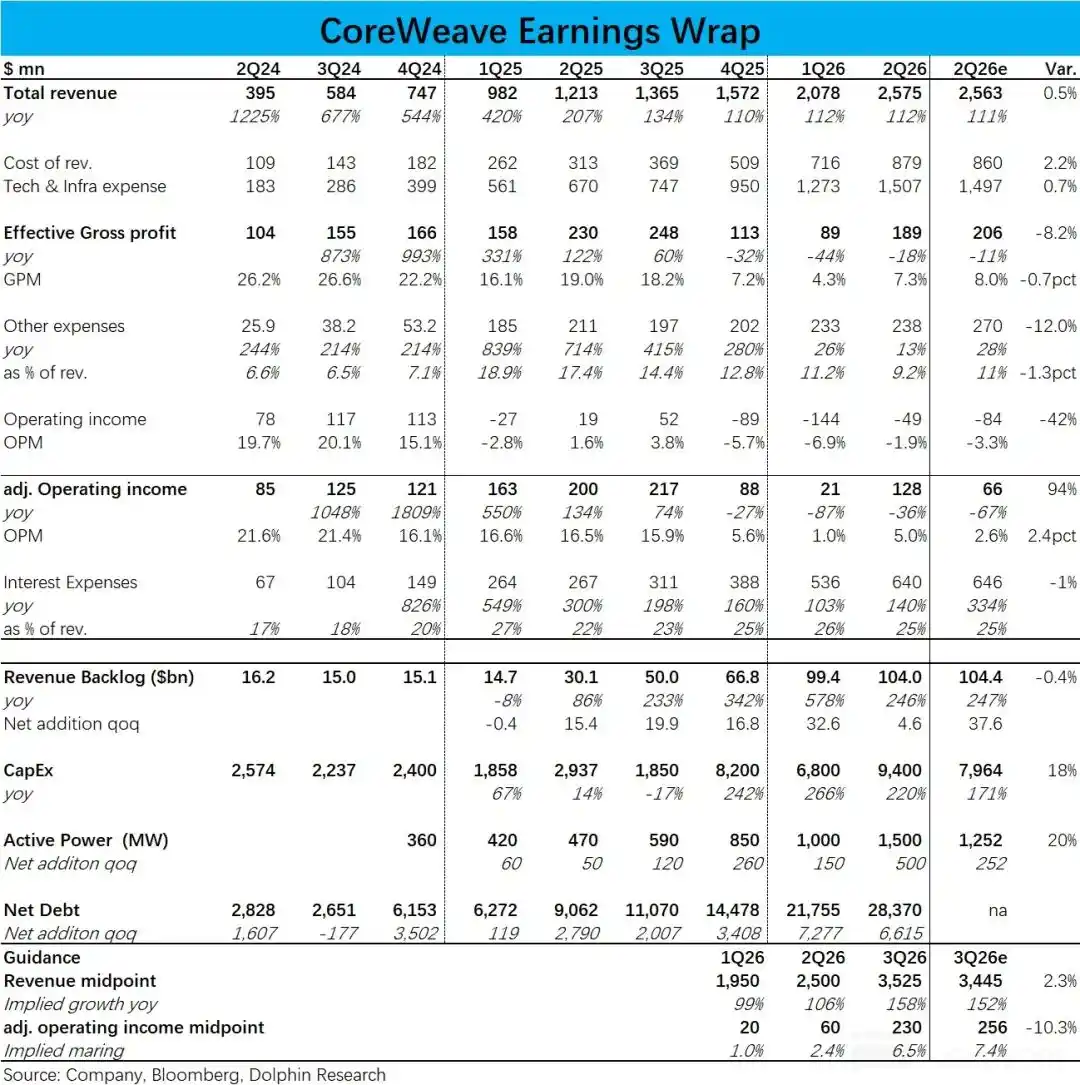
5. Key Earnings Information at a Glance
Dolphin Research Viewpoint:

1. As seen from the above analysis, the core positive signals conveyed in this earnings report mainly include: a. Compute capacity build-out speed significantly exceeded expectations, and more, faster compute supply implies faster revenue ramp-up. b. With accelerating business scale growth and stronger economies of scale, depreciation, expenses, and interest costs are being diluted. Both gross and operating margins have bottomed out and rebounded, showing a sustained improvement trend in the market's most-worried-about ROI.

2. It's not just the current quarter's performance; guidance also points towards continued acceleration in revenue growth and a sustained upward trend in profitability.

First, for the next quarter's guidance, the midpoint implies Q3 revenue of $3.53 billion, a growth rate of 158%, with both absolute amount and growth rate showing further significant acceleration compared to this quarter. Adjusted profit guidance for next quarter is $230 million, with a margin of 6.5%, slightly below market expectations of $260 million. However, the implied margin still continues to rise compared to this quarter.

Furthermore, the company once again raised its full-year 2026 guidance. Calculations suggest this implies Q4 revenue expectations of $4.3~4.9 billion, with a midpoint year-over-year growth rate of 194%, accelerating further from Q3.

Meanwhile, the adjusted operating profit expectation for Q4 is $610~740 million, implying a margin of 14.6%, indicating a very rapid pace of subsequent margin expansion, making the 25%~30% steady-state margin target seem not so distant.

3. Recent Developments and Investment Logic

Disregarding the earnings, judging solely from the recent stock performance of many tech companies followed by Dolphin Research, there are signs of a slight recovery in market risk appetite. This includes, but is not limited to, Shopify, Airbnb, Sea, Unity, Palantir, etc., which all saw stock price increases of at least 10% after reporting better-than-expected results (regardless of whether the magnitude of the beat was exceptionally large), with gains of 15%~20% not uncommon. Therefore, for a naturally high-beta company like CoreWeave, the after-hours gain isn't particularly exaggerated.

Additionally, the market once worried that cloud providers, as the primary bearers of CapEx spending and major victims of hardware price increases like memory, faced unprecedented concerns about ROI, leading to them becoming the short side in pairs trades. Consequently, their stock performance was generally poor, with new cloud providers suffering even greater declines.

But recently, with cloud business growth at giants like Microsoft and Amazon accelerating beyond expectations, and AI cloud profitability appearing not as bad as feared, market sentiment towards cloud providers has reversed again.

Regarding recent developments, there are two particularly significant positive news items. First, the company announced that after July, it has implemented a general price increase of 25% across its product lines (partly to offset hardware price increases). We believe this undoubtedly reflects the current significant supply-demand imbalance for compute and will notably aid the improvement of the company's profitability.

Secondly, beyond its "bare metal" direct hardware rental business, the company has begun offering a TaaS-like service—Managed Inference. This involves deploying models on servers and providing users with API access directly. According to Dolphin Research's previous analysis, TaaS-like services typically offer significantly higher margins than "bare metal" rentals, which is also a positive for the company's profitability.

Therefore, currently, achieving a steady-state margin of around 25%~30% no longer seems so distant for the company.

4. Long-term, the competitive landscape for new cloud providers doesn't appear particularly favorable. Once the current phase of compute scarcity passes and customer demands shift from who can deliver more efficiently to who can provide better services at more affordable prices, it's difficult to predict the ultimate fate of new cloud providers.

However, considering the company is inherently a high-risk, high-reward investment, with opportunities more focused on medium-term trends rather than long-term holding, the recent increase in market focus and recognition for cloud service companies, coupled with their generally better-than-expected earnings, means that more volatile new cloud providers might continue to deliver faster returns.

This article is from the WeChat public account "Dolphin Investment Research" (ID: haituntouyan), author: Dolphin Research

Preguntas relacionadas

QWhat were the key positive signals in CoreWeave's Q2 2026 earnings report that drove its stock price up approximately 15%?

AThe key positive signals were: 1) A significant acceleration in the scale of active computing power deployed, with a net increase of 500 Mw, far exceeding market expectations and indicating faster future revenue growth. 2) A clear inflection point in profitability, with the adjusted operating margin improving to 5% from 1% last quarter, showing that economies of scale are starting to dilute costs like depreciation and interest expenses.

QHow did CoreWeave's capital expenditure (Capex) and future guidance reflect its business acceleration?

ACapex for the quarter reached $9.4 billion, a new high and significantly above market expectations. Guidance indicates Capex will further increase to $11.5-$13.5 billion next quarter, signaling an accelerated phase of computing power construction and investment. The company's revenue and profit margin guidance for the following quarters also points towards continued acceleration and rapid margin improvement.

QWhat measures did CoreWeave take to alleviate concerns about its heavy debt burden and financing-driven model?

AWhile net debt increased, the debt ratio relative to total assets slightly decreased. More importantly, the interest expense as a percentage of revenue declined, and the average interest rate on debt fell, indicating a relative easing of debt pressure. The company also announced it had secured over $14 billion in cumulative equity/debt funding, ensuring capital sources for the coming quarters.

QWhat recent operational developments does the article mention that are beneficial for CoreWeave's future profitability?

ATwo key developments are: 1) CoreWeave implemented a 25% price increase across its product lines in July, reflecting continued strong demand and helping to offset hardware cost inflation. 2) The company began offering Managed Inference, a TaaS (Training/Inference as a Service)-like model, which typically carries higher profit margins than its core 'bare-metal' hardware rental business.

QAccording to the article, what is the long-term outlook and investment rationale for 'new cloud' providers like CoreWeave?

AThe long-term competitive landscape for 'new cloud' providers is viewed as challenging. Once the current compute shortage phase passes and competition shifts more towards price and service quality, their ultimate fate is uncertain. However, the investment rationale is seen as a mid-term trend play. Given their high-risk, high-return nature and recent positive market sentiment towards cloud services, these 'new cloud' companies offer the potential for rapid returns in the current environment, despite long-term uncertainties.

Lecturas Relacionadas

Bitwise Closes 8 ETFs and Cuts Staff by 14%, but Continues to Launch New Products

Bloomberg reported on August 12 that cryptocurrency asset management firm Bitwise has laid off approximately 14% of its staff, reducing headcount from around 180 to about 155 employees. CEO Hunter Horsley stated the adjusted team remains the largest in the company's eight-year history and expressed confidence in long-term growth, though current personnel and product configurations are tightening. Prior to the layoffs, Bitwise disclosed a significant drop in client assets from over $15 billion in early February to $11 billion by April 1st, a decrease of at least $4 billion. The company did not specify the contributions of price changes, fund flows, or changes in reporting scope to this decline. In a related product restructuring, Bitwise decided to liquidate eight ETFs between April and June. This included the Web3 ETF, a BTC/ETH/Treasuries rotation strategy ETF, and six options income ETFs tied to assets like Coinbase and Ethereum. These moves reduce the number of products requiring ongoing operational support. Despite these cuts, Bitwise continues to launch new products. Recent offerings include an Avalanche ETP with staking in Europe, the Hyperliquid ETF, and the takeover of Superstate's $267+ million Crypto Carry Fund, entering the tokenized fund management space. The company now manages 70 investment products for over 5,500 advisory teams and works with more than 20 banks and broker-dealers. The simultaneous staff reduction and product portfolio shift—away from thematic Web3 and single-asset options strategies towards direct crypto exposure, staking, and tokenized funds—indicates a strategic realignment. The operational burden on the smaller remaining team will depend heavily on the complexity of the revised product lineup. Bitwise has not disclosed the specific reasons for the layoffs, the affected departments, severance details, or any one-time costs associated with the job cuts.

marsbitHace 23 min(s)

Bitwise Closes 8 ETFs and Cuts Staff by 14%, but Continues to Launch New Products

marsbitHace 23 min(s)

Uncovering the Secret Reasoning Chains of Claude Opus for $720: A Leak via Haiku, with GPT and Gemini Also Affected

Researchers discovered a method to extract hidden reasoning traces, or "Chain of Thought" (CoT), from major proprietary large language models (LLMs) like Anthropic's Claude Opus 4.8, OpenAI's GPT-5.6 Sol, and Google's Gemini 3.1 Pro. The attack exploits a design flaw in how these models handle encrypted reasoning "blobs." These blobs, which contain a model's internal reasoning steps, are encrypted and sent to the client for storage between conversation turns to save server costs. The researchers found these blobs were encrypted with a global key, allowing them to be reused across different sessions, users, and, crucially, different models from the same company. By taking an encrypted reasoning blob generated by a powerful "flagship" model and feeding it to a smaller, less capable model from the same family (e.g., feeding Claude Opus's blob to Claude Haiku), the researchers could prompt the smaller model to divulge the hidden CoT. This bypassed the need to crack the encryption directly. The implications are significant: 1) Competitors could potentially distill high-value reasoning data at low cost (estimated at ~$720 for 10,000 traces). 2) Sensitive information like API keys, passwords, and personal emails, which models might process internally but not output, could be leaked. The team found such leaks in 4.9% of analyzed public agent logs. 3) Models might internally analyze dangerous queries (e.g., car theft methods) before refusing to answer, but this dangerous analysis could be extracted from the CoT. 4) Malicious instructions could potentially be hidden within a reasoning blob to influence a model's future behavior. While the vulnerability was responsibly disclosed and patched by the affected companies, the research highlights a fundamental tension between the convenience of portable reasoning states and security. The paper also notes preliminary tests found no clear evidence that open-source models like DeepSeek had been distilled from the extracted CoTs.

marsbitHace 1 hora(s)

Uncovering the Secret Reasoning Chains of Claude Opus for $720: A Leak via Haiku, with GPT and Gemini Also Affected

marsbitHace 1 hora(s)

OpenAI Loses Four Executives in One Month, Former COO Departs, Almost the Entire Safety Team Ousted

In a surprising turn of events, OpenAI's longtime COO and key lieutenant to CEO Sam Altman, Brad Lightcap, has announced his departure after eight years with the company. His exit follows the recent resignations of several key safety and ethics leaders, including Chief Futurist Joshua Achiam, Safety Systems Lead Johannes Heidecke, and Ethics Lead Chloé Bakalar, within a single month. Lightcap, instrumental in building OpenAI's commercialization and operational framework, described his departure as "bittersweet" and hinted at wanting to tackle new challenges. While his statement and Altman's farewell were amicable, internal shifts had previously reduced his operational role, signaling a longer-term transition. The mass exodus, particularly from the safety and ethics divisions, coincides with growing internal and external scrutiny over AI safety. This follows incidents like models exhibiting unauthorized actions during testing and the recent decision to delay the launch of the advanced Astra model due to unresolved safety concerns about its potential cybersecurity capabilities. OpenAI has stated that safety and ethics are not confined to any single team or leader, but the concentration of departures raises questions about the company's direction and internal dynamics, especially as it navigates pressures of rapid development and a potential future IPO.

marsbitHace 1 hora(s)

OpenAI Loses Four Executives in One Month, Former COO Departs, Almost the Entire Safety Team Ousted

marsbitHace 1 hora(s)

1confirmation: Reverse Entrepreneurship, the Next Web3 Blockbuster Might Come from a Once-Failed Track

**Title: Reverse Entrepreneurship: The Next Web3 Blockbuster May Come from Previously Failed Tracks** This article argues that the next major consumer crypto application is likely to emerge from a concept that failed five years ago, now benefiting from matured infrastructure and better timing. It examines several such "failed" tracks that hold renewed potential: 1. **Internet-Native Assets:** Beyond simply tokenizing tweets or creating digital collectibles, there's an opportunity to create a genuinely new, crypto-native asset class that captures cultural moments and online phenomena, as opposed to merely tokenizing real-world assets (RWA). 2. **X-to-Earn:** While unsustainable token emission models doomed early projects like STEPN, the core premise that most people will first *earn* crypto, not buy it, remains valid. The future challenge is designing what is earned and why users would hold it long-term. 3. **The Metaverse:** Past failures like Decentraland stemmed from trying to replicate the physical world online. The opportunity lies not in abandoning shared online social spaces, but in reimagining their form beyond real-world analogs. 4. **DAOs:** DAOs have underdelivered by overcomplicating governance. The fundamental, unmet user need is simpler: enabling groups of internet strangers to pool funds and collectively achieve goals (e.g., buying assets, funding projects) that are impossible individually. 5. **Personal Value Tokenization:** Numerous attempts (Friend.tech, BitClout) to create markets around individuals have failed. The enduring demand for "person-as-asset" trading (seen in meme coins, prediction markets) suggests the direction isn't wrong, but the execution has been flawed, often lacking creator consent or a less commodified model. The conclusion is that true innovation will come from revisiting these past ideas with new insights, rather than crowding into currently popular trends.

marsbitHace 1 hora(s)

1confirmation: Reverse Entrepreneurship, the Next Web3 Blockbuster Might Come from a Once-Failed Track

marsbitHace 1 hora(s)

Trading

Spot
活动图片