Top House Democrat Questions Kansas City Fed’s Approval Of Kraken Master Account

bitcoinistPublicado a 2026-03-28Actualizado a 2026-03-28

Resumen

Representative Maxine Waters, the top Democrat on the House Financial Services Committee, has questioned the Federal Reserve Bank of Kansas City's approval of a "limited purpose account" for crypto exchange Kraken. This approval grants Kraken's banking arm direct access to the Fed's payment system, a first for a cryptocurrency firm. Waters expressed concerns about the lack of transparency, potential risks to financial stability, and the adequacy of consumer protections, especially as this access was granted while Congress is still debating the terms for such expansions. She has requested detailed information on the services accessible to Kraken, the conditions applied, and the risk assessments conducted. The move has also drawn opposition from traditional banking groups, who warn it could threaten the U.S. payment system.

House of Representatives Ranking Member Maxine Waters has pressed the Federal Reserve Bank of Kansas City over its approval of a “limited purpose account” for Kraken, expressing concerns about the implications of granting a crypto firm access to the Federal Reserve’s (Fed) payment system.

Rep. Waters Seeks Clarity On Kraken’s Master Account Approval

On Thursday, Representative Maxine Waters, the top Democrat on the House Financial Services Committee, sent a letter to Jeff Schmid, President and CEO of the Federal Reserve Bank of Kansas City, questioning the Kansas City Fed’s recent decision to approve a “limited purpose account” to the US’s second-largest crypto exchange, Kraken.

In the letter, Waters seeks clarification from the Kansas City Fed regarding the practical implications of this approval “at a time when Congress has debated whether or not to expand access to the Fed’s payment rails and on what terms.”
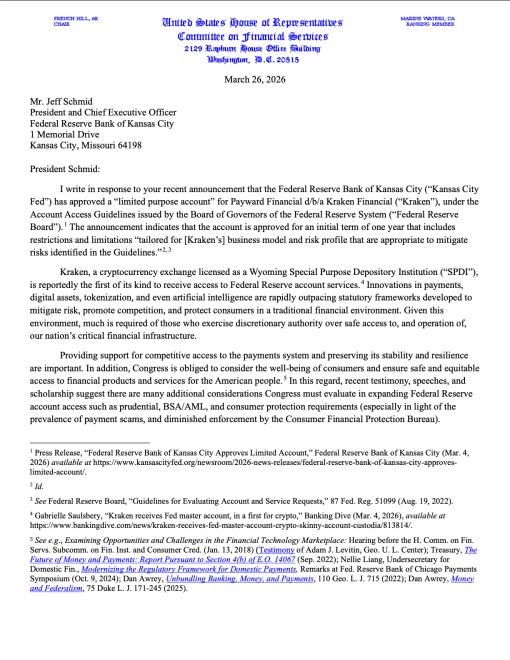
Rep. Waters' letter to Kansas City Fed's President Jeff Schmid. Source: House Financial Services Committee

Notably, Kraken Financial, Kraken’s banking arm, made history as the first crypto company to gain direct access to the Federal Reserve’s core payment system. This achievement was accomplished after Kraken secured approval from the Kansas City Fed for a Fed master account earlier this month.

As reported by Bitcoinist, the master account’s approval will enable Kraken Financial to expedite and streamline transactions for its large clients and professional traders. Additionally, it will grant Kraken’s banking unit direct access to Fedwire, a prominent interbank payment system that processes over $4 trillion in transfers daily.

The milestone represents a significant triumph for the crypto industry, which had been repeatedly denied access to the Federal Reserve system for years. Previously, the company had relied on intermediary banks to facilitate transfers to other firms.

The lawmaker highlighted that granting a cryptocurrency firm access to the Federal Reserve’s payment system for the first time raises policy, regulatory, and consumer protection concerns, arguing that it is particularly concerning given the rapid pace at which financial innovation is outpacing the rules and safeguards designed to ensure the safety of the financial system.

The Kansas City Fed’s announcement does not disclose specific information about Kraken’s access to the range of Federal Reserve financial services “due to the confidentiality of business information provided by applicants.” However, the announcement raises questions about the approval because neither statute nor the Federal Reserve Board’s Account Access Guidelines refer to a ‘limited purpose account’ type.

Crypto Access To Fed’s Payment Rails Faces Opposition

Representative Waters emphasized that access to the nation’s core payments infrastructure carries significant public responsibility and should not be extended without full transparency, clear legal grounding, and confidence that risks will be properly managed.

Therefore, she requested information no later than April 10, 2026, on the Federal Reserve services that Kraken can now access, the conditions or restrictions that apply, and the prudential, anti-money laundering (AML), and consumer protection considerations that were weighed before proceeding with the approval.

The lawmaker’s letter arrives as banking groups express significant concerns about granting crypto and fintech companies direct access to the Federal Reserve’s payment systems. Traditional banks have cautioned that even limited access could pose a substantial threat to the US payment system and overall financial stability.

For context, Kraken’s limited access to the master account is similar to the “skinny” master account concept initially proposed by the Federal Reserve Board of Governors in October 2025.

This type of restricted account would enable payment fintechs and crypto companies to access the Federal Reserve’s payment systems. However, it would exclude other advantages more closely associated with banks, such as the discount window lending facility.

In addition, the Office of the Comptroller of the Currency (OCC) approved conditional bank charters for Ripple, Circle, BitGo, Paxos, and Fidelity in December, raising concerns that it could blur the lines between banking activities and lead to regulatory arbitrage.

Last month, the American Bankers Association (ABA) urged the main banking regulator to postpone its approval of applications for crypto bank charters, suggesting that the agency should wait until the regulatory uncertainties are resolved.
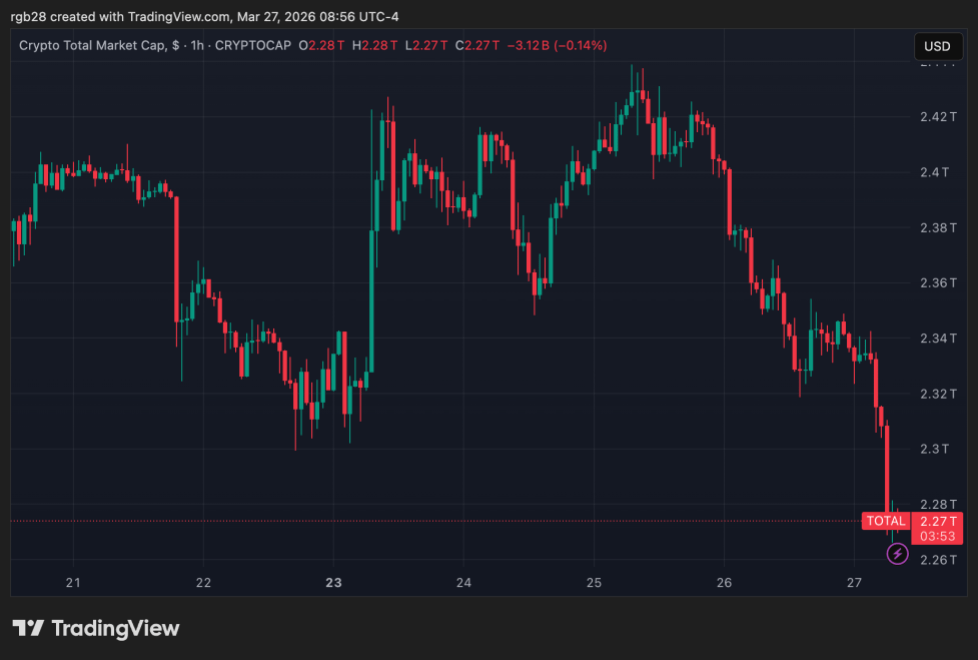
Total crypto market capitalization is at $2.27 trillion in the one-week chart. Source: TOTAL on TradingView

Preguntas relacionadas

QWhat is the main concern raised by Representative Maxine Waters regarding the Kansas City Fed's approval of a master account for Kraken?

ARepresentative Maxine Waters expressed concerns about the policy, regulatory, and consumer protection implications of granting a cryptocurrency firm direct access to the Federal Reserve's payment system for the first time, arguing that financial innovation is outpacing existing rules.

QWhat specific type of account did the Federal Reserve Bank of Kansas City approve for Kraken, and why is it notable?

AThe Kansas City Fed approved a 'limited purpose account' for Kraken. It is notable because it marks the first time a crypto company has gained direct access to the Federal Reserve's core payment system, a significant milestone for the industry.

QWhat practical benefits does the master account provide to Kraken Financial?

AThe master account enables Kraken Financial to expedite and streamline transactions for its large clients and professional traders and grants it direct access to Fedwire, a major interbank payment system that processes over $4 trillion daily.

QWhat information did Representative Waters request from the Kansas City Fed, and by when?

ARepresentative Waters requested information on the Federal Reserve services Kraken can access, the conditions or restrictions that apply, and the prudential, AML, and consumer protection considerations weighed before approval. This information was requested by April 10, 2026.

QWhy are traditional banking groups opposed to granting crypto companies access to the Fed's payment systems?

ATraditional banking groups, like the American Bankers Association, are concerned that even limited access for crypto and fintech companies could pose a substantial threat to the U.S. payment system and overall financial stability, potentially leading to regulatory arbitrage.

Lecturas Relacionadas

Breaking: OpenAI Undergoes Major Reorganization, President Brockman Assumes Command

OpenAI has announced a major internal reorganization just months before its anticipated IPO. The company is merging its three flagship product lines—ChatGPT, Codex, and the API platform—into a single, unified product organization. The most significant leadership change involves co-founder and President Greg Brockman moving from a background technical role to take full, permanent control over all product strategy. This follows the indefinite medical leave of AGI Deployment CEO Fidji Simo. Additionally, ChatGPT's longtime lead, Nick Turley, has been reassigned to enterprise products, with former Instagram executive Ashley Alexander taking over consumer offerings. The consolidation, internally framed as a strategic move towards an "Agentic Future," aims to break down internal silos and create a cohesive "Super App." This planned desktop application would integrate ChatGPT's conversational abilities, Codex's coding power, and a rumored internal web browser named "Atlas" to autonomously perform complex user tasks. The reorganization occurs amid significant internal and external pressures. OpenAI has recently seen a wave of high-profile departures, including Sora co-lead Bill Peebles and other senior technical leaders, leading to concerns about a thinning executive bench. Externally, rival Anthropic recently secured funding at a staggering $900 billion valuation, surpassing OpenAI's own. Google's upcoming I/O developer conference also poses a competitive threat. Analysts suggest the dramatic restructure is a pre-IPO move to present a clearer, more focused narrative to Wall Street—streamlining operations and demonstrating decisive leadership under Brockman to counter internal turbulence and intense market competition.

marsbitHace 3 hora(s)

Breaking: OpenAI Undergoes Major Reorganization, President Brockman Assumes Command

marsbitHace 3 hora(s)

Two Survival Structures of Market Makers and Arbitrageurs

Market makers and arbitrageurs represent two distinct survival structures in high-frequency trading. Market makers primarily use limit orders (makers) to profit from the bid-ask spread, enjoying high capital efficiency (nominally 100%) but bearing inventory risk. This "inventory risk" arises from passive, fragmented, and discontinuous order fills in the limit order book (LOB). This risk, while a potential cost, can also contribute to excess profit if managed within control boundaries, allowing for mean reversion. Market makers essentially sell "time" (uncertainty over execution timing) to the market for price control and low fees. In contrast, cross-exchange arbitrageurs typically use market orders (takers) to exploit price differences or funding rates, resulting in lower nominal capital efficiency (requiring capital on both exchanges) and higher transaction costs. Their risk exposure stems from asymmetries in exchange rules (e.g., minimum order sizes), execution latency, and infrastructure risks (e.g., ADL, oracle drift). These exposures are active, exogenous gaps that primarily erode profits rather than contribute to them. Arbitrageurs essentially sell "space" (capital sunk across venues) for localized, immediate certainty. Both strategies engage in a trade-off between execution friction and residual risk. Optimal systems allow for temporary, controlled risk exposure rather than enforcing zero exposure at all costs. Their evolution converges towards hybrid models: arbitrageurs may use maker orders to reduce costs, while market makers may use taker orders or hedges for risk management. Ultimately, both use different forms of risk exposure—market makers exposing inventory, arbitrageurs immobilizing capital—to extract marginal, hard-won certainty from the market.

链捕手Hace 3 hora(s)

Two Survival Structures of Market Makers and Arbitrageurs

链捕手Hace 3 hora(s)

Who Will Define the Rules of the AI Era? Anthropic Discusses the 2028 US-China AI Landscape

This article, based on Anthropic's analysis, outlines the intensifying systemic competition between the U.S./allies and China for AI leadership by 2028. It argues that access to advanced computing power ("compute") is the critical bottleneck, where the U.S. currently holds a significant advantage through chip export controls and allied innovation. However, China's AI labs remain competitive by exploiting policy loopholes—via chip smuggling, overseas data center access, and "model distillation" attacks to copy U.S. model capabilities—keeping them close to the frontier. The piece presents two contrasting scenarios for 2028. In the first, decisive U.S. action to tighten compute controls and curb distillation locks in a 12-24 month AI capability lead, cementing democratic influence over global AI norms, security, and economic infrastructure. In the second, policy inaction allows China to achieve near-parity through continued access to U.S. technology, enabling Beijing to promote its AI stack globally and integrate advanced AI into its military and governance systems, altering the strategic balance. Anthropic contends that maintaining a decisive U.S. lead is essential for shaping safe AI development and governance. The core recommendation is for U.S. policymakers to urgently close compute and model access loopholes while promoting global adoption of the U.S. AI technology stack to secure a lasting strategic advantage.

marsbitHace 5 hora(s)

Who Will Define the Rules of the AI Era? Anthropic Discusses the 2028 US-China AI Landscape

marsbitHace 5 hora(s)

Trading

Spot
Futuros

Artículos destacados

Cómo comprar HOUSE

¡Bienvenido a HTX.com! Hemos hecho que comprar Housecoin (HOUSE) sea simple y conveniente. Sigue nuestra guía paso a paso para iniciar tu viaje de criptos.Paso 1: crea tu cuenta HTXUtiliza tu correo electrónico o número de teléfono para registrarte y obtener una cuenta gratuita en HTX. Experimenta un proceso de registro sin complicaciones y desbloquea todas las funciones.Obtener mi cuentaPaso 2: ve a Comprar cripto y elige tu método de pagoTarjeta de crédito/débito: usa tu Visa o Mastercard para comprar Housecoin (HOUSE) al instante.Saldo: utiliza fondos del saldo de tu cuenta HTX para tradear sin problemas.Terceros: hemos agregado métodos de pago populares como Google Pay y Apple Pay para mejorar la comodidad.P2P: tradear directamente con otros usuarios en HTX.Over-the-Counter (OTC): ofrecemos servicios personalizados y tipos de cambio competitivos para los traders.Paso 3: guarda tu Housecoin (HOUSE)Después de comprar tu Housecoin (HOUSE), guárdalo en tu cuenta HTX. Alternativamente, puedes enviarlo a otro lugar mediante transferencia blockchain o utilizarlo para tradear otras criptomonedas.Paso 4: tradear Housecoin (HOUSE)Tradear fácilmente con Housecoin (HOUSE) en HTX's mercado spot. Simplemente accede a tu cuenta, selecciona tu par de trading, ejecuta tus trades y monitorea en tiempo real. Ofrecemos una experiencia fácil de usar tanto para principiantes como para traders experimentados.

223 Vistas totalesPublicado en 2025.04.27Actualizado en 2025.04.27

Cómo comprar HOUSE

Discusiones

Bienvenido a la comunidad de HTX. Aquí puedes mantenerte informado sobre los últimos desarrollos de la plataforma y acceder a análisis profesionales del mercado. A continuación se presentan las opiniones de los usuarios sobre el precio de HOUSE (HOUSE).

活动图片