TON Strategy Earns $15 Million from Gram Staking in Q2

cryptonews.ruPublicado a 2026-08-12Actualizado a 2026-08-12

Resumen

TON Strategy, the company managing the cryptocurrency treasury for The Open Network (TON) ecosystem, reported its Q2 results. The company generated $15 million in revenue from staking Gram (the rebranded native asset, formerly Toncoin) and increased its reserve to approximately 230.5 million tokens. This represents about 4.4% of Gram's total supply and 35% of all tokens staked on the network. The staking yield for the quarter was approximately 17%, attributed partly to the Catchain 2.0 consensus update which sped up block creation. The company's fair value of digital assets rose to about $369.5 million from $272 million in Q1. Net profit from continuing operations before tax was $83.5 million, a significant turnaround from a $91.3 million loss in the prior quarter, heavily influenced by an $82.8 million net gain from the change in Gram's fair value. TON Strategy also completed measures to wind down legacy operations, terminating contracts and reducing staff costs, which is expected to cut annual cash operating expenses by around $4 million. CEO Kevin Wilson stated the company now has a more focused business model centered on accumulating Gram and developing the TON ecosystem. He highlighted TON's growing integration with Telegram, its increased speed and lower fees, and its potential role in payments, digital ownership, and AI agents capable of transacting on behalf of users.

The company TON Strategy, which specializes in managing the cryptocurrency treasury of The Open Network (TON) ecosystem, reported its Q2 results. Over the three months, the company earned $15 million in revenue from Gram staking, increased its reserve to 230.5 million tokens, and reduced legacy operating expenses by approximately $4 million per year. The results indicate TON Strategy's shift towards a model focused on accumulating Gram and developing the TON ecosystem.

TON Strategy Earned $15 Million from Gram Staking

As of June 30, 2026, the company owned about 230.5 million Gram, of which approximately 229.9 million were staked. According to TonStat data from August 4, this constituted about 4.4% of the total Gram supply and about 35% of all tokens staked on the network.

Recall that in June, the native asset underwent a rebranding: Toncoin was renamed Gram with the ticker GRAM. TON Strategy stated that it supported this decision, as Gram is the original name of the asset, established back at the white paper writing stage.

For capital allocation, the company uses the "Own, Promote, Amplify" strategy. It involves evaluating the Gram position, liquidity, potential share buybacks, and ecosystem investments from the perspective of their potential to increase long-term value per share.

"We selectively evaluate initiatives that can strengthen the TON ecosystem, improve market access to Gram, or provide attractive financial returns, prioritizing opportunities where strategic initiatives and shareholder interests mutually reinforce each other," said TON Strategy CEO Kevin Wilson.

The fair value of TON Strategy's digital assets at the end of the quarter was about $369.5 million compared to $272 million on March 31.

In Q2, the company received approximately 9.4 million Gram from staking compared to 2.2 million in the first quarter. Accordingly, revenue from staking amounted to $15 million, and the quarterly annualized gross yield was about 17%.
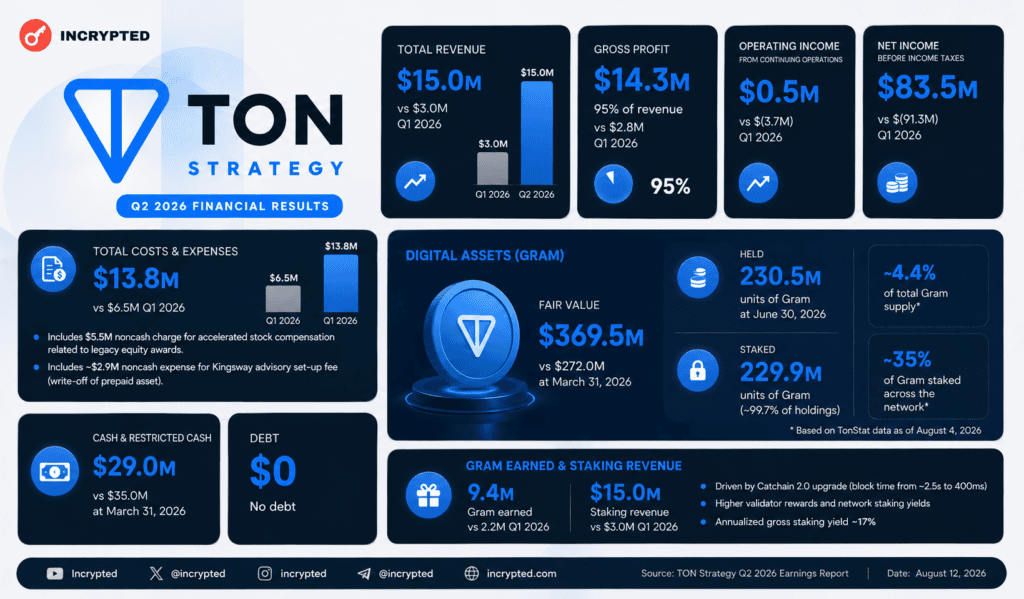
Infographic by Incrypted.

TON Strategy attributed the growth in rewards to the Catchain 2.0 consensus update. It reduced block creation time from approximately 2.5 seconds to 400 milliseconds, which increased validator reward issuance and boosted staking yields.

Against this backdrop, the company's total quarterly revenue also amounted to $15 million compared to $3 million in Q1. Gross profit reached $14.3 million, or 95% of revenue.

At the same time, the financial result included a significant effect from the revaluation of crypto assets. Net profit from continuing operations before taxes was $83.5 million, whereas in Q1 the company recorded a loss of $91.3 million.

Specifically, in Q2, TON Strategy realized $82.8 million in net profit from the change in the fair value of Gram.

Company Reduced Costs and Focused on TON

TON Strategy also reported the completion of most measures to wind down legacy operations. The company terminated a number of supplier contracts, reduced staff and contractor expenses, and discontinued certain low-margin services.

These measures are expected to reduce annual cash operating expenses by approximately $4 million.

Furthermore, on August 10, TON Strategy terminated its consulting services agreement with Kingsway Capital Partners. The company noted it had already ceased monthly payments under this agreement back in March.

Wilson stated that after the first three months of operation, the company now has a more focused business model.

"Our Gram treasury demonstrated strong staking rewards during the quarter, and we have largely completed the measures needed to wind down legacy operations. We enter the second half of the year with a more focused business and greater freedom to direct our resources towards the TON ecosystem."

According to him, the company views Gram's potential not only through the profitability of staking.

TON Bets on Payments and AI Agents

Separately, Wilson emphasized the technological development of TON and its integration with Telegram. In his words, the network is becoming faster, cheaper, and more user-friendly, with blockchain functionality being integrated into the Telegram platform with over a billion users.

This, in the CEO's opinion, could strengthen TON's role in payments, digital ownership, and the work of AI agents, which will be able to act and conduct transactions on behalf of users.

Earlier, the network's development was already accompanied by significant technical changes. In April, Pavel Durov announced a significant speed-up of TON after an update: block creation speed increased approximately sixfold, and transactions began to be processed in less than a second.

In May, Durov also reported a roughly sixfold reduction in network fees, almost to zero, and announced Telegram's plans to become the largest validator on TON.

end-content
Criptos en tendencia

Preguntas relacionadas

QWhat were the key financial results reported by TON Strategy for the second quarter?

ATON Strategy reported $15 million in revenue from staking Gram, grew its reserve to 230.5 million tokens, and reduced legacy operational expenses by approximately $4 million annually. The fair value of its digital assets reached about $369.5 million at the end of the quarter.

QHow much of the total Gram supply and staked tokens did TON Strategy's holdings represent as of early August?

AAs of early August, TON Strategy's holdings of approximately 230.5 million Gram represented about 4.4% of the total Gram supply and about 35% of all tokens staked in the network.

QWhat was cited as the reason for the increase in staking rewards during the quarter?

AThe increase in staking rewards was attributed to the Catchain 2.0 consensus update, which reduced block creation time from about 2.5 seconds to 400 milliseconds, thereby increasing validator rewards and staking yield.

QWhat business model shift did CEO Kevin Wilson describe for TON Strategy?

ACEO Kevin Wilson stated that TON Strategy has transitioned to a more focused business model centered on accumulating Gram and developing the TON ecosystem, having largely completed measures to wind down legacy operations.

QWhat future roles for the TON network did the CEO highlight, related to its integration with Telegram?

AThe CEO highlighted that TON's integration with Telegram could strengthen its role in payments, digital ownership, and the operation of AI agents capable of acting and conducting transactions on behalf of users.

Lecturas Relacionadas

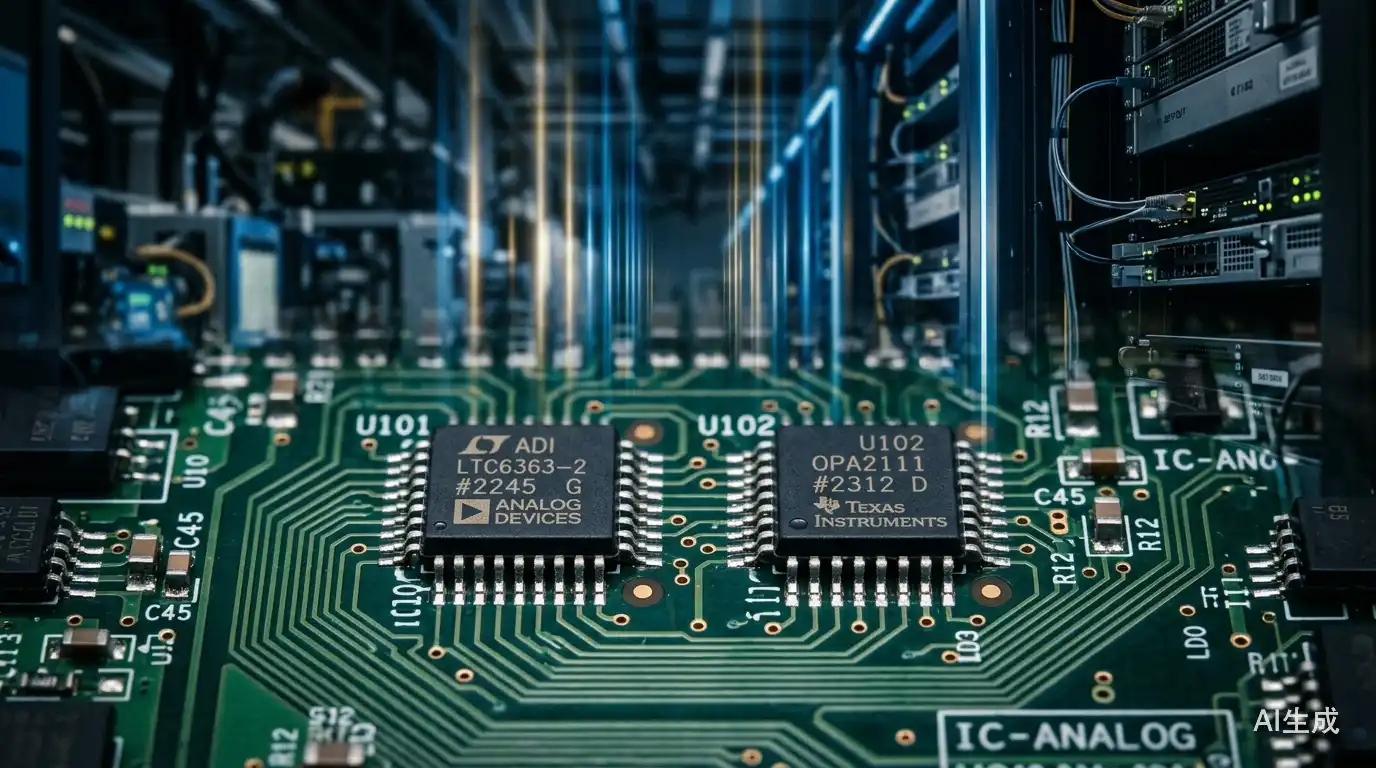
Analog Chip Giants TI and ADI Are Stepping Up

Analog chip giants Texas Instruments (TI) and Analog Devices (ADI) have both reported strong quarterly results, signaling an industry recovery. TI's Q2 2026 revenue reached $5.463 billion, a 23% year-over-year (YoY) increase. ADI's Q3 FY2026 revenue hit $4.022 billion, up 40% YoY, marking a new quarterly record. Both companies benefited from rising demand in industrial and data center markets, though their growth paths differed. TI experienced broad-based strength across its segments. Industrial revenue (33% of total) grew approximately 30% YoY, while data center revenue (9%) doubled. The automotive segment (33%) also showed a strong rebound, attributed to demand from China's EV/hybrid market and low inventory levels at automakers. ADI's growth was led by its industrial (49% of revenue, +53% YoY) and communications (16%, +84% YoY) segments, with data center products constituting 80% of the latter. Management highlighted a significant "AI exposure," with data center and ATE-related businesses now accounting for 20% of total revenue. Key differences emerged in their strategies and supply chain dynamics. ADI attributed a larger portion of its growth to AI infrastructure demand and has built "strategic inventory" to a record high of ~$1.93 billion to support future growth, despite channel inventory being below target levels. Its product lead times have extended to up to six months, and price increases are contributing to margin expansion. TI's inventory remained high at $4.6 billion but saw improved turnover. The company emphasized that its growth is primarily volume-driven, with minimal contribution from recent price hikes. TI maintains a competitive lead time below 13 weeks and expressed confidence in its capacity sufficiency for the next three years. In summary, both companies are riding a recovery wave fueled by industrial and AI/data center demand. TI's approach leverages its broad market presence and prepared capacity, while ADI is more focused on AI-driven growth and strategic inventory buildup. Their differing paths highlight the evolving structure of demand within the analog semiconductor market's rebound.

marsbitHace 25 min(s)

Analog Chip Giants TI and ADI Are Stepping Up

marsbitHace 25 min(s)

Bernstein Research Report Analysis: Circle Benefits from USDC Expansion Cycle, Maintains Outperform Rating with $140 Price Target

Bernstein Report Analysis: Circle Benefits from USDC Expansion Cycle, Maintains Outperform Rating with $140 Target Stablecoin markets are reversing. After nearly six months of stagnation and decline, the supply of USDC suddenly increased by $1.7 billion in the final week of August. Circle's stock price has rebounded 42% from its slump driven by concerns over OUSD competition. On August 24, Bernstein published a report stating this is not a temporary technical rebound. Four key factors are driving a new stablecoin expansion cycle: the macro interest rate environment, expansion of the on-chain capital market, proliferation of stablecoin payments, and the emerging use of AI agent payments. Circle, as the largest compliant stablecoin issuer, is positioned to benefit significantly. Bernstein maintains its "Outperform" rating for Circle with a $140 price target, implying a 59% upside from the current price. The recovery in USDC supply validates the macro logic. The US Treasury's long-end bond buyback plan is reshaping the macro narrative for stablecoins, with stablecoins absorbing incremental short-term Treasury supply. Both Bitcoin and stablecoins benefit from this macro shift. AI agent payments represent a new growth frontier. Stablecoin payments are extending from "person-to-person" to "machine-to-machine." Bernstein highlights the x402 payment protocol, designed for AI agents to autonomously hold wallets, discover services, and make instant micropayments using USDC. While current volumes are small, this signals stablecoins' evolution towards becoming a native currency for the digital economy. USDC accounts for over 99% of x402 transaction volume. Circle benefits from two structural trends. First, the expansion of the on-chain capital market: its ARC blockchain, with validators like BlackRock and DTCC, supports asset tokenization. USDC has also been used as collateral for regulated derivatives. Second, the continued adoption of stablecoin payments: USDC's share of adjusted transaction volume has risen from ~40% in 2025 to over 60% year-to-date in 2026. Bernstein's $140 valuation is based on a long-term discounted cash flow model, corresponding to ~23x 2028 adjusted EBITDA. Key risks include digital asset volatility, increased competition, and Circle's reliance on interest income for 99% of its revenue. The stablecoin expansion is a structural story, and Circle sits at the confluence of these driving trends.

marsbitHace 37 min(s)

Bernstein Research Report Analysis: Circle Benefits from USDC Expansion Cycle, Maintains Outperform Rating with $140 Price Target

marsbitHace 37 min(s)

Trading

Spot

Artículos destacados

Cómo comprar GRAM

¡Bienvenido a HTX.com! Hemos hecho que comprar prev. Toncoin (GRAM) sea simple y conveniente. Sigue nuestra guía paso a paso para iniciar tu viaje de criptos.Paso 1: crea tu cuenta HTXUtiliza tu correo electrónico o número de teléfono para registrarte y obtener una cuenta gratuita en HTX. Experimenta un proceso de registro sin complicaciones y desbloquea todas las funciones.Obtener mi cuentaPaso 2: ve a Comprar cripto y elige tu método de pagoTarjeta de crédito/débito: usa tu Visa o Mastercard para comprar prev. Toncoin (GRAM) al instante.Saldo: utiliza fondos del saldo de tu cuenta HTX para tradear sin problemas.Terceros: hemos agregado métodos de pago populares como Google Pay y Apple Pay para mejorar la comodidad.P2P: tradear directamente con otros usuarios en HTX.Over-the-Counter (OTC): ofrecemos servicios personalizados y tipos de cambio competitivos para los traders.Paso 3: guarda tu prev. Toncoin (GRAM)Después de comprar tu prev. Toncoin (GRAM), guárdalo en tu cuenta HTX. Alternativamente, puedes enviarlo a otro lugar mediante transferencia blockchain o utilizarlo para tradear otras criptomonedas.Paso 4: tradear prev. Toncoin (GRAM)Tradear fácilmente con prev. Toncoin (GRAM) en HTX's mercado spot. Simplemente accede a tu cuenta, selecciona tu par de trading, ejecuta tus trades y monitorea en tiempo real. Ofrecemos una experiencia fácil de usar tanto para principiantes como para traders experimentados.

223 Vistas totalesPublicado en 2026.06.15Actualizado en 2026.08.20

Cómo comprar GRAM

Discusiones

Bienvenido a la comunidad de HTX. Aquí puedes mantenerte informado sobre los últimos desarrollos de la plataforma y acceder a análisis profesionales del mercado. A continuación se presentan las opiniones de los usuarios sobre el precio de GRAM (GRAM).

活动图片