Tokenized Deposits vs. Stablecoins: The Future of Finance is Not Replacement, but Integration

深潮Publicado a 2025-12-10Actualizado a 2025-12-10

Resumen

Tokenized deposits and stablecoins represent complementary, not competing, visions for the future of finance. Banks create money through fractional reserve lending, offering low-cost credit to large clients in exchange for deposits—tokenized deposits extend this on-chain but remain within the banking system’s regulatory and operational framework. Stablecoins, like USDC or USDT, function as permissionless, 24/7 cash-like instruments ideal for global settlements, especially in cross-border payments. The future lies in interoperability: corporations may hold tokenized deposits for credit benefits while using stablecoins for efficient, off-ledger transactions. Smart contracts enable complex, multi-party financial workflows beyond what traditional APIs offer. Rather than one replacing the other, both tokenized deposits (for banking-integrated credit) and stablecoins (for borderless liquidity) will coexist on-chain, enabling a more efficient and accessible financial system. The key is building bridges between these models, not choosing sides.

Author: Simon Taylor

Compiled by: Block Unicorn
Banks create money; stablecoins move it. We need both.

Proponents of tokenized deposits say: "Stablecoins are unregulated shadow banking. Once banks tokenize deposits, everyone will prefer to use banks."

Some banks and central banks love this narrative.

Proponents of stablecoins say: "Banks are dinosaurs. We don't need them on-chain. Stablecoins are the future of money."

Crypto natives particularly favor this story.

Both sides are missing the point.

Banks Provide Cheaper Credit to Their Largest Clients

You deposit $100, it becomes $90 in loans (or even more). This is how fractional reserve banking works. For centuries, it has been an engine of economic growth.

  • A Fortune 500 company deposits $500 million at JPMorgan Chase.

  • In return, they receive a massive line of credit at below-market interest rates.

  • Deposits are the bank's business model, and large corporations know this.

Tokenized deposits bring this mechanism on-chain, but they only serve the bank's own customers. You are still within the bank's regulatory perimeter, still subject to its business hours, processes, and compliance requirements.

For businesses that need low-cost credit lines, tokenized deposits are a good option.

Stablecoins Are Like Cash

Circle and Tether hold 100% reserves, equivalent to $200 billion in bonds. They earn a 4-5% yield but don't pay you anything.

In return, you get funds free from any bank's regulatory oversight. An estimated $9 trillion will be moved cross-border via stablecoins by 2025. Accessible anytime, anywhere with an internet connection, permissionless, 24/7.

No correspondent bank inquiries, no waiting for SWIFT settlement, no "we'll get back to you in 3-5 business days."

For a company that needs to pay an Argentine supplier at 11 PM on a Saturday, stablecoins are a good option.

The Future is Both

A company that wants a good credit line from a bank might also want to use stablecoins as an on-ramp to long-tail markets.

Imagine this scenario:

  • A Fortune 500 company holds tokenized deposits at JPMorgan Chase

  • In return, it gets a preferential credit line for its US operations

  • It needs to pay an Argentine supplier who prefers stablecoins.

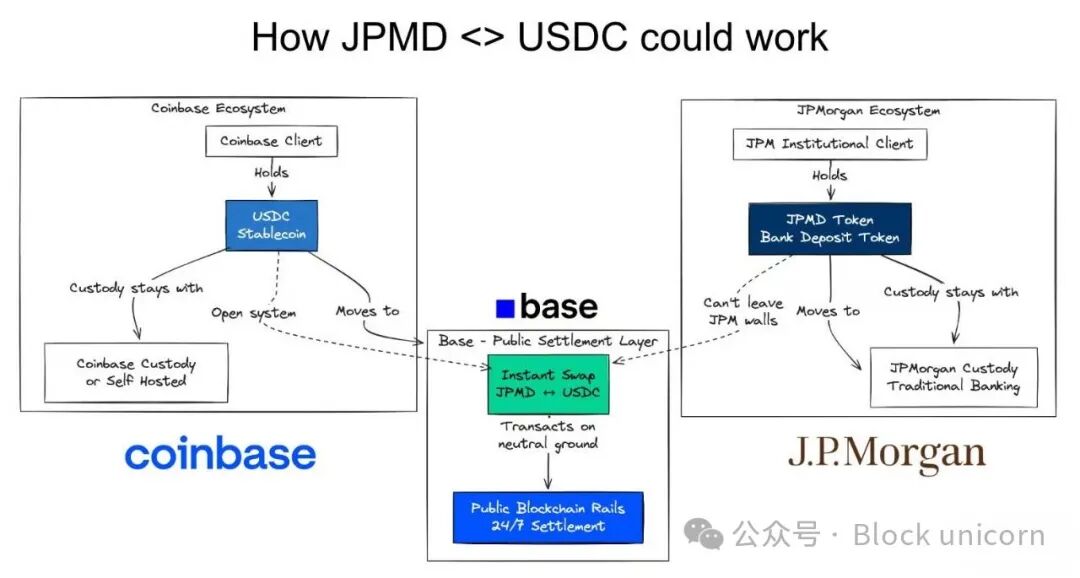
  • So, it swaps JPMD for USDC.

This is an example of where we are headed.

On-chain. Atomic.

Having both.

Using traditional rails where they work.

Using stablecoins where they don't.

It's not an either/or. It's both.

  • Tokenized deposits → Low-cost credit inside the banking system

  • Stablecoins → Cash-like settlement outside the banking system

  • On-chain swaps → Instant conversion, zero settlement risk

Both have pros and cons.
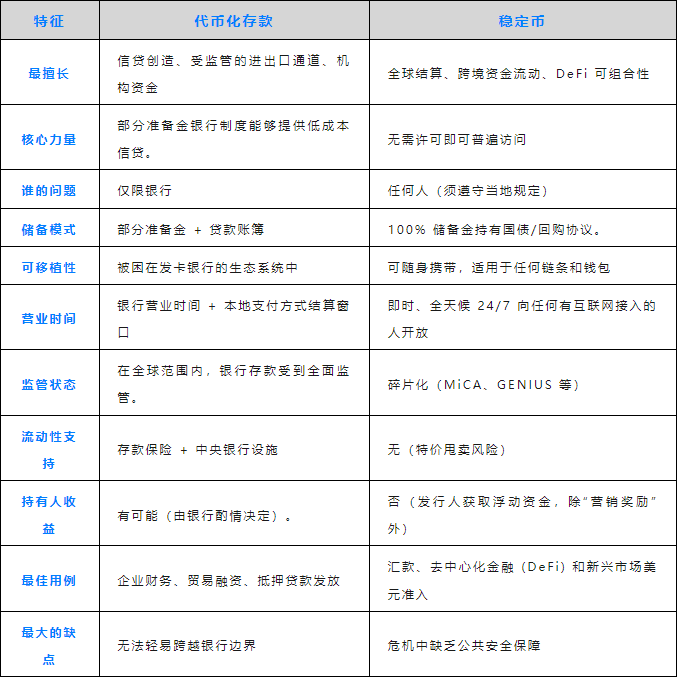
They will coexist.

On-Chain Payments > APIs for Payment Orchestration

Some large banks might say "We don't need tokenized deposits, we have APIs," and in some cases, they are right.

This is precisely the power of on-chain finance.

Smart contracts can build logic across multiple firms and individuals. When a supplier's deposit arrives, a smart contract can automatically trigger inventory financing, working capital financing, FX hedging. Automatically. Instantly. Whether from a bank or a non-bank.

Deposit → Stablecoin → Pay invoice → Downstream payments complete.

APIs are point-to-point. Smart contracts are many-to-many. This makes them ideal for workflows that cross-organizational boundaries. This is the power of on-chain finance.

It's a fundamentally different architecture for financial services.

The Future is On-Chain

Tokenized deposits solve for low-cost credit. Deposits are locked in. Banks lend against them. Their business model remains.

Stablecoins solve for the portability of money. Funds flow permissionless, anywhere. The Global South gets access to dollars. Businesses get fast settlement.

Proponents of tokenized deposits want regulated payment rails only.

Proponents of stablecoins want to replace banks.

The future needs both.

Fortune 500s want massive credit lines from banks AND instant global settlement. Emerging markets want local credit creation AND dollar on-ramps. DeFi wants composability AND real-world asset backing.

Arguing about who wins misses what's happening. The future of finance is on-chain. Tokenized deposits and stablecoins are both necessary infrastructure to get there.

Stop arguing about who wins. Start building interoperability.

Composable money.

Preguntas relacionadas

QWhat is the core argument of the article regarding tokenized deposits and stablecoins?

AThe article argues that the financial future is not about one replacing the other, but about the fusion and coexistence of both tokenized deposits and stablecoins. Each serves a distinct purpose: tokenized deposits provide low-cost credit within the banking system, while stablecoins offer cash-like, permissionless settlement outside it.

QAccording to the article, what primary benefit do tokenized deposits offer to large corporate clients?

ATokenized deposits offer large corporate clients access to substantial, low-cost credit lines from their banks, as the deposits form the basis of the bank's lending business model.

QWhat key advantage do stablecoins provide for cross-border payments as highlighted in the text?

AStablecoins provide a permissionless, 24/7, and fast settlement method for cross-border payments, enabling transactions like sending money to an international supplier at any time without relying on traditional banking hours or intermediaries like SWIFT.

QHow does the article describe the role of smart contracts in the future of on-chain finance?

AThe article states that smart contracts enable multi-party logic and automation across organizational boundaries. They can automatically trigger actions like inventory financing, working capital loans, and FX hedging upon payment's receipt, making them more powerful than point-to-point APIs for complex financial workflows.

QWhat is the final call to action for the industry presented in the conclusion?

AThe final call to action is to stop arguing about which will win—tokenized deposits or stablecoins—and instead start building interoperability to create a future of composable money on-chain.

Lecturas Relacionadas

Can a Hair Dryer Earn $34,000? Deciphering the Reflexivity Paradox in Prediction Markets

An individual manipulated a weather sensor at Paris Charles de Gaulle Airport with a portable heat source, causing a Polymarket weather market to settle at 22°C and earning $34,000. This incident highlights a fundamental issue in prediction markets: when a market aims to reflect reality, it also incentivizes participants to influence that reality. Prediction markets operate on two layers: platform rules (what outcome counts as a win) and data sources (what actually happened). While most focus on rules, the real vulnerability lies in the data source. If reality is recorded through a specific source, influencing that source directly affects market settlement. The article categorizes markets by their vulnerability: 1. **Single-point physical data sources** (e.g., weather stations): Easily manipulated through physical interference. 2. **Insider information markets** (e.g., MrBeast video details): Insiders like team members use non-public information to trade. Kalshi fined a剪辑师 $20,000 for insider trading. 3. **Actor-manipulated markets** (e.g., Andrew Tate’s tweet counts): The subject of the market can control the outcome. Evidence suggests Tate’sociated accounts coordinated to profit. 4. **Individual-action markets** (e.g., WNBA disruptions): A single person can execute an event to profit from their pre-placed bets. Kalshi and Polymarket handle these issues differently. Kalshi enforces strict KYC, publicly penalizes insider trading, and reports to regulators. Polymarket, with its anonymous wallet-based system, has historically been more permissive, arguing that insider information improves market accuracy. However, it cooperated with authorities in the "Van Dyke case," where a user traded on classified government information. The core paradox is reflexivity: prediction markets are designed to discover truth, but their financial incentives can distort reality. The more valuable a prediction becomes, the more likely participants are to influence the event itself. The market ceases to be a mirror of reality and instead shapes it.

marsbitHace 34 min(s)

Can a Hair Dryer Earn $34,000? Deciphering the Reflexivity Paradox in Prediction Markets

marsbitHace 34 min(s)

First Day Review of "Musk's WeChat" XChat: Even Worse Than Expected

Elon Musk's much-anticipated "WeChat-like" app, XChat, has officially launched after multiple delays. The initial review reveals a product that falls short of expectations, offering an experience largely similar to X Platform's (formerly Twitter) direct messages, despite being marketed as an encrypted communication tool. Key observations from the first-day test include: 1. The app's promoted "end-to-end encryption" and its claimed relation to Bitcoin's architecture were criticized by experts as a superficial attempt to capitalize on crypto buzz, with no real technical connection. 2. Musk's vision of an ad-free "secure communication system" is technically met, but only because the app is currently extremely basic, featuring only a single chat interface. 3. A promised anti-screenshot feature appears inconsistent; it works in X Platform group chats but fails within the XChat app itself, where screenshots still capture avatars. 4. The app supports 45 languages and has a 16+ age rating, indicating a broader tolerance for content compared to WeChat's 13+ rating. 5. A puzzling login process requires users to verify the email associated with their X account. 6. The touted encryption" feels minimal in practice, with its presence only indicated by a simple "Encrypted - Yes" label on messages. 7. Disappearing message timers for groups can be set from 5 minutes to 4 weeks, with the timer starting upon being read by a user. 8. Group invite links are shared with X Platform groups. 9. Group size limits are planned to be increased, aiming for 1000 members, a move that has drawn user criticism. 10. The app offers 8 different colored icons, and its chat bubbles are notably similar to WeChat's. Message deletion options mimic Telegram's. Crucially, many pre-announced features like importing X contacts, integrating Grok AI, X Money payments, and Cashtags are not yet available. The initial release is seen as a bare-bones and underwhelming first step.

Odaily星球日报Hace 1 hora(s)

First Day Review of "Musk's WeChat" XChat: Even Worse Than Expected

Odaily星球日报Hace 1 hora(s)

Trading

Spot
Futuros
活动图片