Tian Yuandong Announces Startup Venture After Leaving Meta

marsbitPublicado a 2026-05-14Actualizado a 2026-05-14

Resumen

After leaving Meta, Tian Yuan Dong has announced his new venture. The startup Recursive_SI has officially launched with a list of founders including Tian Yuan Dong. The founding team also comprises Richard Socher (CEO), Tim Rocktäschel, Jeff Clune, Tim Shi, Caiming Xiong, and Alexey Dosovitskiy, among others. These members have experience building AI research labs at companies like Salesforce and Uber, and have held leadership roles at OpenAI, DeepMind, Google Brain, and Meta. Recursive_SI aims to develop artificial intelligence capable of conducting experiments autonomously and safely improving itself through an open-ended, automated scientific discovery process. This is seen as a promising path toward superintelligence. The company has raised $650 million at a valuation of $4.65 billion, led by GV (Google Ventures) and Greycroft, with significant investments from AMD Ventures and NVIDIA. The team has grown to over 25 members, including new additions like Zhuge Mingchen. Zhuge, a Founding Member, holds a Ph.D. in Computer Science from KAUST under Professor Jürgen Schmidhuber. His research focuses on Coding Agents, Recursive Self-Improvement (RSI), and next-generation machine paradigms, with contributions including early RSI systems like GPTSwarm and work on agentic AI frameworks. The founders shared their vision on X: building AI that can automatically discover knowledge and recursively self-improve, fundamentally changing the way science and technology advance. The team ...

After leaving Meta, Tian Yuandong has also started his entrepreneurial journey.

Just now, the startup company Recursive_SI officially debuted and disclosed its list of founders, which includes Tian Yuandong.

In addition to Tian Yuandong, the founding team includes Richard Socher (CEO), Tim Rocktäschel, Jeff Clune, Tim Shi, Caiming Xiong, and Alexey Dosovitskiy, among others.
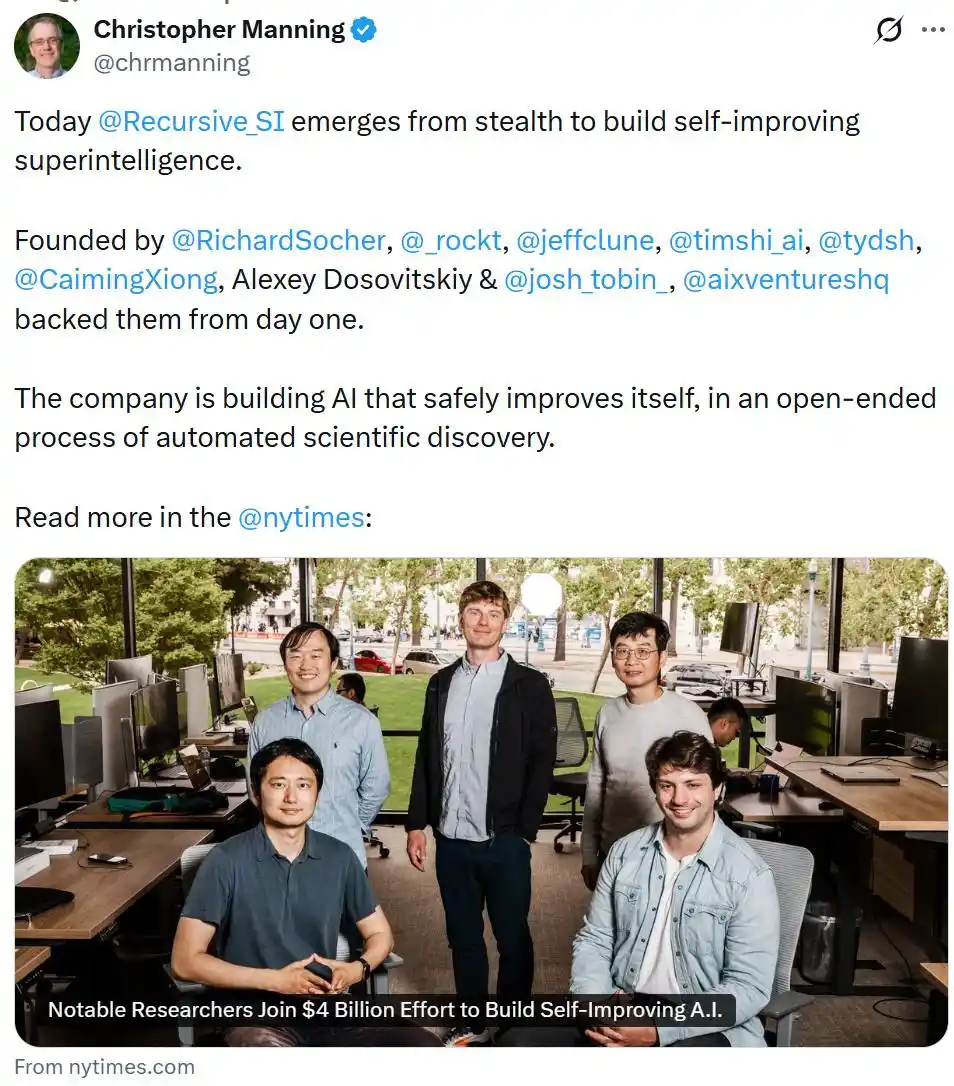
These founding members have previously been involved in establishing AI research labs at Salesforce and Uber, and have held leadership positions at teams such as OpenAI, DeepMind, Google Brain, and Meta, possessing extensive research and entrepreneurial experience.

Recursive_SI is committed to building an artificial intelligence that can autonomously conduct experiments and safely self-improve—continuously evolving within an open-ended, automated scientific discovery process, which is considered the most likely path towards superintelligence.

Currently, Recursive has raised $6.5 billion with a valuation of $46.5 billion, led by GV (Google Ventures) and Greycroft, with significant investments from AMD Ventures and NVIDIA.

The team has grown to over 25 members and continues to expand, having attracted many outstanding talents, including Zhuge Mingchen, who is set to join soon.

Zhuge Mingchen is currently a Founding Member at Recursive. He holds a Ph.D. in Computer Science from King Abdullah University of Science and Technology (KAUST), where he studied under Professor Jürgen Schmidhuber, known as the "Father of LSTM." His research focuses primarily on Coding Agents, Recursive Self-Improvement (RSI), and Next-generation Machine Paradigms.

Since 2023, Zhuge Mingchen has been systematically exploring the direction of Recursive Self-Improvement (RSI).

During the MetaGPT period, he proposed that agents should possess mechanisms for continuous self-optimization and capability evolution, advancing this research direction in subsequent work. Among these, GPTSwarm is considered one of the earliest RSI system paradigms in the LLM era. It was the first to systematically propose and validate a Graph-based Agents framework for self-organizing collaboration, enabling coordination, feedback, and capability evolution among agents through dynamic graph structures. Its core concepts have since been widely adopted by numerous subsequent multi-agent and Agentic AI projects. Agent-as-a-Judge further explored continuous feedback and self-evaluation mechanisms in long-term tasks, attempting to address issues of continuity and stable optimization for agents in complex missions. Research on NeuralComputer further advanced towards next-generation AI system architectures, exploring new machine paradigms that integrate memory, reasoning, and autonomous evolution capabilities.

It can be seen that the research team joining Recursive possesses profound academic experience in the field of recursive self-improvement.

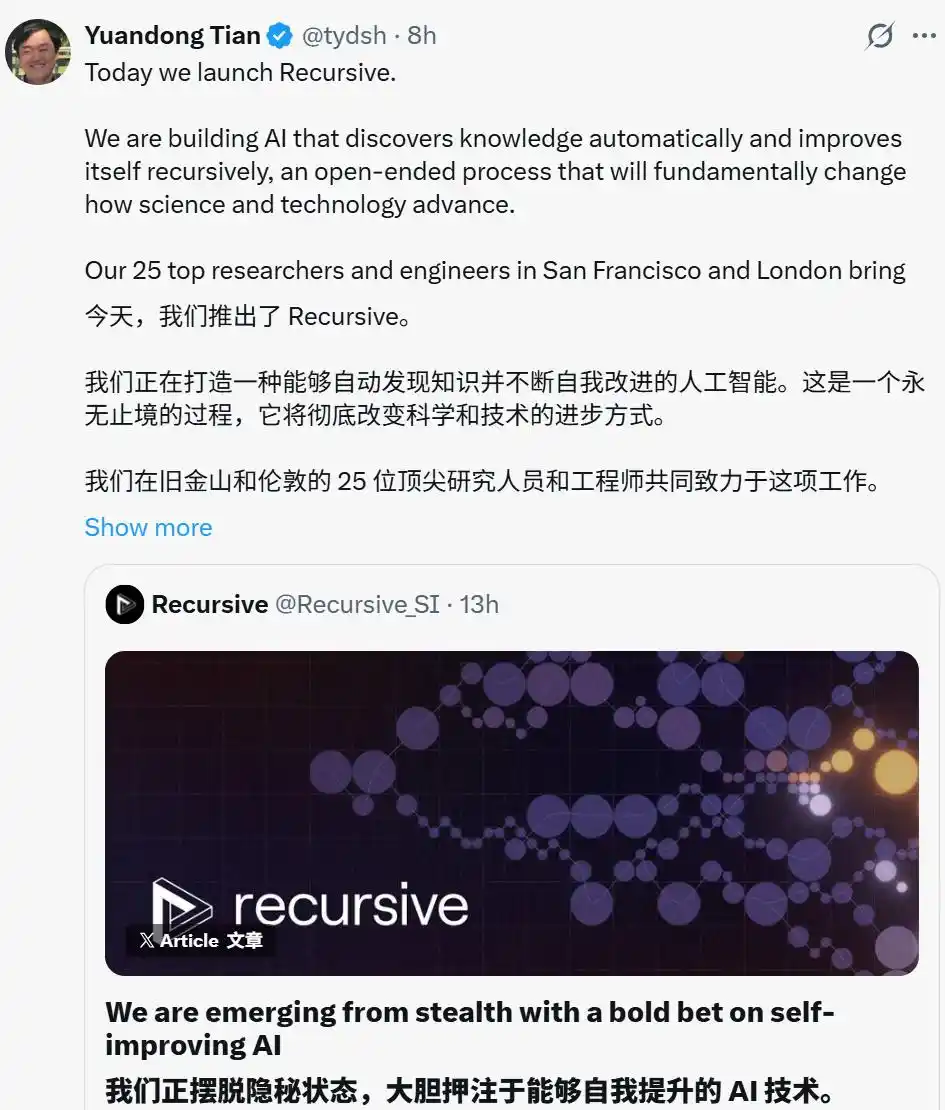
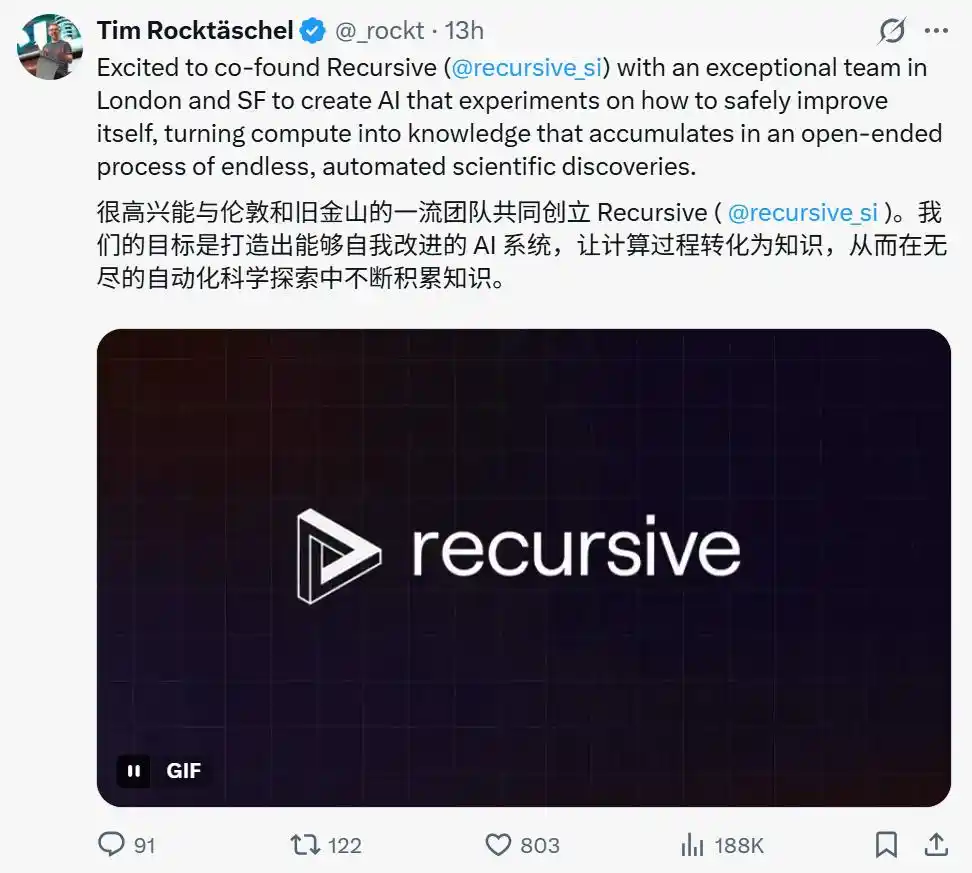
Tian Yuandong and several other founders have promoted the venture on X: "We are building an artificial intelligence that can autonomously discover knowledge and recursively self-improve—this open-ended process will fundamentally change the way science and technology advance."
In several core areas of recursively self-improving artificial intelligence, the team is at the industry forefront.

Members have previously achieved major breakthroughs in fields such as open-ended algorithms, quality-diversity algorithms, AI-generated algorithms, self-improving programming agents, automated red teaming and capability discovery, prompt engineering and its automation, learning challenges and environment generation, foundational world models, deep learning for natural language processing, vision transformers, retrieval-augmented generation, and AI scientists.

Therefore, we are truly filled with anticipation for the upcoming research from Recursive_SI.

This article is from the WeChat public account "机器之心" (Machine Heart), author: 机器之心 (Machine Heart), editor: 机器之心编辑部 (Machine Heart Editorial Department)


Preguntas relacionadas

QWhat is the name of the startup co-founded by Tian Yuan Dong after leaving Meta, and what is its primary mission?

AThe startup is called Recursive_SI. Its primary mission is to build an artificial intelligence that can autonomously conduct experiments and safely self-improve through an open-ended process of automated scientific discovery.

QWho are the key investors in Recursive_SI, and what is the current valuation and funding amount mentioned in the article?

AKey investors include GV (Google Ventures) and Greycroft, with AMD Ventures and NVIDIA also participating in significant funding. The company has raised $6.5 billion with a valuation of $46.5 billion.

QWho is Zhuge Mingchen and what is his research focus, particularly in relation to Recursive Self-Improvement (RSI)?

AZhuge Mingchen is a Founding Member of Recursive_SI, holding a Ph.D. in Computer Science from KAUST under Professor Jürgen Schmidhuber. His research focuses on Coding Agents, Recursive Self-Improvement (RSI), and Next-generation Machine Paradigms. Since 2023, he has systematically explored RSI, contributing to early RSI system paradigms like GPTSwarm and Agent-as-a-Judge.

QWhat are some of the core AI research areas where the Recursive_SI founding team is said to be at the industry forefront?

AThe team is at the forefront in areas including open-ended algorithms, quality-diversity algorithms, AI-generated algorithms, self-improving programming agents, automated red teaming and capability discovery, prompt engineering and automation, learning challenge and environment generation, foundational world models, deep learning for natural language processing, vision Transformers, retrieval-augmented generation, and AI scientists.

QWhich major tech companies' AI research labs have the founders of Recursive_SI been involved in establishing or leading, according to the article?

AThe founding members have been involved in establishing or leading AI research labs at Salesforce and Uber, and have held leadership positions at OpenAI, DeepMind, Google Brain, and Meta.

Lecturas Relacionadas

Will the Next Crypto Bull Run Start with On-Chain Trading of SpaceX?

This article presents a scenario-based forecast for the crypto industry from 2026 to 2029, arguing that the next major cycle will be driven not by technological narratives but by legal access to real-world assets. The author predicts that by mid-2026, pre-IPO perpetual contracts for top private companies like SpaceX, OpenAI, and Anthropic on platforms like Hyperliquid will become the primary gateway for accessing quality assets, as most crypto-native tokens fail to capture real value. The much-hyped AI x Crypto intersection largely fails except for prediction markets, which thrive on betting on AI model supremacy. By 2027, public blockchain foundations are forced to choose between catering to retail speculation or building compliant infrastructure for institutions, with many opting for the latter. Growth in stablecoins and tokenized private credit/equity hits a "triple ceiling" due to regulatory and political uncertainty rather than market demand. The pivotal shift is forecast for 2028. A major liquidation event in pre-IPO perpetuals exposes the structural flaw of synthetic markets lacking a real underlying asset anchor. In response, regulatory changes finally allow the public solicitation of private securities resales to verified accredited investors. This creates a legitimate secondary market for real company equity, which then becomes the core asset class of the new bull market, relegating synthetic perps to a niche role. By 2029, the industry becomes "boring" but foundational. Tokens without claims on real cash flows or assets cease trading. Stablecoin growth is steady but politically capped. Crypto infrastructure fades from view as it gets absorbed into traditional finance backends. The article's central thesis is that the key bottleneck for crypto's next phase is legal and regulatory channels for real asset ownership, not technology.

marsbitHace 24 min(s)

Will the Next Crypto Bull Run Start with On-Chain Trading of SpaceX?

marsbitHace 24 min(s)

The Value Distribution of Stablecoins

**Summary: The Value Distribution of Stablecoins** The article argues that stablecoins are evolving from mere trading tools into broader channels for dollar access. It divides the stablecoin ecosystem into four layers to analyze how value is distributed: 1. **Issuance Layer:** Mints stablecoins, holds reserve assets, and captures the spread between reserve yield and user costs (e.g., Tether, Circle). This layer currently earns the largest profit margin. 2. **Infrastructure Layer:** Connects stablecoins to the traditional financial system, handling fiat on/off-ramps, banking integration, compliance (KYC/AML), and asset management (e.g., Bridge, BVNK). This is the "unglamorous" but critical work, building the essential bridges between crypto and real-world finance. 3. **Acquiring/Distribution Layer:** Integrates stablecoins into merchant systems, manages payment flows, and provides enterprise financial software (e.g., Stripe, Coinbase). They act as the access point for businesses. 4. **Application Layer:** The end-users and businesses that ultimately use stablecoins for payments, settlements, or as a store of value. They benefit from convenience but have little pricing power. The core thesis is that while the issuance layer currently dominates profits, the often-overlooked **infrastructure layer holds significant long-term potential**. The real challenge and barrier to mass adoption is not the on-chain transfer of stablecoins (which is simple), but the complex "last mile" integration into existing business workflows, banking systems, and regulatory frameworks across different countries. Companies in this layer are currently in a "land grab" phase, investing heavily to build networks, secure bank partnerships, and establish compliance pathways. While their position is currently pressured by the profitable issuers above and distribution platforms below, the article suggests that if stablecoins become a default financial rail for businesses, the infrastructure providers who have done the hard work of integration will ultimately gain strong pricing power and become entrenched, essential players.

marsbitHace 7 hora(s)

The Value Distribution of Stablecoins

marsbitHace 7 hora(s)

The Value Distribution of Stablecoins

The Value Distribution of Stablecoins The article argues that stablecoins are evolving from a mere trading tool into a broad "dollar channel." It analyzes the industry's value chain through four layers: 1. **Issuance Layer (e.g., Tether, Circle):** The top layer that mints stablecoins, holds reserve assets, and captures the thickest interest rate spread. 2. **Infrastructure Layer (e.g., Bridge, BVNK):** Connects stablecoins to the traditional financial system, handling critical but complex "dirty work" like fiat on/off-ramps, banking integration, compliance (KYC/AML), and cross-border settlement. 3. **Acquiring/Distribution Layer (e.g., Stripe, Coinbase):** Embeds stablecoins into merchant systems, manages payment flows, and integrates with enterprise software. 4. **Application Layer:** End-users and businesses that ultimately use stablecoins for payments, settlement, or storing value. The author posits that while the issuance layer currently captures the most profit, the most overlooked and potentially critical layer is infrastructure. The core challenge for stablecoin adoption isn't the on-chain transfer (which is simple), but bridging the gap between blockchain and the real-world financial system. This involves solving practical problems for businesses: fiat conversion, reconciliation, tax handling, and user onboarding. Infrastructure companies are currently in a difficult "land-grab" phase—building networks, securing banking relationships, and achieving compliance country-by-country. They face pressure from both the profitable issuance layer above and distribution platforms below. However, the author suggests this layer is building a crucial moat. Once stablecoins become a default business rail, the infrastructure players who have done the hard work of integration may gain significant, durable value and pricing power.

链捕手Hace 7 hora(s)

The Value Distribution of Stablecoins

链捕手Hace 7 hora(s)

Trading

Spot
Futuros
活动图片