Three Weeks into the US-Iran War: Who is Profiting and Who is Paying?

marsbitPublicado a 2026-03-24Actualizado a 2026-03-24

Resumen

Three weeks after the U.S. and Israel launched military strikes against Iran, the conflict has severely disrupted global energy markets. The blockade of the Strait of Hormuz cut off 20 million barrels of daily oil transit, with IEA reporting a net loss of 11 million barrels per day—exceeding the combined impact of the 1973 oil embargo and 1979 Iranian revolution. Over 40 energy facilities across the Middle East were damaged, and global gas supply fell by 140 billion cubic meters. Russia emerged as a key beneficiary: its Urals crude price surged nearly 80% from under $60 to around $90 per barrel, narrowing the discount to Brent. Sanctions-era price caps effectively collapsed as India increased fossil fuel purchases from Russia by 48% in early March. Russia earned an additional €672 million in oil revenue in just two weeks. U.S. consumers faced a 33% spike in gasoline prices, with jet fuel costs rising over 60%. United Airlines cut flights, warning of potential $110 billion in added annual costs if oil hits $175/barrel. Global airlines from Delta to Qantas raised fares or reduced capacity. Even gig economy platforms like DoorDash began offering fuel subsidies to drivers. With a U.S. sanctions exemption on Russian oil set to expire April 11, further market volatility is expected.

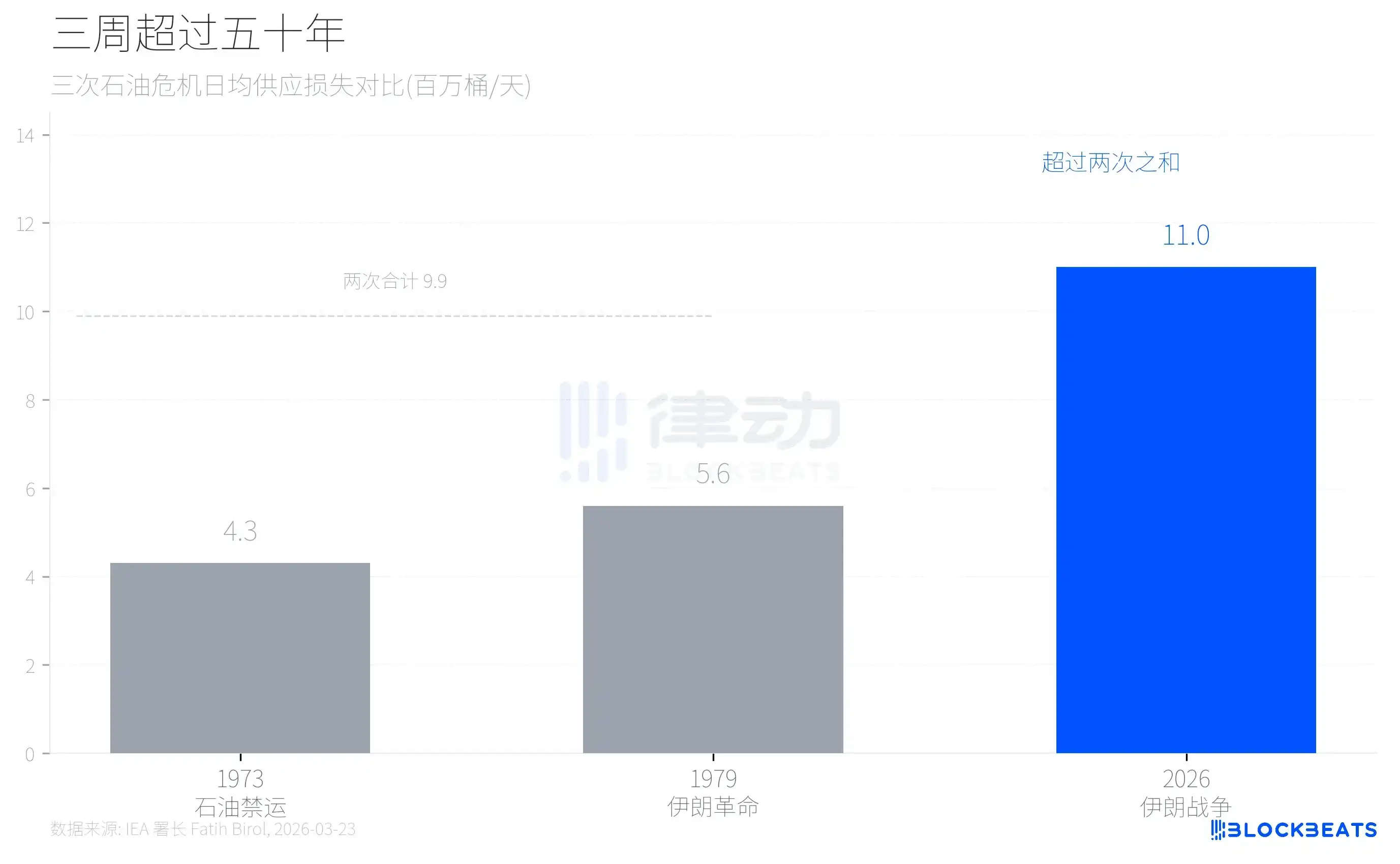
On February 28, the United States and Israel launched a military strike against Iran. Iran immediately blockaded the Strait of Hormuz, cutting off the global daily transit of 20 million barrels of oil. Three weeks later, on March 23, IEA Director Fatih Birol provided a figure at the National Press Club of Australia: the global daily oil supply loss caused by this war is 11 million barrels.

This figure exceeds the combined losses of the 1973 oil embargo and the 1979 Iranian Revolution crises.

Energy infrastructure at over 40 sites across 9 Middle Eastern countries suffered varying degrees of damage. Concurrent IEA data shows that the global natural gas supply loss reached 140 billion cubic meters, nearly double the European gas loss during the Russia-Ukraine conflict (75 billion cubic meters). In just three weeks, the quantitative shock this conflict inflicted on the energy market has surpassed that of the entire 1970s.
But the supply loss is only half the story. The other half is that there are clear beneficiaries of this crisis.

Putin's Windfall

Before the Iran war began, Urals crude was trading at less than $60 per barrel. This price had been locked in for nearly three years, a direct result of Western sanctions. After the Russia-Ukraine war broke out, Europe and the US imposed a price cap on Russian oil, maintaining a long-term discount of $30 to $40 between Urals crude and the international benchmark Brent. This discount was the most直观 signal of the sanctions working.

The Iran war changed all that. Following the blockade of the Strait of Hormuz, a huge gap appeared in the global oil market, forcing buyers to seek alternative supplies. According to data from the Centre for Research on Energy and Clean Air (CREA), Russia's total fossil fuel export revenue reached 7.7 billion euros in the first two weeks of March, averaging 513 million euros per day, an 8.7% increase from February's 472 million euros per day. Daily oil export revenue averaged 372 million euros, earning an extra 672 million euros (approximately $777 million) over those two weeks.

Urals crude rose from under $60 to around $90 within three weeks, a surge of nearly 80%. As reported by Al Jazeera, energy analyst George Voloshin pointed out that Brent also rose from around $65 to over $110 during the same period, but the key is not the absolute price, but the spread between them. The discount of Urals to Brent narrowed significantly from the pre-war level of about $40. The Moscow Times reported on March 16 that Urals crude delivered to India briefly traded at a premium to Brent, something that had not happened since the sanctions took effect.
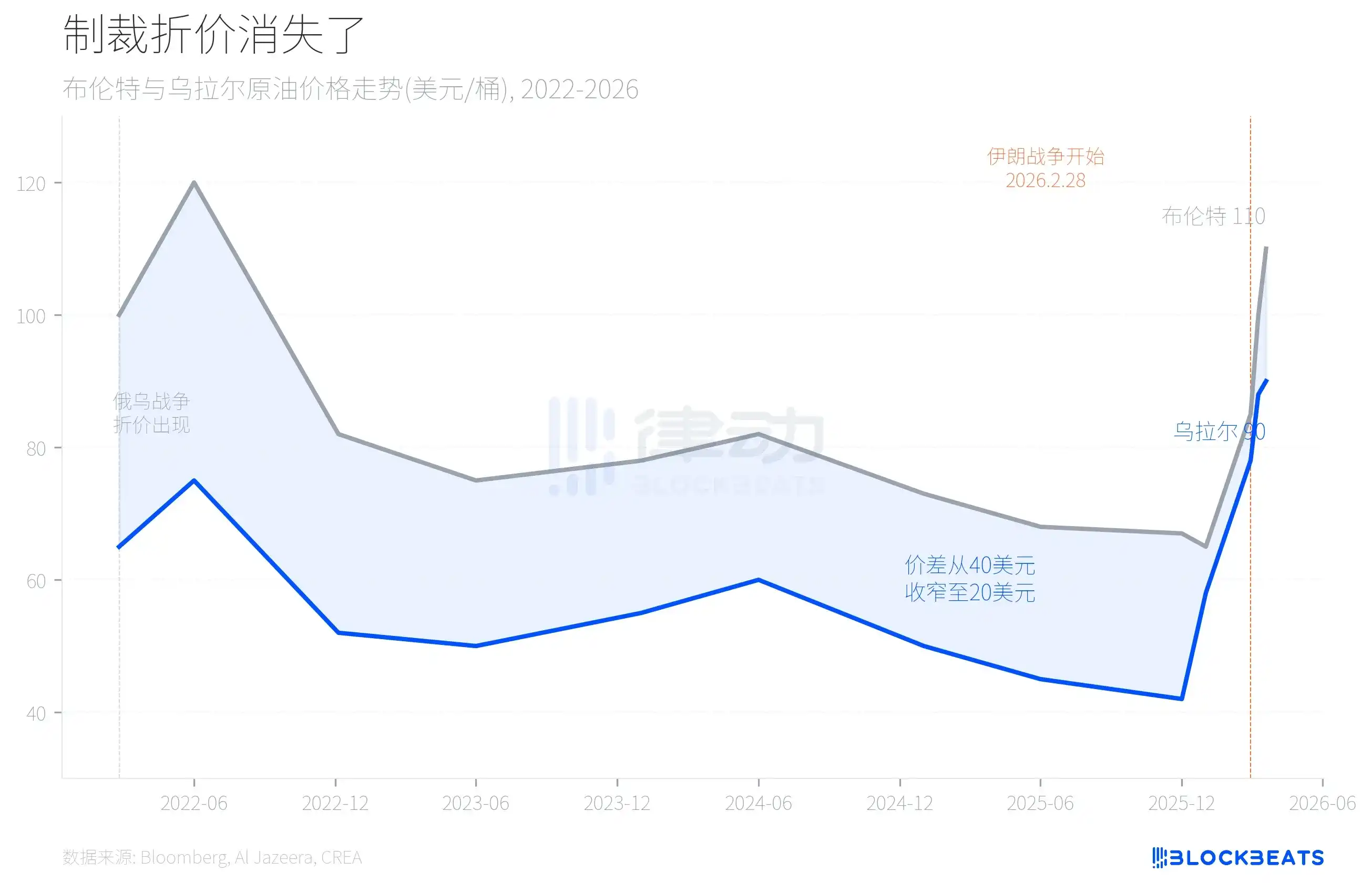
In other words, a significant part of the economic wall built by three years of Western sanctions was dismantled by three weeks of war in Iran.

The Trump administration announced a 30-day sanctions waiver on March 12, allowing countries to purchase Russian oil en route, with Treasury Secretary Scott Bessent stating it would release about 140 million barrels of supply. However, analysts widely believe the waiver's condition of "not generating significant financial benefit" is nearly impossible to enforce. Concurrently, the IEA announced the release of 400 million barrels from strategic petroleum reserves, the largest such release in history. This waiver is set to expire on April 11, at which point the market will face a new round of uncertainty.

India is the most direct actor. CREA data shows that India's purchases of Russian fossil fuels totaled 1.3 billion euros in the first two weeks of March, averaging 89 million euros per day, a 48% increase from February's daily average of 60 million euros. Al Jazeera confirmed that at least 7 tankers originally bound for China changed course to India mid-voyage, with one ship named Aqua Titan arriving at an Indian port on March 21. While the world worries about oil prices, oil trade between Moscow and New Delhi is accelerating.

Who is Paying?

Losses on the supply side and gains on the beneficiary side ultimately get passed on to the consumer. American consumers are bearing the most direct burden.

AAA data shows the US national average price for gasoline rose from $2.98 before the war to $3.96 on March 23, a 33% increase. The average price in California reached $5.56, while the lowest, in Kansas, was $3.23. The average diesel price hit $5.07, the highest since 2022.

Fortune reported that this round of oil price increases has effectively swallowed up the tax refunds American families just received.

The aviation industry was among the first to feel the impact. Platts assessment data shows US jet fuel prices rose over 60% in three weeks, doubling in some regions. United Airlines became the first major US carrier to officially announce capacity cuts. CEO Scott Kirby stated in an internal memo that the company is preparing for oil prices to probe $175 per barrel, which would mean an annual fuel cost increase of about $11 billion, more than double the company's "best annual profit in history." United will cut 5% of its flights in the second and third quarters.

The effects are spreading globally. According to a CNBC report on March 21, Delta Air Lines also warned it might reduce capacity. Euronews reports show that Qantas, SAS, and Thai Airways have already raised prices, and Air New Zealand has canceled over 1,000 flights.
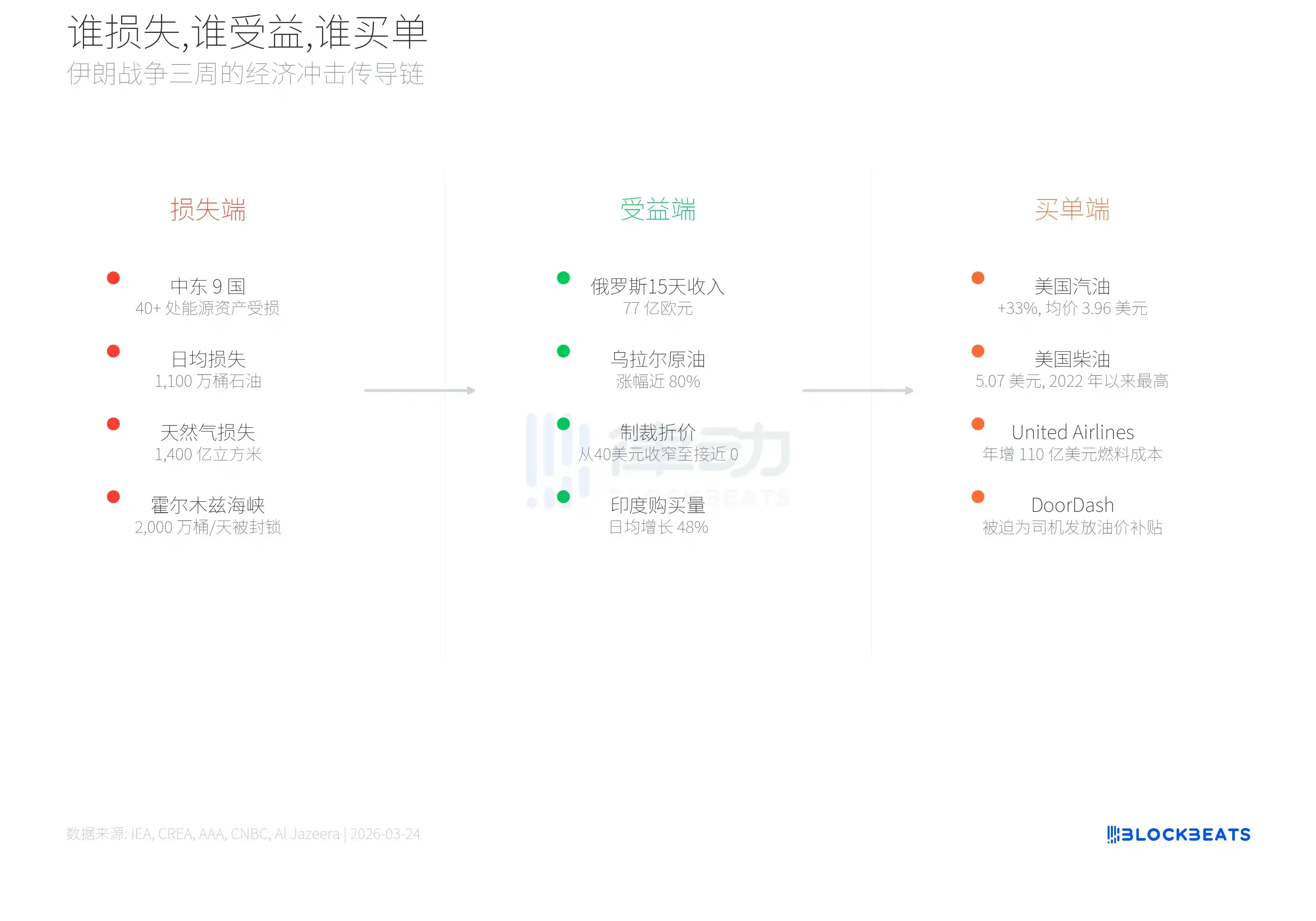
Even the gig economy is affected. According to a Philadelphia Inquirer report on March 23, DoorDash began issuing weekly gas subsidies of $5 to $15 and 10% cash back on gas to drivers, in response to reduced order acceptance due to rising fuel costs. When a food delivery platform has to pay for a war in the Middle East, the length of the shock transmission chain needs no further explanation.

Three weeks into the Iran war, the world loses 11 million barrels of oil daily, Russia made nearly $800 million extra in 15 days, American consumers are paying a third more for gas, and this transmission chain will continue to lengthen after the sanctions waiver expires on April 11.


Criptos en tendencia

Preguntas relacionadas

QAccording to the IEA, what was the daily global oil supply loss caused by the Iran war after three weeks?

AThe daily global oil supply loss was 11 million barrels of oil per day.

QWhich country's fossil fuel exports saw a significant financial gain, and what was the increase in its daily export revenue in the first two weeks of March?

ARussia's fossil fuel exports saw significant gains. Its daily export revenue increased to 513 million euros per day in the first two weeks of March, up 8.7% from 472 million euros in February.

QHow did the price of U.S. gasoline change from pre-war levels to March 23rd, and what was the national average price on that date?

AThe U.S. national average gasoline price rose 33% from the pre-war price of $2.98 to $3.96 on March 23rd.

QWhat action did United Airlines take in response to the surge in jet fuel prices, and what was the cited potential annual cost increase?

AUnited Airlines announced it would cut its capacity by 5% in the second and third quarters. The company stated that if oil prices reached $175 a barrel, its annual fuel cost would increase by approximately $11 billion.

QWhat major sanction policy change did the Trump administration announce on March 12th regarding Russian oil, and when was it set to expire?

AThe Trump administration announced a 30-day sanctions exemption allowing countries to purchase Russian oil that was already in transit. This exemption was set to expire on April 11th.

Lecturas Relacionadas

NVIDIA CPU Advances, China's RISC-V Responds: Semiconductor Deep Dive - Part Four

NVIDIA is set to launch its new Vera AI data center CPU in China as early as August, with high pricing. While this move offers a new option, it highlights China's continued dependence on foreign-controlled Arm architecture. In response, the Chinese semiconductor industry is increasingly turning to RISC-V as a strategic alternative for achieving high-performance computing autonomy. The article explores the concept of the "impossible triangle" in CPU development—balancing prosperity, control, and autonomy—and posits that RISC-V's open-source, modular nature offers a unique path to achieving all three. While RISC-V is already dominant in embedded systems, the focus is now shifting to data centers and AI workloads. China has become a global hotspot for RISC-V development, driven by AI-driven compute demand, supply chain concerns from export controls, cost benefits of open-source, and strong policy support. Multiple Chinese companies have reportedly crossed the key performance threshold of 15 SPECint per GHz, a benchmark for entering the high-performance CPU club. Progress extends beyond single-core benchmarks. Companies are developing complete computing subsystems, including commercial-grade coherent network-on-chip (NoC) technology and server processors with up to 40 cores that strictly adhere to the RVA23 standard to ensure software compatibility. Real-world applications are emerging in areas like video transcoding and edge AI. However, significant challenges remain. The RISC-V ecosystem faces fragmentation, immature toolchains and verification processes, and gaps in single-core performance and energy efficiency compared to mature x86 and Arm architectures. The formidable software moat, epitomized by NVIDIA's CUDA, is a long-term hurdle. In conclusion, while RISC-V cannot immediately replace offerings like NVIDIA's Vera, it represents a viable long-term path for China to develop a self-sufficient, high-performance CPU ecosystem. The journey is acknowledged to be long and arduous, requiring sustained effort to overcome technical and ecosystem challenges.

marsbitHace 5 hora(s)

NVIDIA CPU Advances, China's RISC-V Responds: Semiconductor Deep Dive - Part Four

marsbitHace 5 hora(s)

My Coding Betting Dashboard is Profiting, but Polymarket is Truly Not a Good Place for 'Arbitrage'

The author built a custom monitoring dashboard for Polymarket, a prediction market platform, and tested it with $1,600, achieving over 30% returns. However, the core argument is that Polymarket is not a good venue for traditional arbitrage. The dashboard has two main sections: a "Portfolio Dashboard" for tracking active positions with key metrics like total capital, P&L, and a risk-control module using a tier system (T1, T2, T3), and an "Opportunity Watchlist" for monitoring markets. The article details a critical structural trap in binary markets: a bet with a high perceived probability of success still carries a 100% loss risk if wrong. The author's T1/T2/T3 system is designed to manage this by limiting position sizes based on conviction and time horizon, emphasizing that high confidence should not equal high concentration. A key insight is the danger of "pseudo-diversification"—betting on different markets driven by the same underlying variable. The author concludes that Polymarket offers few true low-risk, arbitrage opportunities. It is instead a high-risk environment where wins can create a false sense of mastery, leading to large losses. The platform is better viewed as a training ground for honing judgment through disciplined, framework-driven betting rather than a reliable income source. The tools help transform intuition into structured, rule-based decisions to mitigate the risk of catastrophic errors.

marsbitHace 8 hora(s)

My Coding Betting Dashboard is Profiting, but Polymarket is Truly Not a Good Place for 'Arbitrage'

marsbitHace 8 hora(s)

WeChat AI Card Hands-On Guide: Has the AI Shopping Era Arrived?

**"WeChat AI Card" Practical Test Guide: Has the Era of AI Shopping Arrived?** WeChat has officially launched the "AI Exclusive Card," a feature integrated into its Workbuddy AI assistant. This card is designed to handle payments for AI-initiated purchases. Our hands-on test reveals it's not yet a tool for fully autonomous AI shopping, but rather a controlled payment layer for AI agents. The AI Card functions as an isolated sub-wallet within WeChat Pay. Users must bind the card and transfer funds into it from their main wallet. Crucially, every transaction requires explicit user confirmation via smartphone scan; AI cannot spend autonomously. Currently accessible through the Workbuddy agent, the card targets specific digital consumption scenarios: purchasing paid content (reports, data), calling paid APIs/tools, and subscribing to services. Its design prioritizes security and control by separating funds and mandating approval for each payment. We tested a real-world scenario: ordering bubble tea via Workbuddy using a "Meituan Life Assistant" skill. The process encountered multiple hurdles: high "skill" usage costs (exceeding daily free credits), and most importantly, while a payment was successfully initiated, the AI purchased an incorrect product (a mismatched group-buy coupon instead of the desired drink). This highlights the current limitation: the **AI Card only solves the payment step**. The broader challenge lies in the **AI agent's execution chain**—accurately understanding intent, navigating third-party platforms, selecting the right product, and ensuring proper fulfillment. The payment succeeded, but the purchase failed to meet the user's need. In conclusion, the WeChat AI Exclusive Card is a cautious, early-step experiment in AI commerce. It provides a secure, user-controlled payment method for agent interactions but is not yet capable of reliable, end-to-end complex purchases. For now, it's best used for low-value, low-risk digital services with careful user verification at each step. The vision of AI handling complete shopping tasks remains a work in progress.

marsbitHace 11 hora(s)

WeChat AI Card Hands-On Guide: Has the AI Shopping Era Arrived?

marsbitHace 11 hora(s)

Trading

Spot
Futuros

Artículos destacados

Cómo comprar WAR

¡Bienvenido a HTX.com! Hemos hecho que comprar WAR (WAR) sea simple y conveniente. Sigue nuestra guía paso a paso para iniciar tu viaje de criptos.Paso 1: crea tu cuenta HTXUtiliza tu correo electrónico o número de teléfono para registrarte y obtener una cuenta gratuita en HTX. Experimenta un proceso de registro sin complicaciones y desbloquea todas las funciones.Obtener mi cuentaPaso 2: ve a Comprar cripto y elige tu método de pagoTarjeta de crédito/débito: usa tu Visa o Mastercard para comprar WAR (WAR) al instante.Saldo: utiliza fondos del saldo de tu cuenta HTX para tradear sin problemas.Terceros: hemos agregado métodos de pago populares como Google Pay y Apple Pay para mejorar la comodidad.P2P: tradear directamente con otros usuarios en HTX.Over-the-Counter (OTC): ofrecemos servicios personalizados y tipos de cambio competitivos para los traders.Paso 3: guarda tu WAR (WAR)Después de comprar tu WAR (WAR), guárdalo en tu cuenta HTX. Alternativamente, puedes enviarlo a otro lugar mediante transferencia blockchain o utilizarlo para tradear otras criptomonedas.Paso 4: tradear WAR (WAR)Tradear fácilmente con WAR (WAR) en HTX's mercado spot. Simplemente accede a tu cuenta, selecciona tu par de trading, ejecuta tus trades y monitorea en tiempo real. Ofrecemos una experiencia fácil de usar tanto para principiantes como para traders experimentados.

192 Vistas totalesPublicado en 2024.12.11Actualizado en 2026.06.02

Cómo comprar WAR

Discusiones

Bienvenido a la comunidad de HTX. Aquí puedes mantenerte informado sobre los últimos desarrollos de la plataforma y acceder a análisis profesionales del mercado. A continuación se presentan las opiniones de los usuarios sobre el precio de WAR (WAR).

活动图片