Korean Cryptocurrency Market Platform Kimpga Integrates with Global Web3 Data Platform RootData, Providing Popularity and Growth Scores for Token Projects

marsbitPublicado a 2026-08-05Actualizado a 2026-08-05

Resumen

South Korean cryptocurrency market data platform Kimpga (kimpga.com) has announced a data partnership with the global Web3 project data platform RootData. As a result, Kimpga has integrated comprehensive token project information directly into its platform services. The integration introduces a new "RD Score" column within Kimpga's market listings. Clicking the score opens a detailed data window that displays the "RD Popularity Index," the "RD Growth Index," and key fundamental project data such as leading investors, core team members, and project category tags. For example, for Solana (SOL), users can view its indices and identify major backers like Polychain Capital, a16z, and Multicoin Capital directly from the interface, with links to full RootData project pages for deeper research. Jin Jae-yong, a representative of Kimpga, stated that the partnership allows users to quickly assess a project's fundamental strength, including its development team and investor lineup, without leaving the market data screen. This addresses a key challenge for investors who previously had to rely solely on price and premium data. RootData is a widely used global platform providing Web3 project details on funding history, team composition, and investor portfolios for due diligence and investment analysis. Kimpga, which boasts 10 million cumulative users, is a leading Korean crypto market platform providing real-time data and price premiums from over 18 domestic and international exchanges. ...

Reporter:Chae-eun Oh

The Korean domestic cryptocurrency market platform Kimpga (kimpga.com) announced a data partnership with the global Web3 project data platform RootData and has begun directly providing token project information within its platform services.

Core Features and Data Display

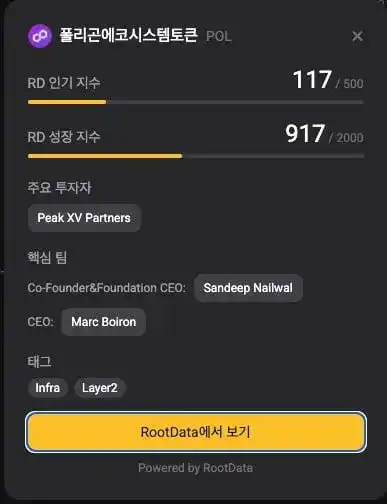
Through this data integration, Kimpga's market listing panel will add an "RD Score" for each token. Upon clicking the score, a window containing detailed project data will pop up, allowing users to intuitively view:
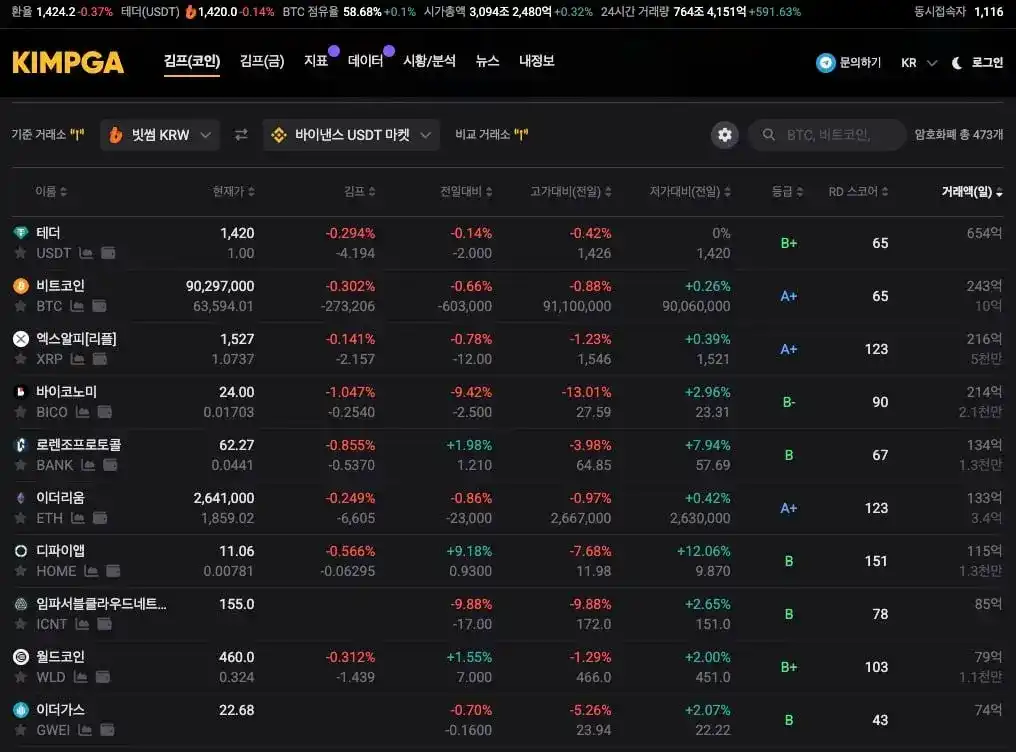
  • RD Popularity Index: An indicator quantifying market attention towards a project.

  • RD Growth Index: An indicator showcasing project development and growth trends.

  • Project Fundamental Data: Including key investment institutions, core team composition, project category tags, etc.

For example, with Solana (SOL), users can not only view its RD Popularity and Growth Indices but also directly confirm key investment institutions such as Polychain Capital, a16z (Andreessen Horowitz), Multicoin Capital, and co-founder information within the same interface. Each data item is linked to RootData's project detail page, facilitating deeper user research.
Enhancing Investment Decision Efficiency

Kimpga Representative Jin Jae-yong stated:

"With just real-time prices and premiums, it's difficult for investors to understand the development teams and investment lineup behind projects. By integrating RootData, users can quickly confirm a project's fundamental strength without switching or leaving the market interface."

RootData is a global platform providing Web3 project data such as fundraising history, team composition, and investment firm portfolios in a database format. It is widely used by global investors and researchers as a tool for project due diligence and investment analysis.

Continuously Strengthening Data Services

Previously, Kimpga had partnered with the token assessment rating platform APYWA to introduce token rating data. The official announcement states that following this integration with RootData, the platform has further complemented its existing market data and rating data layers with project fundamental information, providing stronger support for user investment decisions.

Currently, Kimpga has accumulated 10 million users and is a mainstream cryptocurrency market platform in Korea, providing real-time market data and premium data from over 18 major domestic and international exchanges.

Disclaimer: This article is based on market data and does not constitute investment advice for any specific cryptocurrency.

Criptos en tendencia

Preguntas relacionadas

QWhat is the main collaboration announced between Kimpga and RootData?

AKimpga, a South Korean cryptocurrency market platform, has announced a data collaboration with the global Web3 project data platform RootData. This integration allows Kimpga to provide comprehensive project information and indices for various tokens directly within its platform.

QWhat are the two key RD (RootData) indices that Kimpga users can now access for each token?

AKimpga users can now access the RD Popularity Index, which quantifies market attention for a project, and the RD Growth Index, which illustrates the project's development and growth trends.

QAccording to Kimpga's representative, what problem does the integration with RootData help solve for investors?

AAccording to Kimpga representative Jin Jae-yong, relying solely on real-time prices and premiums makes it difficult for investors to understand the background of a project, such as its development team and investor lineup. The integration allows users to quickly confirm a project's fundamental strength without leaving the market interface.

QBesides RootData, which other data service has Kimpga previously partnered with to enhance its offerings?

APrior to the RootData collaboration, Kimpga had already partnered with the token assessment rating platform APYWA to introduce token rating data.

QWhat is Kimpga's current user base and its market position as described in the article?

AThe article states that Kimpga currently has a cumulative user base of 10 million people and is a mainstream cryptocurrency market platform in South Korea, providing real-time market and premium data from over 18 major domestic and international exchanges.

Lecturas Relacionadas

Arthur Hayes' 10,000-Word New Article: When Will the AI Wave Peak? Will the Bubble Burst? Why Am I Fiercely Buying ETH?

In his latest essay, "When Will the AI Wave Peak? Will the Bubble Burst? Why Am I Loading Up on ETH?", crypto veteran Arthur Hayes presents a contrarian thesis on the AI investment boom, framing it as an impending credit bubble rather than a tech growth story. Hayes argues that massive AI infrastructure spending (AI CAPEX) is fundamentally a real estate play—building data centers—disguised as high-growth technology. This misclassification leads to dangerous capital misallocation. He predicts the bubble is a credit bubble akin to the 2008 financial crisis, not an earnings bubble like the 2000 dot-com bust. The turning point will not be AI companies failing to profit, but a slowdown in the growth rate of data center construction, which will cause over-leveraged players to falter. He anticipates AI CAPEX growth will slow by mid-to-late 2027, entering a "slowdown phase" in 2028. However, credit will continue flowing due to profitable lending, government pressure, and implicit bailout guarantees. This creates a period of misallocation where credit exceeds valuable projects. Hayes draws parallels to the 2006-2007 housing market "no man's land." Governments, particularly the US, will inevitably print money to bail out the system, possibly through direct equity purchases via SPVs—a form of "Equity QE." This massive future liquidity injection, exceeding the 2008 crisis response, will ultimately flow into crypto, specifically Bitcoin, potentially driving it past $1 million. Regarding the current crypto market, Hayes believes the AI boom has sucked away liquidity, contributing to Bitcoin's correction. He expects Bitcoin to bottom as AI capital misallocation accelerates, with the excess fiat liquidity eventually fueling its next bull run. Finally, Hayes reveals a major personal trade: aggressively accumulating ETH. He targets $5,000 by end-2026, betting on a new narrative where Ethereum becomes the settlement layer for TradFi RWA tokenization, citing projects like Robinhood using Arbitrum L2s as a catalyst. He views ETH as a hated, high-Lindy asset with strong liquidity, presenting an asymmetric opportunity.

Odaily星球日报Hace 2 min(s)

Arthur Hayes' 10,000-Word New Article: When Will the AI Wave Peak? Will the Bubble Burst? Why Am I Fiercely Buying ETH?

Odaily星球日报Hace 2 min(s)

Stunning, Musk Joins Forces with Huang Jen-hsun to Deploy the Stellar Brain! AI Computing Center Launched into Space

SpaceX, in its first public earnings report, has announced a partnership with NVIDIA to launch Starmind, an orbital AI computing network. This initiative aims to move AI's computational foundation into space to solve the critical challenges of energy consumption and heat dissipation faced by terrestrial data centers. The core concept involves deploying data centers equipped with NVIDIA's advanced GPUs (like the upcoming Rubin) into sun-synchronous orbit. Key advantages include near-continuous solar power for energy, the vacuum of space for highly efficient radiative cooling, and the absence of terrestrial constraints like land use and grid capacity. The first computational node, the Starmind AI1 satellite, is described as a massive vehicle with a 75-meter wingspan, generating 210 kW of solar power to run a 150 kW computing payload—equivalent to a full NVIDIA GB300 supercomputer rack. These "compute satellites" will connect to users via SpaceX's existing Starlink constellation using high-speed laser links, promising low-latency access from anywhere on Earth. SpaceX's ability to realize this vision is underpinned by its Starship rocket, designed for low-cost, high-frequency launches to transport thousands of satellites, and massive planned manufacturing facilities like the Gigasat factory and the Terafab chip plant. Elon Musk framed the project within the context of the Kardashev Scale, proposing Starmind as humanity's first substantive step toward becoming a Type II civilization capable of harnessing a star's energy. The ultimate goal is to deploy one terawatt of computational power in space, with even more ambitious plans involving lunar-based manufacturing and launch systems. The report positions Starmind not merely as a commercial AI service, but as a foundational infrastructure project to expand human intelligence and capability beyond Earth, leveraging SpaceX's integrated strengths in rockets, satellites, and global connectivity.

marsbitHace 54 min(s)

Stunning, Musk Joins Forces with Huang Jen-hsun to Deploy the Stellar Brain! AI Computing Center Launched into Space

marsbitHace 54 min(s)

Despite the sell-off, Goldman Sachs remains bullish on Samsung and SK Hynix. Here's why.

Goldman Sachs maintains "Buy" ratings on Samsung Electronics and SK Hynix despite recent stock declines. Its bullish view centers on three core arguments. Firstly, it expects HBM (High Bandwidth Memory) pricing to re-establish a premium over conventional DRAM by 2027, with a projected blended ASP of around $2.9/Gb. This is driven by tight supply-demand dynamics, increasing manufacturing complexity for newer HBM generations, and the need to restore its historical price premium. Secondly, the volatility of the memory cycle is expected to moderate due to widespread adoption of 3-5 year Long-Term Agreements (LTAs) with key customers. These contracts, covering a significant portion of planned capacity, feature mechanisms like price floors, prepayments, and penalties, reducing supplier risk and improving earnings visibility. Thirdly, inventory levels remain low at key suppliers and major customers, providing a buffer against a sharp downturn. Furthermore, robust demand from enterprise SSDs for AI servers is seen offsetting weakness in consumer segments like smartphones and PCs, preventing NAND markets from slipping into oversupply in the near term. While risks exist—such as potential weaker AI demand or aggressive capacity expansion—Goldman Sachs believes the combination of HBM repricing, LTAs, and low inventory underpins a more stable earnings outlook for the leading Korean memory makers.

marsbitHace 1 hora(s)

Despite the sell-off, Goldman Sachs remains bullish on Samsung and SK Hynix. Here's why.

marsbitHace 1 hora(s)

Trading

Spot

Artículos destacados

Cómo comprar DATA

¡Bienvenido a HTX.com! Hemos hecho que comprar DATA Network (DATA) sea simple y conveniente. Sigue nuestra guía paso a paso para iniciar tu viaje de criptos.Paso 1: crea tu cuenta HTXUtiliza tu correo electrónico o número de teléfono para registrarte y obtener una cuenta gratuita en HTX. Experimenta un proceso de registro sin complicaciones y desbloquea todas las funciones.Obtener mi cuentaPaso 2: ve a Comprar cripto y elige tu método de pagoTarjeta de crédito/débito: usa tu Visa o Mastercard para comprar DATA Network (DATA) al instante.Saldo: utiliza fondos del saldo de tu cuenta HTX para tradear sin problemas.Terceros: hemos agregado métodos de pago populares como Google Pay y Apple Pay para mejorar la comodidad.P2P: tradear directamente con otros usuarios en HTX.Over-the-Counter (OTC): ofrecemos servicios personalizados y tipos de cambio competitivos para los traders.Paso 3: guarda tu DATA Network (DATA)Después de comprar tu DATA Network (DATA), guárdalo en tu cuenta HTX. Alternativamente, puedes enviarlo a otro lugar mediante transferencia blockchain o utilizarlo para tradear otras criptomonedas.Paso 4: tradear DATA Network (DATA)Tradear fácilmente con DATA Network (DATA) en HTX's mercado spot. Simplemente accede a tu cuenta, selecciona tu par de trading, ejecuta tus trades y monitorea en tiempo real. Ofrecemos una experiencia fácil de usar tanto para principiantes como para traders experimentados.

329 Vistas totalesPublicado en 2026.07.01Actualizado en 2026.07.01

Cómo comprar DATA

Discusiones

Bienvenido a la comunidad de HTX. Aquí puedes mantenerte informado sobre los últimos desarrollos de la plataforma y acceder a análisis profesionales del mercado. A continuación se presentan las opiniones de los usuarios sobre el precio de DATA (DATA).

活动图片