Those Who Hate Bitcoin Are 'Plundering' the World with Private Credit

marsbitPublicado a 2026-03-06Actualizado a 2026-03-06

Resumen

Author Jeff Park argues that private credit is the latest and most insidious financial innovation designed to conceal risk, ultimately socializing losses onto unsuspecting pensioners and insurance policyholders. Unlike past instruments like junk bonds or structured credit, private credit is structured to be opaque, with slow, smoothed valuations that hide problems until catastrophic, instantaneous write-downs occur (like BlackRock recently writing two loans to zero). The article posits that the 2008 crisis didn't eliminate risk but pushed it into a shadow banking system. The $2 trillion private credit market, now funding major AI projects, creates a perverse cycle: workers' retirement savings are used for automation that may eliminate their jobs. The core criticism is the flawed incentive structure: fund managers collect fees upfront while long lock-ups and a lack of transparency ensure that retirees and ordinary investors bear all the losses when the investments fail, making it a form of "theft of time" where profits are privatized and losses are socialized.

Written by: Jeff Park

Compiled by: Chopper, Foresight News

In the financial world, every generation invents a new tool to package its worst instincts into something that appears prudent.

The 1980s had junk bonds, cloaked in the guise of 'democratizing capital'; the 1990s had emerging market debt, packaged as a noble cause to help developing countries integrate into the global economy; the 2000s had structured credit, so complexly layered that even its designers couldn't understand it before it collapsed.

These 'innovations' share a common thread: they created artificial solutions (like liquidity transformation) for real problems (like insufficient growth), ultimately leading to disaster due to excess.

Private credit is the latest chapter in this story, and perhaps the most insidious one. Unlike its predecessors, it is designed from the outset to make the清算 (liquidation) before a risk explosion completely invisible. By the time it's discovered, the consequences are irreversible.

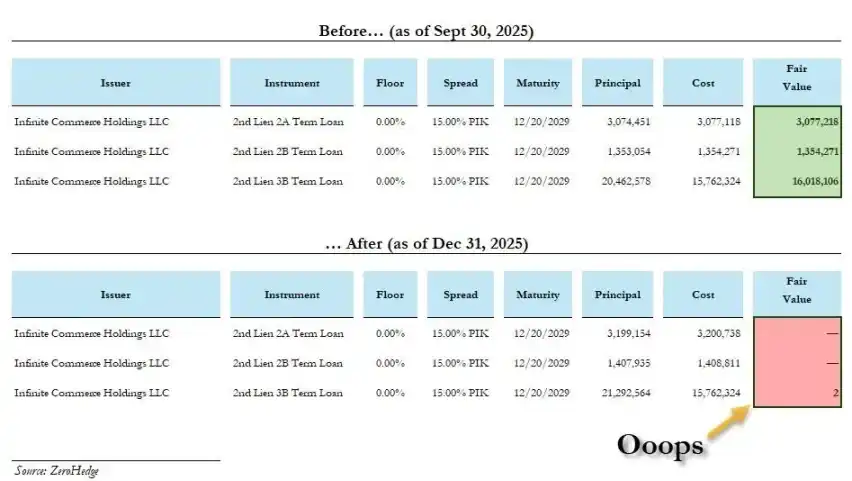
Recently, BlackRock directly wrote down the face value of two private credit loans from 100% to 0 in one go, one of them in less than a month. This doesn't look like a technical error in valuation methods; it looks more like a confession of flawed incentives.
How did we get here?

The Crisis Isn't the Root Cause; Concealing the Truth Created It

The mainstream industry narrative goes like this: After the 2008 financial crisis, banks, constrained by Basel III, became afraid to lend. Non-bank institutions stepped in to fill the void, serving small and medium-sized enterprises. This was the market's inevitable choice.

The more truthful situation is that the post-2008 regulatory framework did not truly eliminate risk. Instead, it actively fostered a shadow system that bears the same underlying risks but evades the regulations originally designed to constrain them.

The private credit market has ballooned from $46 billion in 2000 to about $2 trillion today. This money didn't appear out of thin air, nor did it accidentally flow into pension funds and insurance companies. It was precisely channeled to institutions with large capital bases, long lock-up periods, and a willingness to accept opaque valuations.

Its structure is identical to that which precipitated the 2008 financial crisis, with one significant difference. When the subprime mortgage market collapsed in 2008, losses were concentrated in reckless borrowing households and the banks that lent to them. If private credit crashes, the losses have no boundaries; the money comes from life insurance policyholders and pension beneficiaries—ordinary people.

The socialization of losses that outraged the public in 2008 at least had a preceding period of private gains. With private credit: profits go into the pockets of fund managers, losses are socialized and flow to the retirement accounts of teachers, nurses, civil servants—people who never agreed to bear this risk.

Worse, the industry, not content with just harvesting institutions, is now targeting retail investors. Since 2025, private credit ETFs have become hugely popular, but the problem is even more severe: illiquid assets don't become liquid by being put into an ETF. It merely transfers the bomb of 'redemption runs hitting but assets being unsellable' from professional institutions to the brokerage accounts of ordinary investors.

This is the reality unfolding.

Asset Allocators Who Hate Bitcoin Expose Everything

Over the past few years, I've been recommending Bitcoin to institutions everywhere and discovered a startling pattern: those who reject Bitcoin are often fervent enthusiasts of private credit. This isn't just two different viewpoints on a topic; it's the same mentality.

Their objections to Bitcoin sound 'prudent': too volatile, drawdowns are inexplicable, no cash flow so it can't be valued.

But the subtext is: Bitcoin's price is too honest. Real-time, public, visible to all. If it makes a mistake, it's wrong, and it can't be hidden.

Private credit is the exact opposite:

  • Valuation changes are extremely slow, 'smoothed' quarterly by fund managers
  • There is no liquid market to puncture the lies
  • Lock-up periods are long enough for the decision-makers to get promoted, change jobs, or retire

The so-called 'proprietary deal flow' is just an excuse for a lack of effective pricing competition.

A true fiduciary seeks the truth. These allocators seek to avoid facing the truth. This isn't risk management; it's the opposite of risk management, yet it's cloaked in professionalism, completely disregarding the beneficiaries' interests.

The AI Boom Turns It Into a Systemic Risk

Morgan Stanley estimates that from 2025 to 2028, global data centers will require $2.9 trillion in capital expenditure, with about $800 billion of that to be solved by private credit. This has turned private credit from a lending market into the key infrastructure for the most important technological transformation of the coming decades.

A typical case: In October 2025, Meta and Blue Owl completed a $27 billion data center financing deal, the largest private credit transaction in history. The money came from PIMCO, BlackRock, and ultimately from pensions and insurance companies.

The cruelty of this cycle: the retirement savings of ordinary workers are used to fund automation and AI, which in turn replaces the very jobs of those workers. Private credit distorts the cost of capital and suppresses the value of labor. Now, nearly $50 billion in private credit floods into the AI sector every quarter.

The financialization of AI infrastructure and the displacement of the workforce that funds it form a closed loop: the left hand cuts the right hand.

Liquidity Transformation is Theft of Time

I'm not saying credit itself is sinful, nor that all private credit firms are bad. Credit has always been a game of probabilities; bad debts and mismatches exist in every era.

The key difference is: who truly bears the loss?

  • If a bank makes a bad loan, it's on their balance sheet, regulated, faces bank runs and equity wipeouts—there is real money at risk;
  • Private credit managers earn performance fees, incentives that 'encourage you to place bets,' not incentives that 'encourage you to win responsibly.'

By the time the loan goes to zero, the manager has already made enough money.

Every financial engineering endeavor ultimately points to one question: who bears the costs nobody wants?

The 'brilliance' of private credit is how 'elegantly' it answers this question:

Profits flow upward and backward: to the older, already retired beneficiaries of long-term capital

Costs flow downward and forward: suppressing wages, freezing hiring, delaying investment, distorting the entire economy's cost of capital

Private credit is the theft of time.

This is the age-old liquidity transformation in finance, just stripped of its disguise.

They bear risks they shouldn't have to bear, through tools they cannot choose, at prices they cannot foresee.

Lock-up periods ensure they cannot exit. The lack of public valuation ensures they cannot protest. And the quarterly valuation smoothing mechanism ensures that when the final bill comes, those responsible are long gone.

It doesn't look like plunder; it looks like 'steady returns.' The two are almost indistinguishable until the moment of collapse. While this story is age-old, the novelty lies in its sheer scale, its profound lack of transparency, and the astounding success of an asset class built on this illusion of safety, which has managed to convince the world's most cautious capital managers.

There is no asset class in the world that can be valued at 100% for three consecutive months and then written down to zero overnight.

If this isn't theft, then I don't know what is.

Preguntas relacionadas

QWhat is the main argument the author makes about private credit?

AThe author argues that private credit is the latest and most insidious financial innovation that artificially solves real problems like lack of growth, but is designed to hide risks until it's too late. It socializes losses onto ordinary people while managers privatize gains, making it a form of 'theft of time'.

QAccording to the author, what is a key difference between the 2008 subprime crisis and a potential private credit crash?

AIn the 2008 subprime crisis, losses were primarily concentrated on reckless households and lending banks, with a period of private gain before losses were socialized. In a private credit crash, losses would flow directly to pensioners, teachers, nurses, and public servants—ordinary people who never agreed to bear the risk—while the gains have already been pocketed by fund managers.

QWhy does the author believe that asset allocators who reject Bitcoin often favor private credit?

AThe author contends that these allocators reject Bitcoin because its price is 'too honest'—it is real-time, public, and cannot hide mistakes. In contrast, they favor private credit because its valuations are smoothed, lack a liquid market to expose lies, and have long lock-up periods that allow decision-makers to avoid accountability by the time losses occur.

QHow is the AI boom exacerbating the systemic risks of private credit?

AThe AI boom is creating massive capital expenditure needs for data centers, with an estimated $800 billion expected to be funded through private credit. This transforms private credit from a lending market into critical infrastructure for a major technological shift. It creates a perverse cycle where workers' pension funds are used to finance AI and automation that may ultimately replace their own jobs.

QWhat does the author mean by 'private credit is theft of time'?

AThe author means that private credit 'steals time' through its structure: profits flow upward and backward to older, retired beneficiaries of long-term capital, while the costs (lower wages, hiring freezes, delayed investment) are pushed downward and forward onto future generations. The long lock-ups and lack of transparency ensure that by the time the bill comes due, those responsible are no longer accountable, and the true risk-takers (ordinary people) cannot protest or exit.

Lecturas Relacionadas

Bitwise: Bullish on Bitcoin's Performance in the Second Half of the Year, AI and Regulation Will Spark a New Altcoin Season

Bitwise CIO Matt Hougan and Research Lead Ryan Rasmussen express strong bullish sentiment on Bitcoin's long-term prospects, suggesting that its $1 million price target may be too conservative. They argue Bitcoin serves a dual role: as digital gold and a potential global settlement asset, especially amid declining trust in traditional monetary systems. Despite a weak Q1 2026 where nearly all crypto assets and prices saw double-digit declines, the analysts remain optimistic due to strong forward-looking catalysts, including institutional adoption via Bitcoin ETFs from major firms like Morgan Stanley and Goldman Sachs. Geopolitical instability, such as Iran’s mention of using Bitcoin for international payments, increases the value of Bitcoin’s “out-of-the-money call option” as a non-political, global settlement currency. This enhances its appeal beyond a mere store of value. . Additionally, Hougan highlights that a clearer regulatory token framework under current SEC leadership, combined with AI efficiency gains and high-performance blockchains, could fuel a new “altseason” by late 2026. This may lead to a wave of legitimate, value-capturing token projects, unlike the earlier ICO boom. . Bitwise also announced an Avalanche ETF, citing its unique architecture and rapid growth in real-world asset (RWA) tokenization, which has surged 10x to nearly $30 billion in two years. The firm believes Layer 1 blockchains are still early in their growth cycle, with significant potential ahead.

marsbitHace 29 min(s)

Bitwise: Bullish on Bitcoin's Performance in the Second Half of the Year, AI and Regulation Will Spark a New Altcoin Season

marsbitHace 29 min(s)

Trading

Spot
Futuros

Artículos destacados

Qué es BITCOIN

Entendiendo HarryPotterObamaSonic10Inu (ERC-20) y Su Posición en el Espacio Cripto En los últimos años, el mercado de criptomonedas ha sido testigo de un aumento en la popularidad de las monedas meme, capturando el interés no solo de los comerciantes, sino también de aquellos que buscan compromiso comunitario y valor de entretenimiento. Entre estos tokens únicos se encuentra HarryPotterObamaSonic10Inu (ERC-20), un proyecto intrigante que mezcla referencias culturales en el tejido de las criptomonedas. Este artículo profundiza en los aspectos clave de HarryPotterObamaSonic10Inu, explorando sus mecanismos, ethos impulsado por la comunidad y su relación con el paisaje cripto más amplio. ¿Qué es HarryPotterObamaSonic10Inu (ERC-20)? Como su nombre sugiere, HarryPotterObamaSonic10Inu es una moneda meme construida sobre la blockchain de Ethereum, clasificada bajo el estándar ERC-20. A diferencia de las criptomonedas tradicionales que pueden enfatizar la utilidad práctica o el potencial de inversión, este token prospera en el valor de entretenimiento y la fuerza de su comunidad. El proyecto tiene como objetivo fomentar un entorno donde los usuarios comprometidos puedan reunirse, compartir ideas y participar en actividades inspiradas por diversos fenómenos culturales. Una característica notable de HarryPotterObamaSonic10Inu es su cero impuestos en las transacciones. Este atractivo elemento tiene como objetivo incentivar el comercio y la participación comunitaria, sin cargos adicionales que puedan disuadir a los comerciantes de pequeña escala. El suministro total de la moneda está establecido en mil millones de tokens, una cifra que marca su intención de mantener una circulación sustancial dentro de la comunidad. Creador de HarryPotterObamaSonic10Inu (ERC-20) Los orígenes de HarryPotterObamaSonic10Inu están algo envueltos en misterio; los detalles sobre el creador siguen siendo desconocidos. El desarrollo de este token carece de un equipo identificable o de un plan explícito, lo cual no es inusual dentro del sector de monedas meme. En cambio, el proyecto ha surgido de manera orgánica, con su progreso muy dependiente del entusiasmo y la participación de su comunidad. Inversores de HarryPotterObamaSonic10Inu (ERC-20) En cuanto a inversiones externas y respaldo, HarryPotterObamaSonic10Inu también sigue siendo ambiguo. El token no lista ninguna fundación de inversión conocida o apoyo organizacional significativo. En cambio, la savia del proyecto es su comunidad de base, que informa su crecimiento y sostenibilidad a través de la acción colectiva y el compromiso en el espacio cripto. ¿Cómo Funciona HarryPotterObamaSonic10Inu (ERC-20)? Como una moneda meme, HarryPotterObamaSonic10Inu opera principalmente fuera de los marcos tradicionales que a menudo rigen el valor de los activos. Hay varios aspectos distintivos que definen cómo funciona el proyecto: Transacciones Sin Impuestos: Sin tarifas impositivas en las transacciones, los usuarios pueden comprar y vender el token libremente sin preocuparse por costos ocultos. Compromiso Comunitario: El proyecto prospera en la interacción comunitaria, aprovechando plataformas de redes sociales para crear entusiasmo y facilitar la participación. Las discusiones, el intercambio de contenido y el compromiso son elementos cruciales que ayudan a expandir su alcance y fomentar la lealtad entre los seguidores. Sin Utilidad Práctica: Cabe señalar que HarryPotterObamaSonic10Inu no ofrece utilidad concreta dentro del ecosistema financiero. Más bien, se clasifica como un token principalmente para actividades de entretenimiento y comunitarias. Referencia Cultural: El token incorpora astutamente elementos de la cultura popular para atraer interés, conectando con entusiastas de los memes y seguidores de las criptomonedas por igual. HarryPotterObamaSonic10Inu ejemplifica cómo las monedas meme operan de manera diferente a los proyectos de criptomonedas más tradicionales, ingresando al mercado como construcciones sociales innovadoras en lugar de activos utilitarios. Cronología de HarryPotterObamaSonic10Inu (ERC-20) La historia de HarryPotterObamaSonic10Inu está marcada por varios hitos notables: Creación: El token surgió de un meme viral, capturando la imaginación de muchos entusiastas de las criptomonedas. Las fechas específicas de creación no están disponibles, subrayando su ascenso orgánico. Listado en Exchanges: HarryPotterObamaSonic10Inu ha llegado a varios exchanges, permitiendo un acceso y comercio más fácil por parte de la comunidad. Iniciativas de Compromiso Comunitario: Actividades continuas destinadas a mejorar la interacción comunitaria, incluyendo concursos, campañas en redes sociales y generación de contenido por parte de fanáticos y defensores. Planes de Expansión Futuros: La hoja de ruta del proyecto incluye el lanzamiento de una colección de NFT, mercancía y un sitio de comercio electrónico relacionado con sus temas culturales, involucrando aún más a la comunidad e intentando añadir más dimensiones a su ecosistema. Puntos Clave Sobre HarryPotterObamaSonic10Inu (ERC-20) Naturaleza Impulsada por la Comunidad: El proyecto prioriza la participación colectiva y la creatividad, asegurando que la involucración de los usuarios esté a la vanguardia de su desarrollo. Clasificación como Moneda Meme: Representa la epítome de las criptomonedas basadas en el entretenimiento, diferenciándose de los vehículos de inversión tradicionales. Sin Afiliación Directa con Bitcoin: A pesar de la similitud en el nombre del ticker, HarryPotterObamaSonic10Inu es distinto y no tiene relación con Bitcoin u otras criptomonedas establecidas. Enfoque en la Colaboración: HarryPotterObamaSonic10Inu está diseñado para crear un espacio para la colaboración y el intercambio de historias entre sus poseedores, proporcionando una vía para la creatividad y el vínculo comunitario. Perspectivas Futuras: La ambición de expandirse más allá de su premisa inicial hacia NFTs y mercancías describe un camino para que el proyecto potencialmente ingrese a avenidas más tradicionales dentro de la cultura digital. A medida que las monedas meme continúan capturando la imaginación de la comunidad de criptomonedas, HarryPotterObamaSonic10Inu (ERC-20) se destaca debido a sus lazos culturales y su enfoque centrado en la comunidad. Si bien puede no encajar en el molde típico de un token impulsado por la utilidad, su esencia radica en la alegría y la camaradería fomentadas entre sus seguidores, destacando la naturaleza en evolución de las criptomonedas en una era cada vez más digital. A medida que el proyecto continúa desarrollándose, será importante observar cómo las dinámicas comunitarias influyen en su trayectoria en el cambiante paisaje de la tecnología blockchain.

1.3k Vistas totalesPublicado en 2024.04.01Actualizado en 2024.12.03

Qué es BITCOIN

Cómo comprar BTC

¡Bienvenido a HTX.com! Hemos hecho que comprar Bitcoin (BTC) sea simple y conveniente. Sigue nuestra guía paso a paso para iniciar tu viaje de criptos.Paso 1: crea tu cuenta HTXUtiliza tu correo electrónico o número de teléfono para registrarte y obtener una cuenta gratuita en HTX. Experimenta un proceso de registro sin complicaciones y desbloquea todas las funciones.Obtener mi cuentaPaso 2: ve a Comprar cripto y elige tu método de pagoTarjeta de crédito/débito: usa tu Visa o Mastercard para comprar Bitcoin (BTC) al instante.Saldo: utiliza fondos del saldo de tu cuenta HTX para tradear sin problemas.Terceros: hemos agregado métodos de pago populares como Google Pay y Apple Pay para mejorar la comodidad.P2P: tradear directamente con otros usuarios en HTX.Over-the-Counter (OTC): ofrecemos servicios personalizados y tipos de cambio competitivos para los traders.Paso 3: guarda tu Bitcoin (BTC)Después de comprar tu Bitcoin (BTC), guárdalo en tu cuenta HTX. Alternativamente, puedes enviarlo a otro lugar mediante transferencia blockchain o utilizarlo para tradear otras criptomonedas.Paso 4: tradear Bitcoin (BTC)Tradear fácilmente con Bitcoin (BTC) en HTX's mercado spot. Simplemente accede a tu cuenta, selecciona tu par de trading, ejecuta tus trades y monitorea en tiempo real. Ofrecemos una experiencia fácil de usar tanto para principiantes como para traders experimentados.

4.7k Vistas totalesPublicado en 2024.12.12Actualizado en 2025.03.21

Cómo comprar BTC

Qué es $BITCOIN

ORO DIGITAL ($BITCOIN): Un Análisis Integral Introducción al ORO DIGITAL ($BITCOIN) ORO DIGITAL ($BITCOIN) es un proyecto basado en blockchain que opera en la red Solana, cuyo objetivo es combinar las características de los metales preciosos tradicionales con la innovación de las tecnologías descentralizadas. Aunque comparte un nombre con Bitcoin, a menudo referido como “oro digital” debido a su percepción como un refugio de valor, ORO DIGITAL es un token separado diseñado para crear un ecosistema único dentro del paisaje Web3. Su meta es posicionarse como un activo digital alternativo viable, aunque los detalles sobre sus aplicaciones y funcionalidades aún están en desarrollo. ¿Qué es ORO DIGITAL ($BITCOIN)? ORO DIGITAL ($BITCOIN) es un token de criptomoneda diseñado explícitamente para su uso en la blockchain de Solana. A diferencia de Bitcoin, que proporciona un papel de almacenamiento de valor ampliamente reconocido, este token parece centrarse en aplicaciones y características más amplias. Aspectos notables incluyen: Infraestructura Blockchain: El token está construido sobre la blockchain de Solana, conocida por su capacidad para manejar transacciones de alta velocidad y bajo costo. Dinámicas de Suministro: ORO DIGITAL tiene un suministro máximo limitado a 100 cuatrillones de tokens (100P $BITCOIN), aunque los detalles sobre su suministro circulante no se han divulgado actualmente. Utilidad: Si bien las funcionalidades precisas no están delineadas explícitamente, hay indicios de que el token podría ser utilizado para diversas aplicaciones, potencialmente involucrando aplicaciones descentralizadas (dApps) o estrategias de tokenización de activos. ¿Quién es el Creador de ORO DIGITAL ($BITCOIN)? En la actualidad, la identidad de los creadores y el equipo de desarrollo detrás de ORO DIGITAL ($BITCOIN) sigue siendo desconocida. Esta situación es típica entre muchos proyectos innovadores dentro del espacio blockchain, particularmente aquellos alineados con las finanzas descentralizadas y fenómenos de monedas meme. Si bien tal anonimato puede fomentar una cultura impulsada por la comunidad, intensifica las preocupaciones sobre la gobernanza y la responsabilidad. ¿Quiénes son los Inversores de ORO DIGITAL ($BITCOIN)? La información disponible indica que ORO DIGITAL ($BITCOIN) no tiene patrocinadores institucionales conocidos ni inversiones destacadas de capital de riesgo. El proyecto parece operar en un modelo de peer-to-peer centrado en el apoyo y la adopción de la comunidad en lugar de rutas de financiamiento tradicionales. Su actividad y liquidez se sitúan principalmente en intercambios descentralizados (DEX), como PumpSwap, en lugar de plataformas de trading centralizadas establecidas, lo que resalta aún más su enfoque de base. Cómo Funciona ORO DIGITAL ($BITCOIN) Los mecanismos operativos de ORO DIGITAL ($BITCOIN) pueden elaborarse en función de su diseño blockchain y atributos de red: Mecanismo de Consenso: Al aprovechar el único proof-of-history (PoH) de Solana combinado con un modelo de proof-of-stake (PoS), el proyecto asegura una validación de transacciones eficiente que contribuye al alto rendimiento de la red. Tokenómica: Si bien los mecanismos deflacionarios específicos no se han detallado extensamente, el vasto suministro máximo de tokens implica que podría atender microtransacciones o casos de uso nicho que aún están por definirse. Interoperabilidad: Existe el potencial de integración con el ecosistema más amplio de Solana, incluyendo varias plataformas de finanzas descentralizadas (DeFi). Sin embargo, los detalles sobre integraciones específicas permanecen no especificados. Cronología de Eventos Clave Aquí hay una cronología que destaca hitos significativos relacionados con ORO DIGITAL ($BITCOIN): 2023: El despliegue inicial del token ocurre en la blockchain de Solana, marcado por su dirección de contrato. 2024: ORO DIGITAL gana visibilidad al estar disponible para trading en intercambios descentralizados como PumpSwap, permitiendo a los usuarios comerciar contra SOL. 2025: El proyecto presencia actividad de trading esporádica y potencial interés en compromisos liderados por la comunidad, aunque no se han documentado asociaciones notables o avances técnicos hasta el momento. Análisis Crítico Fortalezas Escalabilidad: La infraestructura subyacente de Solana soporta altos volúmenes de transacciones, lo que podría mejorar la utilidad de $BITCOIN en varios escenarios de transacción. Accesibilidad: El potencial bajo precio de trading por token podría atraer a inversores minoristas, facilitando una participación más amplia debido a oportunidades de propiedad fraccionada. Riesgos Falta de Transparencia: La ausencia de patrocinadores, desarrolladores o un proceso de auditoría conocidos públicamente puede generar escepticismo sobre la sostenibilidad y confiabilidad del proyecto. Volatilidad del Mercado: La actividad de trading depende en gran medida del comportamiento especulativo, lo que puede resultar en una volatilidad de precios significativa y en incertidumbre para los inversores. Conclusión ORO DIGITAL ($BITCOIN) surge como un proyecto intrigante pero ambiguo dentro del ecosistema de Solana en rápida evolución. Si bien intenta aprovechar la narrativa del “oro digital”, su alejamiento del papel establecido de Bitcoin como refugio de valor subraya la necesidad de una diferenciación más clara de su utilidad y estructura de gobernanza previstas. La aceptación y adopción futura dependerán probablemente de abordar la actual opacidad y de definir sus estrategias operativas y económicas de manera más explícita. Nota: Este informe abarca información sintetizada disponible hasta octubre de 2023, y pueden haber ocurrido desarrollos más allá del período de investigación.

83 Vistas totalesPublicado en 2025.05.13Actualizado en 2025.05.13

Qué es $BITCOIN

Discusiones

Bienvenido a la comunidad de HTX. Aquí puedes mantenerte informado sobre los últimos desarrollos de la plataforma y acceder a análisis profesionales del mercado. A continuación se presentan las opiniones de los usuarios sobre el precio de BTC (BTC).

活动图片














